Mono Mode - Getting the Most from... MONO MODE (Part 5)
(MT Dec 86)


Magazine Archive
Home -> Magazines -> Issues -> Articles in this issue -> View
Sequential Tom | |
Article from One Two Testing, July 1985 | |
clever sound manipulation

IN LAST MONTH'S episode of Adventures With Sequential (Multi-Track synth), your narrator commented that aforementioned bods always find different ways of doing things. This legend lives on in the TOM, an update of their Drum-Traks beat box.
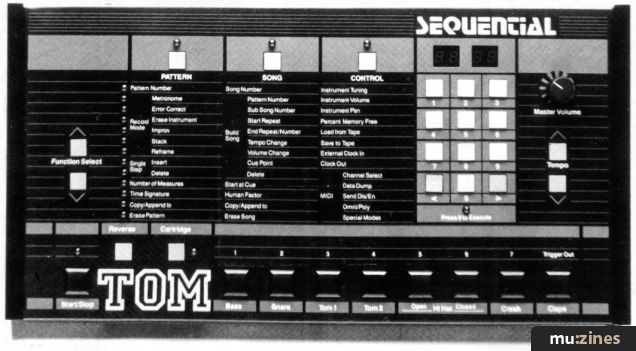
It's a digitally sampled (PCM) machine with the usual capacity for storing patterns; building them into songs, and dumping libraries of material to tape. What ho. Rather than dealing with the construction of enchanting boom-thwacks, in which most of us have dabbled, let's go straight to what makes the TOM unique.
First is the programmable tuning within patterns — a trick pioneered by the Drum-Traks. Each sound sample has a 32-step scale of tunings taking (for example) the TOMS from low bass drum-like thuds to high Octabanish pings. At every beat in the rhythm that you're writing, each sample can be fixed at one of these pitches, then shifted to an entirely new setting on the very next beat.
It's 'impossible to exaggerate the creative potential this lends the TOM', as poets say, or 'smart' as us non-poets call it. You've got not eight but 256 'sounds' to play with. Apart from simply tweaking the tuning to give you a fatter bass drum or a higher 'splash' cymbal from the crash, you've got space to programme huge drum rolls around a vast imaginary kit; leap up-and-down in pitch for sequenced percussive effects, or go doolally as in the next two examples. (A) Since the TOM also has eight volume levels for programming dynamics, load in one tom-tom beat at max, then immediately afterwards, five others at volumes '4', '3', '2', '1', '0'. Set each tom-tom a step lower in pitch, and you've got a dropping-echo behind the original tom-tom thwack. (B) set the TOM to one of its finer resolutions (96 per beat is max) then programme a series of beats very close together, descending or ascending through all 32 tuning steps. They'll blur to produce not a lightening fill, but a smear of sound 'bbrraaahhhhhHHHH!!' — as close to scratching as you're likely to get on a drum box.
Trick two is 'stacking'. The TOM has eight samples, but only four readout channels to reproduce them — you have a limit of four sounds on any one beat. It's enough. On most digital drum machines, if you wanted to belt the crash cymbal three or four times in succession, the 'playback' would be stopped part way through its course, and started again. The cymbal would choke to a sudden end and be re-struck, whereas on a genuine kit, it would continue ringing and you'd get an extra stick impact on top. By 'stacking' its readout channels, the TOM can playback the same sample up to four times without halting any of the earlier strikes — far more realistic. However, it's safer to stick to two stacks, otherwise there are no channels left for any other sample falling on that beat.
The strange (and desirable) side effect of this, is that if the readouts are fractionally later each time, the delivered samples will be slightly out of phase — instant flanging. So you now have a drum machine that can produce a 256-piece kit, echo, scratching, bizarre fills and flanging. A bargain, mayhap.
The samples themselves are good, but safe. A tight, thuddy bass drum; a crisp if-not-cracking snare (a little lacking in aggression), two short, brisk toms with a touch of ambience, a great open hi-hat (really can hear the two cymbals 'ttss-umpp'-ing together), warm, slightly loose, closed hi-hat; excellent crash (plenty of variety from gong, to dark to splash, to ping) and a reasonable handclap. No ride — bit of a shame.
Most of the sounds benefit from being tuned down a degree or two — it thickens the snare and beefs up the toms. Take it to extremes and the toms provide a fine alternative bass drum (a great 'whump' without the click of the beater).
And yet there's more. Every sound sample playback can be reversed — remarkable on the crash which rises from silence to a sudden woosh, and handy on the tom-toms when they're tuned very high.
To continue and conclude... programmable panning on each drum (good) but no individual outputs (most serious crit); you write patterns to a metronome using the buttons at the front of the Multi-Trak-like panel, but if you link the MIDI-ed TOM to a suitable touch sensitive keyboard, you can write-in the dynamics, depending on how hard you hit the keys. It has auto-repeat for setting fast rolls and reiterative hi-hats, and a feature known as 'improv' which will drop in pre-programmed fills at random moments, the frequency being dependent on the percentage programmed (fills 27% of the time, and so on). Associated to that is a 'Human' factor, which supplies a random lift or depression in the dynamics of a repeating pattern. What else? A programmable footswitch which can be set to operate 16 different functions. The usual insert, delete and edit functions, dealing with the 100 patterns and 10 songs with plenty of repeat, and sub-song features to get the most from the 2,300 note memory capacity (expandable to 10,400). Finally, there's a cartridge slot at the front to take a Rom pack with eight more drum samples, and TOM patterns can draw from on- or outboard-sounds. Latin Percussion is the first pack to arrive.
How to weigh up? For the price, you can do more with each sample than any other drum machine on the market, but it's still a matter of fiddling with the same sample. Would you prefer the Yamaha RX direction of alternative sounds — two snares, two bass drums, etc? Me? I found the TOM to be one of the most inventive and fun drum machines I've come across. A chap.
SEQUENTIAL TOM drum machine: £799
Contact: Sequential, (Contact Details).
Also featuring gear in this article


Sequential Circuits Tom - Drumcheck
(IM Aug 85)

Tasty Tom - Sequential TOM drum machine
(ES Sep 85)
Browse category: Drum Machine > Sequential Circuits
Publisher: One Two Testing - IPC Magazines Ltd, Northern & Shell Ltd.
The current copyright owner/s of this content may differ from the originally published copyright notice.
More details on copyright ownership...

One Two Testing - Jul 1985
Donated by: Colin Potter
Review by Paul Colbert
Ads for Gear in this article:

Previous article in this issue:
Next article in this issue:
Help Support The Things You Love
mu:zines is the result of thousands of hours of effort, and will require many thousands more going forward to reach our goals of getting all this content online.
If you value this resource, you can support this project - it really helps!
Donations for July 2026
Issues donated this month: 0
New issues that have been donated or scanned for us this month.
Funds donated this month: £0.00
All donations and support are gratefully appreciated - thank you.
Magazines Needed - Can You Help?
Do you have any of these magazine issues?
If so, and you can donate, lend or scan them to help complete our archive, please get in touch via the Contribute page - thanks!
If you're enjoying the site, please consider supporting me to help build this archive...
...with a one time Donation, or a recurring Donation of just £2 a month. It really helps - thank you!

 @mu_zines
 RSS Feed
 Blog
Blog