


Magazine Archive
Home -> Magazines -> Issues -> Articles in this issue -> View
Shape Of Things To Come | |
Article from Sound On Sound, July 1991 | |
Yet another selection of recently announced new products to whet your appetite!
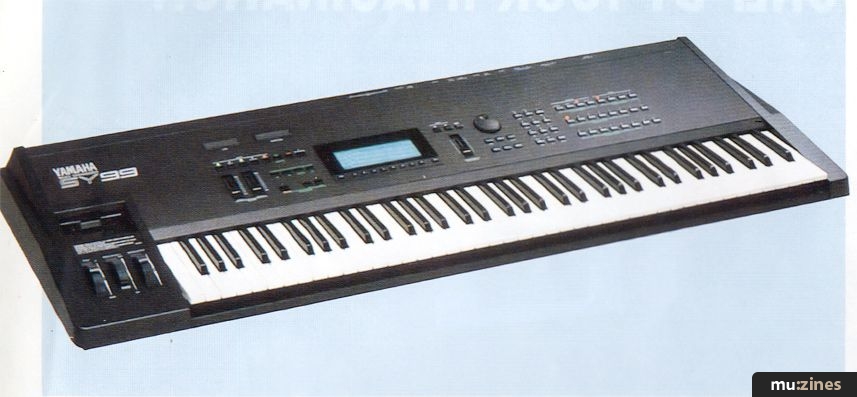
YAMAHA SY99 DEBUTS AT APRS
Yamaha's new flagship SY99 synth workstation received its first UK showing, albeit a low key one with only a single unit on a corner of the Yamaha stand, at the recent APRS. Expect a higher profile at the IMS.
The SY99 (£2499) adds to the '77-style voice capability a larger 8MB ROM wave area containing 267 preset waves. 512k of user RAM is also provided, into which new samples can be loaded from external wave cards, floppy disk, or via the MIDI sample dump standard. An expansion slot allows up to 2.5MB of RAM to be added via memory expansion boards (£249 for a 512k board).
The effects section is improved, to SPX1000 spec in fact, with two independent high-performance processors that offer 63 effects with real time control. Other features include a 76-note keyboard, a zone aftertouch facility, a RAM MIDI data recorder, and a range of master keyboard functions.
Yamaha-Kemble Music UK, (Contact Details).
KURZWEIL BACK IN THE UK
Following the rescue of Kurzweil by Young Chang, the company's new UK distributors will be showing their new range of products at the International Music Show.
The new professional range includes the K1200 synth (£1899), the Pro 76 (76-note version of the 1200, £1786) and the Pro 1, a rack module version of the K1200 (£1529). The K1200 synth features 24-voice polyphony, 16-channel multi-timbrality, an 88-note weighted velocity and pressure sensitive keyboard, and 162 presets.
The 6MB of samples contains 152 re-synthesized Kurzweil sounds, and presets are built up from up to four layers. Sound editing is facilitated by Kurzweil's K-Edit software for the Atari ST.
Also new are two digital pianos. The Mark III and Mark IV Ensemble Grand digital pianos contain the renowned Kurzweil piano samples in a range of 100 presets. Both keyboards are 16-part multi-timbral.
Acrobat Music, The Piano Workshop, (Contact Details)
FOSTEX ANNOUNCE PORTABLE DAT AND DOLBY S ON G16
Fostex have announced their first portable DAT recorder, a professional 4-head timecode machine called the PD2. The PD2 has been designed particularly for stereo TV and film location sound recording, with features that include a timecode generator, off-tape monitoring, and synchronisation via a variety of external references. Fostex have made extensive use of surface mount technology in order to keep the PD2 compact, and it can be powered from rechargeable cells, standard HP2 dry batteries, or from an external PSU.
Back on the analogue front, Fostex have announced their first 16-track recorder with Dolby S, the G16S variant of their G16 half-inch multitrack. The machine is identical to the original G16 in all other respects, with an optional built-in chase synchroniser, MTC capability and an RS422 port for VTE linkage. The G16S is complemented by another new Fostex product, the 3045 Dolby C convertor, which will enable the G16S to decode half-inch tapes recorded with Dolby C. The 3045 is a 1U rack unit powered directly from the G16S, switchable to decode Dolby C or control the Dolby S decoder in the tape machine.
Also new from Fostex is the 2412, the world's most compact recording console for 24-track work. It is, according to Fostex, their response to "the growing demand for more input channels, greater flexibility, and MIDI automation."
The mixer is a split design, with 24 inputs to the left and 12 subgroups plus mixdown inputs on the right. Each of the 24 input modules actually contains two input channels, and two equalisers which can be assigned to either signal path. MIDI muting is provided on the main inputs and subgroups, along with a 4-scene snapshot mute and preview system. Monitoring facilities include 'in place stereo solo', offering rapid and precise control of the stereo image. 14 bar graph meters are provided for signal level display.
Fostex UK, (Contact Details).
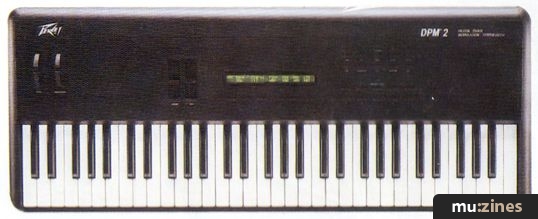
LITTLE BROTHER FOR THE DPM3
PEAVEY DPM2 SPECIFICATIONS
- 61-note velocity sensitive keyboard.
- 16 interpolating oscillators.
- 16-voice polyphonic.
- 16-part multi-timbral.
- 24-bit programmable dual effects processor.
- 39 effect types/combinations.
- 200 internal RAM program memories.
- 10 32-piece drum kit memory locations.
- Four 16-channel Multi locations.
- Stereo audio outs.
Peavey's DPM2 (£1149.46), a junior version of their acclaimed DPM3, is now available. The 16-voice poly, 16-part multi-timbral DPM2 features essentially the same software-based (and therefore re-configurable) voicing architecture as the DPM3, but it omits its big brother's sequencer. The 4MB of 16-bit internal wave ROM is the same (although unlike the latest SE version of the DPM3, there is no facility to import user samples). The DPM2 has an on-board 24-bit dual effects processor, offering 39 effect types. In addition to the instrument voices, the DPM2 also has 10 programmable drum kit locations, each kit containing 32 drum sounds mapped across the keyboard.
Peavey Electronics UK, (Contact Details).
DIGIDESIGN OFFER LOW-COST MULTITRACK HARD DISK RECORDING
Digidesign announced their new Pro Tools digital recording system at the APRS. Pro Tools develops Deck's basic MIDI + audio recording into a modular system which allows from four to 16 tracks of digital audio recording and playback, with digital effects, alongside MIDI sequencing and editing.
The basic Pro Tools package, running on a Mac II offers 4-track audio operation (as with Deck, there can be any number of 'virtual' tracks, but only four can be recorded on or played back simultaneously). Further 4-channel boards can be added to achieve 16-channel operation, but an accelerator card that provides a direct path from the audio cards to hard disks must be added in order to go above four channels. All tracks feature EQ, and all on-screen channel functions can be automated via both dynamic and snapshot systems.
Pro Tools' MIDI sequencer offers basic recording and editing of MIDI data, and playlist-style playback of standard MIDI files from dedicated sequencers. Analogue input is via balanced XLRs, and digital i/o is via AES/EBU and S/PDIF interfaces.
The basic system is expected to ship within weeks, with the 8 to 16-channel version and further DSP facilities later in the year. Prices have yet to be confirmed, but the US price for the basic 4-channel system will be around $6,000. Digidesign have made it clear that they will make upgrades for existing Sound Tools owners as simple as possible, and around half of the Sound Tools users worldwide (over 4,100 systems have been installed) are expected to follow the upgrade path.
Sound Technology plc, (Contact Details).

COOPER CONTROL HARDWARE
For some people, the only problem with computer music tools is simply the interface — no matter how powerful the application, if there's no large red button marked Record, there's still something missing. The JL Cooper CS1 control station (£410) puts the buttons back into recording, in the form of a hardware controller for Mac and Atari music applications. The CS1 has a data entry wheel and 15 soft switches — the unit comes with ready-to-run presets for Digidesign's Sound Tools and Sound Designer, and MOTU's Performer. It can also be used to enhance the basic Apple keyboard (communication is via the ADB), and additional software allows the user to create custom presets for virtually any program.
With Sound Tools, the wheel is used to select screen items and to perform the functions normally handled by the Scrub tool. The soft keys are assigned to the most commonly used functions of the program, and the bottom row of switches follows conventional transport control conventions, making program control fast and intuitive. The CS1 concept is incorporated in an optional CS10 hardware controller for Digidesign's new Pro Tools multitrack hard disk recording system (see separate story). The controller will offer 8 Fadermaster-style faders and CS1 control, in a single remote hardware controller.
Sound Technology plc, (Contact Details).
SYBIL FOR REAL TIME PERFORMANCE
New from Scorpion Systems of the USA is sYbil (£99), a program which differs to regular sequencers and algorithmic composers in that it is intended specifically for real time performance. sYbil is available for the ST, Mac and PC (Yamaha C1 version also available). Scorpion Systems say that it "allows you to harness the power of MIDI, yet maintain the fire and excitement of live performance."
The program doesn't make performance decisions for you, or fill in the musical blanks — rather its architecture lets you improvise on several instruments at once, the program acting as a dynamic MIDI event processor. Play a simple passage on your MIDI controller, and sYbil can turn it into a set of multi-timbral chords, a complex melody, or a set of program change commands for your synthesizer. You have complete control over these and many other effects. Celebrity converts to sYbil include Carlos Rios (Stevie Nicks, George Michael), Scott Henderson (Chick Corea Elektric Band), and saxophonist Michael Brecker.
Digital Music, (Contact Details).
DENON DISCO DOUBLE
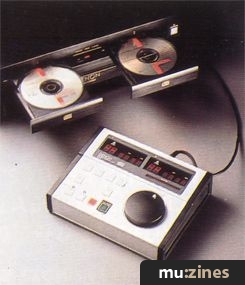
Denon have launched a double CD player that combines digital audio sound with the turntable control facilities required, by DJs. The DN4000F features a built in Scratch button, which produces a digital version of the dance DJ's essential effect, and +/-10% varispeed. It also offers instant start and beat shift, to ensure a synchronised down beat and seamless fade in. The deck has the same 18-bit 8 x oversampling convertors as the rest of the current Denon professional CD range.
Hayden Pro-Audio, (Contact Details).
A NICHE IN YOUR RACK?
The latest of the various rackmount level/mute automation systems to hit the market is Niche — however, the 8-channel Niche (£349) is a device with a difference, in that it does not use conventional VCAs. In their place, Niche uses Large Scale Resistor Networks, which the manufacturers claim avoids totally problem of zipper noise. Also, as a resistor is a passive component, Niche's signal path is essentially a straight wire, hence a frequency response which is flat within 1 dB from 30Hz to 30kHz, and a signal to noise ratio of better than 95dB.
Niche is a 1U rack device, with eight audio inputs and outputs, designed to be used either between an instrument output and a desk input, or in a mixer's insert points. The level of each output can be controlled by user definable MIDI controllers, and muting is available via user-definable MIDI note numbers.
Niche is also equipped with a stereo mix out, enabling it to be used as an eight channel automated stereo line mixer.
Argents, (Contact Details).
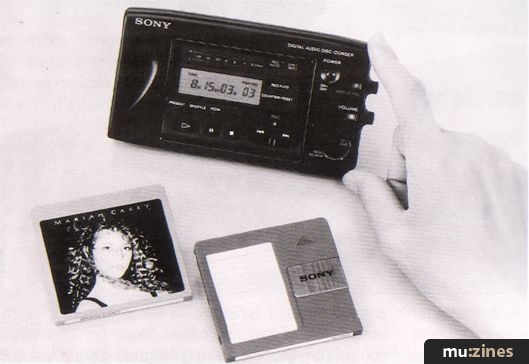
Prototype Mini Disc player/recorder, prerecorded disc and blank recordable disc.
SONY LAUNCH DISC RIVAL TO DCC
Sony have officially announced the development of the Mini Disc (MD) system, which plays back an ultra-compact optical disc which can be manufactured using existing CD production facilities. The system can also record and play back 74 minutes of digital audio sound on an ultra-compact (2.5" diameter) magneto-optical disc. The system is an obvious rival to Philip's Digital Compact Cassette (DCC) format and a successor to analogue compact cassettes as the consumer recording/playback medium.
Whilst DCC has the advantage of being able to play back existing cassettes as well as making new digital recordings, MD is a rather more elegant solution to the problem of providing a cheap recordable consumer digital medium. Sony is working to gain the support of domestic and overseas hardware and software companies for the new format while preparing for its own product introduction, targeted for late 1992.
MD employs a 64mm (2.5 inch) diameter record/playback magneto-optical disc which comes in its own cartridge to protect it from physical damage, similar to a computer diskette. MD's high-efficiency data compression technology compresses by five times the digital audio data. Whilst this means that a generous 74 minutes of digital sound can be squeezed on to a 64mm disc, quality will not be as high as that of CD or DAT — this feature is shared with DCC.
The player's 'shock-proof memory' prevents skipping by storing data read from the disc in a memory chip - if the player is jolted and the optical pickup is shifted off the correct track, uninterrupted playback continues while the pick up returns to the correct position Sony are planning to incorporate into the Mini Disc system the Serial Copy Management System (SCMS).
(Even with this much data compression, a good deal of data is still squeezed on to a single disc, around 15MB in fact, which raises the question of whether the system without compression could be used as a high-capacity floppy or compact removable hard disk drive. Sony have indicated that they are looking in to such applications.)
MINI DISC SPECIFICATIONS
| Channels: | 2 channels (stereo) |
| Frequency Response: | 5-20,000Hz |
| Dynamic Range: | 105 dB |
| Wow/flutter: | Below measurement limit |
| Sampling Frequency: | 44.1kHz |
| Coding System: | ATRAC (Adaptive TRansform Acoustic Coding) |
| Modulation System: | EFM |
| Error Correction System: | CIRC |
| Recording/playback time: | Up to 74 minutes |
| Cartridge Size: | 68mm x 72mm x 5mm |
| Disc Diameter: | 64mm |
Sony UK, (Contact Details)
MULTIVERB ALPHA — LESS GETS YOU MORE
The Multiverb Alpha, the latest and greatest version of ART's pro multi-effects units, is now available. The Alpha has four times the processing power of previous versions, and offers over 50 different effects (including 24 reverbs, pitch transposition, 21 stereo delays, and sampling), and a new acoustic environment simulator which can produce up to six effects simultaneously. Features include 200 memory locations, a rotary edit control, and a full MIDI implementation that allows for real time control of up to eight different parameters in each patch. And the price of all this? Considerably less than the Alpha's predecessor in fact — around £320.
Ihe X15 Ultrafoot is ART'S new foot pedal controller, offering musicians who want MIDI foot control two expression pedals and 14 pushbutton switches. The X15 is aimed principally at guitarists, but wind players, or even keyboardists, could benefit from the real time mix or effects control that the unit allows in conjunction with suitable effects processors. The X15 is built into a rugged steel case, and features 200 memory locations, MIDI In, Out and Thru, and a bright program display.
Harman UK, (Contact Details)
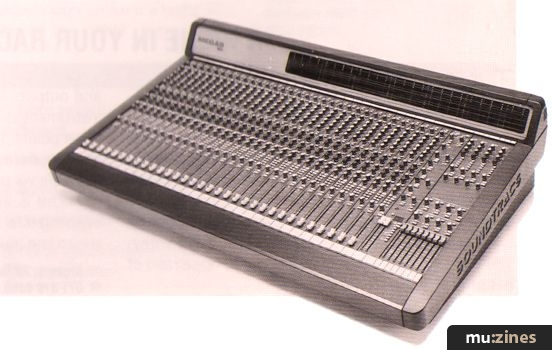
SOUNDTRACS MEGAS GOES MIDI
Following the launch of Soundtracs' Megas Mix, Megas Stage and Megas Studio consoles earlier this year, two further models are to be added to the range: the Megas MIDI and Megas Monitor.
The Megas MIDI is a dedicated in-line recording console, with dual inputs on each channel (24, 32 or 40-channel configurations available), and stereo effects returns. This makes possible a total of 56, 72 or 88 inputs on mixdown, depending on configuration, all with EQ. All inputs, monitors, aux masters and effects returns are provided with MIDI mutes.
The Megas Monitor is a complementary product to the Megas Stage, offering 24, 32 or 40 inputs into 12 monitors. Features include 4-band EQ on all inputs, with a fully parametric EQ on the monitor outputs. All input levels are controlled on linear faders.
Also new from Soundtracs is Tracmix II, the latest version of their fader and mute automation system. Up to 64 channels can be automated. In addition to the VCA grouping, MIDI generator and fader bypass found on version I, Tracmix II now offers extensive off-line editing, including mix merging, mute editing, autofading, and master trimming of channels.
Tracmix II will read and convert Tracmix I files. Tracmix I owners can upgrade to the new version without modification to their current hardware.
Soundtracs plc, (Contact Details)
Publisher: Sound On Sound - SOS Publications Ltd.
The contents of this magazine are re-published here with the kind permission of SOS Publications Ltd.
The current copyright owner/s of this content may differ from the originally published copyright notice.
More details on copyright ownership...

Sound On Sound - Jul 1991
News
Help Support The Things You Love
mu:zines is the result of thousands of hours of effort, and will require many thousands more going forward to reach our goals of getting all this content online.
If you value this resource, you can support this project - it really helps!
Donations for June 2026
Issues donated this month: 0
New issues that have been donated or scanned for us this month.
Funds donated this month: £0.00
All donations and support are gratefully appreciated - thank you.
Magazines Needed - Can You Help?
Do you have any of these magazine issues?
If so, and you can donate, lend or scan them to help complete our archive, please get in touch via the Contribute page - thanks!
If you're enjoying the site, please consider supporting me to help build this archive...
...with a one time Donation, or a recurring Donation of just £2 a month. It really helps - thank you!

 @mu_zines
 RSS Feed
 Blog
Blog