


Magazine Archive
Home -> Magazines -> Issues -> Articles in this issue -> View
Sidefills | |
Article from Sound On Stage, March 1997 | |
Boss SYB-3 Bass Synth Pedal, Roland RX-82 Mixer, JHS SS41B Speaker Stands, Yamaha MM1402 Mixer
BOMB THE BASS

The new SYB-3 Bass Synthesizer is a very different kind of pedal designed for use with bass guitar, delivering two different types of bass synthesizer effect or a T-Wah effect. Housed in the familiar Boss style case, power comes from a PP3 battery (around four hours continuous use), so an external 9V DC power supply might be a good investment. Plugging in the bass switches the unit on, and you can choose from a mixed output or have the original sound on one output and the synth sound on another. Balance between the direct and effected sounds is controlled by a pair of 'piggyback style' pots on the top of the case.
There are 11 modes of operation selected via a rotary switch. The first seven of these relate to a pitch-tracking synthesizer, which generates a synthesized note that can be used on its own or mixed with the original bass sound. This is the same principle as most pitch-following guitar synths, but only works on monophonic lines. There's a generous selection of output waveforms to choose from: sawtooth, square, pulse width modulated square, sawtooth one octave below input frequency, sawtooth plus noise, pulse width modulated plus noise, and sawtooth-plus-noise one octave below. In pitch-follow mode, a knob labelled Sens/Decay provides control over sweep filter decay, and control over the start point of the filter is set by a frequency knob. The resonance knob peaks up the filter, providing access to some truly outrageous sounds. The end result is a range of truly fat sounds — the pulse width modulation in particular is excellent.
The first seven modes also feature a pedal activated hold function where the synthesized note continues to sound until the pedal is pressed again. This is very useful for laying down a drone so you can solo over it with your normal bass sound. I've a feeling that some of the original attack of the instrument is added to the synth sound to get over the usual tracking delay that afflicts guitar and bass synths. There's no discernible delay between plucking the string and hearing the synth note. However, the synth can only handle one note at a time in these modes, so good string damping discipline and positive picking are essential for clean operation. These are minor drawbacks though and I soon became accustomed to keeping the thing happy.
The next two modes work by processing the signal from your bass to produce a synth-like sound. You can select whether the filter cut-off frequency moves up or down with the input level. In these two modes, the Sens/Decay knob sets the depth of the sweep and the other knobs retain their previous functions. Because this isn't a pitch-tracking mode, you can play as many notes at a time as you like. I found some great filter decay effects available here, and you can 'Ka-Ka' or 'Chow-Chow' to your heart's delight. As the depth of the modulation is attack-sensitive, the output can sound remarkably different depending on how and where you strike the strings.
The final two modes provide T-Wah, one with an upward filter sweep and one downwards, where the Sens/Decay knob sets the depth of effect.
Surprisingly, the pedal can also be used very creatively with guitar, it's only limitation being that the detection range in the first seven modes only runs from B0 to G4.
This pedal is a real surprise, and very enjoyable to use. The pitch-tracking synth modes require a clean playing technique for accurate operation, but the remaining filter-based modes don't demand any changes to your playing style, yet they still produce some wonderfully dynamic effects. I shall part with the SYB-3 very reluctantly.
Further Information
SYB-3 £169 inc VAT.
Roland (UK) Limited, (Contact Details)
SPEAKERS CORNER
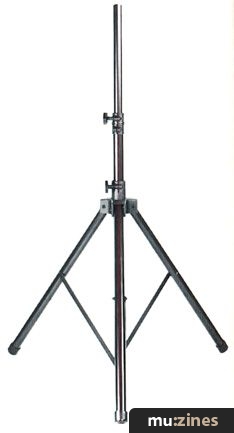
Over the past few issues, we've underlined the importance of having your PA speakers set up in the best possible position. If you're lucky enough to be on a major tour, the chances are that some speakers will be standing either side of the stage, while others will be suspended from flying hardware. On smaller tours, PA speakers are often free standing, again in stacks, but in the real world where the rest of us work, PA frequently means a pair of 12 or 15-inch speakers with horns, perched on tripods either side of the stage.
You might wonder how such a boring, utility item as a speaker tripod might be improved, and on the face of it, apart from the nice non-reflective black finish, the JHS alternatives look pretty conventional. However, pick one up and the first difference becomes obvious — they are incredibly light, and closer inspection reveals them to be made of aluminium rather than the more common chromed mild steel. My bathroom scales put them on the light side of 4lbs.
The other difference is that there are no pins that need slotting through holes — height adjustment is achieved using plastic friction collars with metal nut and screw inserts. Large plastic knobs are fitted to the adjustment bolts, and the centre column can be raised to around two metres maximum. Thoughtfully, 'top hat' speaker mountings are included, just in case your speakers don't have any, and the pole diameter is a standard 35mm, which fits most existing small PA speaker fittings.
Just to be thorough, I took these stands to a gig and found them to be a lot quicker to put up than my existing stands — they also felt quite secure in situations where the base legs couldn't be splayed to their maximum extension. My speakers fitted snugly, and there was plenty of available height range. Considering the SS41Bs cost no more than run-of-the-mill budget speaker stands, and are significantly easier to transport and erect, I can heartily recommend them. In fact, I'm more than tempted to pension off my old stands and get these instead!
Further Information
SS41B £78.15 inc VAT.
John Hornby 5kewes & Co Limited, (Contact Details)
FRIENDLY AND FLEXIBLE
The MM1402 is a compact and lightweight mixer, complete with an internal power supply.
Working down the mono channels 1 to 6 from the top, you'll find an XLR mic socket, a balanced line jack socket, and a wide-ranging level pot, offering up to 60dB of mic gain. Next comes the EQ section, featuring shelving High and Low controls plus a peaking Mid-band, each control having a centre detent and a cut/boost range of ±15dB. Following on are two Aux Sends, one pre and one post-fade, each allowing 10dB extra gain above unity. Beneath these is a centre detent pan pot, a peak-level LED, and a PFL button. At the bottom of the channel is a 55mm logarithmic fader. Channels 7 to 14, which include the same controls as 1 to 6, but without mid-band EQ or a second (post-fade) Aux Send, are all line-level stereo, with Left and Right jack input sockets, and a three-way switch which selects +4/-10/-20dB input level.
The Master section is where you find the metering, the master stereo controls, the aux master control, and the headphone output. At the top of the section are unbalanced line (+4dB) jack sockets; L & R Stereo out; L& R Monitor out; Aux Sends 1 & 2, and L & R Sub In. Aux returns 1 & 2 each have a L (mono) & R jack socket (-10dB). L & R Tape In and Record Out phono connectors (-10dB) allow for easy two-track recording or the use of, say, a DAT backing track in the mix.
Looking further down, you'll find a L & R 12-LED meter, adjacent to which are indicator LEDs for (global) phantom power and PFL. The meter permanently indicates the L & R levels of the stereo mix unless a channel is solo'd. Below the meter display is a five-band, stereo graphic equaliser providing ±12dB boost/cut to the stereo outputs at 100Hz, 400Hz, 1 KHz, 5KHz, and 10KHz.
Below the graphic equaliser are four pots that control Send and Return line-level for Aux 1 & 2, allowing up to 10dB gain above unity. Beneath these are the Stereo Out 55mm logarithmic faders, and to the right of these are the headphone socket and level pot, the Monitor Out level pot and the Tape In level pot. The latter has a switch routing it to either the monitor or stereo buss.
In use, the mixer is both quiet and predictable, having very low discernible noise and no audible crosstalk. The mic preamps are wide ranging, with plenty of headroom; the Channel Peak Indicators provide advance warning of clipping; and the line channels accept a useful range of input levels. There were no clicks or pops on operating any of the controls, and the headphone amp is reasonably quiet with plenty of level. The MM 1402 is quick and easy to set up due to its friendly layout. It's also versatile enough for use in live mixing and location recording. This is a very flexible little mixer at the price.
Further Information
MM1402 £329 inc VAT.
Yamaha-Kemble Music (UK) Limited, (Contact Details)
FITTING THE BILL
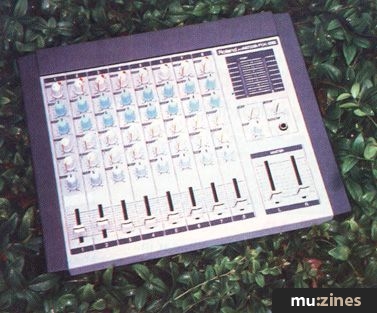
Small mixers are big business. And Roland's new RX-82 is definitely small at just 360 x 100 x 304mm (WHD). Roland's aim with the RX-82 was to build a really simple but tough mixer, suitable for mobile applications. Housed in a tough, yet nicely styled case, the RX-82 has an integral power supply, proper channel faders, and nice bar graph meters on the output. All the pots are fixed to the front panel with nuts, so there's no alarming knob wobble. Each of the eight mono input channels is identical, with the dual purpose channel input on a balanced jack rather than the more usual XLR. The impedance is chosen so as to work with almost any type of mic or line source, but the trade-off is that the noise level is slightly higher than need be when low impedance microphones are used.
A single Gain control adjusts the mic/line gain, and there is no selector switch. The EQ is a simple two-band shelving affair, operating at 100Hz and 10kHz with ±12dB of range. A peak LED monitors the EQ output, enabling the input gain trim to be set for optimum performance. There are no insert points, no direct outputs, and no pre-fade foldback sends, but there are two post-fade effect sends. These are complemented by a single stereo effect return (on two separate jacks) in the master section, but if you want to return two stereo effects, you have to use two input channels. Each channel has a pan control and a 55mm fader, and a white 'scribble' area is screened above the fader for use with a chinagraph pencil.
The nominal output level of this mixer is +4dBm (unbalanced jack), and that corresponds to 0 on the twin bar graph output meters. Separate left and right faders control the main output level, and there's also a separate headphone output with its own level control knob. Level and Balance controls are provided for the effects return, but there's no master level control for the two effects sends.
The gain controls on this little mixer cover a very wide range, and it's only when you get right up to the top end of their travel that you get enough gain for use with low impedance mics. If you turn the gain up full with nothing plugged into the input, you can hear quite a bit of background noise, but plugging in the mic reduces this by a significant margin. At lower gain settings for use with line-level signals or high impedance mics, the noise level remains reassuringly low.
Although the EQ is only two-band, it works fine, providing you don't pile it on too thickly. In fact, my only real criticism is the oversimplification of the feature set. For example, if you're using a mixer live, you may need a pre-fade send to set up a foldback mix, and you may also need two stereo returns without having to sacrifice some of your input channels. It's also possible that you might want to use an external processor on one of the mic inputs, but without an insert point, there's no way to do this.
The RX-82 is best suited to very straightforward jobs where the user wants a no-fuss mixer — it would also work fine as a small keyboard mixer or as the centre of a basic club PA installation. If all you need are basic features in a well-designed, rugged package, then the RX-82 fits the bill nicely.
Further Information
RX-82 £285 inc VAT.
ROLAND (UK) Limited, (Contact Details)
Publisher: Sound On Stage - SOS Publications Ltd.
The contents of this magazine are re-published here with the kind permission of SOS Publications Ltd.
The current copyright owner/s of this content may differ from the originally published copyright notice.
More details on copyright ownership...

Sound On Stage - Mar 1997
Gear in this article:
Review by Duke Ashton, Paul White
Help Support The Things You Love
mu:zines is the result of thousands of hours of effort, and will require many thousands more going forward to reach our goals of getting all this content online.
If you value this resource, you can support this project - it really helps!
Donations for May 2026
Issues donated this month: 0
New issues that have been donated or scanned for us this month.
Funds donated this month: £0.00
All donations and support are gratefully appreciated - thank you.
Magazines Needed - Can You Help?
Do you have any of these magazine issues?
If so, and you can donate, lend or scan them to help complete our archive, please get in touch via the Contribute page - thanks!
If you're enjoying the site, please consider supporting me to help build this archive...
...with a one time Donation, or a recurring Donation of just £2 a month. It really helps - thank you!

 @mu_zines
 RSS Feed
 Blog
Blog