





Magazine Archive
Home -> Magazines -> Issues -> Articles in this issue -> View
Speakers Cornered | |
Making sense of monitors in the marketplaceArticle from Sound Engineer and Producer, May 1986 | |
Modern monitors: a five page special
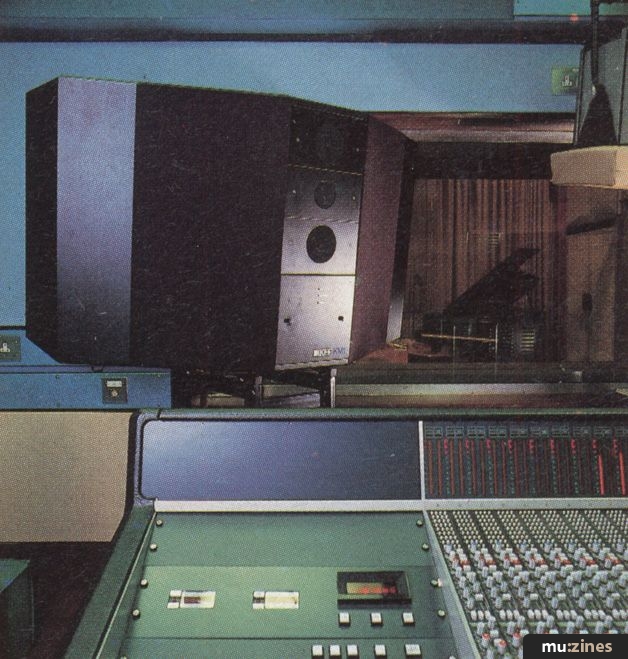
Kef monitor system at the BBC Maida Vale 2
Image credit: Ian Bobbie
What is a monitoring loudspeaker? The answer will be different according to who you ask. Thirty or so manufacturers produce well over one hundred different versions of 'the truth' — if indeed 'truth' is a relevant criterion. The only valid assumption is that a monitoring loudspeaker is required to fulfil a monitoring function of some kind or another. Perhaps regrettably, at the top end of the market it may also have a role in 'selling' the image and services of the studio itself.
The term monitor ought to imply a degree of accuracy in the reproduction of the signal, though in the real world even the concept of accuracy is ill-defined and hotly disputed, and practical and environmental considerations play a major role. Personal taste and fashion aside, the requirements and conditions for monitoring vary so substantially that the wide range of alternatives is necessary. Start adding subjective preferences and the evolution of different technologies and you end up with the current state of semi-confusion, where the console is cluttered with a collection of 'nearfields', and major studios can trot out a variety of bigger monitors to suit the whim of the engineer or producer.
Recent years have seen greater acceptance of freefield, nearfield, mini and desk-top monitoring, as a supplement — or alternative — to the full size high level installations.
For many, the nearfield or freefield is superior for mixing, though the big built-in system is still useful for realistic levels when laying down tracks, particularly percussion and drums. The more cynical have observed that the main monitors real value is in adding prestige to the studio's equipment list, and impressing the client.
Alongside the realisation that small can be beautiful (in some respects anyway), has come a second trend towards what are referred to, collectively if imprecisely, as soft dome monitors. More realistically this is probably a reaction against certain characteristics of mid and high frequency compression drivers. Whether this surge in soft dome popularity is a major long term trend or a temporary flavour of the month is a keen element in current monitoring debates.
Frankly horn systems seem most unlikely to go into sudden decline. The pendulum of fashion swings inexorably and unpredictably: Tannoy's horns currently find themselves in vogue in the US, while Quested's soft domes are the UK's most fashionable just now. The historical evolution of studio monitoring often seems painstakingly slow, but there are underlying trends, operating with much longer time constants than the fickle allegiance to a particular tweak or brand. Identifying such trends requires a historical perspective and awareness of developments in related fields, such as sound reinforcement, broadcast monitoring, and today's hi-fi loudspeaker.

Tannoy's SRM series has hand-wired crossover networks
THE STATUS QUO
With new materials, bonding techniques and magnet design we are approaching a time when direct radiator dynamic systems are rugged and loud enough to satisfy nearly all requirements. 125dB spl is now reliably within the capabilities of the largest dynamic systems, though compression-based techniques can add an extra 10dB and still sound good. However, 135dB is probably only justifiable in terms of extra headroom in the largest studios, rather than necessary level — and perhaps has more to do with the projection of a macho studio image and the ability to frighten musicians into submission. Such installations will in any case probably be custom built-in systems using a variety of techniques and engineered as part of the room.
For the majority 120dB will be considered enough, so the loudness/power handling element of comparison between compression and direct radiator systems can now be effectively ignored — perhaps for the first time. There are several other criteria for choosing one type of monitor over another of course: price, size, suitability to room characteristics and site therein, etc. But simple subjective preference is becoming increasingly important. And the products on offer increasingly reflect every possible approach from sophisticated miniaturised PA to over-engineered high-end hi-fi.
It is also apparent that the distinction and polarisation between horn and dome is blurring. JBL's recent bi-radial technology is a significant move towards the middle ground from the higher gain/higher coloration horns of earlier generations. Despite the differing technologies and approaches, there is evidence that the industry is moving slowly towards a consensus.
The hi-fi influence is certainly increasing in mixdown, where some level is better sacrificed in the interests of the more accurate stereo provided by nearfield monitoring. The Auratone Cube is a valuable standard for the industry as a whole that must be maintained, but its limitations are beginning to look a little unrepresentative of the compact disc age. Yamaha NS10s and AR18s are more relevant to the modern domestic circumstance, yet also possess certain qualities lacking in the big monitor.
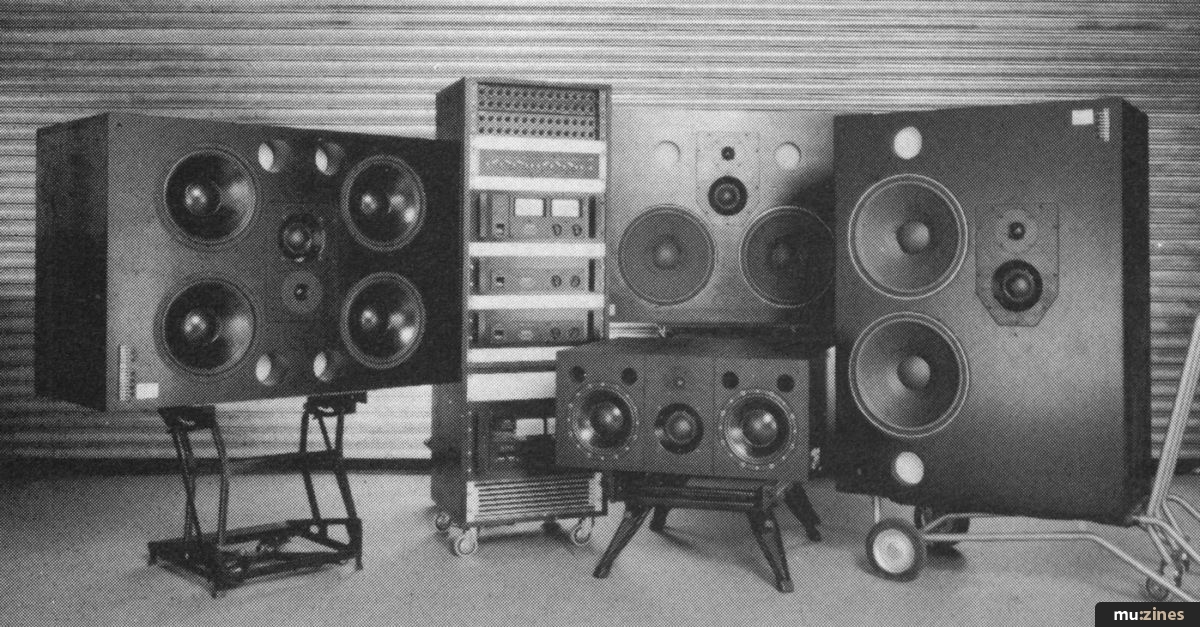
Macho styling with soft dome sweetness: Quested's success
TECH AND TECHNOHYPE
As one steeped in the disreputable hi-fi tradition of technohype, I have long regarded the ultra-conservative professional loud speaker user as an impressively sane creature, unwilling to be swayed by the latest tweak.
One of the most important lessons I learned in some early formative years at Spendor was that the object of the exercise was not to make a 'better' loudspeaker than the one before, but to try making one that sounded the same. Yet when ringing around the various monitor manufacturers in the course of preparing this article, I was confronted by distinct evidence that the technohype has now become an endemic part of pro audio.
Arguments are advanced in favour of the subjective qualities of compression drivers which by implication knock the soft dome approach, and vice versa, largely on the basis of an over-simplified assumption of cause and effect. Similar prejudices are expressed in favour or against mos fet and bi-polar output devices on power amplifiers, on similarly shaky grounds. Much of this is rubbish — a pollutant more likely to mislead than direct. The proof of the pudding must be whether it does the job, not how it does the job. Techniques do of course influence the final result, and most offer certain advantages and disadvantages.
But the whole is invariably greater than the sum of its parts if the designer has done a good job.
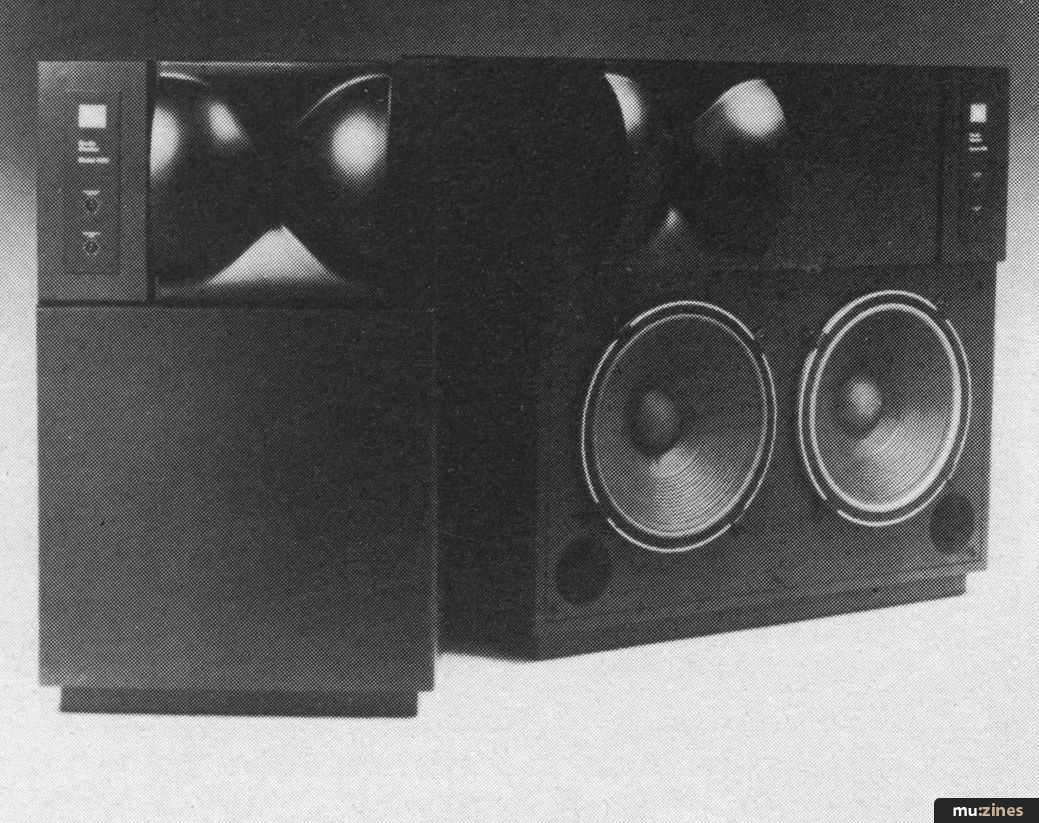
JBL's bi-radial biggies
Every monitor still represents a variety of conflicting compromises between about a dozen variable criteria we do know, and probably a dozen we don't. It is not surprising that different recipes produce different results — sometimes marginally, sometimes radically. Each manufacturer has his own style, and it is down to the user to choose the one that suits his expectations and methods of working.
The horn or compression driver has been a source of controversy for years. Certainly there are inherent problems with the approach, notably unavoidable nonlinearities and phase discontinuities. But the diaphragm is air-damped, and directivity is more controllable, though less easily integrated with the direct radiating bass. And the amplifier doesn't have to work so hard — so probably performing better especially at high levels and with less risk of voice-coil damage. Where one user might comment that he is fed up with horns 'barking' at him, another will relish the 'speed' and 'attack' — whatever its cause.
Conversely, the soft dome proponent will claim improved sound quality at lower levels, greater linearity, wider dispersion and better phase response. But dispersion is a multi-edged sword, diaphragm mechanical control is more difficult, and power amplifier demands more extreme. (Contrary to much popular belief, the tweeter amplifier has a tougher job than the bass amplifier in many respects, having to swing more volts faster and control midband resonances.)
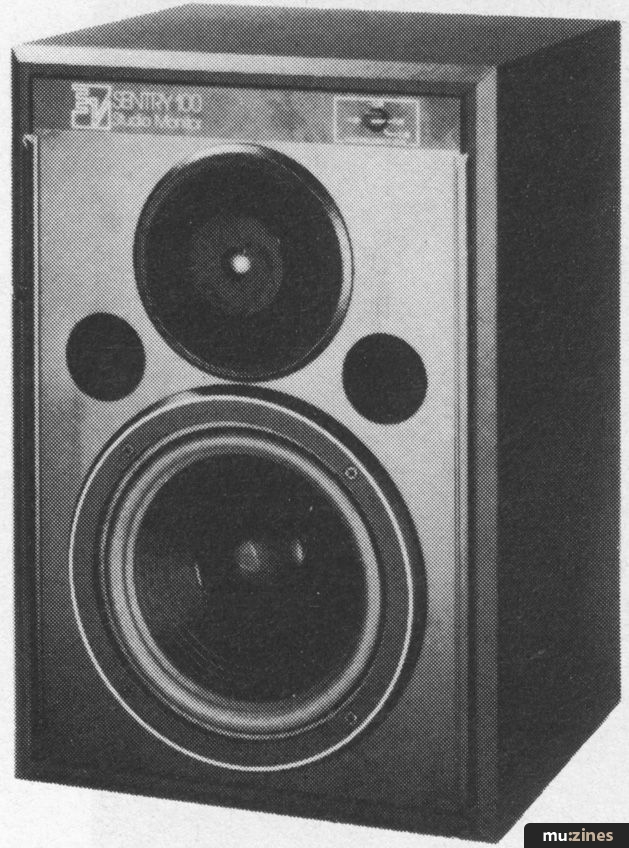
Baby E-V Sentry 100
Concentricity of drivers has often been used as a major justification for a design. Certainly the point source is an appealing concept, particularly for nearfield monitoring, but it does inevitably mean some form of high frequency horn loading, and I know of no studies which have demonstrated convincingly that a point source sounds more accurate than a short vertical line. Nor does it simplify the network circuitry necessary to ensure time-alignment, and in fact removes the ability to direct the optimum response window away from the main axis in a chosen direction.
The BBC once had a monitor which strapped a pair of dynamic tweeters across the front of a 15" driver to provide a near-concentric source, because they were using the big driver to an unusually high frequency. But mounting flexibility and cavity effects took their toll, and the next generation reverted to the in-line baffle with carefully spaced, close-mounted units.
In fact the whole time alignment concept was bounced around in the hi-fi field a decade ago, by Technics, B&O, KEF, B&W et al. Some such speakers were superb, particularly in terms of stereo imagery, but in many instances the (putative) virtues of time-alignment were offset by constructional complications, and the net results were more expensive but not necessarily better. Active amplification with low level equalisation makes time alignment much easier to achieve, and is certainly a major rationale for adopting active instead of passive drive.
The vital role of cabinets is one lesson studio monitor designers have learnt well. Despite the dramatic advances in loudspeaker measurement techniques in recent years, cabinet design is still very much a black art. Simple economics have forced the hi-fi market into major compromises, where the higher priced studio product has always recognised that the cabinet plays a major role in the overall sound, and in determining the available dynamic range. Manufacturers like Lockwood owe their very existence to the subtle art and craft of cabinet design and construction, and a number of manufacturers, such as Westlake and Wellard, make much of their own particular efforts.
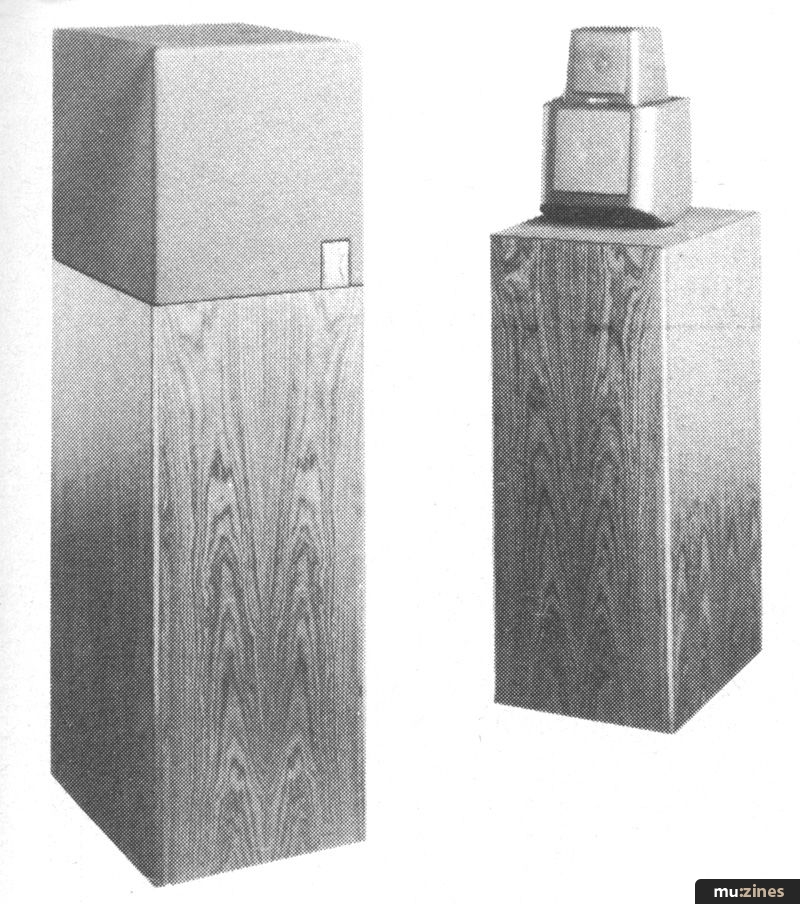
Balanced for classical neutrality, new hybrid KEF101
The bigger the cabinet, the bigger the problems of course, so the full range monitor has the hardest problems. When approaching the ultimate combination of bass extension and output levels, the sanest approach is to build bass enclosures into the architecture, like Andy Munro's 17Hz/130+dB Puk studio in Denmark. The enclosures for such a system are effectively non-transportable, so there is a good case for using building materials for all but the baffle.
The physical difficulty of achieving as good a cabinet performance from a big loudspeaker as from a small one is one of the main reasons why small freefield monitors now pose a serious challenge to the full size models. The very fact that the whole surface area of a loudspeaker enclosure radiates unwanted sound is one argument in favour of the small box, as is the comparative ease with which smaller panels may be made rigid; the combination of these two points probably outweighs the disadvantages of higher box internal pressures in sealed systems, or the shorter internal reflections. Rigidity per se is only one approach, which some may dismiss as the 'brute strength and ignorance' route. No less effective, particularly in reducing midrange coloration, is the subtle thinwall Finnish birchply solution developed by the BBC and used by Spendor and Rogers.
It is hardly possible to over emphasise the importance of cabinets. Even though it is difficult to define all the desirable criteria, because rival theories of rigidity versus compliance versus decoupling can all be argued with conviction, it is difficult to deny that one vital function is to maintain the mechanical integrity of all the drive unit motors (magnet gaps) in as fixed a relationship as possible to the mechanical earth represented by the room. This, to me, is the most convincing argument supporting the use of spikes and spiked stands, a controversial tweak which is threatening to be imported from the hi-fi world.
Speaking personally and subjectively, from a hi-fi context (Linn Isobarik PMS), spikes work, far more effectively than I expected when contemplating the several hours needed to set them up properly. Having done the deed, I heartily regretted not having spiked the system properly months before. I also recollect clearly the mildly stunned expressions on the faces of a couple of very sceptical BBC engineers when the effect was demonstrated to them at a hi-fi show a couple of years back.

Yamaha's NS-1000
But I wouldn't attempt to convince anyone else by argument. Spiking is not a universal panacea appropriate in every circumstance. Besides, it also spoils the furniture. Try it for yourself, when you're feeling annoyed with the sound of your monitors. You might just have an agreeable surprise. But if you don't try it, you won't know (and you won't have any right to go around dismissing the idea).
One hi-fi tweak that seems to have been eagerly and rapidly adopted by the pro world is the importance of wiring to and within the monitor. Westlake again emphasise the lack of fuses and paraphernalia is the signal path, and Tannoy recently reverted to 'hard-wired' crossover networks, eschewing the ubiquitous printed circuit board. In avoiding interference in the signal path from amplifier to loudspeaker, active systems naturally have a head start.
Loudspeaker design will always combine tech with technohype. Fortunately, the UK pro audio industry has a long tradition of leading the former and rejecting the latter.
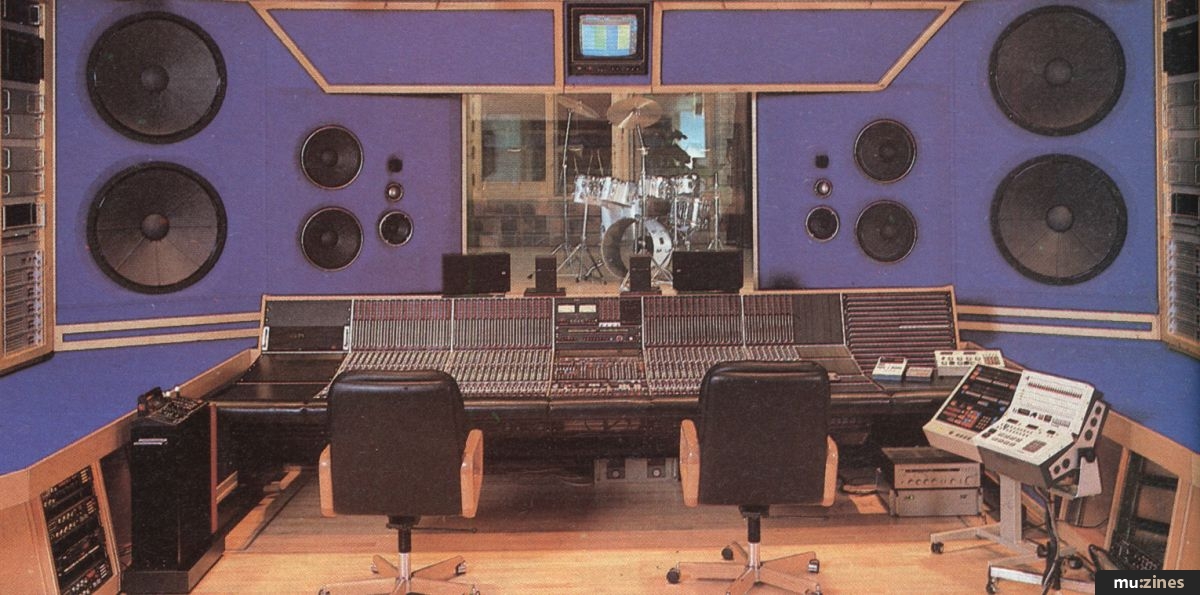
PUK Studios monitor system, Denmark
THE MARKETPLACE
Many brands are nominally available in the UK, but comparatively few make a significant commercial impact. However, it is often the newer, smaller operations which have some of the most interesting ideas, showing the way the monitor may be developing for the future.
The leading manufacturer is of course Tannoy, and it is a testament to its current management skills as well as the remarkable engineering tour de force represented by the evergreen Dual Concentric driver that it has held in this position so consistently for so long. This original concept of a horn tweeter working within the magnet and cone structure of a low frequency unit (which automatically provides concentricity) must be approaching its fortieth birthday, yet patient development and a responsiveness to the requirements of customers, has ensured its competitiveness.
Certainly there is a Tannoy sound, which appeals more to some than to others, but it is probably the nearest thing that exists to a world standard (aside from the Auratone Cube of course). The Dual Concentric drivers are an impressively rugged breed, and are available in a wide range of sizes and shapes for different uses. A recent addition is a desk-top variant, the DTM-8, using an eight inch DC unit for nearfield applications. At the other end of the scale, the FSM uses two 15 inch drivers, one of which is a dual concentric, and has adjustable LF EQ for free air or soffit mounting. The latest Tannoys are the SGM series, where PCBs have been discarded for the improved sonics of hardwiring in the crossover.
The other major world brand in monitoring is the American JBL range, which has built up a near legendary reputation for drive unit engineering, such that these are often chosen by other system manufacturers and for custom installations. They are currently particularly proud of a titanium dome tweeter with a bandwidth extending to 27kHz, which is fitted to the small and medium size models in its very extensive range. At the big end of the market JBL's constant directivity bi-radical horn technology is well regarded, and symptomatic of the move away from more extreme horn profiles.
Now owned by JBL, Urei came in with a bang a few years ago, using an unusual 813B (horn/dynamic) coaxial drive unit and emphasising time-alignment. Now no longer the fashion leaders, Urei can gain some satisfaction from observing how nearly everyone else has jumped on the phase bandwagon. They have also keen expectations for the immediate future, with the imminent launch of a revised 813C driver.

Questeds and Yamahas are the chosen monitors at Chipping Norton
This retains the major characteristics of its predecessor, but uses a four inch voice coil and titanium HF diaphragm to increase power handling to 200+W, a worthwhile improvement in an area where the 813B received some criticism. An interesting wrinkle, when used with their own power amplifier, Ureis can be connected into the feedback loop, so compensating for any adverse effects from the wiring to the speaker.
However, the current 'flavour of the month' in the UK is Quested. Little more than a year old, it has already supplied a most impressive hit list of customers, has a most extensive range of models, and shows no signs of losing momentum (despite the hopes of some competitors). Doyens of the soft dome approach, most models use the unusual ATC large dome midrange with the rugged Audax fabric dome tweeters along with Gauss or ATC bass drivers, and are actively driven. While it is difficult to point to any obvious engineering superiority in models which have been described as giant hi-fi speakers, their success derives from sound quality and the overall balance of ruggedness, essential simplicity, and flexibility in physical and electronic configuration, combined with the entrepreneurship of Roger Quested himself — very much a member of the UK pro audio fraternity, and hence ultra-sensitive to its needs and desires.
Branching out successfully from studio construction, Westlake's recent range of monitors has been attracting favourable subjective comment. They stress the vital role of highly developed cabinets, and the clean signal path provided by quality internal wiring and omission of fuses (A selection of replacement tweeters is actually supplied!) They offer a wide range of active and passive models to suit most applications, from the four way compression driver HR-1 to the smaller BBSM series. The very loud and dynamic BBSM-12 freefield has been very popular, and bears a striking resemblance to the Gale hi-fi speaker which showed a flurry of professional activity a few years ago. Whatever one's personal reaction to the Westlake sound, its achievement in creating remarkable consistency across the range is a firm pointer to considerable expertise.
Other US brands active in the UK market include PA-orientated companies such as Electro-Voice, Altec, Meyer and Gauss. EV uses its extensive experience in controlling treble directivity in the compact but efficient Sentry 100 and 500 series, available in active or passive configurations. They also have high hopes for the crystal nearfield, reportedly about as 'bulletproof it is possible to make a small loudspeaker.

Genelec dare to be different
A more European approach is represented by Genelec, a small Finnish company who are champions of the 'rational' approach, so that the various models in their range are distinguished by logical 5dB steps in loudness capability.
Main man Ilpo Martikainan is an ardent advocate of active drive, and has been involved in several significant papers on the subject. One model shows further evidence of creative thinking in using a moulded, curved, lightweight fibreglass cabinet to give improved distribution and reduced discontinuities in the polar response. It is hard not to be impressed by Genelec, acknowledging them as founder members of the soft dome approach. However, they have not been particularly successful in the UK, perhaps because they seem a little over complex, a trifle too 'advanced' or maybe just a little too neutral! They nevertheless remain a company to watch.
Probably similar reasons of complexity, 'differentness', and neutrality have worked against KEF re-establishing themselves in the professional market with the remarkable KM1. This major hi-fi company has links with the BBC that go back decades, and developed this high level dynamic monitor primarily for rock recording at Maida Vale. An engineering tour-de-force capable of 123dB spl, it is a fully integrated active system with 1.6kW of onboard power, flexible room equalisation electronics, and advanced analog computing protection circuitry; it is also very expensive. KEF has the capability to make a significant contribution, and are often favoured for nearfield work. The new Reference Series Model 107 will probably repeat the success of the 105 in the classical market, its active/passive 'hybrid' approach offering 112dB with bandwidth down to 18Hz.
'Smart' protection circuitry along the lines of the KM1 are featured in the about-to-be-launched Klark Teknik monitor. An inauspicious reception to an early prototype a year ago put the project back into development. With Andy Munro now assisting on the acoustic side, and advanced and competitive K-T electronics, the prospects for this newcomer looks distinctly promising.

S.W. Davies monitor
As one gets down amongst the smaller, newer names, the products are no less interesting. Many, like KEF perhaps, suffer the albatross of association with the hi-fi world, but prejudice seems to be gradually lessening (in inverse proportion to increased power handling), as they find themselves operating in both markets. One such is Wellard, who have associations with the well regarded Myst amplifiers but also a very nice small freefield active monitor. Well pleased to have put Phil Collins at the top of its customer list, they have also supplied to The Lane in Dublin. As you stoop to tuck one of these little boxes under an arm, you wonder whether it has been screwed down to the stand and floor, the contribution of a lead lined cabinet and driver-sized magnets being an all in weight of 42Kg.
Many of the hi-fi oriented companies find their main niche with broadcasters and in classical recording, notable names such as Spendor, B&W and Quad. Rogers go some way towards bridging the gap with the big LS5/8 etc series, as do ProAc, Profile, SD Acoustics and others who note a steady narrowing of the gap between professional and serious hi-fi.
But bridging that gap most precisely is ex-cutting engineer Sean Davies' S.W. Davies Pro monitor systems, which use the 12 inch polypropylene Rogers/BBC driver as a high power handling, low coloration midrange unit, with appropriate reinforcement either side to provide full output monitoring and power handling. Customers are reportedly most enthusiastic at the combination of clarity and power.
Finally, one should at least mention the popular commercial desktops, not just the universal Auratone Cube but more recent hi-fi type models which have gained some credence in studio applications. The Yamaha NS10 is only sold to the Pro market, where it has done extremely well, with the help of tissue paper over the tweeter — a cockeyed mod, as REP pointed out recently, as it merely introduces an HF comb-filter due to early reflections (comb plus tissue paper equals kazoo?). Yamaha are trying to sell up to the NS20, while a popular if fragile cheap alternative is the AR18. Just about every manufacturer seems to be weighing into the nearfield market just now, and one cannot help feeling that the compromises of the models mentioned above could be better avoided by a nice little two-way active system at a moderate price.
This is not an exhaustive survey, aiming to mention each and every brand and model. But it does give some idea of the broad range of choice from the custom-built Hidleys and Munros down to the tiny nearfield. On the one hand this can be seen as a symptom of lack of direction in a fickle market. More optimistically, however, it is clear that the breed is steadily improving, and that the different approaches are evolving in a more or less common direction, rather than away from each other.
HISTORY
For decades theatre and cinema sound systems represented the state of the loudspeaker art, demanding both high levels and high quality when neither was easily achieved. Electronics, materials science and glue technology were all in their infancy, so the task of filling large spaces using only small thermionic amplifiers led inexorably to horn/compression designs. Horns gave far greater conversion efficiency from electrical via mechanical to sound energy than direct radiators, because the horn shape acts as an 'acoustic transformer', helping to match the mechanical impedance of air and diaphragm in the transfer of energy.
The post war boom in recording and broadcasting activities, not to mention the emergence of the concept of consumer and hobbyist high fidelity, found scaled down and carefully engineered horn systems being used where the high cost and large space requirements were not prohibitive. But available amplifier power was rising, and the size of a full-bandwidth bass horn is so daunting that the familiar concept of dynamic bass with compression mid and treble became the norm, as it remains today in the recording world. Purists have always regarded the integration of these two different propagation methods with some suspicion, but it was really the only practical method of achieving the necessary realistic levels.
However, during this same post war period, someone was actually conducting some serious original research on monitoring loudspeakers per se. The BBC wanted to know more precisely what it was broadcasting. The introduction of Quad's remarkable full range Electrostatic loudspeaker in the Fifties, accomplished with a little helping hand from the BBC, caused dissatisfaction with some of the qualities of other speakers of the time, notably coloration. Regrettably the Quad ELS was nowhere near loud or rugged enough for general professional use, and the dipole radiation characteristic posed serious siting problems in the studio, though Philips, for one, has consistently used them for classical session work.
BBC broadcast monitoring places a premium on reproduction of the spoken word, and rarely requires the sort of levels popular in studios, so the target was set to create dynamic monitor loudspeaker systems capable of coloration as low as the Quad but with improved distribution characteristics and general practicality. A further BBC monitoring problem lay in trying to introduce monitoring consistency across the country. This was being frustrated by the sheer size of a major broadcast network and the serious sample inconsistencies in commercial drivers, due to comparatively primitive manufacturing techniques in an era when producing engineering hardly existed.
Painstaking psychoacoustic testing, artfully conceived measurement techniques, and open-mindedness towards new plastics materials led to a much greater understanding of loudspeaker technology as a whole. Colorations were dramatically reduced and consistency improved by avoiding horn-loading and using man-made plastics materials, but the price was an inability to crank it out at 110dB+ for hour after hour without melting an important bit of wire in the tweeter voice coil and bringing proceedings to a juddering halt. If the music business was generally mildly underwhelmed by these clean but soft plastic speakers, the technology went down a bomb in the hi-fi market and amongst broadcasters. Spendor, Rogers, KEF, Quad and B&W all owe a great deal of their success in professional and domestic markets to the Kingswood Warren research.
But for studios, it remained vital that the main monitor system could handle a live drum kit at realistic levels, and stay bulletproof against increasingly powerful, if frequently far from stable, transistorised power amplifiers. Moreover, there is an immutable law in the recording and music world that if it is possible to make it louder then it is necessary so to do — almost as if one were taking revenge upon the ears which had dragged one into the whole crazy business! Where monitoring for classical music followed the broadcaster's new route, the evolving rock studio stuck with what it knew worked. New fangled plastics were different, certainly, but not necessarily better — you gained some things, lost out on others, and still too often ended up with a wisp of smoke from the top of the cabinet when you got carried away. Hi-fi type speakers have increasingly made a mark with nearfield and freefield low level applications, but the main monitor still usually bears the hallmark of PA technology.
ACTIVE OR PASSIVE?
From the loudspeaker designer's perspective, active has everything to offer with no obvious disadvantages - and the bonus that he pinches part of the amplifier specialist's market. But there are those who prefer to choose their own amplification - some believing that amplifier sound quality is as, or more, important than speaker sound quality - and like the flexibility so to do, so passive monitors still have an important place.
And of course there is every stage in between. It is possible to choose an adjustable active filter, any (or all) of a variety of power amplifiers, and hook up to a standard or custom speaker system. The results can be marvellous, or a hideous mistake. There are many pitfalls, and some of the obvious benefits of a fully integrated active system are not available.
The integrated active system does permit much more precise tailoring of phase and frequency response, of speaker to room, of amplifier and power supply size to drive units, and some exceedingly smart protection circuitry. The KEF KM 1 and new Klark Teknik systems use sophisticated monitoring of actual signal conditions, integrating the power against the thermal capacities and time-constants of voice-coils. Warning indicators followed by automatic switched gain reduction should ensure their 'bulletproof' performance no matter how they are abused. But the counter-argument that these are complex systems and you can't easily swap an amplifier if a channel goes down still has persuasion in favour of the more traditional passive approach.
Ultimately, active systems must represent the future, though perhaps closer cooperation is needed between amplifier and loudspeaker manufacturers. Tannoy's purchase of Tresham is one example, but this single example still doesn't enhance choice. The onus ultimately must be on the amplifier specialists to develop modular systems which allow dedicated active configurations for specific monitors.
Publisher: Sound Engineer and Producer - Media Week Ltd.
The current copyright owner/s of this content may differ from the originally published copyright notice.
More details on copyright ownership...

Sound Engineer and Producer - May 1986
Feature by Paul Messenger
Help Support The Things You Love
mu:zines is the result of thousands of hours of effort, and will require many thousands more going forward to reach our goals of getting all this content online.
If you value this resource, you can support this project - it really helps!
Donations for October 2026
Issues donated this month: 0
New issues that have been donated or scanned for us this month.
Funds donated this month: £0.00
All donations and support are gratefully appreciated - thank you.
Magazines Needed - Can You Help?
Do you have any of these magazine issues?
If so, and you can donate, lend or scan them to help complete our archive, please get in touch via the Contribute page - thanks!
If you're enjoying the site, please consider supporting me to help build this archive...
...with a one time Donation, or a recurring Donation of just £2 a month. It really helps - thank you!

 @mu_zines
 RSS Feed
 Blog
Blog