100 Things To Do With FM - Yamaha DX100 Polysynth
(EMM Feb 86)



Magazine Archive
Home -> Magazines -> Issues -> Articles in this issue -> View
Yamaha DX100/27 | |
Article from Sound Engineer and Producer, May 1986 | |
Budget FM synthesisers that could form the heart of a controllable system

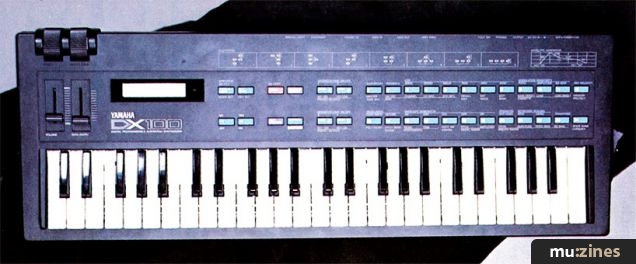
DX100
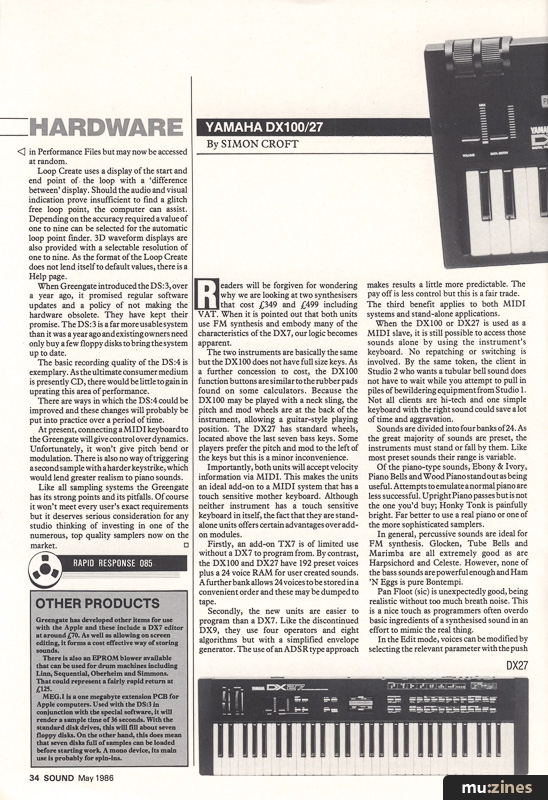
Readers will be forgiven for wondering why we are looking at two synthesisers that cost £349 and £499 including VAT. When it is pointed out that both units use FM synthesis and embody many of the characteristics of the DX7, our logic becomes apparent.
The two instruments are basically the same but the DX100 does not have full size keys. As a further concession to cost, the DX100 function buttons are similar to the rubber pads found on some calculators. Because the DX100 may be played with a neck sling, the pitch and mod wheels are at the back of the instrument, allowing a guitar-style playing position. The DX27 has standard wheels, located above the last seven bass keys. Some players prefer the pitch and mod to the left of the keys but this is a minor inconvenience.
Importantly, both units will accept velocity information via MIDI. This makes the units an ideal add-on to a MIDI system that has a touch sensitive mother keyboard. Although neither instrument has a touch sensitive keyboard in itself, the fact that they are standalone units offers certain advantages over add-on modules.
Firstly, an add-on TX7 is of limited use without a DX7 to program from. By contrast, the DX100 and DX27 have 192 preset voices plus a 24 voice RAM for user created sounds. A further bank allows 24 voices to be stored in a convenient order and these may be dumped to tape.
Secondly, the new units are easier to program than a DX7. Like the discontinued DX9, they use four operators and eight algorithms but with a simplified envelope generator. The use of an ADSR type approach makes results a little more predictable. The pay off is less control but this is a fair trade. The third benefit applies to both MIDI systems and stand-alone applications.
When the DX100 or DX27 is used as a MIDI slave, it is still possible to access those sounds alone by using the instrument's keyboard. No repatching or switching is involved. By the same token, the client in Studio 2 who wants a tubular bell sound does not have to wait while you attempt to pull in piles of bewildering equipment from Studio 1. Not all clients are hi-tech and one simple keyboard with the right sound could save a lot of time and aggravation.
Sounds are divided into four banks of 24. As the great majority of sounds are preset, the instruments must stand or fall by them. Like most preset sounds their range is variable.

DX27
Of the piano-type sounds, Ebony & Ivory, Piano Bells and Wood Piano standout as being useful. Attempts to emulate a normal piano are less successful. Upright Piano passes but is not the one you'd buy; Honky Tonk is painfully bright. Far better to use a real piano or one of the more sophisticated samplers.
In general, percussive sounds are ideal for FM synthesis. Glocken, Tube Bells and Marimba are all extremely good as are Harpsichord and Celeste. However, none of the bass sounds are powerful enough and Ham 'N Eggs is pure Bontempi.
Pan Floot (sic) is unexpectedly good, being realistic without too much breath noise. This is a nice touch as programmers often overdo basic ingredients of a synthesised sound in an effort to mimic the real thing.
In the Edit mode, voices can be modified by selecting the relevant parameter with the push buttons and using the Data Entry fader or the± incrementing buttons. The LCD gives parameter name and value. This is not illuminated — hardly a big problem in the studio but bad news on stage as it also displays the program names.
In conclusion the signal to noise of these synthesisers is comparable to other electronic instruments. MIDI has been comprehensively implemented, particularly with regard to velocity, although there is no MIDI mono mode. No less than three manuals and a cassette tape are supplied to aid programming.
There are few points on which these instruments preclude professional use. Unfortunately, the units do use an external mains supply. This is not of over-riding importance if the keyboard is to be used on a rack or shelf but could otherwise prove inconvenient.
It is more likely though that these instruments will be ignored because they are not very expensive. This is a great shame because a rack full of DX100s would offer remarkable flexibility at a fraction of the cost of Yamaha's FM modules.
Also featuring gear in this article

The Dynamic Duo
(SOS Feb 86)


Yamaha DX100 - SynthCheck
(IM Feb 86)

Yamaha DX100
(12T Mar 86)

Patchwork
(EMM Apr 86)

Patchwork
(EMM Oct 86)

Patchwork
(MT Mar 87)

Patchwork
(MT Feb 88)

Patchwork
(MT Oct 88)

Patchwork
(MT Mar 89)
...and 5 more Patchwork articles... (Show these)
Browse category: Synthesizer > Yamaha
Featuring related gear

FM 4-Operator Editors
(MT Jul 88)

Quinsoft 4-OP Librarian - Atari ST Software
(MT Mar 90)

Browse category: Software: Editor/Librarian > Dr. T
Browse category: Software: Editor/Librarian > Quinsoft
Browse category: Software: Editor/Librarian > Soundbits
Publisher: Sound Engineer and Producer - Media Week Ltd.
The current copyright owner/s of this content may differ from the originally published copyright notice.
More details on copyright ownership...

Sound Engineer and Producer - May 1986
Review by Simon Croft
Ads for Gear in this article:


Help Support The Things You Love
mu:zines is the result of thousands of hours of effort, and will require many thousands more going forward to reach our goals of getting all this content online.
If you value this resource, you can support this project - it really helps!
Donations for October 2026
Issues donated this month: 0
New issues that have been donated or scanned for us this month.
Funds donated this month: £0.00
All donations and support are gratefully appreciated - thank you.
Magazines Needed - Can You Help?
Do you have any of these magazine issues?
If so, and you can donate, lend or scan them to help complete our archive, please get in touch via the Contribute page - thanks!
Please Contribute to mu:zines by supplying magazines, scanning or donating funds. Thanks!
Monetary donations go towards site running costs, and the occasional coffee for me if there's anything left over!

 @mu_zines
 RSS Feed
 Blog
Blog