


Magazine Archive
Home -> Magazines -> Issues -> Articles in this issue -> View
Sync-Opation | |
Roland SBX80 S.M.P.T.E./MIDI Sync BoxArticle from In Tune, December 1985 | |
Stuck how to sync your sequencer? Dazzled by drum machine disasters? Nick Graham explains all about S.M.P.T.E. time codes and how Roland's latest wonder box could be your saviour!
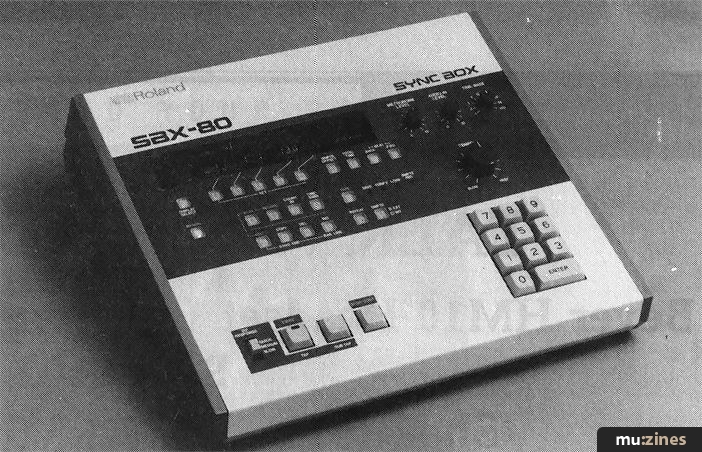
Those of you who have ever driven sequencers or drum machines from a code recorded on tape well know some of the problems. Unless you run from the beginning of the track each time, it's difficult to trigger sequences in perfect synchronisation. Moreover, if you lose that code (by accidental erasure or dropouts on tape), or if it's interfered with in any way, there's not much chance of re-synchronising the machines to it. Add to this the headache of delays in triggering between machines, the control of tempo/time signature changes and the fact that most makes of sequencers and drum machines have different sync codes, and the problems begin to mount.
O.K., I know there are devices which overcome these problems by generating and reading an S.M.P.T.E. time code, but until now they have been very expensive and thus only available to professional users. This isn't meant to imply that the Roland SBX80 S.M.P.T.E. Sync Box is anything less than a professional machine (a lot of studios would benefit greatly by owning one), but it is a lot cheaper than anything previously available, even though the facilities it offers are just as comprehensive. If your work or play involves sequencers and drum machines, then what follows is bound to be of interest!
First of all, a quick explanation of S.M.P.T.E.. If you already know, don't be offended; just skip this paragraph or read it to check that I'm right! S.M.P.T.E. is an acronym which stands for Society of Motion Picture and Television Engineers, and it was developed initially for editing video tapes. It's been the standard synchronisation code for the film/TV business for some time, and is now becoming standard for the music industry. The reason for its popularity is that position information is recorded onto tape, making it possible to use the code to quickly locate any point in a piece of music; thus it is used, for example, to provide time information for computer-controlled desks. Don't make the mistake of thinking that an S.M.P.T.E. code has anything to do with tempo - it's a time code which counts in hours, minutes, seconds, and fractions of a second or 'frames'. There are 25 frames per second (30 in the USA, Canada and Japan), and each of these frames is subdivided into 80 bits, thus giving 2000 markers per second. Any machine which can read this code - e.g. the SBX80 - is capable of synchronising a track to this level of accuracy.
To describe in detail the operation of the SBX80 would take roughly the space of the 36-page Roland manual, so I'll have to confine myself to an outline of the general functions. At its most simple level, this sync box can be used as a master controller for a number of devices. There are two DIN sync outputs which will drive any Roland device direct; two MIDI sync outputs (any MIDI device) and a Time Base output which is adjustable between 1 and 120. Tempo and time signature can be set at this stage, as can the optional two bar count-in. It's interesting that tempo can not only be chosen by entering values from the keypad or tempo knob but also by tapping out a count on the 'Tap Buttons' or by feeding a click signal into 'Audio In'. This can be extremely useful if you want to set tempo from something already recorded, and it would in fact be possible, using the SBX80, to synchronise your drum machines/sequencers to a real band in a live situation by tapping the button in time with the musicians - tedious for a keyboard player, but very effective (perhaps you could get a roadie to do it!).
If, however, you require more than just a versatile master clock, then switch to the Play/Record modes where the SBX80 really comes into its own. In Play, the whole 'song' has to be written beat by beat, bar by bar into the memory. This is just like programming a step time sequencer, except that you're only dealing with tempo, beats per bar and song length (or pattern repeat). All these parameters are entered from the keypad, and subtle tempo/time changes can be programmed. Comprehensive editing facilities mean that data can be changed, inserted, deleted and copied fairly easily.
When the song is written and all the machines linked to the SBX80 are triggering according to plan, you can start running sequences to tape by locking the sync box to a pre-recorded S.M.P.T.E. code. Although this code may have been generated by the Roland, it would synchronise just as easily to a code recorded by another device on another occasion. In fact the Record mode on the SBX80 makes it possible to re-sync your sequencers to a track which has lost its code for some reason, or never even had one in the first place! Just 'stripe' the tape (pro jargon for recording a code) and, either by tapping the Tap Button (in time, preferably!!) or feeding in a regular click signal, the SBX80 will re-programme itself, responding to any variations which are on the track. Even a track which wasn't recorded by machines (oh, no! not by real musicians, drinking, swearing, arguing with the producer and worse...) can have sequencers added if necessary.
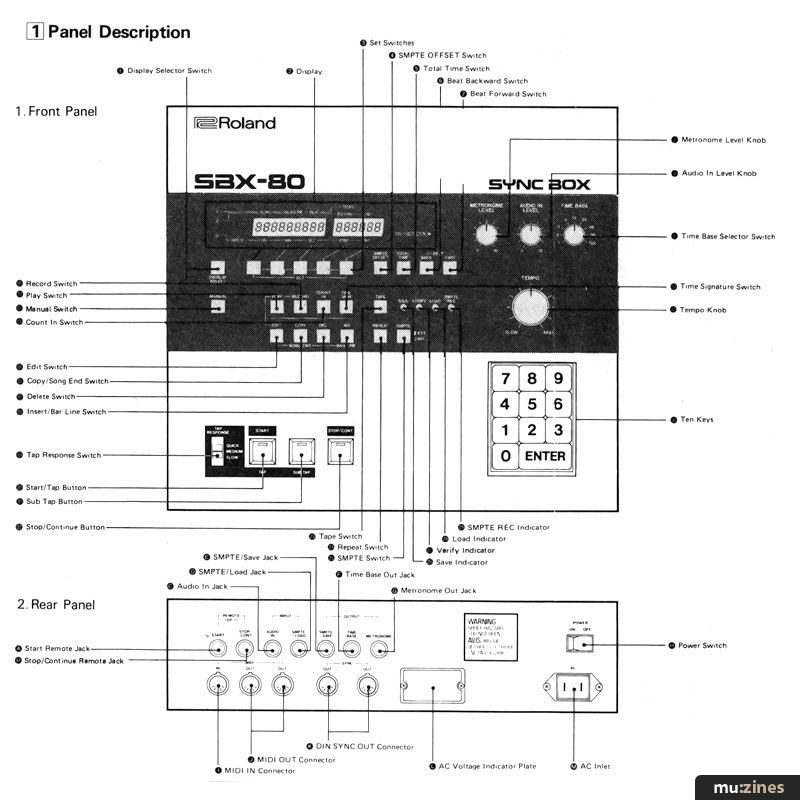
I'm not going to dwell on the pros and cons of recording codes, but I will say one thing - any problems I encountered with the SBX80 have been either operator error (usually me!) or faults in the code on tape. However, S.M.P.T.E. is probably less sensitive to bad recording than other sync codes, and since, as I explained above, it marks position information, the Roland sync box always knows exactly where it is in the song. If you 'reel' your tape machine forward to any position and then go into Play, the SBX80 will immediately pick up the code and start running from the right bar. Better still, if you're running MIDI devices like the Roland 707/727 or MSQ100, which will respond to song position information, then they too will start at the right bar in perfect sync. Using MIDI in this way, it would be perfectly possible to record and mix tracks without ever putting the sequencers on to tape (ideal for expanding the scope of your 8-track or Portastudio - and think of the gain in quality!).
Cue points can also be set on the SBX80, allowing drop-ins of sequenced passages at any bar in the song. This is very useful for outrageously old-fashioned people like me, who still use Steam Age pre- or early-MIDI technology like the Linn-1/2, Oberheim DMX, Roland MC4, MSQ700 etc. etc. etc. Finally, if when you successfully cue a drop-in and find that, due to triggering delay, the new part is fractionally late, then changing the 'Offset Time' will put it into focus. Of course you can dump your carefully constructed programmes on to cassette for later use; you may have to change all the sequencer patterns because the record company don't like the keyboard player...!
My conclusion is - wait for it! - the SBX80 is absolutely brilliant - it could have done with another variable Time Base output, but for this money you can't have everything. It's a must for those who need one, and for those who think they don't, you probably soon will!
RRP £1000
Further details from Roland (U.K.) Ltd., (Contact Details).
Also featuring gear in this article

Effective Automation (Part 2)
(SOS Jan 86)

Perfect Timing
(IM Apr 85)

Roland SBX-80 Sync Box - Sequencercheck
(IM May 85)

Roland SBX80 Sync Box
(EMM Feb 85)

Roland SBX80 Sync Box
(HSR Mar 85)

SBX-80 - The Time Keeper
(IM Jun 85)

The Sync-ing Feeling
(IM Mar 85)
Browse category: Synchroniser > Roland
Featuring related gear


Publisher: In Tune - Moving Music Ltd.
The current copyright owner/s of this content may differ from the originally published copyright notice.
More details on copyright ownership...

In Tune - Dec 1985
Gear in this article:
Synchroniser > Roland > SBX-80
Review by Nick Graham
Ads for Gear in this article:

Help Support The Things You Love
mu:zines is the result of thousands of hours of effort, and will require many thousands more going forward to reach our goals of getting all this content online.
If you value this resource, you can support this project - it really helps!
Donations for April 2026
Issues donated this month: 0
New issues that have been donated or scanned for us this month.
Funds donated this month: £0.00
All donations and support are gratefully appreciated - thank you.
Magazines Needed - Can You Help?
Do you have any of these magazine issues?
If so, and you can donate, lend or scan them to help complete our archive, please get in touch via the Contribute page - thanks!
If you're enjoying the site, please consider supporting me to help build this archive...
...with a one time Donation, or a recurring Donation of just £2 a month. It really helps - thank you!

 @mu_zines
 RSS Feed
 Blog
Blog