


Magazine Archive
Home -> Magazines -> Issues -> Articles in this issue -> View
Tama Superstar | |
DrumCheckArticle from International Musician & Recording World, August 1986 | |
A new Superstar and Bob H get acquainted
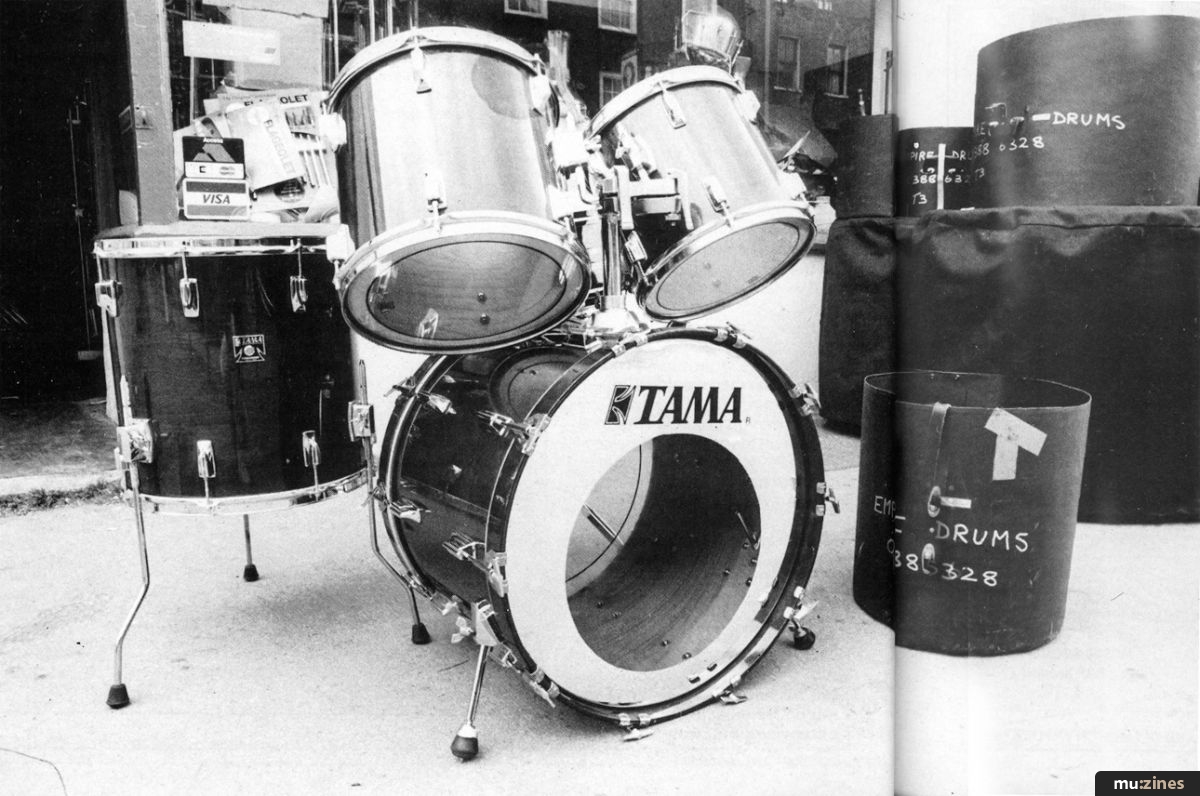
It's been more than seven years since we looked at a SuperStar set and at that time Billy Cobham was really making waves with them. Obviously we've tested ArtStars, ImperialStars and several other Tama sets in the interim, but these Supers are really the bread and butter of the Tama professional sets.
SuperStars are made from six plies of Birch whereas Artstars have a Birch core with Cordia (a South American densewood) on the inner and outer faces. All SuperStar shells are the same thickness and the plies are joined at an angle to the very smooth bearing edge. This is to eliminate potential weak points around the circumference. Tama were the first to use this method and they, like most manufacturers, dry their wood thoroughly before glueing is carried out. (This also ensures that both inside and outside of the shell react equally to moisture once the drum is in use.) The shells are then stained in one of three colours: Mahogany, Maple or Cherry Wine before being lacquered to a high lustre. This exterior finish has changed very much for the better since my original review. They were decidedly matt at the beginning.
The SuperStar set I saw had extra depth shells which measured 22" x 16", 12" x 11", 13" x 12", and 16" x 16" with a 6½" x 14" metal shell snare drum. As you can see from the heading the set is no longer supplied with stands, but if you want them a package of upmarket pedals and things will cost about £350. We'll discuss this later.
Bass Drum
SuperStar's bass drum has 20 timpani-type tuners, pressed steel claws and large single nutboxes. Unlike ImperialStar drums this one has wooden hoops. Tama still use disappearing spurs: they're made from substantial rod and have lockable rubber or spike-tipped ends. The holders which locate these spurs face ever so slightly forward to allow them to stabilise the drum better. A large wing bolt locks the spur in the desired position. The original SuperStar set I looked at had what I felt at the time was a tight, flat sound. However the latest bass drums are much rounder. I think the heads they are using these days have made a big difference; before they used to fit Ambassador heads but nowadays they have CS or PinStripes. The front head is one of Tama's own mirror-finish Mirage heads. Obviously the extra deep shell has added some roundness to the sound.
Tom Toms
I always felt that SuperStar's toms were very penetrating and likened them to Slingerland's. However, that was before they added that extra couple of inches to the shells. Nowadays they appear to be in a class of their own. They're still bright and penetrating but with lots of oomph too. The toms also come with a CS head top and bottom but I have heard them with Pinstripes and a mixture of the two. Naturally thicker heads will tend to stop the sound from clattering. Both the mounted toms have six nutboxes per head while the floor tom has the usual eight. All have triple flange hoops and, of course, square headed tensioners. No longer do they fit internal dampers but they were the first to make an external one. It fits to the rim and can be locked on via a cam lever. (I must say I was rather partial to their old style of lockable damper which worked inside. It was definitely better than anybody else's.) The small toms mount onto their holder via a cast block with an 'O' bolt inside and this also doubles as retaining block for the floor tom legs. These legs are double bent and with rubber feet. Like all the drums the interiors are beautifully clean with unobtrusive bolts and screws.
Snare
The drum I saw had a metal shell with a 6½" depth known to its catalogue as 8006. Yes, it's the old King Beat drum, but since Tama appear to make at least eight snare drums in two and sometimes three different depths you can virtually tailor your drum to what you need or can afford! I've always been partial to this drum; It's sophisticated and works well. It has a seamless shell with 10 square headed tension screws per head, and double ended waisted nut boxes. The shell is double 'beaded' in the centre to strengthen it and stop it from buckling. Tama's PC die cast hoops are fitted with that screw adjustable, lockable, under-batter-head-operating, spring-steel damper. This drum still comes with coated Ambassador heads but I like the flat sound that they contribute to the snare drum. There appears to be a move back to the 'crack' of these heads. Anyway, like all high quality shells 8006 has an inverse flange bent at 45° to give a very accurate bearing edge to seat the head. It measures 2mm at contact and underneath is a graduated snare location area to allow the snares to touch the head evenly at the edges and the centre.
King Beat's snare mechanism is really strong and positive. It doesn't seem to have changed over the years and allows you to have separate control over snare stretch and head touch pressure. (In other words it stretches the snares independently of vertical pressure.) This is called parallel action and many companies have been involved with their own versions of these over the years; however Tama's seems to embody the best characteristics of them all. The snare wires themselves are attached directly to the strainer so there's no need for strings or plastic strips. This strainer will also take their steel snappy snare or aircraft wire snappy snare which gives a much drier sound. The die cast rims they fit are much more stable but they do make the sound a little thicker and less breathy. Mind you, in the recording studio this can be a positive advantage. This drum is really the closest thing to an old Ludwig 'super sensitive' I've played.
Stands/Accessories
As I said at the beginning the price doesn't include any ancillary equipment (except for an Omnilock double tom holder which works on the ball and cage system with 'L'shaped arms to locate and hold the toms), but of course Tama do make excellent stands and pedals. Their stands all have double braced legs with 'touchlock' at all adjustment points. This consists of a cam lever with a nylon bush inside and a fine adjustment knob. Boom stands are counter weighted with substantial cast ratchet tilters and the cymbal itself is cosseted by the usual collection of felts, washers and a cymbal mate plastic wing bolt.
The snare stand too has the 'Touchlock' together with a brake drum type locking system for the playing angle and a basket type holding mechanism which locks via a capstan nut. The Titan hi hat stand has a centre-pull action with a spring inside a chamber joined to the down tube. It uses a bike chain to link its two-piece footplate to the centre with a screwable spur set into the base and the usual touchlock complete with a memory lock. (Tama supply all different sizes of these and you could even fix them to your tom tom legs.)
The company appear to make three footpedals these days: Pro-Beat, King-Beat and their Cameo Chain Drive. All have two-piece footplates while the King-Beat has a compression spring inside a chamber. It is the heavier of the pedals with spurs and a very strong jaw to join it to the bass drum hoop. The other two have chain actions although only the Cameo has a chainwheel cog fixed to the axle. All three have toe stops and all have totally adjustable actions. If I had to choose I'd go for the King-Beat, but all three have their different applications.
Conclusions
I have to say I was shocked to hear the RRP of just five Tama drums! I appreciate that there has been a lot of fluctuation recently between the dollar and the yen but didn't dream it would have had that sort of effect on prices. However, there's no doubt that these drums are beautifully, carefully and thoughtfully made so I suppose if you want them then you won't mind spending out for them. The set I saw was finished externally in Cherry Wine and looked great. Just like everything else in life, with drums you get what you pay for!
Tama Superstar X-tras RRP: £1,225 (No Stands)
Also featuring gear in this article

Publisher: International Musician & Recording World - Cover Publications Ltd, Northern & Shell Ltd.
The current copyright owner/s of this content may differ from the originally published copyright notice.
More details on copyright ownership...

International Musician - Aug 1986
Gear in this article:
Review by Bob Henrit
Previous article in this issue:
Next article in this issue:
Help Support The Things You Love
mu:zines is the result of thousands of hours of effort, and will require many thousands more going forward to reach our goals of getting all this content online.
If you value this resource, you can support this project - it really helps!
Donations for May 2026
Issues donated this month: 0
New issues that have been donated or scanned for us this month.
Funds donated this month: £0.00
All donations and support are gratefully appreciated - thank you.
Magazines Needed - Can You Help?
Do you have any of these magazine issues?
If so, and you can donate, lend or scan them to help complete our archive, please get in touch via the Contribute page - thanks!
Please Contribute to mu:zines by supplying magazines, scanning or donating funds. Thanks!
Monetary donations go towards site running costs, and the occasional coffee for me if there's anything left over!

 @mu_zines
 RSS Feed
 Blog
Blog