


Magazine Archive
Home -> Magazines -> Issues -> Articles in this issue -> View
The Explorer discovered | |
Article from Music UK, September 1982 | |
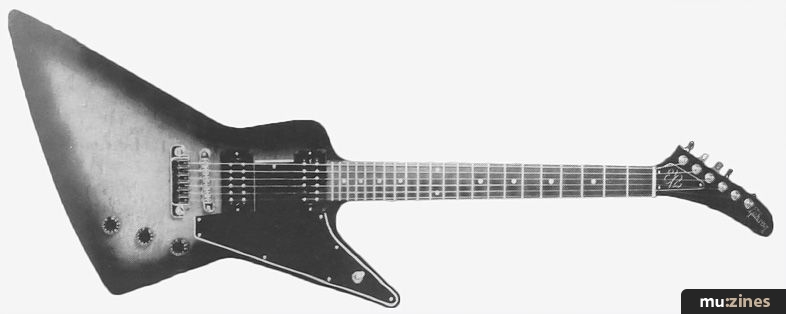
April 1958 must have been a golden month in the history of Rock 'n Roll guitar design, because it was then that Gibson U.S.A. introduced two of the wildest guitar shapes yet to hit a public still trying to work out Elvis Presley and Gene Vincent. The guitars? They were the Flying V and the Explorer. Since then, like most innovative ideas, those two guitars have returned again and again, each time a little different (or a great deal different in some instances) and each time capturing a slice of a market learning to love those shapes in their original form in the hands of players lucky enough to own vintage original models.
For some bizarre reason, despite coming from a society which loved such oddities as whitewall tyred Cadillacs, D.A. haircuts and Pat Boone (!), these two new Gibsons somehow never caught the imagination of enough of the guitar buying fraternity to justify continued production. So, like the Firebirds and Thunderbirds, it was Bye Bye Flying V and So Long Explorer — for a few years at any rate.
Good shapes and great guitars don't lie down and die though, and a generation that had outgrown the tastes of the 50's (and even a few like Albert King who'd always seen what the V was about, anyway) started to lust after those dusty old oddities up on the walls of guitar shops. Prices began to climb, people started to talk — and Gibson responded with re-issues of many of these old guitars, some good, some maybe not so good, but all proving that they were originally ideas well ahead of their time.
And now in 1982, the latest two re-thinks of the Explorer and Flying V have just hit these shores. I borrowed The Explorer from U.K. distributors Rosetti and Co. to see how the legend has changed.
To start with that shape is good, very clean, very sharp, and yet curiously comfortable to hold. You can even play an Explorer sitting down (which I've never been able to do with a V!) and that's weird as it looks impossible. I'd go further too — the beast is even comfortable to hold that way!
And is it well made? Certainly my sample was — it was superb, beautiful in fact, but then Rosetti retain Peter Cook Guitars to set-up and carefully adjust every instrument they import from Gibson. Since they've been doing that I haven't heard or seen a duff one — but that's Peter's tribute: how they leave the factory is pure guesswork. All I know is that, notwithstanding some of the duff ones I was seeing in the mid-Seventies, these days I'd happily walk into any dealer in the country and take a new Gibson off the wall to buy (assuming I had the money that is!). Whether I'd like it or not would be a matter of taste — but it would be accurately fretted, well finished and with a neck that was straight and good to play.
So, this Explorer was a peach of a guitar to look at and fondle. Yes, teacher, I did use the word 'fondle'. You see it's a very sensuous guitar this. It's not made these days in the African Korina wood of the original, but rather a tree sandwich of maple layers with a dark stained back and a top of really fine looking wood. Open the case and, like all good new guitars, it smelled of glue and wood, not plastic.
The neck too is lovely to touch, superbly well finished from another laminated maple job and faced with a very nice piece of rosewood.
As expected the Gibson wore those fat frets of theirs (obviously the best for string bending and sustain) and these bore the tiny marks of fine polishing which probably explained the lack of fret buzz and the excellent comfort when the guitar was played up around the very top of the neck. Talk about accessible too! The Explorer's shape makes high screaming solos easy to get at as you can wrap your fingers round the top of the 24¾" neck.
From a hardware point of view, The Explorer is extremely well kitted-out. You have a well cut bone nut, gold plated machines, gold-plated Tune-o-matic bridge and TP6 tailpiece. I've lived with one of these TP6's for a year or so now and still can't make up my mind about it. Some players tell me that the ease with which you can right hand tune your guitar mid-solo is great, others, like me, probably swap guitars around too much to grow used to automatically reaching to the 'wrong' place to scrabble back into pitch when on the verge of panic! Stick with a TP6, though, and I'm sure you'd grow used to it, in which case it's a fine idea.
Pickups fitted to this guitar are a brand new type of exposed Humbuckers called "Super Dirt", rather aptly named in fact. They are controlled by two volumes and one tone plus a pickup selector down on the bottom horn. This is a bit of an odd placing for it — possibly due more to looks than ease of use on the original but again I reckon you could get used to it with time.
So, having said that the finish of the guitar was excellent, that it looked like a dream and handled superbly well, what about the sound? Well, I always thought that Explorers were real 'screamers' — not that they were prone to feedback, you understand, but rather that their natural sound was ideal for deliberately induced sustain/whine and high sounding solo work. Maybe this one is and maybe I just couldn't find the right amp setting to get it but the sound was fatter than I had expected — almost ultra—Gibson twin coil, in fact, and much fuller and warmer than I had been anticipating. Not that this is a criticism. There's many a player (myself included) who loves that thick, dirty sound, but it's not what I had been anticipating from this guitar.
Sustain, on the other hand, is far better than I had expected, notes ringing on and on with a really powerful hangover to them, ideal for solos ending in long sustained feedback notes, really a true rock guitar with no concessions to anything else.
In fact, even down quiet, these 'Super Dirts' don't sound too clean they must have a massive output! This axe was quite obviously made for riffing and soloing, not forty nine to the bar jazz stuff; it's a Rockers guitar and should appeal well to Rock players, providing they don't expect really staggering treble — it's certainly no Telecaster and Gibson have obviously no intentions of making it one as they haven't even fitted a coil tap — odd because even if not on the original Explorer, or the Explorer II it would be good to have. Don't run away with the idea that The Explorer is devoid of top, however. It's got a brilliant enough sound on the bridge pickup — it's just that I'd really like to try one with a coil tap. Or maybe I should get a toppier amp?
And so to the price. Full RRP on this version of The Explorer is £875, a heck of a lot of money, but you get a heck of a lot of guitar for it. I wouldn't like to put my hand on my heart and say that it was a bargain at that price as, of course, there are much cheaper guitars and much cheaper Gibson guitars at that, like the five layer Maple/Walnut Explorer II. But on the other hand, a great deal of impressive workmanship has gone into this beautiful maple instrument and, obviously, the materials used in its construction are exemplary. As prices generally rise it should be something of an investment, even at nearly £900, and if you fall in love with it — what the hell does money mean then?
Publisher: Music UK - Folly Publications
The current copyright owner/s of this content may differ from the originally published copyright notice.
More details on copyright ownership...

Music UK - Sep 1982
Review by Gary Cooper
Previous article in this issue:
Next article in this issue:
Help Support The Things You Love
mu:zines is the result of thousands of hours of effort, and will require many thousands more going forward to reach our goals of getting all this content online.
If you value this resource, you can support this project - it really helps!
Donations for May 2026
Issues donated this month: 0
New issues that have been donated or scanned for us this month.
Funds donated this month: £0.00
All donations and support are gratefully appreciated - thank you.
Magazines Needed - Can You Help?
Do you have any of these magazine issues?
If so, and you can donate, lend or scan them to help complete our archive, please get in touch via the Contribute page - thanks!
Please Contribute to mu:zines by supplying magazines, scanning or donating funds. Thanks!
Monetary donations go towards site running costs, and the occasional coffee for me if there's anything left over!

 @mu_zines
 RSS Feed
 Blog
Blog