

Magazine Archive
Home -> Magazines -> Issues -> Articles in this issue -> View
The Great Pretender? | |
Casio CK-500Article from Electronic Soundmaker & Computer Music, May 1985 | |
A four-track find or fraud? We pass judgement.
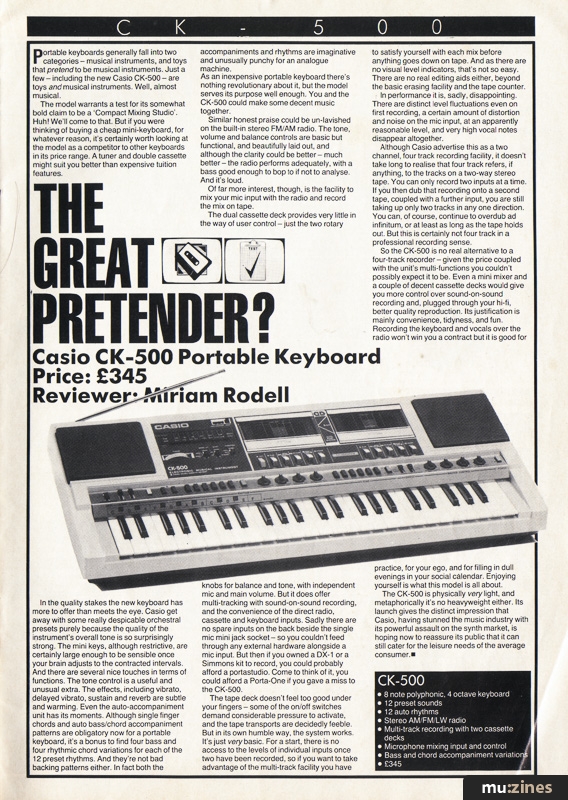
Casio CK-500 Portable Keyboard
Price: £345

Portable keyboards generally fall into two categories - musical instruments, and toys that pretend to be musical instruments. Just a few - including the new Casio CK-500 - are toys and musical instruments. Well, almost musical.
The model warrants a test for its somewhat bold claim to be a 'Compact Mixing Studio'. Huh! We'll come to that. But if you were thinking of buying a cheap mini-keyboard, for whatever reason, it's certainly worth looking at the model as a competitor to other keyboards in its price range. A tuner and double cassette might suit you better than expensive tuition features.
In the quality stakes the new keyboard has more to offer than meets the eye. Casio get away with some really despicable orchestral presets purely because the quality of the instrument's overall tone is so surprisingly strong. The mini keys, although restrictive, are certainly large enough to be sensible once your brain adjusts to the contracted intervals. And there are several nice touches in terms of functions. The tone control is a useful and unusual extra. The effects, including vibrato, delayed vibrato, sustain and reverb are subtle and warming. Even the auto-accompaniment unit has its moments. Although single finger chords and auto bass/chord accompaniment patterns are obligatory now for a portable keyboard, it's a bonus to find four bass and four rhythmic chord variations for each of the 12 preset rhythms. And they're not bad backing patterns either. In fact both the accompaniments and rhythms are imaginative and unusually punchy for an analogue machine.
As an inexpensive portable keyboard there's nothing revolutionary about it, but the model serves its purpose well enough. You and the CK-500 could make some decent music together.
Similar honest praise could be un-lavished on the built-in stereo FM/AM radio. The tone, volume and balance controls are basic but functional, and beautifully laid out, and although the clarity could be better - much better - the radio performs adequately, with a bass good enough to bop to if not to analyse. And it's loud.
Of far more interest, though, is the facility to mix your mic input with the radio and record the mix on tape.
The dual cassette deck provides very little in the way of user control - just the two rotary knobs for balance and tone, with independent mic and main volume. But it does offer multi-tracking with sound-on-sound recording, and the convenience of the direct radio, cassette and keyboard inputs. Sadly there are no spare inputs on the back beside the single mic mini jack socket - so you couldn't feed through any external hardware alongside a mic input. But then if you owned a DX-1 or a Simmons kit to record, you could probably afford a portastudio. Come to think of it, you could afford a Porta-One if you gave a miss to the CK-500.
The tape deck doesn't feel too good under your fingers - some of the on/off switches demand considerable pressure to activate, and the tape transports are decidedly feeble. But in its own humble way, the system works. It's just very basic. For a start, there is no access to the levels of individual inputs once two have been recorded, so if you want to take advantage of the multi-track facility you have to satisfy yourself with each mix before anything goes down on tape. And as there are no visual level indicators, that's not so easy. There are no real editing aids either, beyond the basic erasing facility and the tape counter.
In performance it is, sadly, disappointing. There are distinct level fluctuations even on first recording, a certain amount of distortion and noise on the mic input, at an apparently reasonable level, and very high vocal notes disappear altogether.
Although Casio advertise this as a two channel, four track recording facility, it doesn't take long to realise that four track refers, if anything, to the tracks on a two-way stereo tape. You can only record two inputs at a time. If you then dub that recording onto a second tape, coupled with a further input, you are still taking up only two tracks in any one direction. You can, of course, continue to overdub ad infinitum, or at least as long as the tape holds out. But this is certainly not four track in a professional recording sense.
CK-500
- 8 note polyphonic, 4 octave keyboard
- 12 preset sounds
- 12 auto rhythms
- Stereo AM/FM/LW radio
- Multi-track recording with two cassette decks
- Microphone mixing input and control
- Bass and chord accompaniment variation
- £345
So the CK-500 is no real alternative to a four-track recorder - given the price coupled with the unit's multi-functions you couldn't possibly expect it to be. Even a mini mixer and a couple of decent cassette decks would give you more control over sound-on-sound recording and, plugged through your hi-fi, better quality reproduction. Its justification is mainly convenience, tidyness, and fun. Recording the keyboard and vocals over the radio won't win you a contract but it is good for practice, for your ego, and for filling in dull evenings in your social calendar. Enjoying yourself is what this model is all about.
The CK-500 is physically very light, and metaphorically it's no heavyweight either. Its launch gives the distinct impression that Casio, having stunned the music industry with its powerful assault on the synth market, is hoping now to reassure its public that it can still cater for the leisure needs of the average consumer.
Also featuring gear in this article


Publisher: Electronic Soundmaker & Computer Music - Cover Publications Ltd, Northern & Shell Ltd.
The current copyright owner/s of this content may differ from the originally published copyright notice.
More details on copyright ownership...

Electronic Soundmaker - May 1985
Donated by: Ian Sanderson
Gear in this article:
Review by Miriam Rodell
Ads for Gear in this article:

Help Support The Things You Love
mu:zines is the result of thousands of hours of effort, and will require many thousands more going forward to reach our goals of getting all this content online.
If you value this resource, you can support this project - it really helps!
Donations for June 2026
Issues donated this month: 0
New issues that have been donated or scanned for us this month.
Funds donated this month: £0.00
All donations and support are gratefully appreciated - thank you.
Magazines Needed - Can You Help?
Do you have any of these magazine issues?
If so, and you can donate, lend or scan them to help complete our archive, please get in touch via the Contribute page - thanks!
Please Contribute to mu:zines by supplying magazines, scanning or donating funds. Thanks!
Monetary donations go towards site running costs, and the occasional coffee for me if there's anything left over!

 @mu_zines
 RSS Feed
 Blog
Blog