


Magazine Archive
Home -> Magazines -> Issues -> Articles in this issue -> View
The Normalled, Live Performance 4700/S | |
Article from Polyphony, January/February 1981 | |
Normalled synthesizers are very convenient for live performance, but for my first synthesizer a modular system seemed to suit my needs. So, I chose a 4700/S and despite all those patch cords, still managed to use it in live performance by applying a trick or two.
My playing situation wasn't too unusual; while doing time in the Air Force in Germany, I became involved in a musical revue/variety show put on by the base recreation center. Besides touring a few bases in the area, we ultimately ended up as one of the acts in the open house festivities at Templehof Airport in West Berlin. In addition to playing rhythm guitar, I used the 4700/S for background melodies and sound effects.
NORMALLING THE 4700/S
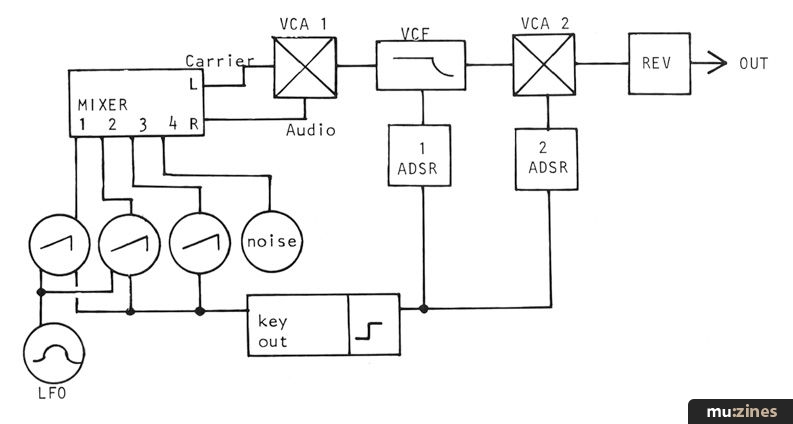
Since no elaborate patches were required, I came up with the normalled patch scheme shown in figure 1. This covered about 80% of my playing needs, so that the only plug-pulling I had to do was occasionally bypassing the first balanced modulator/VCA, changing VCO waveforms, and routing the filter output.
1
ADDING A PITCH CONTROL PRESET
2
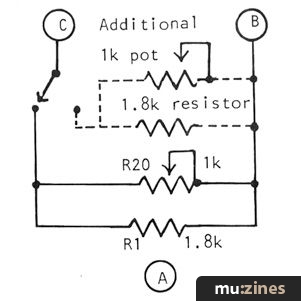
We opened our shows with the old white noise/howling wind cliche, which changed to rising oscillator sounds. An off stage voice did a space launch-style countdown while this was happening, and when he said "liftoff", the rest of the band would kick in (a bit corny, but the audience ate it up). Seeing as how I also had to play along with the band later on (preferably in tune!), twisting the pitch control around could have created problems. So, I added the preset modification shown in figure 2 to the 2720-9 glide circuit board. The extra knob and switch were stuck beside the pitch and glide controls, below the ground jack. I set one pitch control in tune for regular playing, while the other could be used for special effects and the like.
SIMPLIFYING PATCH CORD CONNECTIONS
There were a couple of tricks I used to make patching easier. First of all, when the gig was over I unplugged the wires going to the keyboard (CV out, trigger, ground) and plugged these into unused jacks on the modules. Thus, the two module cases could be closed with the patch cords already half-ready to go when I set up for the next show.
3
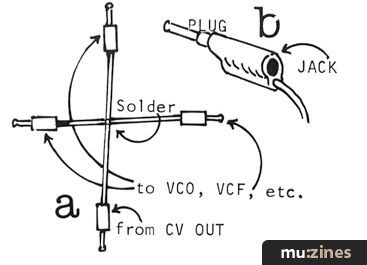
Since the three oscillators were being controlled by a single control voltage output, I took two patch cords and joined them in a "T" configuration (see figure 3a). The long end of this cord went to the CV out jack, while the other three ends went to the oscillators. This cut down on the cord count and freed the multiple jacks for other applications.
Another way to cut down on clutter involves using patch cords with combination pin plug/jack ends (see figure 3b - I used Pomona Electronics model #P-36 cords; I don't know offhand where they're available, but I would think most well-stocked electronic stores would have something similar). When going from, say, the LFO to a VCO, another plug can be inserted in the back of the first plug to run off to another VCO (or whatever).
FINAL COMMENTS
No matter how many miles of wire you've got running around, with careful planning most changes can be made with knobs rather than by switching patch cords around. The only people those cords should intimidate is the audience; you're supposed to know what's going on. Finally, when you're up there on stage and you just can't seem to remember where those last two or three patch cords go, just remember that wise old saying - "If you can't dazzle them with brilliance, baffle them with bull". In other words - fake it!
More from these topics
 On the Road |
 from Go to Woe? - Moby Live |
 PA Column |
 Getting The Best From Your P.A. |
 Technically Speaking |
 Relax... your solo will be just fine - Relaxing For Gigs |
 Waiving the rules - Britannia Row |
 A Deeper Wave - Wavetable Synthesis |
 A Long Alone in London - A Long Ryder Writes... |
 Radio Days - Technology On The Air |
 Advanced Music Synthesis - Inside the Yamaha GS1 & GS2 |
 The Ins and Outs of Digital Design |
Browse by Topic:
Live
Synthesis & Sound Design
Publisher: Polyphony - Polyphony Publishing Company
The current copyright owner/s of this content may differ from the originally published copyright notice.
More details on copyright ownership...

Polyphony - Jan/Feb 1981
Donated & scanned by: Mike Gorman
Feature by Doug Llewellyn
Previous article in this issue:
Help Support The Things You Love
mu:zines is the result of thousands of hours of effort, and will require many thousands more going forward to reach our goals of getting all this content online.
If you value this resource, you can support this project - it really helps!
Donations for May 2026
Issues donated this month: 0
New issues that have been donated or scanned for us this month.
Funds donated this month: £0.00
All donations and support are gratefully appreciated - thank you.
Magazines Needed - Can You Help?
Do you have any of these magazine issues?
If so, and you can donate, lend or scan them to help complete our archive, please get in touch via the Contribute page - thanks!
If you're enjoying the site, please consider supporting me to help build this archive...
...with a one time Donation, or a recurring Donation of just £2 a month. It really helps - thank you!

 @mu_zines
 RSS Feed
 Blog
Blog