
Magazine Archive
Home -> Magazines -> Issues -> Articles in this issue -> View
The Phrase Catcher | |
Audiofile: the digital jukebox at TVSArticle from Sound Engineer and Producer, February 1986 | |
AMS Audiofile at TVS — initial reactions
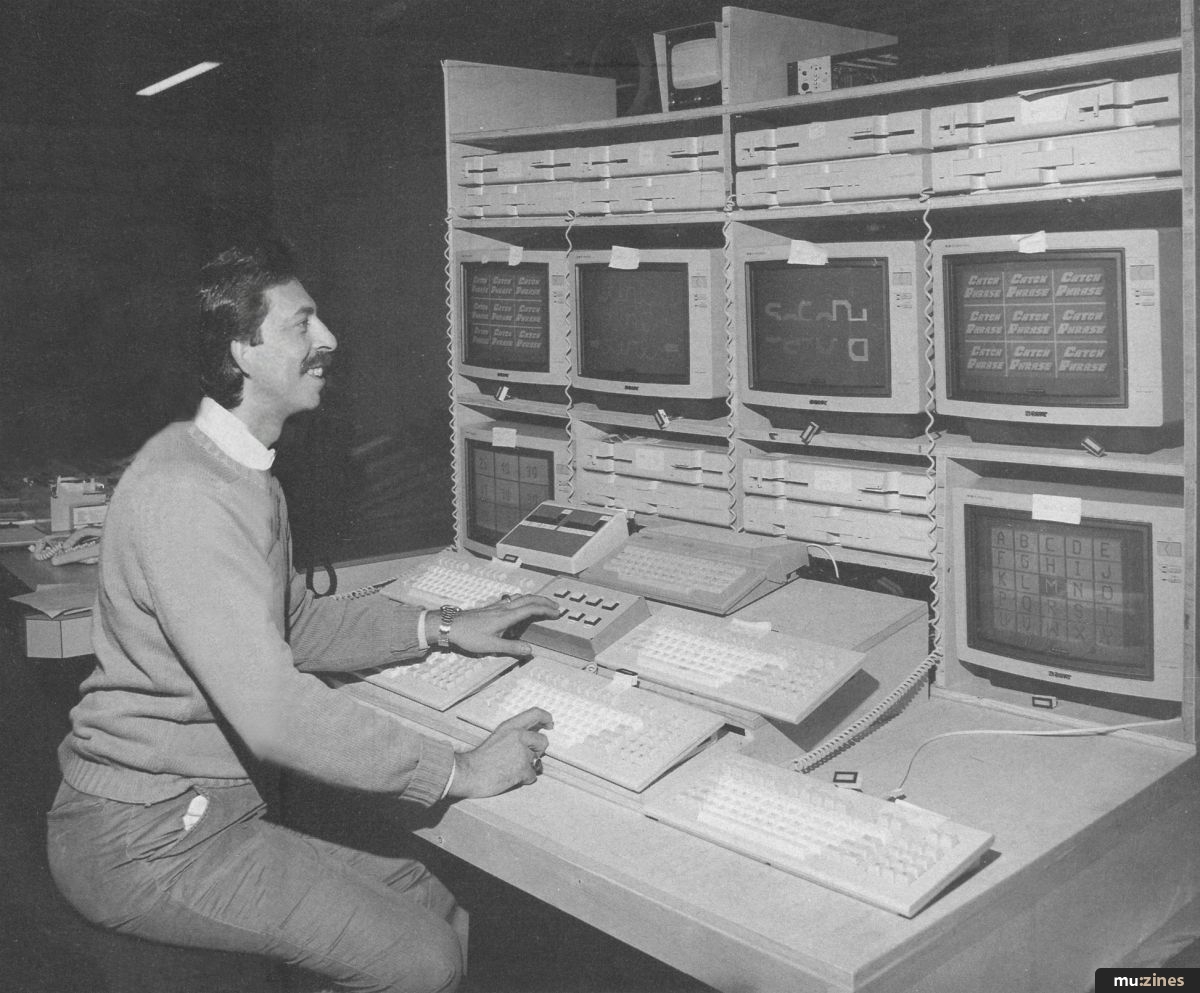
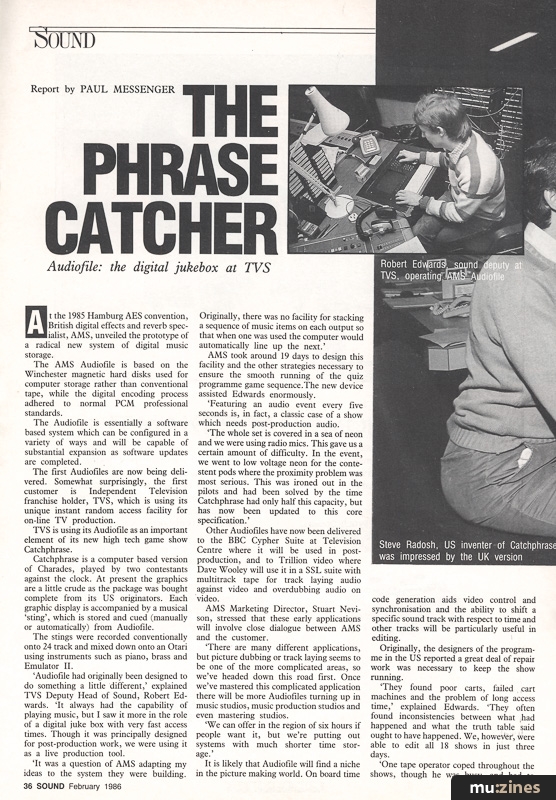
Steve Radosh, US inventer of Catchphrase was impressed by the UK version
At the 1985 Hamburg AES convention, British digital effects and reverb specialist, AMS, unveiled the prototype of a radical new system of digital music storage.
The AMS Audiofile is based on the Winchester magnetic hard disks used for computer storage rather than conventional tape, while the digital encoding process adhered to normal PCM professional standards.
The Audiofile is essentially a software based system which can be configured in a variety of ways and will be capable of substantial expansion as software updates are completed.
The first Audiofiles are now being delivered. Somewhat surprisingly, the first customer is Independent Television franchise holder, TVS, which is using its unique instant random access facility for on-line TV production.
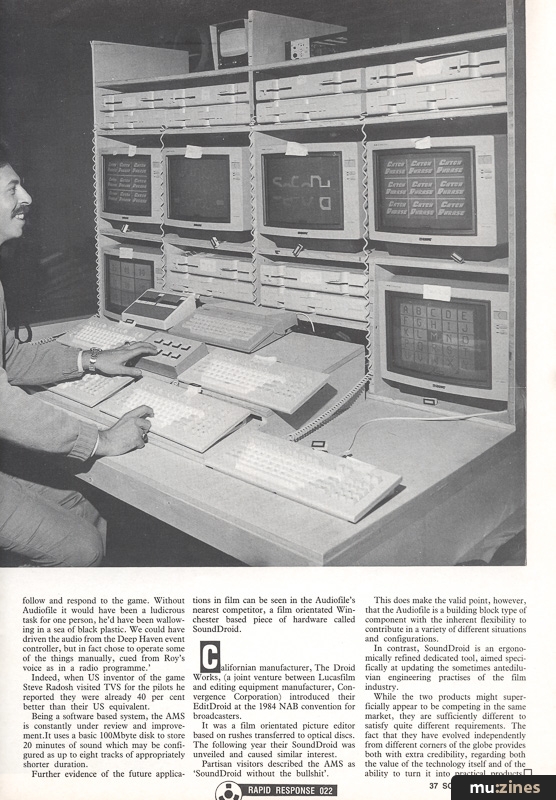
TVS is using its Audiofile as an important element of its new high tech game show Catchphrase.
Catchphrase is a computer based version of Charades, played by two contestants against the clock. At present the graphics are a little crude as the package was bought complete from its US originators. Each graphic display is accompanied by a musical 'sting', which is stored and cued (manually or automatically) from Audiofile.
The stings were recorded conventionally onto 24 track and mixed down onto an Otari using instruments such as piano, brass and Emulator II.
'Audiofile had originally been designed to do something a little different,' explained TVS Deputy Head of Sound, Robert Edwards. 'It always had the capability of playing music, but I saw it more in the role of a digital juke box with very fast access times. Though it was principally designed for post-production work, we were using it as a live production tool.
'It was a question of AMS adapting my ideas to the system they were building. Originally, there was no facility for stacking a sequence of music items on each output so that when one was used the computer would automatically line up the next.'
AMS took around 19 days to design this facility and the other strategies necessary to ensure the smooth running of the quiz programme game sequence. The new device assisted Edwards enormously.
'Featuring an audio event every five seconds is, in fact, a classic case of a show which needs post-production audio.
'The whole set is covered in a sea of neon and we were using radio mics. This gave us a certain amount of difficulty. In the event, we went to low voltage neon for the contestent pods where the proximity problem was most serious. This was ironed out in the pilots and had been solved by the time Catchphrase had only half this capacity, but has now been updated to this core specification.'
Other Audiofiles have now been delivered to the BBC Cypher Suite at Television Centre where it will be used in post-production, and to Trillion video where Dave Wooley will use it in a SSL suite with multitrack tape for track laying audio against video and overdubbing audio on video.
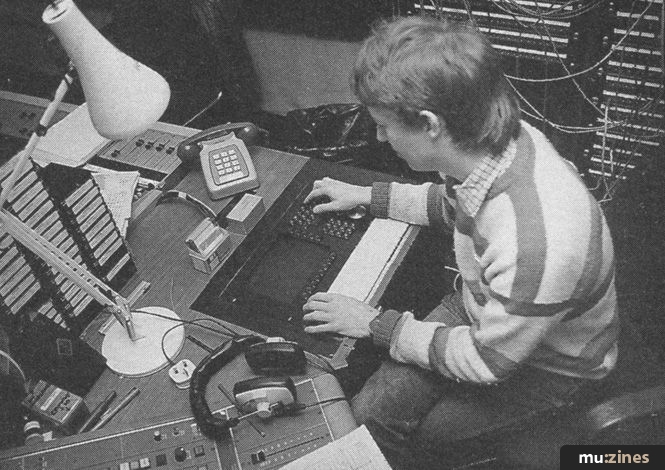
Robert Edwards, sound deputy at TVS, operating AMS Audiofile
AMS Marketing Director, Stuart Nevison, stressed that these early applications will involve close dialogue between AMS and the customer.
'There are many different applications, but picture dubbing or track laying seems to be one of the more complicated areas, so we've headed down this road first. Once we've mastered this complicated application there will be more Audiofiles turning up in music studios, music production studios and even mastering studios.
'We can offer in the region of six hours if people want it, but we're putting out systems with much shorter time storage.'
It is likely that Audiofile will find a niche in the picture making world. On board time code generation aids video control and synchronisation and the ability to shift a specific sound track with respect to time and other tracks will be particularly useful in editing.
Originally, the designers of the programme in the US reported a great deal of repair work was necessary to keep the show running.
'They found poor carts, failed cart machines and the problem of long access time,' explained Edwards. 'They often found inconsistencies between what had happened and what the truth table said ought to have happened. We, however, were able to edit all 18 shows in just three days.
'One tape operator coped throughout the shows, though he was busy, and had to follow and respond to the game. Without Audiofile it would have been a ludicrous task for one person, he'd have been wallowing in a sea of black plastic. We could have driven the audio from the Deep Haven event controller, but in fact chose to operate some of the things manually, cued from Roy's voice as in a radio programme.'
Indeed, when US inventor of the game Steve Radosh visited TVS for the pilots he reported they were already 40 per cent better than their US equivalent.
Being a software based system, the AMS is constantly under review and improvement. It uses a basic 100Mbyte disk to store 20 minutes of sound which may be configured as up to eight tracks of appropriately shorter duration.
Further evidence of the future applications in film can be seen in the Audiofile's nearest competitor, a film orientated Winchester based piece of hardware called SoundDroid.
Californian manufacturer, The Droid Works, (a joint venture between Lucasfilm and editing equipment manufacturer, Convergence Corporation) introduced their EditDroid at the 1984 NAB convention for broadcasters.
It was a film orientated picture editor based on rushes transferred to optical discs. The following year their SoundDroid was unveiled and caused similar interest.
Partisan visitors described the AMS as 'SoundDroid without the bullshit'.
This does make the valid point, however, that the Audiofile is a building block type of component with the inherent flexibility to contribute in a variety of different situations and configurations.
In contrast, SoundDroid is an ergonomically refined dedicated tool, aimed specifically at updating the sometimes antediluvian engineering practises of the film industry.
While the two products might superficially appear to be competing in the same market, they are sufficiently different to satisfy quite different requirements. The fact that they have evolved independently from different corners of the globe provides both with extra credibility, regarding both the value of the technology itself and of the ability to turn it into practical products.
More from these topics
 MIDI Futures at the BBC |
 Down the Tube |
 Getting into Video (Part 1) |
 Talking Pictures |
 Four soundchecks in one day... - Later with Jools Holland |
 Overtones |
 Film Bluff |
 On Video - Hi-Fi Video |
 So You Want To Be A... - Video Producer |
 On Video - Electric Productions |
 The Python and the Redwood Stage - The Producers |
 Ostenders |
Browse by Topic:
Digital Audio Workstations
Video / Film / Picture
Publisher: Sound Engineer and Producer - Media Week Ltd.
The current copyright owner/s of this content may differ from the originally published copyright notice.
More details on copyright ownership...

Sound Engineer and Producer - Feb 1986
Donated & scanned by: Mike Gorman
Feature by Paul Messenger
Ads for Gear in this article:


Help Support The Things You Love
mu:zines is the result of thousands of hours of effort, and will require many thousands more going forward to reach our goals of getting all this content online.
If you value this resource, you can support this project - it really helps!
Donations for July 2026
Issues donated this month: 0
New issues that have been donated or scanned for us this month.
Funds donated this month: £0.00
All donations and support are gratefully appreciated - thank you.
Magazines Needed - Can You Help?
Do you have any of these magazine issues?
If so, and you can donate, lend or scan them to help complete our archive, please get in touch via the Contribute page - thanks!
If you're enjoying the site, please consider supporting me to help build this archive...
...with a one time Donation, or a recurring Donation of just £2 a month. It really helps - thank you!

 @mu_zines
 RSS Feed
 Blog
Blog