


Magazine Archive
Home -> Magazines -> Issues -> Articles in this issue -> View
The Shape Of Things To Come | |
Article from Sound On Sound, May 1986 | |
Time again to peer into the crystal ball to find out what new products will be appearing over the next few months.
More software from Steinberg Research is available in the shape of the EP1 EPROM version of the Pro-16 MIDI Sequencer reviewed last month.
This latest software release is housed in it's own MIDI interface and as before is designed to run on the Commodore 64 or 128 computer.
Further items from Steinberg include the EP2 which is similar to the EP1 but with the addition of the TNS Scorewriter software; the MIDI Matrix, which is a four into eight way MIDI routing box; and the AP Pro-16 which runs on the Apple IIe.
And finally, due for release in May is the Steinberg 24-Track MIDI Sequencer software for the Atari 520ST computer. So everyone who bought the computer because it had a built-in MIDI interface will now have some software to run on it! In the meantime, additional information on the other items is available from UK distributors, (Contact Details)
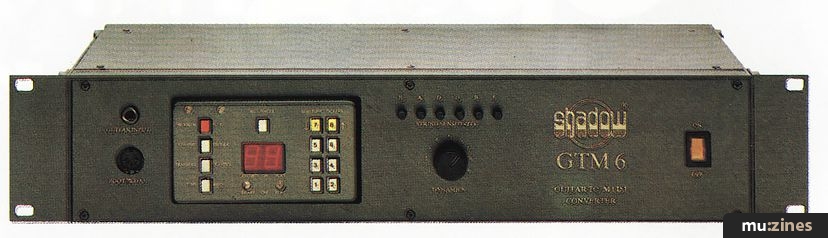
If you play guitar and you're fed up of working with keyboards all the time, then take a look at the Shadow GTM 6 guitar-to-MIDI converter, or alternatively the GTM 4 bass guitar version.
Housed in a rack-mounted unit, the GTM 6 takes pitch signals from the special hexaphonic pickup you attach to your own guitar and converts them into MIDI control data. Once in this domain, the GTM 6 opens up a whole field of control possibilities either through direct playing or via its internal sequencer which has a 1000 note storage capacity. (Contact Details)
You may have thought that a pacer was a chewy mint and so did Audio Kinetics until they christened their latest product with that very name.
From the company that gave us the widely used Q-Lock comes the Pacer Synchroniser - yet another example of how top-end studio technology is starting to filter down to a level and cost that makes SMPTE the buzzword of the moment.
Designed as a two machine synchroniser for use with audio and video equipment, the Pacer comes as a standard 1U rackmounted unit. The usual 24, 25 and 30 fps SMPTE code standards are available plus Frame-lock, Auto-lock and Phase-lock facilities.
Additional function controls are provided by the optional remote control unit, the Pacer Pad, which offers further features such as numeric timecode read-out, drop-in/out memories, offset time display and much more. (Contact Details)

As part of their latest ES range, Sony have introduced a variety of products which include a number of speakers, compact disc players, tuners, cassette decks and amplifiers. However, as space is limited, we can only mention a couple of units this month.
The TC-K444ESII (snappy name that!) is a quality stereo cassette deck which employs the latest Sony technique for reducing modulation noise to a minimum and, together with the special attention paid to the signal amplifiers and separate Dolby B & C circuitry, Sony feel that the new deck will offer a superior audio performance.
Also in the range is the TA-F222ESII (even catchier name that one!) stereo amplifier which boasts a 120dB dynamic range and in the words of Sony, is 'digital ready'. I think that means you can play compact discs through it!
Technically speaking, the amplifier delivers 120 watts per channel into 6 ohms with a 20Hz to 20kHz bandwidth and provides input source selection switches for two cassettes, phono, tuner, CD and video, together with bass and treble controls. Details on the whole ES range of products should be available from any local Sony hi-fi dealer.

When the final mix is over and every member of the band is shouting for a copy of the tracks to play in the car, the end of a tiring day just seems to get a little further away for the down-trodden tape-op.
If you're in that position then take heart, for Graff Electronic Machines have just introduced the ideal solution in the form of the GEM Sapphire high-speed cassette duplicator.
The Sapphire is aimed at studios who require quick, on the spot, copying without any fuss. It offers stereo copying at eight times normal speed and gives fast, quality results we're reliably informed, one tape at a time. (Contact Details)
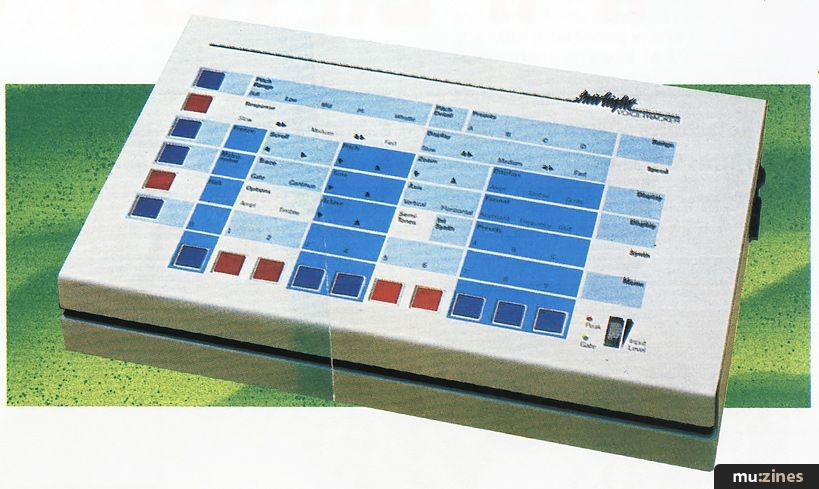
The idea of capturing pitch information and using it to control synthesizers is by no means a new one, but what is new is the Fairlight Voicetracker.
Fairlight reckon they've cracked the perennial mistracking problem that plagued previous manufacturers' attempts to produce voice control devices with this stand-alone unit that incorporates state of the art 32-bit microprocessor technology.
The Voicetracker instantly analyses any monophonic sound source for pitch, dynamics and timbre and converts it into performance data that allows you to play MIDI and/or voltage controllable CV synths. This enables instruments such as guitar, saxophone and more importantly the human voice, to expressively control MIDI equipment over a five octave pitch range. And for sound sources with poor intonation (ie. a bad singer!), a selectable quantisation feature is also included to correct the pitch to the nearest semitone. So if you can't play an instrument but can whistle the melody for a song, with the Voicetracker and a synth there's nothing to stop you composing music!
Finally, you wouldn't expect Fairlight to miss a chance to include a visual display and you'd be right, as the simple connection of a video monitor or TV to the Voicetracker allows you to observe graphic representations of the sound as it occurs and, without the need for any further computer hardware. (Contact Details)

A modular rack effects system is often a vital space-saving solution when you're short of room or perhaps you're looking for a system that will grow with your future needs.
From Tantek comes such a system which has been steadily growing over a period of a year and now includes fifteen individual effects modules which may be selected at will and housed in a mother rack which contains the system power supply.
The most recent module to join the ranks is the Digital Sampler-Delay and this offers up to 1.4 seconds of user-sampling time at 15kHz bandwidth, extending to 8 seconds at a reduced bandwidth.
Once a sound has been sampled, front panel controls enable both ends of the sound to be trimmed and then looped as desired. (Contact Details)

If you're one of those people with a somewhat less than ideal budget, then maybe Time Machine has a product for you.
There are currently three units in their range with more on their way, and all are housed in this year's fashionable half rack width cases, as popularised by Roland in their Micro-Rack effects system.
Of immediate interest to all, irrelevant of budget size, is the Microamp. This compact power amplifier operates in either a stereo 25 watt per channel or mono 75 watt mode and is most suitable as a small talkback, headphone or near-field monitor amplifier.
The Activator from Time Machine, is described as a stereo psychoacoustic enhancer that puts the presence back into a dull sound and, as they say, restores clarity and detail.
Finally, the DI Compression Gate is a mono signal conditioner suitable for both live or studio applications and includes a compressor with fixed attack time and variable release, a noise gate with both variable attack and release, plus a direct injection box. (Contact Details)
Publisher: Sound On Sound - SOS Publications Ltd.
The contents of this magazine are re-published here with the kind permission of SOS Publications Ltd.
The current copyright owner/s of this content may differ from the originally published copyright notice.
More details on copyright ownership...

Sound On Sound - May 1986
Donated by: Gavin Livingstone
News
Help Support The Things You Love
mu:zines is the result of thousands of hours of effort, and will require many thousands more going forward to reach our goals of getting all this content online.
If you value this resource, you can support this project - it really helps!
Donations for June 2026
Issues donated this month: 0
New issues that have been donated or scanned for us this month.
Funds donated this month: £0.00
All donations and support are gratefully appreciated - thank you.
Magazines Needed - Can You Help?
Do you have any of these magazine issues?
If so, and you can donate, lend or scan them to help complete our archive, please get in touch via the Contribute page - thanks!
If you're enjoying the site, please consider supporting me to help build this archive...
...with a one time Donation, or a recurring Donation of just £2 a month. It really helps - thank you!

 @mu_zines
 RSS Feed
 Blog
Blog