


Magazine Archive
Home -> Magazines -> Issues -> Articles in this issue -> View
The Traditional Approach | |
Dave HutchinsArticle from Home & Studio Recording, November 1986 | |
Dave Hutchins compares the traditional and modern methods of recording.
Producer/Engineer Dave Hutchins says a few words about his career and his recording methods.

Dave Hutchins has had a chequered career. His first contact with the recording business started in the early 70s as a tape-op at Basing Street Studios, but his first major success was his involvement in 1974 with Genesis' The Lamb Lies Down on Broadway working with the Island mobile studio. After various other projects in the UK, Dave was enticed over to Germany to be House Engineer at Conny Planks' studio in Cologne. During his association with Conny, Dave engineered Devo's Are we not men?, co-produced Systems of Romance for Ultravox, and worked on live albums for Styx and the Average White Band whilst they were on tour in Germany. A visit to America to engineer on a Helen Schneider album at The Power Station and Electric Lady land resulted in an album which went gold in Germany.
Having turned freelance, Dave has since worked with Camel (at the Riverside in London), engineered A Flock of Seagulls' Listen at Conny's with producer Mike Howlett, and produced albums by Bullet and Cacuman for EMI and Dieter Dierks (of Scorpions fame). CV over, let's take a look at how the man works.
In Real Life
Over the years, you must have developed your own preferences for recording techniques. How would you describe the 'Dave Hutchins sound'?
I much prefer to go for what I call a real sound. When recording drums, for example, I would normally use at least four ambient mics at various positions round the room as well as those used for close miking the kit. These would all be recorded on separate tracks to keep all the options open until the final mix.
How about when you are working with drum machines?
Well, for me there's no substitute for a good drummer, but it could be said that sometimes there's no substitute for a good drum machine. Electronic drums tend to lack ambience, so I often feed stereo-panned drum machine tracks through studio monitors in the live room, positioned to represent the layout of a drum kit, and then use several ambient mics to liven up the sound. Drum machine cymbals always seem to lack the tone-colour and zing of real cymbals, not to mention the variations in sound normally caused by the drummer's technique, so I tend to overdub real hi-hat and cymbal parts.
"I always try to get the sound from the instruments and not with EQ."
I did an album with American percussionist Michael Ranta, which was a 'Tubular Bells' type of concept using only percussion instruments. There was a lot of pre-production work for the album. Although Michael had the ideas clearly laid out, he played all the instruments himself so we ended up using all 48-tracks, with lots of bar counting and clock watching. It was interesting to learn how to record unusual percussion instruments ranging from giant Tibetan temple gongs to banks of eight Celtic drums, each two or three feet in diameter. These drums are tuned by damping the skins down with water and they had to be retuned before every take, so it was imperative to have a bucket of water and a d-cloth close at hand!
Before recording vocals, Dave likes to experiment to find the microphone which suits both the singer and the track best.
For rock tracks, I sometimes end up using a Shure SM57 or SM58 because they sound slightly more harsh than the 'obligatory' Neumann U87 and they tend to add a presence which cuts through a raunchy backing track. For a quiet ballad on the other hand, I use an old Neumann tube mic which tends to add a certain body and warmth. I suppose it's a bit like valve amplifiers which tend to sound better when they've been used for a while. The tube mic seems to take about 20 years to mature.
I like to live record as much of the backing track as possible in one go, including vocals. Quite often the singer has been unable to better the original take, possibly because of the lack of feel and adrenalin without the band playing. I then have the opportunity to repair or replace the vocal track if necessary.
"Systems like the Fairlight and the Synclavier have become a vital part of the industry. The problem is that it is a full time job keeping up-to-date with the technology..."
How do you feel about the use of EQ and effects during recording?
I always try to get the sound I want from the instruments and not from applying excessive EQ. I would prefer to spend a couple of days getting the sound rather than tweak the EQ or add effects. When I was doing a track for Matt Bianco at the Sound Mill in Buckinghamshire, we recorded one guitar part with an amplifier outside in the woods. I'd walked around and found superb echoes coming back from the trees and so I used a combination of close-miking and ambient mics to capture the sound. For me, EQ can make a good sound great but not an average sound good... like the silk purse and the sow's ear.
Synthesisers, sequencers and MIDI are, by his own admission, not Dave's forte, although he sometimes uses sequencers to provide a click-track with more feel.
Systems like the Fairlight and the Synclavier have become a vital part of the industry. The problem is that it is a full time job keeping up-to-date with the technology, so I usually call in a professional programmer who'll be able to dial up the sounds more quickly than I could. There again, I wouldn't expect a programmer to know how to mic a drum kit.
Having worked in many different studios, what do you consider to be the most important feature that you look out for? Have you any preferences for mixing desks?
Obviously a good 'live' room is very important for me. My favourite desks are SSL and 5000 series MCI desks for no other reason than that they are well tried and tested, and I know my way around them. It can be a problem sometimes when you go into a new studio which has a desk that you aren't familiar with, particularly if an assistant from the studio isn't available to help out. I try to go in a day or two early to learn the desk and patching arrangements, and also to check the sound of the studio and the control room. Of course this isn't always possible if the studio is busy. I always take along my own NS10 monitors, and check the control room with familiar tapes to get a feel for the sound.

"I've seen a notice on a studio wall which says 'What do you want — analogue heaven or digital hell?'"
A Changing Industry
With the advent of digital recording and the compact disc, surely recording techniques will have to change? How do you view the analogue versus digital debate?
I've seen a notice on a studio wall which says 'What do you want analogue heaven or digital hell?' The quality of digital has to be heard to be believed, but people are used to the warmth of analogue recordings. As far as multitracking goes, both systems have their merits. Digital multitracks still have a few problems to be ironed out, not to mention the format battle, and you can't hack it around to construct a song as easily as you could, say with a 24-track tape. Conversely, it seems slightly perverse that analogue recordings are being released on compact disc because the CD system allows you to hear all the inherent noise and dirt from the analogue recording.
How does the music industry in Germany compare with the UK?
In terms of general pressures, I've found Germany to be much more relaxed. With the major studios in London, there tends to be a great deal of pressure which is often not conducive to creativity. Although some people need to feed on the buzz of city life, I prefer to work in more rural studios like Farmyard, the Manor and the Soundmill, and to work for as long as it takes to do the job well.
As far as the industry itself is concerned, I've been involved with some interesting projects with bands in the 'Deutche Welle' - new wave with German lyrics. It is good because it's given a lot of young bands the opportunity to record their material rather like the indie labels in England.
What about your plans for the future?
Although I'm earning a good living and I've produced albums that have done very well in Germany, I'm planning to move back to England this year. I want to get more involved in production work. I'm still looking for the one project that I can say I'm happy with in its entirety. Often I play an album that I've worked on, cringe a bit and think 'nice couple of tracks but it could have been better'. I'd still like to do a film soundtrack: something with huge string and brass sections.
Have you any advice for the the budding engineer or producer?
Yes. It's not a glamour industry, and the one thing you do need is ambition. In Germany, you can go to college and come out as a 'Tonmeister', but still lack the experience. Though not as easy to get into as it was, I think it's better to start out as a tape-op and learn the hard way by doing an apprenticeship for a year or two, preferably working with good producers!
Publisher: Home & Studio Recording - Music Maker Publications (UK), Future Publishing.
The current copyright owner/s of this content may differ from the originally published copyright notice.
More details on copyright ownership...
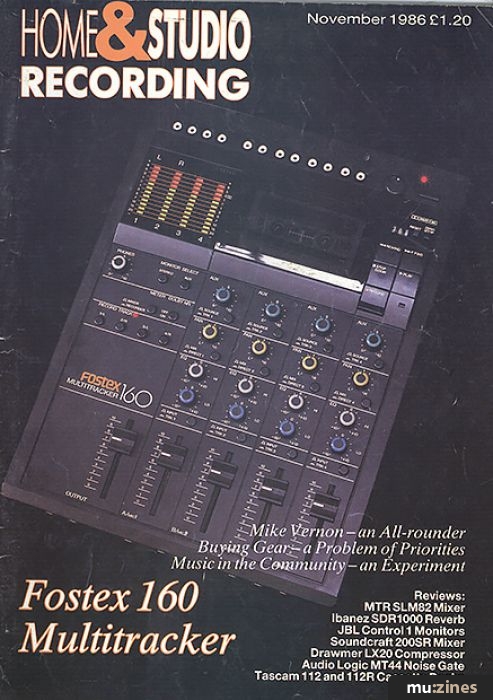
Home & Studio Recording - Nov 1986
Donated & scanned by: Mike Gorman
Interview by John Moores
Help Support The Things You Love
mu:zines is the result of thousands of hours of effort, and will require many thousands more going forward to reach our goals of getting all this content online.
If you value this resource, you can support this project - it really helps!
Donations for May 2026
Issues donated this month: 0
New issues that have been donated or scanned for us this month.
Funds donated this month: £0.00
All donations and support are gratefully appreciated - thank you.
Magazines Needed - Can You Help?
Do you have any of these magazine issues?
If so, and you can donate, lend or scan them to help complete our archive, please get in touch via the Contribute page - thanks!
If you're enjoying the site, please consider supporting me to help build this archive...
...with a one time Donation, or a recurring Donation of just £2 a month. It really helps - thank you!

 @mu_zines
 RSS Feed
 Blog
Blog