A3 (Thompson Twins)
(12T Jan 84)


Magazine Archive
Home -> Magazines -> Issues -> Articles in this issue -> View
Article Group: | |
Track Record: The Thompson Twins | |
Thompson TwinsArticle from International Musician & Recording World, January 1986 | |
Bailey and Betteridge get together for a banter
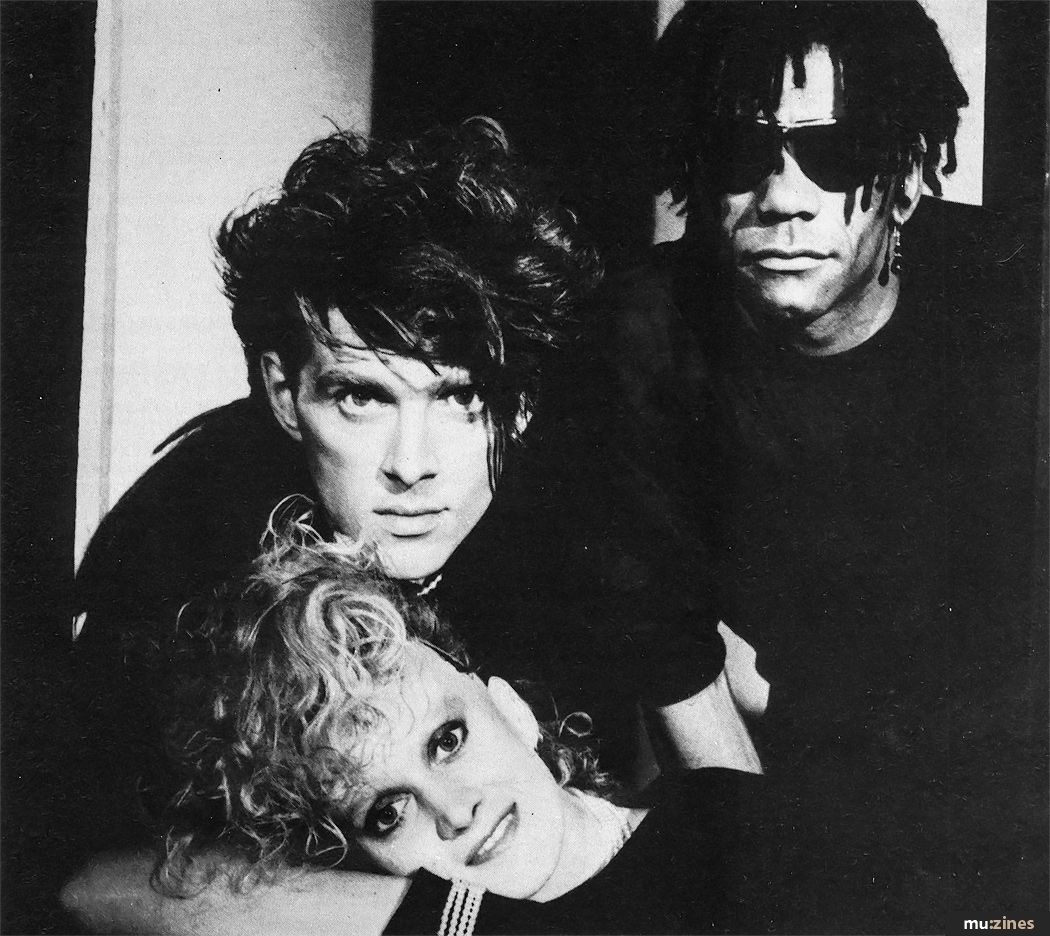
That famous Thompson Twins trio
PRODUCER: Tom Bailey/Nile Rodgers
BAND: The Thompson Twins
TRACK: King For A Day
Tom Bailey describes the making of The Thompson Twin's latest single.
"Whenever we start an album there are usually several obvious contenders for a single, but then there's also sometimes the complete outsider that grows in the studio and turns out to be 'The One'; so I like to take the approach of making everything as good and potentially punchy as possible.
"The three of us always write together and although I take the official responsibility for production, Alannah and Joe are obviously involved at each stage. We have a small eight-track system with an Otari tape machine, an Allen and Heath desk and quite an extensive system of outboard processing equipment, because we use a lot live on stage. We use that for demoing and working out ideas, and with past albums I've generally liked to take the eight-track into the studio, transfer the demo onto the 24-track and work from that. With this album, though, I created the basic arrangements of the songs with a Movement drum machine and a Fairlight synth and took those into the studio instead.
"The way I write songs is something akin to an artist doodling with a sketch pad. I mess around with ideas using the Fairlight until sooner or later something exciting comes up, and it's at that point that I start to try and make it into a song. With King, I'd been playing around with some very muted, staccato guitar samples which I'd arranged in a kind of poly-rhythmic sequence with a series of chord changes, and it was that which led to the writing of the song.
"Both the Movement and the Fairlight will synchronise to SMPTE time code and so the first thing was to record time code from the SRC (SMPTE Reading Clock) onto the multitrack so that the two can be recorded in sync. Altogether the drums and the Fairlight sequences probably took up about 10 tracks which included other textural synth sequences and a melody line to show roughly the vocal. It's a very good way of working, because even if you don't use all that stuff, it gives an architect's drawing, if you like, from which the house is built. Once in the studio, I'll sometimes change the voicings of certain of the Fairlight tracks or perhaps perform them again to give a different feel, or sometimes a whole new stream of ideas will take over completely. In the case of King, for instance, the original poly-rhythmic sequence is hardly in evidence at all. It's very likely that the final result will have changed or grown substantially from the original idea, otherwise all that time spent in production wouldn't [text missing in original article]
"I use the Movement as opposed to any other machine simply because I've had one for so long and so I know it well, although the original Movement sounds were all replaced long ago with new samples recorded to my own specifications. I think in this business people tend to go with what they know because what's most important is your ability to articulate fluently through the machine, and only familiarisation can allow that. So, I'm a little bit behind with drum machines at the moment, but the Linn 9000 is definitely tempting me to experiment.
"We livened up the snare sound by playing back the recorded Movement snare through a small speaker placed next to a real snare drum in a large room, and recording the effect. In that way we got the ambience of the room and the rattle of the real snare. The tom sounds were a combination of the sampled sounds in the Movement and a Simmons SDS-9.
"Having transferred the Movement and Fairlight to tape, I put down some keyboard parts to make the thing sound solid, using the Oberheim OB-Xa which is generally my workhorse synth. If it's possible, I generally like to get a proper vocal track down early rather than leaving it until the end. In this case we completed all the vocals at that early stage although actually we did later change the chorus around during the second stage of the recording.
"The album was recorded over two separate periods of time in two different studios. We recorded the majority of the backing tracks at Marcadet Studios in Paris, and then finished off the overdubs and mixed it at Skyline Studios in New York. When I talk about the 'second stage' I mean the work that we did at Skyline. During the first stretch Nile (Rodgers — co-producer) wasn't involved and I was taking full responsibility for production as well as playing and writing as a member of the band. I really enjoy that level of involvement, but it is very strenuous and time consuming because you can never get away. It was at that time that my health was really starting to suffer and everyone was saying that I should get someone in to help me with production. I finally became very unwell and so we had a break from recording and I took some time out in Barbados to recover. I really didn't want to farm out the production to anyone else, but it was during that period that I met Nile in New York and found that we really got on as far as creative ideas went, and so I thought, 'Why not?'.
"At Marcadet we were using a 3M 32-track digital recorder which was very difficult to use and continually breaking down. By the time we moved to Skyline we'd used more than 24 tracks and so we had to lock-up two of their Sony 3324 digital 24-tracks for the transfer. The Sonys were great; they were very easy to use, never broke down and the lock up time (the time taken for the two machines to achieve accurate synchronisation from a standing start) was not more than one-and-a-half seconds.
"Something I learned very quickly about Nile is that he is primarily a musician, and a significant part of his contribution was as a guitar player. I did a lot of the milder stuff but I lack flexibility of style and all the distorted guitar parts throughout King were down to Nile. He played an ESP Eclipse, with a distortion pedal called 'The Rat', through a Seymour Duncan amp. We weren't really into anything complicated as far as mikes went, we just put a Shure SM57 in front of the amp, mixed that with a DI feed, and did the rest in the control room.
"One of the things about working with the Thompsons is that I always like to leave a good amount of room in the original arrangement for percussion, because I know that we'll want to do some. Alannah has a huge collection of percussion instruments and most of those sounds you hear on the record are acoustic rather than sampled. The castanets on King are actually one of a whole crateful of cheap, tourist things that Alannah brought backfrom Spain, and which she prefers for their bright tone against the various more professional models that she has to choose from.
"The brass parts were multitracked on the Fairlight, and I was very pleased with how real they sounded (I'd already mentioned that I had thought they were real — JB). I guess I can always get a job as a brass section if it ever comes to it!
"We did a lot of experimental vocal things using 16 or more tracks to create a big sound and then mixed them down. The mix was then sampled into a Synclavier and used wherever it was needed. Throughout King you can hear odd bits and pieces of vocals coming in and out as we played with ideas. We generally used an AKG 414 mike for vocals.
"By the time we mixed we'd used a lot of tracks and it took a couple of days, although the process was a fairly straightforward one without any highly sophisticated tricks. We put some life into the drum tracks by playing them back through a miked-up speaker in the lift shaft at Skyline and adding the ambience to the original sound. Otherwise it was simply a matter of taking a lot of care over each part as we came to it."
More with this artist
 |
 All For One and One For All (Thompson Twins) |
 Thompson Twining (Thompson Twins) |
 Ask Thompson (Thompson Twins) |
More with this topic
 Track Record: Lessons In Love |
 Tracks - Detailed track by track analysis of top albums and singles |
 Track Record: Stan Ridgeway |
 Tracks - Marillion - Kerouac |
 Bill Price - Jesus and Mary Chain - Darklands |
 Track Record: Brilliant Mind |
 Tracks - A producer's breakdown of top albums and singles |
 Tracks - Detailed track by track analysis of top albums and singles |
 Track Record: Lean On Me |
 Tracks - A producer's guide to top albums and singles |
 Track Record: Rain or Shine |
 Track Record - Kayleigh |
Browse by Topic:
Classic Tracks
Publisher: International Musician & Recording World - Cover Publications Ltd, Northern & Shell Ltd.
The current copyright owner/s of this content may differ from the originally published copyright notice.
More details on copyright ownership...

International Musician - Jan 1986
Recording World
Feature by Jim Betteridge
Help Support The Things You Love
mu:zines is the result of thousands of hours of effort, and will require many thousands more going forward to reach our goals of getting all this content online.
If you value this resource, you can support this project - it really helps!
Donations for August 2026
Issues donated this month: 0
New issues that have been donated or scanned for us this month.
Funds donated this month: £0.00
All donations and support are gratefully appreciated - thank you.
Magazines Needed - Can You Help?
Do you have any of these magazine issues?
If so, and you can donate, lend or scan them to help complete our archive, please get in touch via the Contribute page - thanks!
Please Contribute to mu:zines by supplying magazines, scanning or donating funds. Thanks!
Monetary donations go towards site running costs, and the occasional coffee for me if there's anything left over!

 @mu_zines
 RSS Feed
 Blog
Blog