


Magazine Archive
Home -> Magazines -> Issues -> Articles in this issue -> View
Vigier Memory Guitars | |
Article from One Two Testing, December 1983 | |
Guitar, bass and memory review.

An £1100 instrument has to possess a very BIG selling point — the Vigier's is the fact that its control settings can be written into 19 different memory locations, recalled at will, edited and replaced, and generally manoeuvred around. Naturally enough, this all requires a barrage of knobs and switches to sort out, and although the initial reaction when faced with a Vigier programmable is one of gentle bemusement, the system does actually make sense once you come to terms with the layout.
On the instrument itself there are eight rotary knobs, four flickswitches and a number of associated LEDs (five on the bass, six on the guitar). That's not all. There's a mains-powered footswitch, too, with one switch on the back to turn the instrument electronics on, and two foot-operated switches on the top which control the sound coming from the footswitch's jack socket: on the left an on/off; on the right a momentary cut-off.
Nearest to your right hand on the guitar is a big round knob which selects the 19 memory locations, and nearby is a little plastic triangular thing that displays the numbers 1 to 19 in green LEDishness. The angle of this visual display has been chosen with the standing, strapped-on person in mind, and seems reasonably visible, though strange lighting conditions (not exactly unknown to us beating musicians) might pose a problem or two here. A hand snucked over the triangle improves things no end.
Between the knob and the triangle is the volume rotary, and further back a master volume. Balancing the two can give you overload effects, more useful on guitar than bass.
Nearer the bottom of the instrument is a pickup balance rotary with a single flickswitch and LED nearby to give (on the bass) in or out of phase, with the addition on the guitar of single coil or humbucking switching (and another LED).
Down below are the four rotaries, single flickswitch and two LEDs which govern the eq facilities, combining to give parametric control. What you get is a pair of parametrics in effect, with two knobs each to select the frequency, and to boost the sound at the selected frequency. Flick the switch for narrow bandwidth rather than the normal wide setting, thus tightening the focus of the frequency knob. LEDs off mean normal wide band, LEDs on mean narrow band, together giving all the possibilities through on/off combinations.
Towards the end of the guitar are the controls which allow you to put the sound obtained from the control settings into one of the 19 memories, and to recall the sounds once they're there.
There's a little 'mode' flickswitch, and an LED to let you know what's going on: off, the instrument's in manual mode, which is to say you can fiddle with it and pretend it's an ordinary (!) guitar; on, you can select a memory number with the big knob and recall the settings written there; flashing, the memory's in 'edit' mode, ready for you to write in new settings.
A larger, lockable flickswitch, well out of harm's way, normally stays in the 'up' position.
To write into a memory position, you have first to call up the number of the memory you want to write into, and set the 'mode' flickswitch to edit (ie flashing LED). Then you set up your sound — fiddle, fiddle, curse, curse, fiddle, fiddle, ahhh — and when you arrive at the sound you want to memorise, unlock the big flickswitch and push it down, then back up again straight away. The LED at the 'mode' flickswitch will now stay on, and your new sound is indeed stored at the assigned memory position. Simple, pal.
As well as the Cannon socket on the edge of the guitar to take the footswitch lead, there's also a conventional jack socket on the front of the guitar or bass. This gives an untreated, single-level sound, unaffected by any of the guitar or footswitch settings. It's presumably there for when the electronics decide to give up on you, or for giving a straight sound when you're searching through the memories for the right number — otherwise you'd get a different sound at each click, which would sound odd. The 'effected' sound could be lost while you're doing this thanks to the momentary switch on the footswitch.
Price
Oh, and there's a so-called 'peak LED' near the volume knob, too. But during our review sessions with the Vigiers we saw no evidence of light actually being emitted. Perhaps we were peakless. Perhaps not.
VIGIER six string
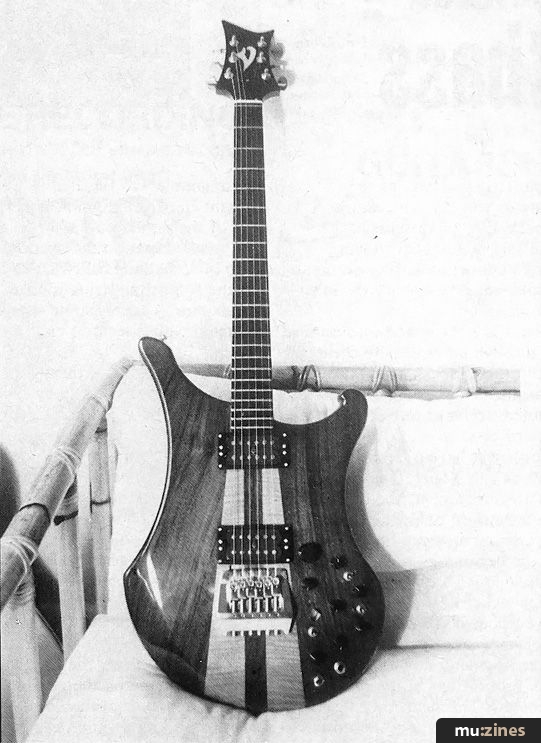
You buy actives... you expect to get your ears burnt. Onboard eq guitars have an exaggerated view of the world — the treble is sharper than a knife, the bass is bigger than a drum. You don't pay this sort of money for realism, you want everything larger than life.
In that respect the Vigier's set of dual parametrics is a runaway success. Having two of these devices slotted into the walnut woodwork lends this French six string the ability to create opposition. It's possible to have electronically padded low notes and blistering top end, all at once, or take out unwanted bass frequencies yet preserve a sparkling middle.
In that sense, the tonal palette offered by the Vigier is vast but it's full of 'created' sounds, and though the six strings can perform some staggering tricks, they are artificial and you lose a certain degree of comfort for the ears. It's a tough, hard bitten so and so, and even though I was surprised at what the next tweak of a control knob could produce, I couldn't help thinking that a lot of the curt and snappy sounds might be better suited to a bass than a six string.
Even before you reach the rotary control that locates the 19 memory positions, the rest of the Vigier's switches are aimed at speedy setting up. Each of the toggles has a dual function. For example, the first you encounter alters the phase and the tappings of the pickups.
Push it down and an LED lights to show the coils are in phase; push it down again and the LED blinks out, confirming the pickups are now out of phase. Flip the same switch upwards and another gleaming status light pronounces the pickups are in humbucking mode, press it upwards a second time and the pickups swap to single coil.
So you could leap from a humbucking coil in phase set up to a single coil out of phase selection by pushing one switch up then down in a single flowing motion. Even if programmability is beyond them, there are many other guitar companies who ought to examine this form of electronic switching.
Physically the Vigier is heavy but well balanced as the so called 'Delta metal' brass-ish sustain strip which runs under the phenolic fingerboard spreads the load evenly across the guitar. The heel-less neck glides effortlessly into the body and is both slim and fast, though the frets need a touch more care as several of the 22 were beginning to lift from the fingerboard.
Okay, so the electronics are pricey, but part of the cost must be down to the motherlode of gold that finds its way to the machines and the massive bridge. At first this bridge looks diabolical, if not impossible to use. The strings settle into forks at the very front then travel underneath the saddles before doubling back on themselves and heading towards the zero fret and Schaller machines. How the hell do you fit a new one? Closer examination reveals that each of the saddles is on an axle so will hinge upwards for easier access. Unusual, clever and robust certainly, but it does subject the string to some very sharp angles which will invite extra wear and threaten to fracture the windings. But the bridge can't be faulted on its remarkably solidity and, in collaboration with the trapezoid shaped through neck which spreads out into the body, it certainly seems to boost sustain and doubtless contributes towards the Vigier's overall brilliance.
If there were changes to make I'd recommend a looser master volume control so you could bow with your little finger, and some way of stepping through the programmes on a footpedal, then your hand need never leave the strings. Talking about footswitches, the Vigier's could do with a couple of lights. I spent two minutes checking amp, lead, volume controls and speakers before realising that the indicator-less output switch was off, disconnecting the guitar from everything around it.
VIGIER bass

And so to four strings. Here, as the bassists among us will confirm, active electronics make a lot more sense.
In fact, the sort of sounds you can draw from the parametrics sitting on the Vigier are wide enough to satisfy the most catholic of sonic tastes.
Perhaps you'd like the sound of a bass guitar going through an extremely cheap transistor radio three blocks away? You would? No problem. Or a boomy, deep bass solid enough to make dub sound trebley? Piece of piss.
But you don't just have a flexible active control set-up on this Vigier. The real advantage of the instrument, the bit you'd be paying about a third of the already high price for, is the memory function, explained at the beginning.
The bass itself looks a bit like an angular Rickenbacker in shape, with a very attractive trapezoid through-neck — in other words, it tapers from a wide piece of wood at the body end down to ordinary neck proportions at the other (naturally enough). This leads to a claimed increase in sustain, and because the bridge is, thanks to the shape of the through-neck, totally contained on the neck, it's conceivable that this improvement is there. But it isn't provable, of course.
Our sample was finished in white with pleasant contrasting gold stripes along the edge of the neck's outline.
A 'new-design' bridge on the bass is made of something called Delta metal, and the serpentine string journey involved (see six-string) means some sharp angles, but again would seem to end in increased sustain. Good!
French through and through, the Vigier's pickups are made by Benedetti. While they look a bit odd — a sort of plastic 'table-top' cover sitting over exposed single-coil windings — the sounds available are smooth, clean and dynamic, helping the parametrics do their job by presenting a good sound to get working on.
Gold has been generously chucked over the hardware — Schaller machines, supplied strap-locks, and so on.
Playing this bass was for me a joyful experience even before I began to play the memory game. True, the fingerboard was a bit buzzy here and there, which the extreme high-ends available can accentuate to annoyance level, but generally — sucker for actives though I may be — the Vigier played and responded well.
The frets are fat, the neck comfortable and by no means slim — dot markers are on the top — and the whole object sits accurately on a strap. In fact the rather dreadful logo on the headstock is totally out of keeping with the overall tastefulness of the instrument.
Back to our memories. You'd have to be well into sound changes to use 19 different settings in one go — and after all, this idea is geared up wholeheartedly to live use. That's where you'd need flick-of-a-switch sound changes of this diversity, and it's obviously to this end that the control package has been designed.
Better, I suppose, to have too many sounds than too few available.
And with this bass there's a lot of everything. Perhaps too much for everyday use, but Vigier are evidently aware that the appeal is limited (as are chaps wandering around with 1100 green ones tucked in the pocket). That appeal may be further diminished by the relative unfamiliarity of the instrument, given our natural conservative leanings (small c, I assure you).
But many points go to Vigier for attempting such an intelligent development of guitar sound control. As for pound notes...
Publisher: One Two Testing - IPC Magazines Ltd, Northern & Shell Ltd.
The current copyright owner/s of this content may differ from the originally published copyright notice.
More details on copyright ownership...

One Two Testing - Dec 1983
Donated by: Colin Potter
Review by Paul Colbert, Tony Bacon
Help Support The Things You Love
mu:zines is the result of thousands of hours of effort, and will require many thousands more going forward to reach our goals of getting all this content online.
If you value this resource, you can support this project - it really helps!
Donations for May 2026
Issues donated this month: 0
New issues that have been donated or scanned for us this month.
Funds donated this month: £0.00
All donations and support are gratefully appreciated - thank you.
Magazines Needed - Can You Help?
Do you have any of these magazine issues?
If so, and you can donate, lend or scan them to help complete our archive, please get in touch via the Contribute page - thanks!
If you're enjoying the site, please consider supporting me to help build this archive...
...with a one time Donation, or a recurring Donation of just £2 a month. It really helps - thank you!

 @mu_zines
 RSS Feed
 Blog
Blog