


Magazine Archive
Home -> Magazines -> Issues -> Articles in this issue -> View
Washburn Bantam Bass | |
Article from One Two Testing, March 1984 | |
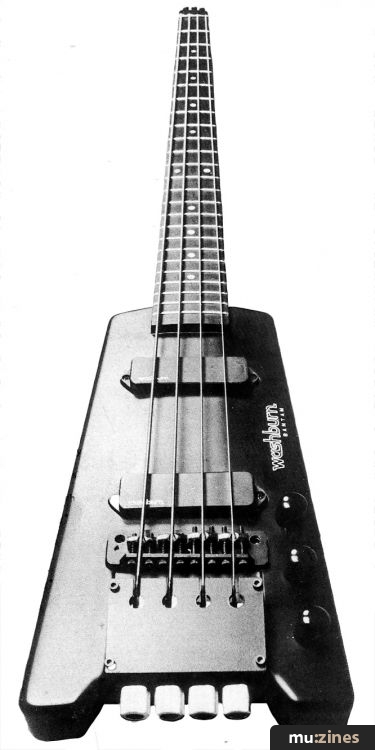
It's a topsy-turvy world — no doubts about it. At last the true Steinberger copy has landed. It's the same one you may have read about recently in a One Two oriental trade fair report, and comes complete with a padded leatherette carrying bag and a current choice of five colours. But contrary to general belief (hope?), Washburn's Bantam bass is made of wood, not moulded resin.
The change from the originally proposed brand-name of Riverhead to Washburn stems from a trading/import arrangement for the UK (writes our financial correspondent).
I'm not too clear on the rationale that produces a wooden copy of a carbon-graphite guitar; the concepts involved are in opposition.
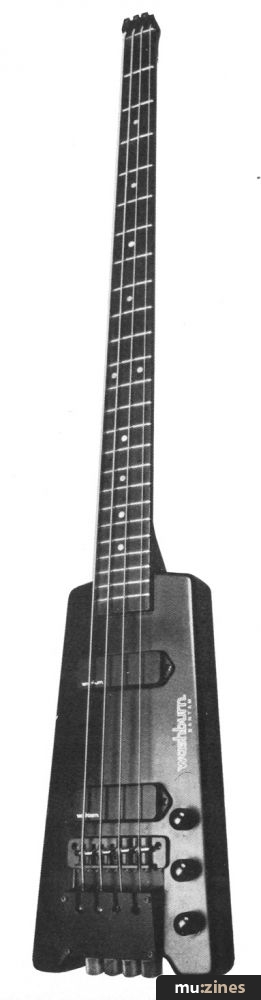
The surprising thing is that the Bantam looks, behaves and even sounds uncannily like a real Steinberger Bass, though naturally there are limits to this, some being more severe than others. Subtle differences in the shape of the bass only become noticeable when compared directly alongside the real thing.
Pickups, on the other hand, and hardware (such as the bridge/tuner and the nut/string-anchor) are not modelled quite so closely on their expensive counterparts, but at first glance, and especially regarding the review instrument, which was black, the Bantam is, visually, a dead-ringer.
The swivelling "chest-plate" — as found on the Steinberger too — enables the player to strap the thing on. The Bantam omits the knee-rest attachment, so it's impossible to play without using a strap. Being only slightly lighter than the Steinberger, the guitar behaves in exactly the same way as regards closeness and balance, giving complete freedom to play with ease. The "chest-plate" is comparatively flexible, which is OK, but I think that the technique of fixing it to the body with a single screw and a couple of washers could be "improved" as well.
I liked the three knobs with their knurled sides and domed tops, although their control over tone and volume was indecisive, with a sharp rise in output only in the last quarter or so of rotation. In fact the circuitry, unlike the Steinberger's, is passive, and upon inspection of the circuit-cavity is apparently simple enough to warrant no screening. The pickups are unspecified, so they may or may not be humbuckers — while electrical interference could be induced without much trouble, its effects were containable and shouldn't lead to any hum or noise problems.
The tuning/bridge assembly is not as compact as that of the Steinberger, and physically obscures the controls, as well as being studded with hand-shredders in the form of cover-screws. The tuners work stiffly though accurately. I'm not sure how much, if any, of the hardware is brass. The bridge itself is a block straddled by the more familiar type of string-barrel, each adjustable fore and aft by a pair of Allen-headed screws. String height is crudely adjusted by moving the whole bridge block up and down.
As far as I'm aware, the neck (this is a wooden guitar, remember) extends into the body up to the middle pickup, but no further. It isn't removable and there's no outward sign of the join.
Fretting is excellent, both in finish and intonation — fast and smooth to play and, with the neck even shallower than the Steinberger, is easy right up to the double octave top fret. There are no dead spots anywhere, so taking into account the fact that the neck doesn't run straight through to the bridge, the length of sustain (topscale in particular) and moderation of 'peakiness' across the fingerboard is impressive and certainly reminiscent of two Steinberger characteristics.
When all the controls are wide open, the sound of the Washburn Bantam does, against all the odds, resemble that of the Steinberger. In other words big, fat and piano-like — up to a point. Prolonged auditioning, though, only served to illustrate the absence of a real range of sounds other than this basic one, quite unlike the carbon-graphite original.
Interplay between the controls themselves and the pickup is, in the main, ineffectual and wishy-washy. Movement of one control has a tendency to interfere with its partner's output volume. The treble pickup sounds like the bass pickup with no bass, and vice versa — neither much use on its own, and together offering a very good but, for me at least, restrictive choice of tone.
The present range of colours is black, red, metallic blue, "lake placid blue", or metallic silver, and the Bantam's street-price will evidently be somewhat lower than the quoted retail figure. Assessed as an ordinary bass guitar, it is very compact, sports a decent neck, and includes a straight-pull tuning system.
Output quality is Steinberger-ish, but one-dimensional. The Washburn, however, is a blatant Steinberger copy, and as such its in-built contradiction of design and intention make it a paradox of questionabie value.
£549
Also featuring gear in this article
Publisher: One Two Testing - IPC Magazines Ltd, Northern & Shell Ltd.
The current copyright owner/s of this content may differ from the originally published copyright notice.
More details on copyright ownership...

One Two Testing - Mar 1984
Review by Andrew Bodnar
Help Support The Things You Love
mu:zines is the result of thousands of hours of effort, and will require many thousands more going forward to reach our goals of getting all this content online.
If you value this resource, you can support this project - it really helps!
Donations for April 2026
Issues donated this month: 0
New issues that have been donated or scanned for us this month.
Funds donated this month: £0.00
All donations and support are gratefully appreciated - thank you.
Magazines Needed - Can You Help?
Do you have any of these magazine issues?
If so, and you can donate, lend or scan them to help complete our archive, please get in touch via the Contribute page - thanks!
Please Contribute to mu:zines by supplying magazines, scanning or donating funds. Thanks!
Monetary donations go towards site running costs, and the occasional coffee for me if there's anything left over!

 @mu_zines
 RSS Feed
 Blog
Blog