
Economy Class
(IT Jan 85)


Magazine Archive
Home -> Magazines -> Issues -> Articles in this issue -> View
Yamaha SE200 and SE300 | |
GuitarcheckArticle from International Musician & Recording World, March 1985 | |
Do we really need more Strat copies? Dave Burrluck ponders the question
Does the world need another Strat copy? Apparently so. The new SE series of guitars from Yamaha are exactly that. Mind you Yamaha would have us believe differently, they would rather we looked on the SE's as scaled down versions of the BB bass guitar design, to which we all reply, "But where did that design come from?"
Oh well, whatever you think the SE series doesn't exactly come loaded with innovation but these new models are piled high with Yamaha's usual quality and start at a very reasonable price too. The present range features three guitars: the 200 and 300 (on review here) and the top of the line 450 which features an Alder body, Maple neck and looks (on paper) well worth its £289 price. Two new models will be added (probably by the time you get to read this) the SE700E, a similar design but with two single coil pickups, and a humbucker in the bridge position, and the SE700HE which will feature twin humbuckers and the same advanced tremolo system as fitted on the SG1300TS. Other features will include black hardware and bound bodies — very seductive!
Anyway back to the guitars in question. I believe I said that if I have to review another Strat copy I'd jump out of the window. Well, always a man of my word, this review was carried out in the back garden — thank Leo Fender I don't live in a tower block. Make mental note; adapt New Year's resolution to include buying a parachute!
SE200
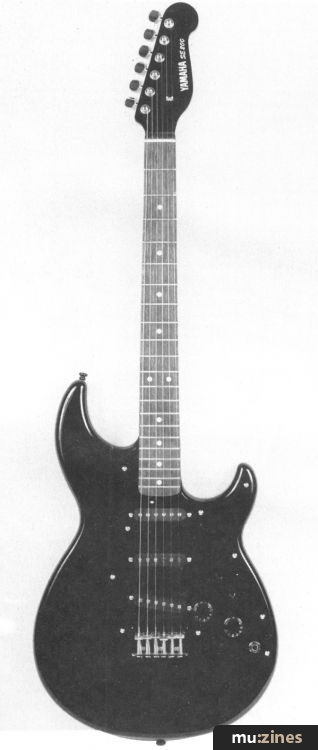
Not too original — but a nice one
Strat-like or not the body on this model is nice enough with its rounded lower bouts and extended upper horn. The body is apparently made from Nato and is left in slab form — without any contours — but with a good radius on the edges. I must be honest and say that I don't know a great deal about Nato as a timber — the cream white lacquer hides any glimpse — but it seems quite light, making the guitar very easy to manage and, despite the lack of body contours, fairly comfortable as well.
Nato is used again for the detachable neck; obviously very Fender in design. The shaping of the neck is good, reminding me of the earlier '70s Fender Telecaster profile, a little chunky but manageable nonetheless. Four screws hold the neck in place in the typical fashion although there is no neck plate. Instead each screw has a chrome 'cup' to stop it digging into the body and generally looking untidy. Certainly the neck/body joint looks tight and feels very stable.
The fingerboard is made from Buvinger which actually looks very similar to Rosewood. Timbers aside, the fingerboard is very nice; the camber seems flatter than a Fender and features white plastic dots on face and side. The fretting on this sample was excellent too with 2mm wire quite high but nicely shaped. A good final polish wouldn't have gone amiss but the price of the guitar means that these little luxuries are absent. With a 25½" scale length and 21 frets the neck is firmly in the Fender mould — while I've no objections to the scale an extra fret would have made quite a little bit of difference.
At the base of the neck is a small cover plate held in place with a single screw. This is in fact simply an access point to the truss rod adjustment — a neat and sensible idea. It's good also to see that the adjustment is at the base of the neck and that the scratchplate doesn't have to be removed to get at it. Interestingly this is probably the only innovation on the guitar and it's not exactly earth shattering!
If Yamaha weren't going for a Fender copy why have they included a bridge that is so obviously Fender inspired, and by today's standards very old-fashioned? The base plate is quite thin, chromed and held to the body with three rather puny looking screws. There are six rod-section saddles adjustable for height and intonation in the usual Fender manner. Each of the strings are anchored at the back of the bridge base and pass over the saddles in a rather indirect route. The problem is that the intonation screw and the string groove on the saddle are in lines, they should, of course, be offset, so that the string can pass in a straight line over the saddles.
The machines on the other hand seem very good, mini-Schaller copies that actually look like Gotohs. They work very well and certainly shouldn't let this guitar down.
There is only a single string retainer on the typically Fender head — on the E and B strings — and this leaves the G nice and high for behind the nut bends (as well as the rest of the strings of course). The non-trem bridge makes this kind of thing more practical, especially if you tune up to an open chord. You can achieve some good sounding harmonic and 'in chord' bends. Yamaha probably didn't plan this feature but the angle of the string break and absent G and D string retainer make the guitar ideal for this technique.
Well, the scratchplate and pickup layout needs no introduction — another feature that immediately says 'Fender Strat'. For the record the scratchplate is a single piece of black plastic (obviously going for the vintage look) with three single coil pickups featuring a master volume and tone and five-way selector switch. The switch is actually quite odd as it's a slider switch instead of the arched toggle type usually fitted. The position notches are quite loose to the touch and it's quite difficult to quickly move from, say, position two to three accurately because of the loose action. Mind you, the control knobs have an easy smooth action and are fitted with speed-type knobs with a slight ribbing for extra grip.
The 'Is it or isn't it' Test
Well, hardly the million dollar question. It sounds just like it should — a Strat copy. All the sounds are good with a wide tone range — out-of-phase sounds are extremely good. The guitar breaks up a bit (figuratively speaking) at high amp levels and it's also prone to a bit of microphonic feedback; probably a combination of the cheapish pickups and light body. The action was set a bit high on this sample but that all adds to the budget priced Fender feel, doesn't it. Still, at low levels the 200 certainly does produce the goods. The sustain was a bit lacking but again that suits the honky Fenderish sound. Not a great sounding guitar by any means, but respectable for the price. Certainly I couldn't really fault much on the guitar — I didn't like the toggle switch at all and with the volume reduced the guitar became rather muddy, but again that is to be expected. Generally though, a nice one.
SE300

Worth the extra few quid
At 40 quid more the 300 is a more attractive instrumental! round. Its also even more like the good old you-know-what! The body has the same shape, again made from Nato, but has body contours on the front and back. The front contour is extremely angular and doesn't blend in with the curved body at all, but we can't have everything I suppose. The neck is attached to the body with the usual four screws — this time, however, via a neck plate. While the neck is essentially the same design its actual shape is a lot better than the 200; more comfortable and not chunky in any way.
Rosewood is employed as fingerboard material here and while the camber, position dots and frets are all the same the frets themselves have received a final polish adding to the more upmarket feel of the neck.
The guitar is heavier than the 200 giving it a more business like feel — one can only think that the timbers, although the same, must be the next grade up-denser and heavier — but we also have a trem block and metal knobs adding to the weight as well.
The machine heads, headstock design and single string retainer are the same as the 200 although thankfully a better bridge is fitted, as well as being a tremolo assembly. The design is identical to the Strat with the old style pressed metal saddles.
Yamaha have gone for the more standard Fender layout for the electronics with the three single coil pickups and master volume, and tone controls for the neck and middle pickups only. The single coil pickups have staggered non-adjustable poles and alnico magnets — very vintage. The control knobs are chromed, dome and knurled metal jobs and this time a proper arched 5-way toggle is fitted which is much more satisfactory than on the 200. The jack socket is on the side of the guitar and all the other gubbins is mounted on a three ply-white/black/white laminate-scratchplate. With its metallic red finish the 300 certainly looks a good deal smarter than the rather dowdy 200 and, sounds apart, the differences warrant more than a £40 price gap.
Sounds
With the same amp settings as used to give the 200 the once over, the 300 has a noticeably more trebly characteristic. The whole thing sounds a lot more professional too. The pickups are a load better and marginally more powerful; they hold their clarity at higher levels and give a better tone all round. Obviously the whole thing performs as a Strat copy should and this guitar will give the Squier ranges and Tokai offerings a good bit of competition. The sustain was a lot longer on this sample too, probably a combination of the denser body timbers and heavier bridge/trem assembly. The trem itself hadn't really been set up properly in that only downward bends were possible as the bridge itself laid flat on the body. Action was smooth, and despite the new strings the tuning stability was quite good.
A minor point: the strap buttons fitted on this 300 were much better than the small affairs on the 200. I nearly came to grief with the 200 — only my super quick reflexes saved the guitar when it dropped off my strap.
Conclusions
Both instruments are well built but lacking that touch of originality. It is in the sound department and feel areas that the differences become apparent. The 300 is simply a far superior guitar in every respect and I would have expected the price difference between the two to be higher. At £229 the 300 is an attractive proposition; maybe the 200 should be more around the £169 price then that too would be more attractive.
There is no doubt that Yamaha can produce great quality guitars — these two prove just that — but I challenge them to produce something original and innovative and build up from the excellent S series.
YAMAHA SE200 and SE300 — RRP: £189 and £229 respectively
Dimensions:
| (In mm unless stated) | SE200 | SE300 |
| Scale Length | 25½" | 25½" |
| Width of neck at nut | 42 | 41 |
| Width of neck at 12th fret | 52 | 52 |
| Depth of neck at 1st fret | 22 | 21 |
| Depth of neck at 12th fret | 25 | 24 |
| String spacing at nut | 34 | 34 |
| String spacing at bridge | 55 | 55 |
| Action as supplied at 12th fret Treble | 1.5 | 1.5 |
| Action as supplied at 12th fret bass | 2.0 | 2.0 |
Also featuring gear in this article
Publisher: International Musician & Recording World - Cover Publications Ltd, Northern & Shell Ltd.
The current copyright owner/s of this content may differ from the originally published copyright notice.
More details on copyright ownership...

International Musician - Mar 1985
Donated & scanned by: Mike Gorman
Review by Dave Burrluck
Ads for Gear in this article:


Help Support The Things You Love
mu:zines is the result of thousands of hours of effort, and will require many thousands more going forward to reach our goals of getting all this content online.
If you value this resource, you can support this project - it really helps!
Donations for October 2026
Issues donated this month: 0
New issues that have been donated or scanned for us this month.
Funds donated this month: £0.00
All donations and support are gratefully appreciated - thank you.
Magazines Needed - Can You Help?
Do you have any of these magazine issues?
If so, and you can donate, lend or scan them to help complete our archive, please get in touch via the Contribute page - thanks!
Please Contribute to mu:zines by supplying magazines, scanning or donating funds. Thanks!
Monetary donations go towards site running costs, and the occasional coffee for me if there's anything left over!

 @mu_zines
 RSS Feed
 Blog
Blog