Drum Dragnet
(ES Dec 84)


Magazine Archive
Home -> Magazines -> Issues -> Articles in this issue -> View
UP-5 and K2X | |
DrumcheckArticle from International Musician & Recording World, March 1985 | |
Bob Henrit takes a look at two alternative brains for UP users

Same pads trigger both brains
Since the launch of their UP-5 sets last year, the Ultimate Percussion Company (nee Magic Music and M and A) have come up with an alternative 'brain'. It's called K2X and is more advanced, more comprehensive, and therefore more expensive. I seized the opportunity to do a real test on the cheap UP-5, and its 'brainier' brother; both at once and the same time.
By now, many of you will have heard of UP-5 and its reputation, but be unfamiliar with its analogue features. Each of its five channels has just an input, an output and a volume control. However, each channel is linked to something known affectionately as PPS (Preset Parameter Selection). This manifests itself as a series of three push-buttons which govern pitch, noise and decay. The basic sound is factory set, but you can change the parameters. This means you can increase the white noise by pushing that button in. It's the same with the other variables, simply push the button in to increase the effect. Believe it or not, these three buttons will give you eight different kit sounds. It isn't possible to change the sensitivity on UP-5, nor is it deemed necessary. (Controlwise you'll see lots of differences between UP-5 and K2X later).
UP-5's 'brain' measures 17½" x 3" x 2" and may be rackmounted with ears which the company will supply as an extra. It is totally dedicated, ie each channel can only be as designated: snare drum, bass drum, and toms one, two and three. There's a rotary potentiometer for the level of each instrument. Next are the three push-buttons for decay, pitch and noise and finally a mix output control and a button for mono or stereo channelling. (The stereo picture is pre-set and has tom one left; tom two, snare and bass centre; and tom three is placed on far right). The only other control on the front is an on/off rocker switch.
The back of the unit is very simple with five ¼" jack sockets for pad input and a stereo output socket for the mixed sounds which will also allow itself to be used by headphones. (This feature allows it to be used as a stimulating practice tool).
K2X has a much more comprehensive 'brain' which measures 17¾" x 12¼" x 1¼". Ostensibly it has exactly the same inherent sounds as UP-5 but with infinite variations. It has a factory pre-set for its six toms, snare and bass drum which can be slightly changed by adjusting level, sensitivity, pan and decay. These four functions are controlled by rotary potentiometers set in a vertical row for each channel. Below these are five more 'pots' which adjust the sounds on the manual side. (No prizes for working out that K2X has two separate sounds. A factory pre-set and a user programmable one). These latter controls are to do with bite (click), noise filter, balance of noise and VCO, pitch, and sweep. None of these channels are particularly dedicated, so you can change them into whatever your heart (or music) desires. A reasonable hi hat (although no Zildjian/Paiste) is possible with practice, so is a cowbell. Below these controls are a pair of push buttons. The first is coloured black and selects factory pre-set or not. The second is much more conspicuously tinted red and activates the pulse. This is a useful feature which allows you to work on the sound of each channel without having to hit the pad. It also has another function which I'll get to in due course.

K2-X — a more comprehensive brain
Mix and match
All the controls I've mentioned are laid out in eight vertical rows but to the right of them we find the mixer section. It consists of two rows of three buttons; the top pair are for level left and right, the next for treble left and right, and the next for bass. Directly below these is a single 'pot' which regulates headphone level. There's a rocker switch for the power which is internally illuminated. So far, the controls are pretty much the same as on the old Magic Music K2.
They've kept another feature from that old product too; the non-programmable micro sequencer. Its control knobs are situated just below the mixer section, and it's actually a bunch of rhythms which are switchable. There's a six position click-switch which selects the factory preset 'feels' and another 'pot' to control their speed. This particular feature is linked to the pulse of each channel which enables us to play along with the rhythm simply by pressing the red button. This is most useful for demos (or even master recording), since it allows the player to add fills in real time. It doesn't take long at all to get used to moving your fingers from red button to red button to play fills around the toms. Of course, you can also play the pads to achieve this. You could also use this facility to do a mindblowing drum solo!
I can't stress enough what a great feature this drum machine section is. It's perfect for practising too; in conjunction with the headphones it will allow the drummer to play along in perfect time, and develop this sense of polyrhythms. By the way, these patterns are eight beats long with a light to show the down beat, and the facility to switch between rhythms. This allows one to change the feel for the chorus or middle eight should one desire. The drum machine itself only actives the last three channels which are bass drum, snare and one other which one would normally setup as a hi hat.
The back edge of the unit, as per usual, has all the jack connections for the pads, etc. Each channel has a pad on trigger input as well as an output for itself, and at the very end we have mix output, left and right, as well as the aforementioned headphone socket. (Interesting things can be achieved by joining channels together to combine their sounds without affecting the originals). The only other feature of the brain to comment on is the fitting underneath to mount it on a mike stand or what-have-you. This is an optional extra available from Ultimate Percussion but, like the cheaper 'brain', K2X may be rack mounted or placed on a case.
The pads are identical for both brains. They're very thoughtfully made; each one has an ABS outer bowl with a steel frame inside it. Welded inside this frame we find a tube which accommodates the 'L' shaped splined rod from the tom holder on the spurs. It has a hank-bush joined to it at right angles and this takes the drum-key operated screw which may be tightened through the playing surface of the pad. This locks the spur or 'L' arm tight and suspends the pad. Two pieces of foam go in next which are shaped to fit inside exactly. The Piezo transducer is laid on top of this foam and a piece of double sided sticky tape holds it in the centre of the pad and joined to the free-floating playing surface. This consists of a piece of plastic glued solidly to a sheet of rubber. It simply lays flat on top of the foam and is held gently in position by a chromed inverted shaped piece of metal which runs all the way around the circumference and is riveted through the plastic bowl and its internal framework. The bass drum pad is more or less exactly the same as the others save for two square headed screws and a piece of right-angled aluminium joined to the botton to accept the bass drum pedal. This metal part has a pair of sharpened bolts tapped into it to further stabilise the bass drum. Each pad is fitted with an XLR socket and a lead is supplied.
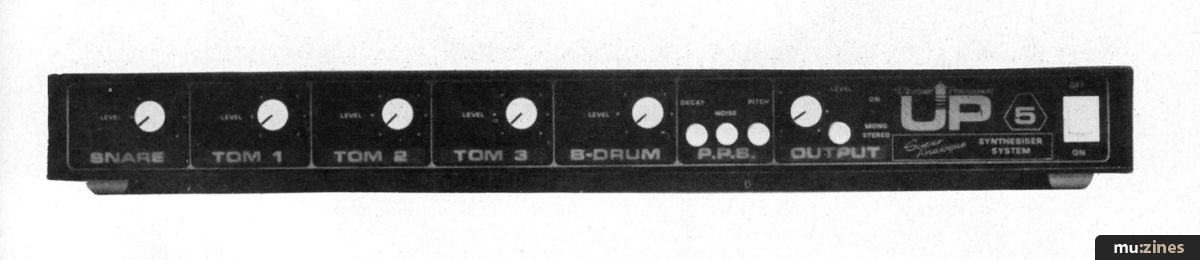
Minimum control for minimum outlay
No hex, please
The pads are six sided but not hexagonal. They actually resemble triangles with the sharp ends chopped off. The smaller pads started life as 12" triangles and are a couple of inches deep. The bass drum pads measure 18" from top to bottom and are 3" thick. A lot of thought has, I understand, gone into making these pads feel like an acoustic drum and to a degree the company have achieved their aim. (I don't believe the actual feel will be emulated until they stretch a membrane over a hollow chamber). Having said all this the bounce and playability of the head surface is very good.
Ultimate percussion's pads are designed to fit onto the sort of double tom stand which has a pair of 'L' shaped arms sticking out of the top. UP-5 can be supplied with Premier Tristar stands at an extra £55 although you may buy it without them and pick your own. The same applies for the K2X, but expect to spend about £25 per stand if you choose to get your own. You need two for a five drum set and the company can supply two extra long arms for the snare and tom three. These allow better positioning for those pads. While I'm on the subject, K2X's price includes bass drum plus four small pads, but the brain has eight channels. So, you can add pads later to increase the size of your set. A large pad lists for £118, a small one for £59, and a lead will cost you £7.
I was measured by the sounds emanating from both of the brains. They are absolutely superior to the old K2 sounds; thicker, richer and stronger. They have an aggressive edge now which wasn't there before. I understand that the company have gone to a deal of trouble to make them sound like acoustic drums. They will also sound very synthesized too if that's what you want. Certainly K2X has more than enough control to allow you to come up with your own sounds. I heard a sound which was as close as dammit to 'stick-across-the-rim' and of course, since the pads do have rims, you can actually play them close to real drum sounds is a subtle pitch change which occurs when you hit harder. It simulates accurately what transpires when a drum head is hit progressively harder.
Up until recently you really could only buy UP-5 in 'any you want as long as it's black'. Now, however, you can have white too.
Anyway, America is taking notice of the Ultimate Percussion sets and they're beginning to make their mark there, yet another British success story — hopefully. Their price in America is obviously a good selling point, but they deliver the goods too.
UP-5 & K2X — RRP: £499 & £853 respectively (not inc stands)
Also featuring gear in this article


Ultimate Percussion UP5 - Electronic Drum Kit
(EMM Dec 84)
Browse category: Drums (Electronic) > Ultimate Percussion
Publisher: International Musician & Recording World - Cover Publications Ltd, Northern & Shell Ltd.
The current copyright owner/s of this content may differ from the originally published copyright notice.
More details on copyright ownership...

International Musician - Mar 1985
Donated & scanned by: Mike Gorman
Gear in this article:
Review by Bob Henrit
Ads for Gear in this article:


Previous article in this issue:
Next article in this issue:
Help Support The Things You Love
mu:zines is the result of thousands of hours of effort, and will require many thousands more going forward to reach our goals of getting all this content online.
If you value this resource, you can support this project - it really helps!
Donations for October 2026
Issues donated this month: 0
New issues that have been donated or scanned for us this month.
Funds donated this month: £0.00
All donations and support are gratefully appreciated - thank you.
Magazines Needed - Can You Help?
Do you have any of these magazine issues?
If so, and you can donate, lend or scan them to help complete our archive, please get in touch via the Contribute page - thanks!
If you're enjoying the site, please consider supporting me to help build this archive...
...with a one time Donation, or a recurring Donation of just £2 a month. It really helps - thank you!

 @mu_zines
 RSS Feed
 Blog
Blog