


Magazine Archive
Home -> Magazines -> Issues -> Articles in this issue -> View
Doctoring The Dr. | |
Article from Electronic Soundmaker & Computer Music, October 1984 | |
An easy-to-follow project to fit separate outputs to your Dr. Rhythm to increase its versatility.
Jake Rothman shows how you can fit separate outputs to the ever popular Dr Rhythm.

At some point in their career, every musician has either come across or owned a Boss Dr Rhythm. A simple four-voice 16-memory drum machine, it has served as an introduction to basic programming for a whole generation of artists, from Thomas Dolby to New Order. Although the Dr 55 was replaced earlier this year by the Dr 110, it can still be found in some shops, often retailing for less than £50.
A common modification to the Roland TR606 Drumatix is fitting separate outputs for each voice. Many articles have appeared in the music press detailing this operation but no one has explained how to carry out this alteration to the humble Dr Rhythm. This is surprising as the sounds can be improved dramatically following this easy to carry out conversion. Anyway, here it is — now there is no excuse to allow your Dr 55 to continue to gather dust on the shelf.

Fig 1
Dismantling
Fig. 1 shows how the outputs of the bass drum, rim shot and hi-hat voices are disconnected from the main mixing buss and taken to the 5-pin DIN socket (for reasons of space, it is necessary to use a DIN output rather than minijacks). This means that the accent does not effect these outputs, this function being reserved for the snare. The accentuated snare output is taken from the end of C8.
To dismantle the Dr Rhythm, remove the Rhythm Select, Volume, Tempo, Tone and Accent knobs; take care, as the spindles are mounted directly on the PCB.
Using a Pozidrive screwdriver, remove the four screws on top of the Dr 55 casing and also the two on the reverse. Remove the battery panel and unclip the battery holder. The housing should now lift off.
The existing jack socket is removed altogether. It should be remembered that this has a power switch connection which turns off the power when a plug is inserted. This is replaced by bridging holes 2 and 3 (Fig. 2) on the circuit board. The earth connection for the replacement 5-pin DIN socket is taken from Pin 1. Pin 4 is no longer needed.
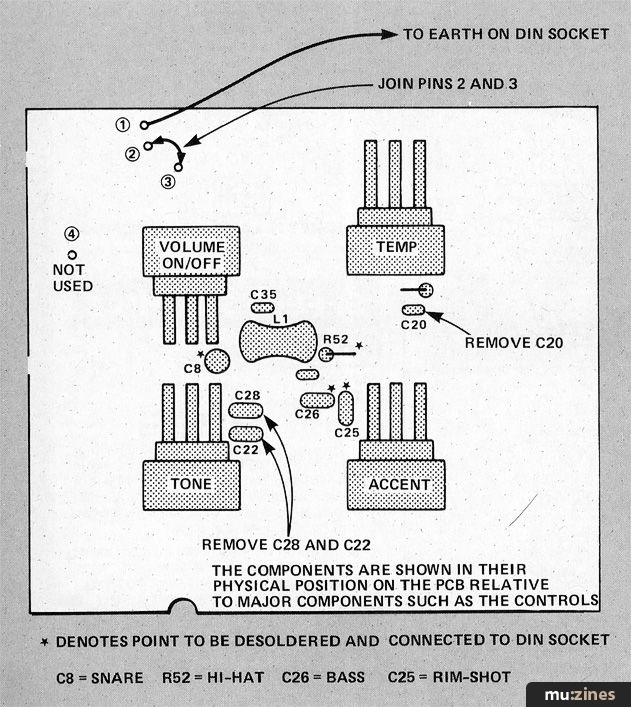
Fig 2
Next, remove C22 and C28, this is to prevent crosstalk between the snare and hi-hat. De-soldering braid should be used, as de-soldering tools can lift the track off the PCB. Then, to connect the separate outputs de-solder the specified end of the components (see Fig. 2), and attach a wire. This is run to the new output socket which is installed at the back of the left hand side of the Dr Rhythm. The existing hole where the original jack socket was situated should be filled.
It will be noted that the separate outputs render the Volume and Tone controls redundant, the sounds being processed via an external mixer. The Volume control now functions purely as an on/off switch.
If you do not own a mixer, a Portastudio such as the Tascam 244 can be used or alternately a simple 4-2 mixer such as the unit featured in February's ES&CM can be constructed.

Additional Modifications
A few other alterations can improve the Dr Rhythm's existing voices still further. The snare can be made crisper by removing C20 (5n6). This capacitor filters the higher frequencies of white noise which results in a somewhat old fashioned sound. Removal of this component restores the snare to its original more aggressive self.
The hi-hat can be tuned up by lowering the value of C35 or down by increasing its value to around 10nF. I changed it from 6n8 to 2n2.
It's surprising just how useful this little unit is, once you can process each voice separately. Lower hl-hat volume is the most obvious improvement — the original hi-hat volume setting always tended to overpower the other sounds. The rimshot, though unrealistic, becomes quite usable once a little reverb is applied as do the snare and bass when gated.
Listen to the recording on the tape, before and after the conversion was carried out. The beat goes on.
Parts List
Five pin DIN socket (180° Type)
Five pin DIN plug
4 x ¼" jacks, minijacks or phonos
Stranded hook-up wire
Screened wire for DIN lead
Warning
Tampering with your Dr Rhythm will invalidate your guarantee.
More with this topic
 Voltage-Controlled Clock for Analogue Sequencers |
 Frequency Divider - Turns Gnome Into "Super-Gnome" |
 Studio Project - Going Direct |
 Analogue Equipment Design - for Rock 'n' Roll (Part 1) |
 BeeBMIDI (Part 1) |
 Test Tone Oscillator |
 Technically Speaking |
 Voice Frequency to Voltage Converter |
 Studio Earthing Techniques - Interconnect (Part 1) |
 Lab Notes: The Polyphonic Synthesizer |
 Keyboard Matrix Interface For EK-3 |
 Experimenting With Analog Delay |
Browse by Topic:
Electronics / Build
Also featuring gear in this article


Browse category: Drum Machine > Boss
Publisher: Electronic Soundmaker & Computer Music - Cover Publications Ltd, Northern & Shell Ltd.
The current copyright owner/s of this content may differ from the originally published copyright notice.
More details on copyright ownership...

Electronic Soundmaker - Oct 1984
Donated & scanned by: Mike Gorman
Topic:
Electronics / Build
Gear in this article:
Drum Machine > Boss > DR55 Doctor Rhythm
Gear Tags:
Feature by Jake Rothman
Ads for Gear in this article:

Help Support The Things You Love
mu:zines is the result of thousands of hours of effort, and will require many thousands more going forward to reach our goals of getting all this content online.
If you value this resource, you can support this project - it really helps!
Donations for June 2026
Issues donated this month: 0
New issues that have been donated or scanned for us this month.
Funds donated this month: £0.00
All donations and support are gratefully appreciated - thank you.
Magazines Needed - Can You Help?
Do you have any of these magazine issues?
If so, and you can donate, lend or scan them to help complete our archive, please get in touch via the Contribute page - thanks!
Please Contribute to mu:zines by supplying magazines, scanning or donating funds. Thanks!
Monetary donations go towards site running costs, and the occasional coffee for me if there's anything left over!

 @mu_zines
 RSS Feed
 Blog
Blog