


Magazine Archive
Home -> Magazines -> Issues -> Articles in this issue -> View
Flash In Japan! | |
Charvel Model 4 & Model 6Article from In Tune, July 1986 | |
2 Charvels on test
Firm favourites on the American custom guitar scene, Charvel's much talked about US-designed, Japanese-made range has at last arrived. But can they live up to all that's expected of them? Gary Cooper tries two of the first samples in the UK.
I didn't even need to see the guitars to realise that something unusual was afoot. When a company spends as much money on producing a brochure as Jackson/Charvel have to launch their new guitars and basses it's pretty obvious that they mean business. Unless you collect literature on luxury cars, I'll bet you've never seen a guitar brochure like it, either. Charvel are obviously out to take over the top end of the Japanese-made guitar market, and they're in deadly earnest.
Most UK players will certainly have heard of Wayne Charvel's guitars, even if they've never played one. As custom models they've gathered possibly the longest endorsee list I've ever seen (Jeff Beck, Bryan Adams, Elliot Easton, Vivian Campbell, Allan Holdsworth, Jake E. Lee and Sammy Hagar just for starters...). But custom guitars are one thing: high volume production is another; so, having teamed up with Grover Jackson and renamed the outfit Jackson/Charvel, Jackson then went to the giant IMC of Fort Worth, Texas. It's under their auspices that this new range of Japanese-made Charvel guitars has evolved.
The line-up of non-custom Charvel guitars ranges from the Model 1 (RRP £259) up to the Model 6 (£739), and includes three basses ranging from £299-£569. I recently had the upper-mid level Model 4 and the flagship Model 6 to try. Would they be good enough to justify carrying the illustrious Charvel name?
CONSTRUCTION & SPECS: MODEL 4
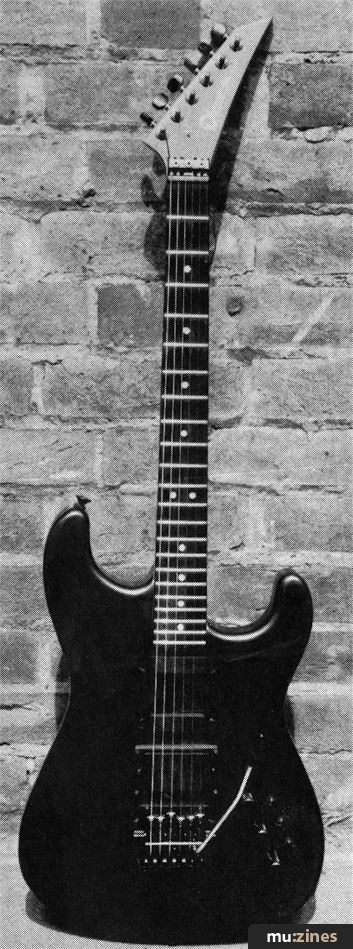
Bolt-on necked, the Charvel Model 4 is a really handsome guitar; especially when finished in the rich Cobalt Blue of my sample. More impressive still was the attention to detail which had gone into the manufacture and finishing of this guitar — frankly, 'immaculate' doesn't even begin to do it justice! Strat-like in shape and general feel, the Model 4 features a Basswood body, one of the materials increasingly encountered from Japanese makers. For the record, Basswood is a form of lime, similar in many respects to the Poplar used on early Fenders, so it promises to perform well. The neck, meanwhile, is of quarter sawn Maple, with a Rosewood fingerboard which is unusual in that it extends over the neck end, providing an extra (22nd) fret. It's almost as if the fingerboard end were suspended in mid air. The frets, however, are much more conventional. Perfectly profiled and finished, they're huge and fat silk-smooth to glide around on and affording supreme bending ease with maximum sustain. Yum!
The rest of the hardware, with the exception of the pickups, is more or less 'off the shelf. There's a full Kahler Standard trem with locking nut, and machines which are labelled Jackson but which are quite possibly Gotohs in drag. Nowt wrong with that, of course — Gotohs are excellent. As far as the Kahler is concerned I won't regurgitate my long-standing objections to locking nuts in general (slow string changing etc. etc.), nor is there much point in re-reviewing the Kahler for what would be the umpteenth time. They're so well known that you'll almost certainly have formed your own opinion by now. All I will say is that, while some objections to Kahlers might be reasonable from players who argue that they change the sound of a Strat, the Charvel isn't a Strat; it was designed to work with a Kahler and sounds right with one. If you like Kahlers then you'll like this.
On to the pickups. Here I was caught out being a right smarty-pants, by not reading the brochure thoroughly before I started playing. I just whipped the Model 4 from its case, plugged it into my Laney AOR valve combo and started playing. NOTHING betrayed the fact that this darned guitar was actively powered, and only when I re-read the brochure an hour or so later did I learn that the pickups on this and the Model 6 both had their circuitry driven from PP3 batteries! The pickups on both these Charvel models are identical, comprising J200 humbuckers in the neck and middle positions and a J50BC humbucker at the bridge. These and other Charvel pickups are soon to be available as individual parts, and if the types on my guitars were anything to go by, they have a good future. Pickup specification fens might care to learn that the J200 uses Alnico V magnets, whereas the J50BC has a ceramic type and is specially voiced to accentuate the highs. The three knurled metal rotary pickup controls are very sensibly positioned, and handle volume, passive roll-off tone and active mid-boost, this third pot delivering a 6dB boost @ 650 Hz. Three flick switches control pickup on/off functions, and that's yer lot — a simple, very usable set-up to have on stage.
CONSTRUCTION & SPECS: MODEL 6
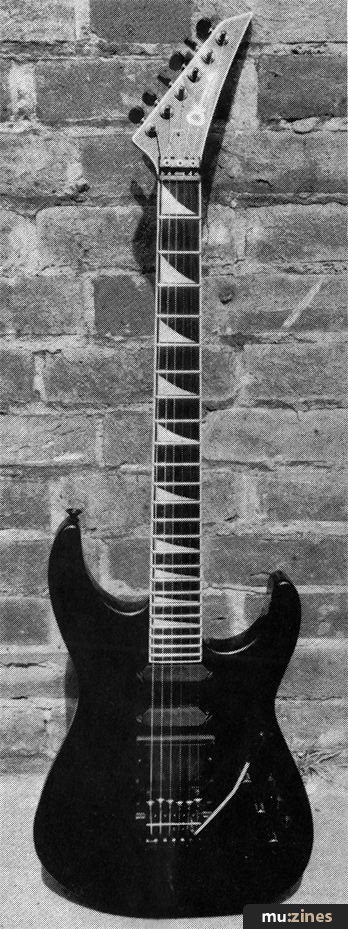
Although in hardware terms the much more expensive Charvel Model 6 is identical to the Model 4, the woodworking and construction is different in almost every respect. As you'd expect for the higher price, the 6 is altogether a more sophisticated guitar. The body, for example, is made of Poplar, and the neck is a straight-through type, comfortably heelless and made of Rock Maple. Like the 4, the 6 sample I borrowed from distributors JHS was beautifully finished. I can't say it was better, because I doubt if the 4's quality really could have been improved on, but it was certainly as well turned out — and that means very well turned out indeed.
The extra money spent on a Charvel Model 6 may buy you the same pickups, the same Kahler Standard and the same finishing quality as you get with the 4, but it also buys a far more luxurious construction, plus features like the elegantly bound Rosewood fingerboard and the 'wedge' position markers in place of the Model 4's dots. It also gains you more frets (24), and, because of the superb neck, every one of these is easily reachable.
PLAYING & SOUND
Although I admired the profile of it, I found myself fighting the feel of the finishing on the back of the neck when I began playing the Charvel 4. The neck's fast — very fast — with a nicely shallow 'U' shape, but the makers have chosen to matt finish the back, which, speaking personally, I find feels sticky and thus slower than I'd like. However, I must stress that other players mightn't agree with me, and you should certainly try this aspect for yourself. After all, matt finished necks are a pretty common feature on Japanese guitars (notably Ibanez) and don't seem to suffer as a result. That aside, the Model 4 was a really fine guitar to handle, the body balancing ideally and the neck perfect for fast, attacking playing.
Much as you'd expect, the Charvel sounded as hot as it looked. Having gone to so much trouble to get their build standard right, Charvel/Jackson were unlikely to fit rotten pickups, weren't they? The Model 4 is a true hard Rock guitar, capable of really forceful attack from the bridge humbucker, and yet with far greater tonal versatility than most such Japanese-made guitars, on account of the mid and neck pickups. In some respects these seemed more like single coil types than humbuckers at times, but that's not to fault them: on the contrary, most HM guitarists seem to love treble.
As I mentioned earlier, the fact that both these Charvels are active powered took me by surprise — although perhaps I should have guessed, as the mid-boost control does a good deal more than most passive controls. Yet there's none of that hideous 'elephant's fart' and 'dustbin lid with fuzz box gone wrong' sound from this circuitry, which is what has doomed so many active guitars in the past. No, the Charvels don't sound at all active — they're responsive, quite tonally versatile and not at all artificial.
Setting out to try the Model 4 with the Laney running clean, I was at first just satisfied with the sound, no more no less; but when I wound the amp up high it was a very different story! Here was a guitar that needed a bit of wellie to deliver its best performance — a true HM monster! Clip harmonics with your pick and you can play a spine-tingling squeal at every fret on the fingerboard, giving that definitive 'on the edge' sound which only the best guitars deliver right up and down the neck. Switch from the bridge pickup and there's an immediate volume decrease, but it's sensibly chosen and its purpose is to enable you to set your rhythm sound from the either or both of the other pickups and then throw-in some vicious, power-boosted overdrive for soloing. And that rhythm sound is really good. You can roll the mid frequencies either on or off for either a super-clangy chord sound or a fat chugging Blues tone. Add the extra sonic twist which you can chuck in courtesy of the Kahler, and you can easily see what has won Charvel their reputation.
Perhaps surprisingly, the Model 6 isn't as different from the Model 4 as you might expect. With different body wood and the straight-through neck, you might anticipate a different sound, but you'd be wrong. The body woods really are quite similar, and of course the pickups are identical. The 6 sounds slightly fuller than the 4, and sustains a bit longer, but the sound variations attract your attention less than the improvements you notice when playing the two models side by side. Obviously, a bound neck feels different to handle (a matter of taste, of course), and I also liked having the extra frets. More to the point for me is that the 6 has a high gloss finish on the back of its neck
THE VERDICT
Providing you like Kahler trems and don't object to matt finished necks, the Charvel Model 4 is one hell of a prospect for many other 'prestige' Japanese-made guitars to contend with. Forget the fact that it's active powered (guitarists are very conservative!) and just treat it as a guitar you'd shortlist for Rock/HM playing — perhaps alongside a similarly Japanese-made Kramer Focus, a top Westone, a premium Aria, a Fernandes or a similarly specced Ibanez. To me, the only one of these guitars that I've tried which can stand comparison is the Kramer, mostly on account of its Floyd Rose trem and its sound — not, I have to say, its finishing quality. In that area, the Charvel has all of them beat hands down. Having said that, £519 is a lot of mazumah, and you can get close to the Charvels for less money from Japan (albeit possibly not quite as well made and finished, and without such a prestige name on the headstock). Is the extra worth the extra? £519 is also getting close to what you can pay for a handmade British exotic — maybe a Jerry Bix Sheer Ptera (£555) or a Wilkes Extrovert (£480). Even a JayDee Hooligan isn't so far away, at £583 including a Floyd Rose trem. The Charvel Model 4 is good, make no mistake about that; but it's also expensive.
Moving on to the Model 6, this is obviously the better guitar of the two, and if money was no object we'd all waltz off and buy it without a thought for the 4 — it's nicer to play, beautiful to look at, and a wonderful guitar for sonic assassination of your audiences. Frankly, I loved it to bits! Against all that praise, however, has to be set an RRP of £739, which takes it way beyond other Japanese guitar prices and into the top rank of British made custom instruments. Yes, it's beautifully produced and finished, and it plays and sounds like a thoroughly professional guitar; but it may lack some of the character a pro looks for when spending this sort of money.
In the end, only you can decide if either of these new Charvels is worth its price. Buy one and you'll be getting a fine instrument, very possibly worth the extra in comparison with any other Japanese-made guitar, but maybe not such good value as some British-made instruments. To my mind, these are the choices. If the Charvels were just £100 each cheaper apiece, they'd be clear winners. As it stands, they have worthy challengers. But if a pure hard Rock guitar is what you really want, make a point of trying them. The sheer quality of these guitars may well seduce your wallet way beyond your powers of control. You have been warned!
Charvel Model 4 (RRP £519) & Model 6 (RRP £739)
More details on Charvel Guitars from John Hornby Skewes & Co. Ltd., (Contact Details).
Publisher: In Tune - Moving Music Ltd.
The current copyright owner/s of this content may differ from the originally published copyright notice.
More details on copyright ownership...

In Tune - Jul 1986
Gear in this article:
Gear Tags:
Review by Gary Cooper
Ads for Gear in this article:

Help Support The Things You Love
mu:zines is the result of thousands of hours of effort, and will require many thousands more going forward to reach our goals of getting all this content online.
If you value this resource, you can support this project - it really helps!
Donations for September 2026
Issues donated this month: 0
New issues that have been donated or scanned for us this month.
Funds donated this month: £0.00
All donations and support are gratefully appreciated - thank you.
Magazines Needed - Can You Help?
Do you have any of these magazine issues?
If so, and you can donate, lend or scan them to help complete our archive, please get in touch via the Contribute page - thanks!
Please Contribute to mu:zines by supplying magazines, scanning or donating funds. Thanks!
Monetary donations go towards site running costs, and the occasional coffee for me if there's anything left over!

 @mu_zines
 RSS Feed
 Blog
Blog