


Magazine Archive
Home -> Magazines -> Issues -> Articles in this issue -> View
Live Sound (Part 6) | |
Stage MonitoringArticle from Recording Musician, April 1993 | |
A practical look at on-stage monitoring for small and awkward gigs.
With bands becoming louder and venues becoming larger, stage monitoring has developed into a very complex science. Paul White looks at practical monitoring systems for gigging bands.
Pop music relies on a mix of normally incompatible elements — in an acoustic world, the vocalist and acoustic guitarist would be completely overwhelmed by the drum kit, for example. It's only since the advent of amplification that all these disparate elements have been brought together with no need to take account of their natural relative levels. In the studio we have no problem, because we can exercise absolute control over relative sound levels, but on stage there are still a few niggling difficulties. The electric guitar, bass and keyboard, for example, can all be amplified to any practical level to balance the drums, but there is a limit to how much amplification can be applied to vocals before feedback becomes a problem. And, because miked drums sound quite different to the unamplified kit, drummers also tend to go through the PA system for all but the smallest gigs.
To avoid vocal feedback under these kinds of conditions, it is necessary to design and operate the PA system so that as little sound as possible finds its way back to the vocal mic — which presents the vocalist with something of a problem. Now we have hundreds of watts of back-line amplification only feet away from a singer with an equivalent natural output of only a few watts. The outcome is that the singer can't hear him/herself and so tends to sing out of tune. This was exactly the situation at the end of the '60s; bands were playing gigs in large stadia with no foldback monitoring. Something had to be done, and the familiar wedge floor monitor was born.
The general principle behind a floor monitor is that if you position it in the 'blind spot' of a cardioid vocal mic, some of the vocal mix can be directed back at the singer without increasing the risk of feedback too much. Indeed, we looked at the setting up of such monitors in the last part of this series and concluded that a position behind the mic and to one side at an angle of around 45 degrees was about right. How well this works depends on what nearby walls and other obstacles are present to reflect the sound from the monitor into the vocal mic and also on the directivity of the monitor itself. There's little use in putting a 12-inch speaker in a box and then adding a cheap piezo-electric tweeter, because the directivity of the 12-inch driver will be reduced to a tight beam at the higher frequencies. Not only does this make it less likely to be heard from the singer's general position, it also increases the risk of a beam of high energy sound being reflected back into the mix. Though it costs more money, the only way to do the job properly is to use a monitor with an integral crossover and a decent high frequency driver. The usual system comprises a 12-inch driver complemented by a small horn-loaded high frequency unit driven from a passive crossover.
Even with a well-designed monitor, the risk of feedback is increased because an amplified version of the vocal signal is being directed back into the general vicinity of the microphone. Feedback will always start to build up at just one frequency where the various parameters of directivity, room resonance and system frequency response conspire to provide most gain. If you've applied any EQ boost to the vocal, then the boosted section of the audio band is especially vulnerable to feedback. The situation can be improved by using either a graphic or a parametric equaliser to apply cut in the frequency bands that are causing problems, but this relies on the expertise of the user for its success. More recently, companies such as Sabine have developed dedicated feedback suppressors which automatically identify the frequencies that are causing trouble and apply appropriate filtering.
For all this technology, the most important factor — other than the quality of the monitors — is where you put them, especially when working in small venues. From my own experience, I have found that in typical pub venues where there may be insufficient room for floor monitors to work properly, it can be more effective to use just a pair of monitors for the whole band and position these either on top of or just behind the main PA speakers, pointing backwards towards the opposite corner of the stage. This effectively catches the whole band in the crossfire, and because the distance from the monitors is greater than usual, the sound is better dispersed before it gets reflected. Figure 1 shows this setup.

Figure 1: Monitors behind PA speakers.
"With in-ear phones, it is quite possible to create very high sound levels, so special care must be taken over sensible monitoring levels."
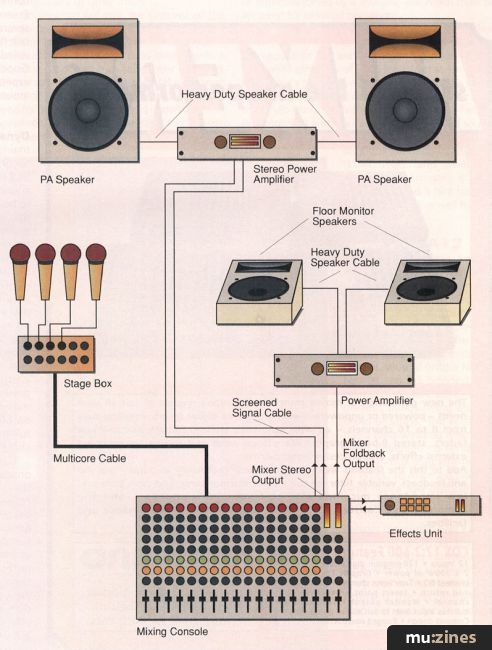
In a larger PA setup where all the band, rather than just the vocalist, has monitors, the setting up becomes a little more complex as not only do the vocal monitors have to be positioned to avoid feedback, everybody else's monitors have to be arranged so as not to direct too much sound into the vocal mic, or the overall vocal sound through the PA will be seriously compromised and the engineer will have less chance of setting up a workable balance.
Mini Monitors
Another approach is to use a much smaller monitor, still designed for good dispersion, and mount it on top of a mic stand very close to the person using it. These monitors are similar to miniature hi-fi speakers; something like a JBL Control 1 or equivalent would be ideal because of its small size, high power handling and robust construction. Mic stand fittings are available for these speakers, and several other manufacturers are now designing compact speakers in a similar physical format. Figure 2 shows how a stand-mounted monitor might be positioned. Though they lack the low bass response of large floor monitors, this is no disadvantage for vocals and may actually help by preventing unwanted low frequency sound being fed back onto the stage area. Again, in very small venues, this type of speaker can also be placed behind the main PA speakers and directed back towards the performers. The small physical size of the speakers makes them easy to position precisely, and I have used this system on several occasions with a high degree of success.

Figure 2: Mini monitor on stand.
Earpiece Monitors
My first encounter with earpiece monitoring came many years ago when Simon Bateson (an occasional RM contributor and lateral thinker of some repute), designed a low power monitoring system for Shirley Gray (also a regular RM contributor with a more realistic concept of deadlines!) which comprised a low power amplifier driving in-ear phones of the type used with personal cassette players. Since then, I have noticed the growing use of such systems in professional circles. The advantages are several, not the least being that little sound finds its way back to the microphone. And in the small venue, it is equally important that the audience are not hearing more from the stage monitors than from the main PA!
Being small, these phones are more or less invisible in use and offer the added advantage that even performers working very close to each other can have quite different monitor mixes without conflict. As you might expect, the bass response is a little limited, so they won't satisfy the drummer who insists on 2kW of side-fills, but for the more pragmatic musician working pubs and clubs, it makes sense on all fronts, especially when it comes to cost and size.
At this point, a word of warning is appropriate, in that we should all now be more aware of the danger of hearing damage from high sound levels. With in-ear phones, it is quite possible to create very high sound levels, so special care must be taken over sensible monitoring levels. On top of that, if you do turn the gain up enough to make these things feed back, you really know about it!
Series - "Live Sound"
This is the last part in this series. The first article in this series is:
Live Sound
(RM Nov 92)
All parts in this series:
Part 1 | Part 2 | Part 3 | Part 4 | Part 5 | Part 6 (Viewing)
More with this topic
 Music On Tap |
 In A Roadie's Pocket - Roadies Unravelled |
 A Hire Plane - PA Hire |
 Live End - Live Music For The Hi-Tech Musician |
 Night flight to the oasis |
 Splitting Image - Why Bands Break Up |
 Adventures In Television Recording |
 PA Column |
 Bad Gigs |
 Son et Lumiere - Jean-Michel Jarre In Concert |
 What's What |
 Tour de Force - Celine Dion Live |
Browse by Topic:
Live
Publisher: Recording Musician - SOS Publications Ltd.
The contents of this magazine are re-published here with the kind permission of SOS Publications Ltd.
The current copyright owner/s of this content may differ from the originally published copyright notice.
More details on copyright ownership...

Recording Musician - Apr 1993
Donated & scanned by: Mike Gorman
Feature by Paul White
Help Support The Things You Love
mu:zines is the result of thousands of hours of effort, and will require many thousands more going forward to reach our goals of getting all this content online.
If you value this resource, you can support this project - it really helps!
Donations for May 2026
Issues donated this month: 0
New issues that have been donated or scanned for us this month.
Funds donated this month: £0.00
All donations and support are gratefully appreciated - thank you.
Magazines Needed - Can You Help?
Do you have any of these magazine issues?
If so, and you can donate, lend or scan them to help complete our archive, please get in touch via the Contribute page - thanks!
If you're enjoying the site, please consider supporting me to help build this archive...
...with a one time Donation, or a recurring Donation of just £2 a month. It really helps - thank you!

 @mu_zines
 RSS Feed
 Blog
Blog