


Magazine Archive
Home -> Magazines -> Issues -> Articles in this issue -> View
Live Sound (Part 3) | |
Loudspeaker EnclosuresArticle from Recording Musician, January 1993 | |
How speaker enclosures work, and how to position them for the best results.
The cabinet can be just as important as the loudspeaker inside it, as Paul White explains.

Figure 1: Air leakage around an unmounted loudspeaker.
Last month we took a look at loudspeakers and crossovers, but the cabinet in which a loudspeaker is mounted has a profound effect on the performance of the completed system. High-frequency and smaller mid-range drivers usually come complete with their own small enclosure, which means they can be mounted on any flat surface and they'll work. But larger mid-range speakers and bass speakers can't be used without some form of cabinet. The reason is fairly evident if you study Figure 1. Here we have a low-frequency driver suspended in free air, and whenever the cone moves forward it compresses the air directly in front of it, while the pressure of the air behind the cone is reduced. However, there is nothing to stop the high-pressure air in front of the cone flowing around the edge of the speaker into the low-pressure region at the rear, and that's just what happens. The lower the frequency, the more time the air has to move around the edge of the cone before it starts to move the other way, which means that at bass frequencies, much of the energy is lost in pumping air from the front of the cone to the back and vice versa. In other words, we have a very inefficient way of converting the cone movement into sound, and the lower the frequency, the less efficient that process becomes.
Figure 2 shows the same driver mounted at the centre of a large, flat plate or baffle. If this is made sufficiently large, the air can't slip around the edges and the acoustic efficiency is much improved. However, all the sound generated by the rear of the speaker cone is lost as far as the listener in front of the speaker is concerned. This mounting arrangement is hardly practical, as the baffle would need to be very large indeed to be effective at low frequencies, and a more common approach is to shape the baffle into the form of a completely enclosed box. This is known as the 'infinite baffle' enclosure and is the basis of many hi-fi designs though, because the sound energy due to the rear of the cone is, in effect, wasted, its acoustic efficiency is not great.
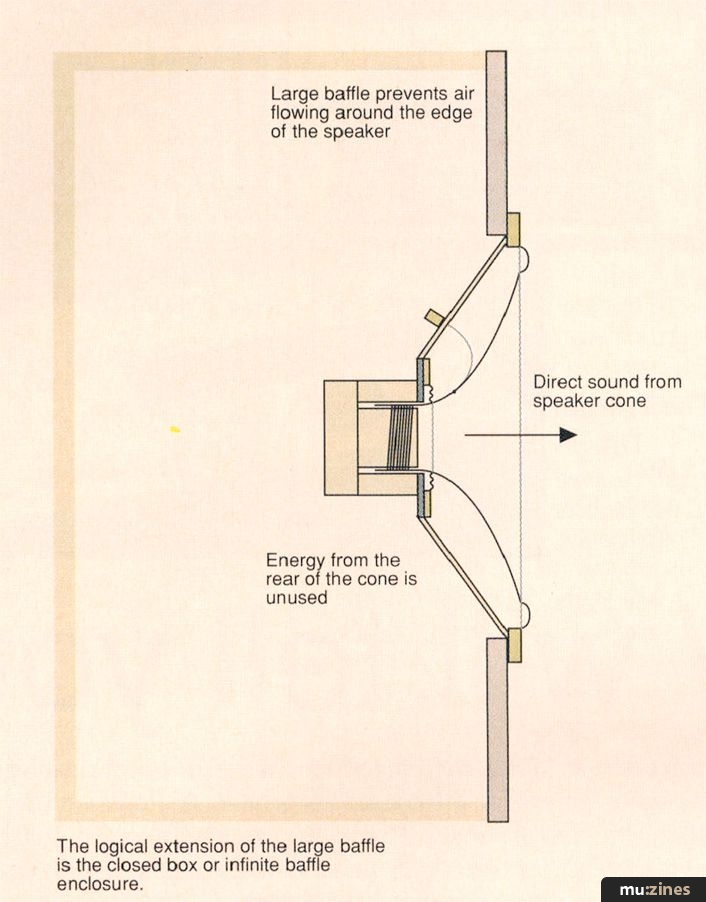
Figure 2: Loudspeaker mounted on a plane baffle.
PA Applications
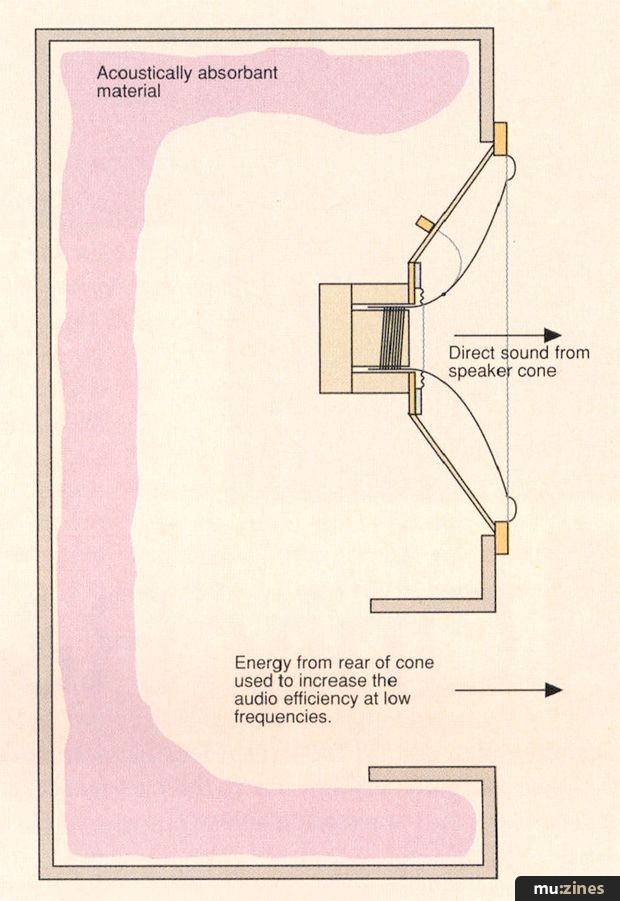
Figure 3: Ported loudspeaker enclosure.
In PA and live sound applications, it is important that as much energy as possible is turned into useful sound, which is where the so-called ported or vented enclosure shown in Figure 3 comes in. The design shown is known as a direct radiating, ported system because the front of the loudspeaker cone couples directly with the air in front of it. The port in the cabinet makes the cabinet resonate, rather like an organ pipe, and the actual frequency of resonance depends on the volume of air inside the box and also on the dimensions of the port. The mechanical characteristics of the loudspeaker also affect the calculations. There is a potential problem due to sound reflecting from the internal walls of the cabinet, and to combat this, most cabinets are lined with acoustic wadding to absorb as much high-frequency energy as possible.
A typical ported cabinet is designed to be resonant at a low frequency so as to reinforce the bass end of the spectrum, and at the resonant frequency, the energy from the rear of the speaker cone adds constructively to the energy from the front, giving a higher acoustical sound output. A carefully-designed ported cabinet can usefully extend the low-frequency range of a loudspeaker, and many hi-fi designs also employ this principle to provide the best possible bass response from a small cabinet. However, care must be taken over the choice of cabinet parameters, as excessive tuning can produce a 'coloured' sound.
Larger diameter speakers tend to require a larger volume of cabinet, which means that cabinets designed for 12-inch and 15-inch drivers can be quite bulky, especially if the system is required to work to very low frequencies. It must be appreciated that the cabinet dimensions and port size need to be calculated for each specific model of loudspeaker; it isn't, for example, possible to take a cabinet designed to work with one kind of 12-inch speaker and expect it to work properly with a different model of 12-inch speaker.
Horns
All direct radiating loudspeaker systems are relatively inefficient because of the poor matching of the loudspeaker cone to the air. Loudspeakers are very good at pushing small amounts of air over large distances, but in the real world, sound tends to involve large volumes of air vibrating over very small distances. A significant improvement in matching can be achieved by placing the driver at the end of an exponential horn as shown in Figure 4. Not only does this improve the mechanical coupling between the loudspeaker cone and the air, it also directs the sound over a narrower area, making it easier to control the coverage pattern in an auditorium or outdoor concert.
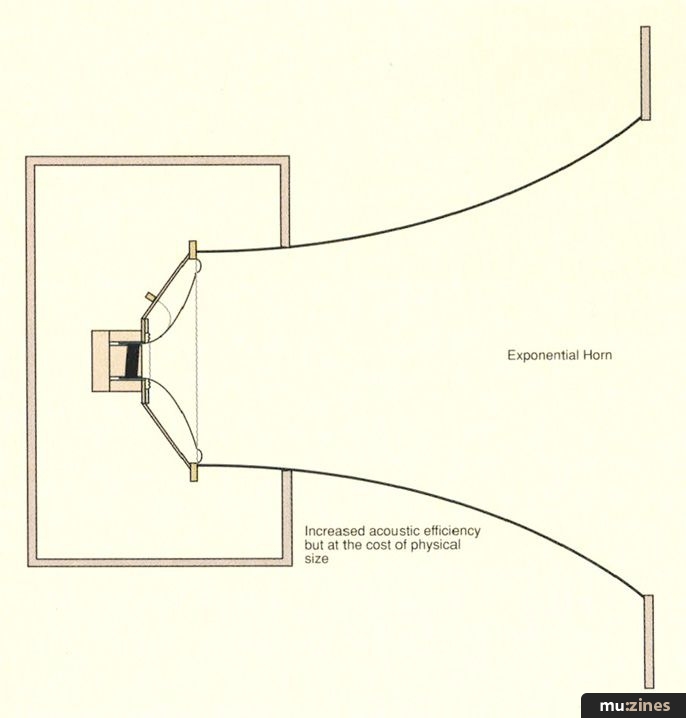
Figure 4: Loudspeaker loaded by an exponential horn.
Short horns with square or rectangular section flares are often used in the design of mid-range PA loudspeakers, as they can be used to throw sound to the back of a large auditorium, but for bass frequencies, a physically large horn is required, making a straight horn prohibitively bulky, especially for use in portable systems. But before looking at ways around this, a few useful facts about horns.
The shape and size of a horn dictates the frequency down to which it will work properly, and if frequencies below this 'cutoff frequency' are fed to the driver, there is a real risk of driver damage, as the cone is no longer 'loaded' by the air in the horn and will tend to move too far. For this reason, electronic high-pass filtering is often included in the system.
In general terms, the diameter of the horn mouth (or equivalent diameter of a rectangular horn mouth) needs to be at least a quarter of the wavelength of the lowest note to be reproduced. At 50Hz, for example, the wavelength is approximately 20ft, so a horn with a diameter of at least 5ft would be required. And sub-bass systems capable of going down to 25Hz would need to be 10ft across!
This might seem to be an impossible requirement, but here physics is on our side, and stacking several horns together makes them behave like a single horn with an equivalent horn diameter the size of the whole stack. That's why you see walls of bass cabinets stacked up at pop concerts.
Folded Horns
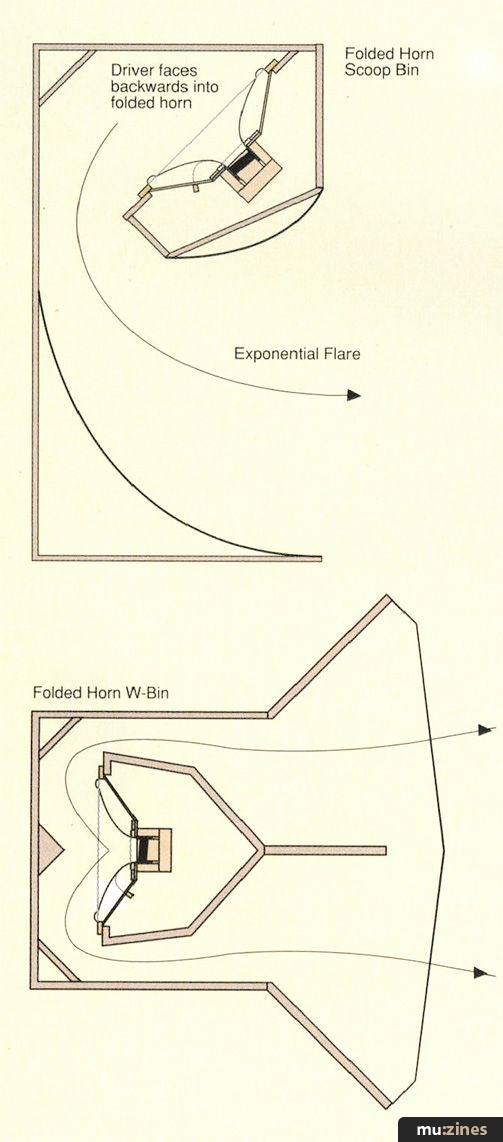
Figure 5: Typical folded horn enclosures.
To address the problem of a straight horn several feet long, cabinets have been designed which resemble a horn that has been folded to make it physically more compact. There are several methods of doing this, two of the more popular variations being shown in Figure 5. In acoustic terms, these are not as satisfactory as a straight horn, but they are so much more practical that the compromise is worthwhile.
Practical Systems
Until recently, a typical concert PA comprised a stack of horn-loaded bass cabinets, (or bins as they are often called), stacked mid-range horns and high frequency, horn-loaded compression drivers. The more sophisticated high-frequency horns use carefully calculated flare shapes to produce what is known as a constant directivity pattern. This amounts to a directivity pattern that is relatively consistent over the entire frequency range covered by the horn. It is also possible to design the flares to give different degrees of directivity in the horizontal and vertical planes, which enables designers to build systems to provide the optimum sound coverage.
The various components of the speaker system would be fed from a multiple amplifier system which, in turn, would be fed from an off-the-shelf, active crossover. Safety limiters are commonly included to protect the drivers against excessive power levels.
Progress
In recent years, PA design has moved away from this kind of 'component' system to a more integrated approach. Currently popular systems tend to use arrays of full-range cabinets, usually three-way affairs combining direct radiating bass and mid-range units with compression-driven high-frequency units, though some variations on the design also use horn loading for the mid and low-frequency drivers. These full-range cabinets are fed from sophisticated electronic processors which combine the roles of crossover, protection limiting, specialist EQ, time alignment delay and suchlike.
Larger systems are augmented by dedicated bass bins or sub-bass bins, and rather than being stacked in walls, they tend to be slung from the ceiling in carefully angled arrays. Though it might seem this kind of concert PA system is miles removed from the sort of thing you might sling into the back of your Transit for the local pub gig, many of the modern gigging systems bear a strong resemblance to a scaled-down concert system. Next month I'll be looking at some practical implementations of small gigging PA systems.
Cabinet Construction
All the joints of a cabinet should be airtight, which usually means caulking with silicone rubber, and this includes the mounting of the drivers themselves, which often involves the use of foam rubber gaskets. Most of the major loudspeaker manufacturers provide cabinet construction details for their drivers and some even produce books of designs. If you are interested in constructing your own PA loudspeakers, you may find it worthwhile to contact the following: JBL (Harman UK) (Contact Details); WEM (Contact Details); Celestion (Contact Details); Electrovoice (Shuttlesound) (Contact Details); ATC (Contact Details).
Series - "Live Sound"
Read the next part in this series:

Live Sound (Part 4)
(RM Feb 93)
All parts in this series:
Part 1 | Part 2 | Part 3 (Viewing) | Part 4 | Part 5 | Part 6
More with this topic
 Seeding the future - or burying the past? - Cyberseed cyber-festival |
 Down the Tube |
 Live End - Live Music for the Hi-Tech Musician |
Remember, Remember... - 21 Things To Remember On Tour |
 from Go to Woe? - Moby Live |
 Miller - Still A Killer |
 PA Column |
 So You Want To Be A... - FOH Engineer |
Lingo Stars - Foreign phrases for tour survival |
Driving For Roadies - lesson one |
 Don't Forget Your Toothbrush! - The Essential Gigging Toolkit |
 PA Column |
Browse by Topic:
Live
Publisher: Recording Musician - SOS Publications Ltd.
The contents of this magazine are re-published here with the kind permission of SOS Publications Ltd.
The current copyright owner/s of this content may differ from the originally published copyright notice.
More details on copyright ownership...

Recording Musician - Jan 1993
Donated & scanned by: Mike Gorman
Feature by Paul White
Help Support The Things You Love
mu:zines is the result of thousands of hours of effort, and will require many thousands more going forward to reach our goals of getting all this content online.
If you value this resource, you can support this project - it really helps!
Donations for May 2026
Issues donated this month: 0
New issues that have been donated or scanned for us this month.
Funds donated this month: £0.00
All donations and support are gratefully appreciated - thank you.
Magazines Needed - Can You Help?
Do you have any of these magazine issues?
If so, and you can donate, lend or scan them to help complete our archive, please get in touch via the Contribute page - thanks!
Please Contribute to mu:zines by supplying magazines, scanning or donating funds. Thanks!
Monetary donations go towards site running costs, and the occasional coffee for me if there's anything left over!

 @mu_zines
 RSS Feed
 Blog
Blog