


Magazine Archive
Home -> Magazines -> Issues -> Articles in this issue -> View
On The Beat (Part 8) | |
Article from Music Technology, March 1990 | |
South America: home of Latin rhythms and countless rhythmic influences is this month's port of call for Nigel Lord on his rhythm programming journey.
IF YOU'RE GOING TO BE DENIED THAT EXOTIC SOUTH AMERICAN HOLIDAY AGAIN THIS YEAR, A GUIDED TOUR OF THE CONTINENT'S RHYTHMS MAY BE THE BEST SUBSTITUTE YOU (AND YOUR MUSIC) WILL GET.
AS A CLASSIC example of the melting-pot syndrome - which so often expresses itself when people of disparate cultures are brought together under conditions of relative hardship - there can be little to compare with the development of the style of music we have come to Know as Latin-American. Any study of the diverse musical elements which came together and suffused the South American subcontinent over a century ago reveals a breadth of influence quite unparalleled in Western music terms.
As is often the case, however, trying to establish a coherent structure to this melange becomes something of a nightmare. The cross-fertilisation of cultures that can occur in an area containing some 30 separate countries each using variations of two different European languages as well as having well-established relations with continents as diverse as Africa and the United States, becomes quite overwhelming in its complexity.
And the situation is further complicated by the fact that much of the evolution of Latin music has taken place during the 20th century, when continuously improving systems of communication have left virtually no corner of the globe unaffected by the cultures that surround it. This has resulted in styles of music which themselves have absorbed strong Latin influences being 'fed back' into the melting pot of South America to complete a cycle, the beginning of which it is impossible to fathom.
As if things weren't difficult enough, we must also take account of the public perception of Latin American music - particularly in Britain. This, to a large extent, has been shaped by the kind of black and white B-movies made during the '30s and '40s which featured big bands playing their own, rather sanitised version of Latin music. You know the kind of thing: against a background of muted trumpets and a slow, loping rhythm, some dusky chanteuse would slide her way though an audience of perspiring, overweight males sat at candlelit tables with their rather embarrassed wives.
The rhythms, of course, could be found on any self-respecting home organ. The intention, no doubt, was to give the instruments a more exotic feel, but with sambas, rumbas and tangos in amongst the quicksteps and foxtrots, it was difficult to know whether to play them or use them to call the police.
In recent years, things have improved somewhat: TV coverage of the carnivals (particularly in Brazil) has begun to raise public awareness of the intensity of Latin rhythm and its grip over everyday life in South America. And of course, with the rising interest in world music over the past decade, many musicians are at last beginning to look to Latin America as a 'source' in their unselfconsciously plagiaristic approach to music - check out David Byrne's compilation Brazil Classics 1; Beleza Tropical.
In the States it has always been different. Over the last 50 or 60 years, the US has acted as a huge watershed for Latin music, becoming one of its principal markets and absorbing it into its own indigenous music styles. Primarily, of course, this was due to the huge influx of Latino immigrants to the US over a century or so, but it also has much to do with the ready adaptability of the rhythms which go to make up the broad range of Latin music.
It is by restricting ourselves to an examination of these rhythms that we are able to simplify our study of Latin music to a practicable level. This is due in no small part to the historical association (through the slave trade) of Africa with the countries of Cuba and Brazil. However, whereas Cuba drew the major part of its European influence from Spain (as did the majority of Latin America). Brazil was historically aligned with Portugal. As we shall see over the next couple of months, this factor was largely responsible for the emergence of a more fluid, laid-back style in Brazil, whilst Cuban rhythm is characterised by a driving beat and an altogether harder edge.
But Spanish or Portugese, the single spark that could be said to have lit the flame of Latin American music actually came about by the wonderfully off-chance meeting of African polyrhythms with traditional European folk music. That the two were able to combine successfully was due to a large extent to Spain and Portugal's Moorish heritage which made it possible for their music to fuse with many African rhythms without crushing them under the weight of a strict four-beat structure - as was the case with most Afro-American fusions.
But of all the South American countries, it is probably fair to say that the black heart of Africa beats more insistently in Cuban music than in any other Latin style. Indeed the fundamental structure of Cuban music, the 2-3 or 3-2 rhythm provided by the claves, can be shown to have evolved from the call and response structure of much African music.
Likewise, many of the instruments which have evolved in Cuban music over the years have their origins in African culture - the guiro and the quijada for example, and, of course the claves. In addition, it was Cuban musicians such as Arsenio Rodriguez who were responsible for popularising African rhythms such as the Congolese "mamba" during the '40s.
Though there is considerable freedom for expression and improvisation - particularly on the drum instruments such as the congas, bongos and timbales/cowbell - the rhythms themselves are disciplined and highly structured. And it's because of this that adapting them for drum machines becomes a realistic proposition. Indeed, given the human feel parameters which are now being introduced on all but the most basic machines, it is possible to produce some quite impressive results.
The only real problem (for those without access to a sampler) would be the availability of the right instruments, and, where these do exist, having a sufficiently wide variation of sounds for each of them to produce an authentic part. The two conga drums, for example, need a minimum of six different sounds if they are to be really convincing. And whilst many machines these days have a tuning facility which makes it possible to achieve the effect of two differently pitched drums, few offer the choice of closed, open and slap sounds used in traditional Cuban rhythm.
Fortunately, it is possible to program machines in such a way that even without a full complement of sounds, we can achieve the basic feel of a rhythm, and a number of these techniques have been employed in this month's examples. Of course, even with these concessions, there is a minimum standard of machine on which it will be possible to program these rhythms, but even those without the necessary instruments might like to try experimenting with the sounds they do have at their disposal - substituting tom-toms for congas and hi-hats for maracas for example.
One of the most striking aspects of all Latin rhythm lies in its cumulative effect on the listener. Most patterns are fairly unspectacular in themselves and rely on repetition and a slight raising of intensity over a period of time. In this respect, Cuban rhythms are no different. So, after each one of the patterns has been programmed, let it run for quite a while before deciding if you like it. I think you'll find that you will.
If, on the other hand, you find you've no use for a rhythm which doesn't have the bass and snare drums hammering away at the front, you might like to try adding either of the two extra patterns I've included with each of this month's examples. They're all fairly basic in structure, but this is intended to prevent the main rhythm being masked out. Alternatively, of course, you could write your own parts, perhaps using other instruments.
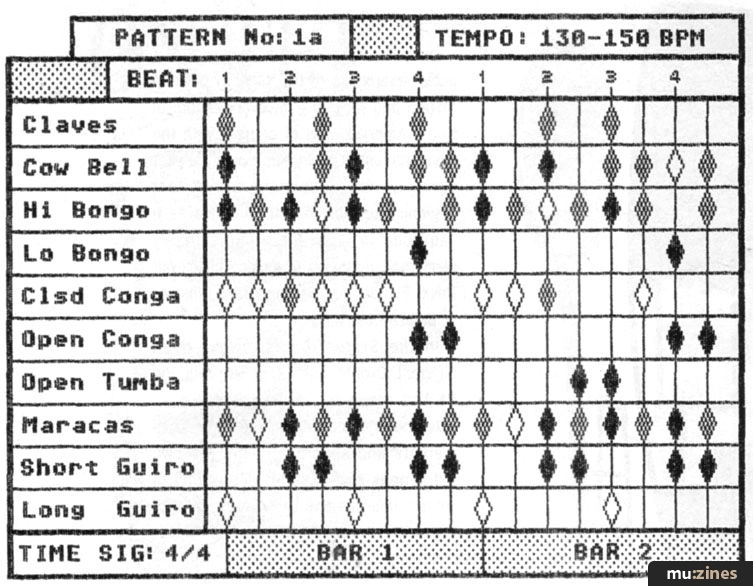

The first of this month's examples, Son Montuno, is one of the earliest Cuban rhythms and originated in the mountainous area on the eastern side of the island (monte means mountain). A medium-to-fast rhythm, its principal instruments are the bongos and maracas, with the congas and cowbell next in importance. The high bongo part, though not traditionally played with alternately accented strokes, is programmed in this way in order to simulate the effect of playing the drum with two hands (and the same is true of the maracas in later examples).
The conga/tumba parts (the tumba is the lower pitched of the two drums) represent a distillation of the open/closed strokes of the traditional instruments. I have also replaced the slap strokes with simple, accented beats, but of course if a slap conga sound is available, by all means use it. If tuning is also an option on your machine, you can pitch these instruments anywhere within the range available, but remember, in Cuban music the tumbadoras (as they are called) are intended to be the bass instruments and so should be kept fairly low. This also prevents them from overlapping with the bongos which can easily be lost in the mix.
The guiro - a long hollow instrument with grooves along its sides - is traditionally played with a small stick which is scraped along its side to produce a very characteristic "zipping" sound of either long or short duration. Unfortunately, none of the drum machines I've ever come across has featured a guiro sound of any duration, and this could well pose a problem for most programmers. Sampling is the obvious answer, of course, but where a sampler is not available, you'll have to try some alternative instrument. Unlike shakers/maracas and so on. there is unfortunately no near equivalent.
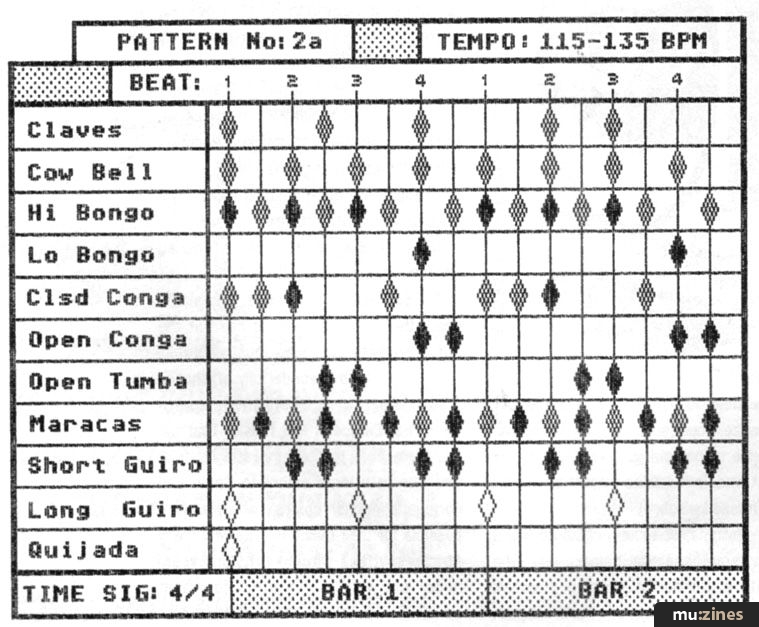

Pattern 2, the Cha-Cha-Cha, is blessed with one of those names which most people associate with the sequinned Zimmer frames and pre-stressed cummerbunds of Come Dancing. Needless to say, this is a great shame, since although it is unequivocally a dance rhythm, its subtlety and even flow give it a pleasantly insistent feel. Not only that, but its simple 4-beat rhythm makes it very suitable for combining with a whole range of contemporary pop styles - and even rock (Santana used Cha-Cha-Chas as the rhythmic base for a number of their songs).
A slower rhythm than the Son Montuno, this one should run at around the 125bpm mark, but most of the programming notes for Pattern 1 apply here also. The only real instrument difficulty (apart from the aforementioned guiro), is likely to be the quijada or vibraslap, but this can be omitted without serious effect on the pattern.
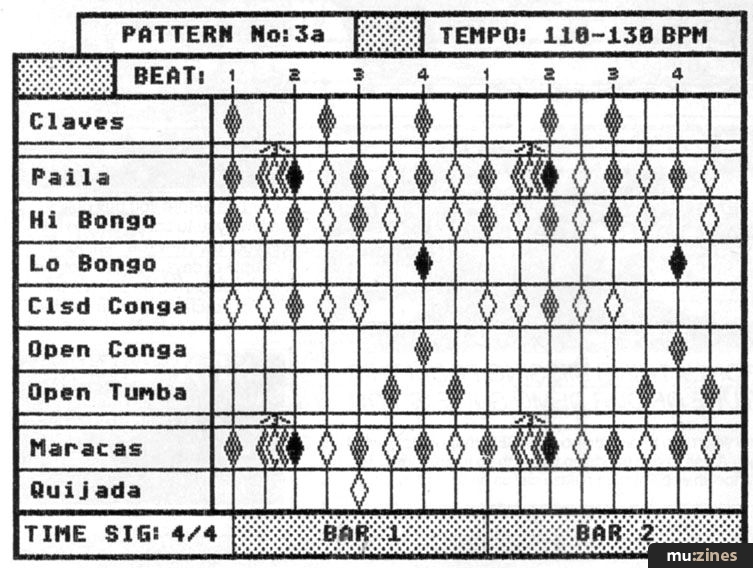

Thanks to Torvill and Dean (and, of course, Ravel), the name Bolero has more than its fair share of mental associations too. But if you could just put these to one side long enough to get this rhythm into your machine, I think you'll find it worth the trouble.
Principally used for ballads back in Cuba, this is one of the slowest of the traditional rhythms, but is quite compelling nevertheless. The "lead" instruments are the maracas and/or the timbales with the bongos and conga/tumba taking second place. But wait - there's no timbale part. I hear you murmur, so how can it be the lead instrument? The answer is that in Cuban music, the timbale player also plays the cowbell (mounted on a stand) and quite often uses the other hand to tap out a rhythm on the side of the drum which is known as Paila. And, if you look at the third line down the rhythm you'll see that there indeed, is the Paila part.
What you'll also see is that just above it are a couple of triplet signs relating to two sets of three notes at the beginning of each bar and corresponding signs above the notes in the maracas line. How you program these will depend on your machine: obviously if you can set individual quantisation for each instrument, this will be much easier. But you could program the whole rhythm in triplet time with the other parts resolved as non-triplets. Either way, the results should justify the effort involved.
I don't believe for a moment there's a drum machine out there with the sound of a timbale being struck on the side as part of its sonic arsenal, but the conventional side-stick or rim shot should prove adequate substitutes, as long as the sound isn't too heavy.
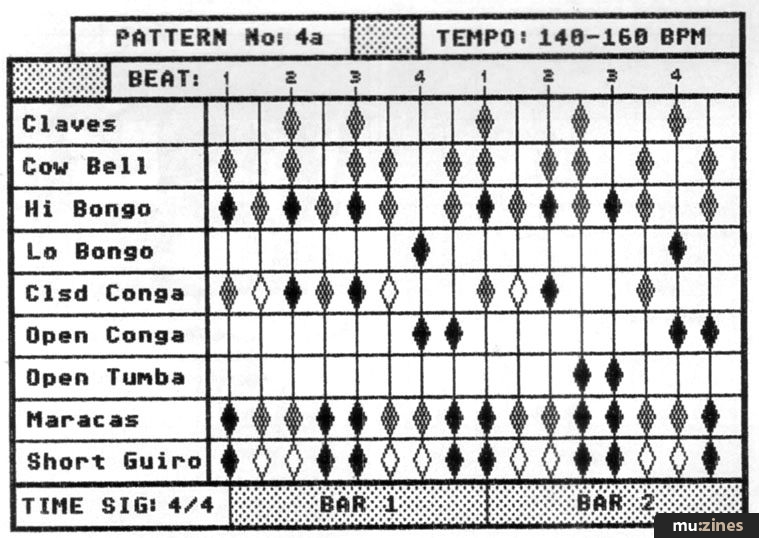

Pattern 4 is one of a number of Mambo rhythms used in Cuban music, but this one is characterised by its (relatively) fast tempo and reversed clave feel - 2-3 instead of 3-2. Reversing the clave part also means reversing the cowbell, so if it is decided to revert to the 3-2 feel, remember to change both parts round.
The congas/tumba again take the lead instrument role with the cowbell next in line alongside the maracas. Being a fairly fast rhythm, the guiro part is made up entirely of short strokes (...I'll resist the temptation), and this may make it easier to replace with another instrument.
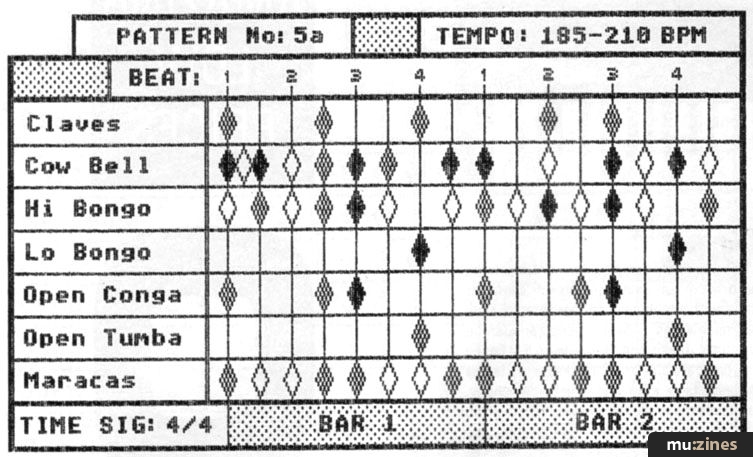

Finally we come to a rhythm which has been the mainstay of Cuban music and one which takes on a role somewhat akin to that of Samba in Brazil - Rumba.
In fact Rumba is not really a rhythm at all, but a combination of rhythms along with the dancing and singing which go with them. There are many examples of rumba played at widely differing tempos and dating from various periods in the development of Cuban music - the Yambu, the Guaguanco and the Rumba Abierta to name but a few. By and large, however, the instrumentation remains more or less the same for most rhythms with the bongos, congas and tumba taking the lead.
The example here is a fairly modern variation which borrows freely from Mambo rhythms and runs at a pretty sprightly 200bpm. Beyond that, there isn't much I can say except load the pattern in and listen to how they get the feet moving, Havana style.
All the accompanying bass/snare drum patterns are quite straightforward as you can see, and a considerable amount of interchangeability is possible if you feel like experimenting. Watch out for the 64th note flams in Pattern 1 (Son Montuno) and Pattern 5 (Rumba), and remember to keep levels down to a point where the Cuban patterns can be properly heard.
And that's it for this month. In the next article we're going to be looking a Brazilian rhythm and there'll be another handful of patterns for your collections. In the meantime it might be worth trying to locate a machine equipped with the irresistible sound of the cuica, the reco-reco, the chocalho and the pandeiro...
Series - "On The Beat"
Read the next part in this series:

On The Beat (Part 9)
(MT Apr 90)
All parts in this series:
Part 1 | Part 2 | Part 3 | Part 4 | Part 5 | Part 6 | Part 7 | Part 8 (Viewing) | Part 9 | Part 10 | Part 11 | Part 12 | Part 13 | Part 14 | Part 15 | Part 16 | Part 17 | Part 18 | Part 19 | Part 20 | Part 21 | Part 22 | Part 23 | Part 24 | Part 25 | Part 26 | Part 26 | Part 27 | Part 28 | Part 29 | Part 30 | Part 31 | Part 32 | Part 33 | Part 34 | Part 35
More with this topic
 Personalise Your Drum Machine Sounds - Masterclass - Drum Machines |
 Funky Stuff - Making Classic Funk |
 Beat Box |
 Tuning Your Breakbeats |
 Alesis D4 Drum Processing Tricks |
 Beat Box |
 The Sounds Of Motown |
 Beat Box |
 The Rhythm Method - Beat Box Hits |
 Beat Box |
 Warren Cann's Electro-Drum Column (Part 1) |
 Beat Box Ballistics - Drum Machines |
Browse by Topic:
Drum Programming
Publisher: Music Technology - Music Maker Publications (UK), Future Publishing.
The current copyright owner/s of this content may differ from the originally published copyright notice.
More details on copyright ownership...

Music Technology - Mar 1990
Topic:
Drum Programming
Series:
On The Beat
Part 1 | Part 2 | Part 3 | Part 4 | Part 5 | Part 6 | Part 7 | Part 8 (Viewing) | Part 9 | Part 10 | Part 11 | Part 12 | Part 13 | Part 14 | Part 15 | Part 16 | Part 17 | Part 18 | Part 19 | Part 20 | Part 21 | Part 22 | Part 23 | Part 24 | Part 25 | Part 26 | Part 26 | Part 27 | Part 28 | Part 29 | Part 30 | Part 31 | Part 32 | Part 33 | Part 34 | Part 35
Feature by Nigel Lord
Help Support The Things You Love
mu:zines is the result of thousands of hours of effort, and will require many thousands more going forward to reach our goals of getting all this content online.
If you value this resource, you can support this project - it really helps!
Donations for May 2026
Issues donated this month: 0
New issues that have been donated or scanned for us this month.
Funds donated this month: £0.00
All donations and support are gratefully appreciated - thank you.
Magazines Needed - Can You Help?
Do you have any of these magazine issues?
If so, and you can donate, lend or scan them to help complete our archive, please get in touch via the Contribute page - thanks!
Please Contribute to mu:zines by supplying magazines, scanning or donating funds. Thanks!
Monetary donations go towards site running costs, and the occasional coffee for me if there's anything left over!

 @mu_zines
 RSS Feed
 Blog
Blog