Four-track Cassette Machines
(12T Jan 85)


Magazine Archive
Home -> Magazines -> Issues -> Articles in this issue -> View
One Upmanship | |
Tascam Porta OneArticle from Electronic Soundmaker & Computer Music, January 1985 | |
A sensational budget portastudio from Tascam, the Porta One, looks like being on most musicians' Most Wanted list. We bring it back alive.

Teac's Tascam division have finally come up with an answer to the Fostex X-15. Their last few cassette-based products, the 234 and the 225, whilst arguably well designed, somehow missed the point for the non-professional home recording masses, but after this slight deviation from the cause of the back room demo, they have returned once more with a product of really significant worth to the serious, semi-broke recording musician. I give you the Porta One Ministudio. Thank you, that'll be £429.00.
As is their wont, Tascam have gone somewhat upmarket of the X-15 to provide practically all the features of the original 144 Portastudio, in a light, battery powered, highly portable package. An optional mains power supply is available and recommended for non-location work. The price was originally intended to be £399.00 — about £100.00 more than the Fostex, but the strength of the Japanese Yen and the unfortunate present state of our pound, has brought us to this final bottom line of £429.00. I have it on impeccable authority that, should be exchange rate improve in our favour, then so too will the price.
Tascam agents seem keen to push the Porta One as a slightly downmarket 244, but I maintain that it's probably more instructive to see it as an upmarket X-15. Its size and weight are slightly greater: 13" x 9-13/16" x 2-3/4" and 7.7lbs as opposed to the X-15's 11-1/2" x 9" x 7-3/4" and about 6.5lbs. The extra bulk brings commensurately greater flexibility and control, however, and it's still no problem to carry around using the clip-on shoulder strap supplied.
Like the X-15, the Porta One runs at the domestic speed of 1-7/8ips and has a slider with centre detent providing +/-15% varispeed. This makes it approximately compatible with standard pre-recorded stereo cassettes, which is a great advantage if you're a little pushed to afford both a home recording system and a hi-fi. The original Portastudio track format had the four tracks evenly spaced across the width of the tape and hence they got a reputation for being incompatible with domestic machines, even those that ran at 3-3/4ips. The format has now been modified to give a slightly wider centre gap thus matching far more closely the domestic layout. Hence the Porta One works well as a hi-fi machine when replaying non-Dolby tapes, but its use of dbx noise reduction poses a slight limitation. The dbx can be switched out, however, and the effects of replaying a Dolby B encoded tape without decoding are relatively minor, and can be compensated for with eq. Tapes using Dolby C, on the other hand, would pose a definite problem.
Low noise
Whilst dbx undoubtedly works quite well for professional applications, it has on occasion been seen to be a little too sensitive to any mis-alignment of the tape recorder record/replay electronics to maintain that high standard with the lower accuracy of 4-track cassettes systems. The use of lower tolerance components in budget equipment NR circuitry has possibly also added to the problem, and thus I have always favoured Dolby C (though not Dolby B) for such applications. With this in mind it was a relief to find that, in the case of the Porta One review sample, the NR worked very well. It seems that dbx is generally improving.
One acid test for a noise reduction system is a hi-hat and snare combination for an analogue drum machine. There was a little low level pumping in response to this, but as compared to other 4-track cassette systems it was very good, with the quality of the sounds remaining reasonably intact.
A major point in favour of the Porta One is the provision of four separate mixer input channels each with input trim, treble and bass, pan and channel fader. All controls are very low profile such that the highest point on the entire board is but 2.5mm above the surface, making it fairly immune to physical knocks on location. The rotary controls are about 2cm in diameter, and are made of a rough, high friction rubber composite allowing even the sturdiest fingers easy access and smooth control.
The eq has a shelving characteristic which shows +/—10dB at 100Hz and 10kHz, and is as musical and effective as any such fixed, wide band device can be.
The channel to track routing works on a two-buss system, with the output of each channel going through its pan control to this main stereo buss. The left buss can be routed to either track 1 or 3, while the right is switchable to either track 2 or 4. In this way all four channels can be routed to any single track or any odd/even combination of two tracks, at one time. This is very important in that, unlike with the X-15, a combination of instruments or sounds, such as the different outputs of a drum machine, can be individually eq'd and balanced before being recorded.
Single and unbalanced
There is only a single multi-purpose, unbalanced ¼" jack input per channel which is billed as being capable of handling anything with an output impedance of between 150ohms and 10kohms. This is the wonder of high gain op-amp technology, although with a nominal input impedance of 10kHz, their abilities are perhaps a little overstated. It has to be said that in practice they hardly flinched under an onslaught of drum machines, guitars, basses and a microphone variously. The mic, with a standard studio impedance of 200ohms, worked very well, and although the tone controls on the guitars were somewhat subdued, there was no audible distortion.
The four track outputs plus the main stereo output, all come out on phono sockets. The headphones output is a stereo ¼" jack and is designed to drive a nominal 8ohm load, although it provided adequate punch for my 600ohm pair.
Having recorded up to three tracks, they can very easily be bounced down to the fourth track, and here again the four mixer channels allow individual re-equalising of each track on the bounce. In addition, the spare mixer channel can be used to add a fourth voice or instrument to the bounce as you're doing it, thus saving tracks. By each channel fader is a channel source switch giving input, off and tape positions, the latter being used for bouncing and final mixdown. With a battery operated machine low power consumption is a major consideration and hence fluorescent paint is used as a substitute for LED switch position indicators. The dbx worked very well on less testing envelopes such as vocals and guitar, and even after a couple of bounces, the noise level was very reasonable.
Transports of delight
Again with power consumption in mind, a servo assisted mechanical set of transport controls (as with the X-15) have been used rather than full electronic logic. A motor drives the whole head assembly to and from the tape for play and fast wind modes respectively. Unlike the Fostex machine, the Porta One uses a standard electronic drop-in/out switch, and although the rather long time taken and hence the low precision of the process is predictably rather limiting, it is much easier to operate than the X-15's (equally slow) pneumatic mechanical orange system. A simple but invaluable 'return-to-zero' function is included.
Metering is via four moving coil meteres giving the usual Tascam VU/PPM hybrid characteristic. In mains operation these remain illuminated, whereas in the battery mode they can be lit up by holding down a momentary (non-latching) button.
Conclusion
The Porta One offers practically all the portability of the X-15 with few of the limitations. Who knows what the Tascam will sell for once it's been in the shops for a while, but the price difference may mean that the two machines aren't actually in competition with each other. If you are with sufficient funds, the Teac's undoubtedly the better machine and worth the extra; if you aren't, then I guess there's no argument.
Incidentally, Teac are now in the business of manufacturing a range of tape cassettes (ferrous, chrome and metal) referred to as their '52' series. Each cassette contains a pair of miniature reels on which the tape is wound, and the '52' refers to the fact that only 52 minutes of tape can be wound on to a reel. This design costs extra and does nothing for their performance, but it does look very good: maybe for those all important demo's you're sending out? Who knows maybe the A&R man will pick it out from the pile. We all need a little extra hope.
Also featuring gear in this article


Reviews
(IM Dec 86)

Tascam Porta One Ministudio
(HSR Dec 84)

Tascam's Porta-1
(IT Dec 84)

The New Portastudio - Tascam Porta One 4-track
(12T Nov 84)
Browse category: Cassette 4-Track > Tascam
Featuring related gear

Making Tracks - Tascam Porta Two
(HSR Dec 86)

Tascam Porta Two
(MM Nov 86)


The Porta Two has Landed - Tascam Porta Two
(SOS Dec 86)
Browse category: Cassette 4-Track > Tascam
Publisher: Electronic Soundmaker & Computer Music - Cover Publications Ltd, Northern & Shell Ltd.
The current copyright owner/s of this content may differ from the originally published copyright notice.
More details on copyright ownership...
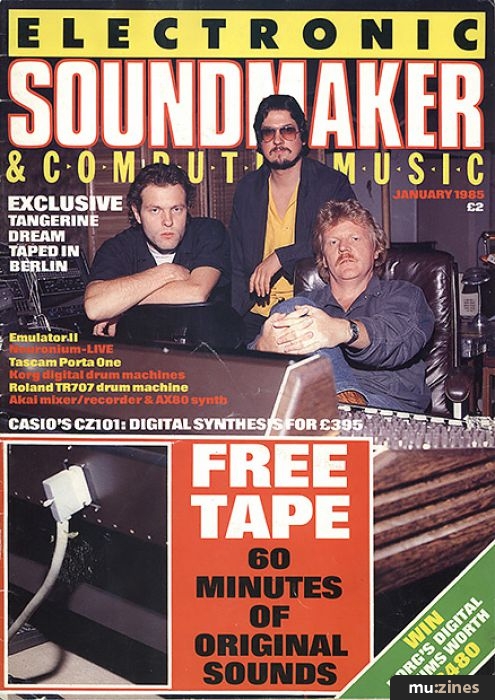
Electronic Soundmaker - Jan 1985
Donated & scanned by: Mike Gorman
Review
Ads for Gear in this article:


Help Support The Things You Love
mu:zines is the result of thousands of hours of effort, and will require many thousands more going forward to reach our goals of getting all this content online.
If you value this resource, you can support this project - it really helps!
Donations for August 2026
Issues donated this month: 0
New issues that have been donated or scanned for us this month.
Funds donated this month: £0.00
All donations and support are gratefully appreciated - thank you.
Magazines Needed - Can You Help?
Do you have any of these magazine issues?
If so, and you can donate, lend or scan them to help complete our archive, please get in touch via the Contribute page - thanks!
Please Contribute to mu:zines by supplying magazines, scanning or donating funds. Thanks!
Monetary donations go towards site running costs, and the occasional coffee for me if there's anything left over!

 @mu_zines
 RSS Feed
 Blog
Blog