


Magazine Archive
Home -> Magazines -> Issues -> Articles in this issue -> View
Studio By Design | |
Orinoco StudioArticle from Music Technology, February 1988 | |
Another studio receives a visit from a roving MT reporter. This time the intrepid Dan Goldstein drops in on South East London's Orinoco Studios.
There are now a number of studios that have been built specifically to take advantage of the MIDI integration of equipment. London's Orinoco studio is one of the latest - and possibly most sophisticated.
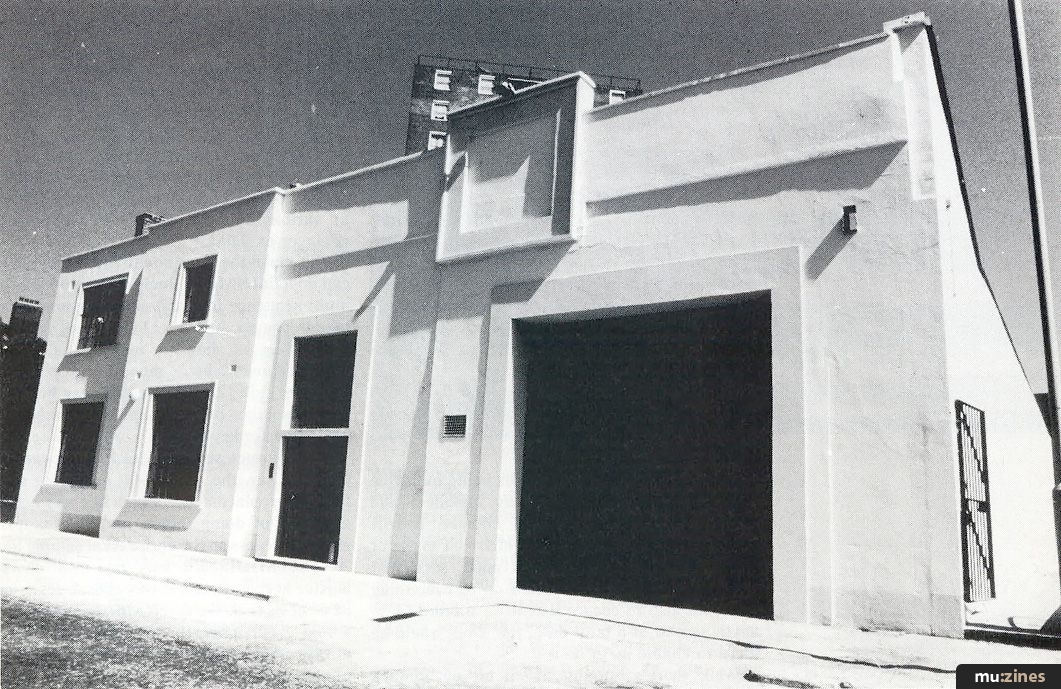
The area of London in which Orinoco recording studio lies is almost as mysterious (and comparatively uncharted) as the South American river from which the studio gets its name. It's just south of the Thames, somewhere between London Bridge and the Elephant & Castle, in an area sometimes known as Borough and sometimes known as nothing at all. The only other thing this part of London is famous for - apart from a notoriously underused tube station, some horrendous '60s housing estates and a bit of recent yuppie-inspired gentrification - is another recording studio, PWL. And that, in case you weren't aware, is where Messrs Stock, Aitken & Waterman 'make records' for (as opposed to with) the likes of Rick Astley, Sinitta and Bananarama.
But this piece is not about PWL or Stock, Aitken & Waterman, though they may be mentioned 'between the lines', as it were.
No. This is the story of a fairly new recording studio, one that has been built with high artistic and technical ideals and meticulous attention to detail, and which also happens to be one of the most tastefully decorated recording facilities this writer has ever seen.
You enter Orinoco through massive double doors, and what greets you could be one of three things: the interior of a new Covent Garden menswear shop, the bar section of a trendy Italian Soho restaurant, or the atrium of a fashion-conscious foreign exchange dealer's office block somewhere on the outskirts of the City. It could never in a million years lead to a recording studio, but it does.
There are none of the interior eyesores that bug so many studios whose desire to be 'exclusive' results in a proliferation of spotlights, deep shag pile carpeting, and glass coffee tables. Instead, the whole thing looks as though it was designed from a clean sheet of paper, and indeed it was.
Orinoco's owner, Tom Astor, used to own a rehearsal studio complex in Covent Garden. When the menswear shops edged that out of existence, Tom decided the time was right to realise a long-standing ambition - to become more involved in recording. For a few months he scoured London looking for a suitable site, approaching designers and architects, and seeking out engineers.
In the end, he found a '30s building that looks inside as though it might have once been a municipal indoor swimming pool and has been, among many other things, a meat warehouse. He also found a firm of architects that were willing to take on the task of making a studio look entirely unlike a studio, while also (and here comes the difficult bit) ensuring that every detail of design had a specific job to do, and did that job well.
On his travels, Astor also bumped into Ken Thomas, producing an album at Musicworks studios in North London. Thomas liked what Astor was up to and joined him as house producer and consultant, and brought with him Gerard Johnson as house engineer.
IT IS JOHNSON who gives me a guided tour of Orinoco before we sit down and talk turkey. Incredibly, the portholed doors that met me as I entered led on to such modern studio necessities as a video post-production room, a tape machine room, and a lavatory. Another pair of them eventually (the place is labyrinthine, to say the least) led to a massive, concrete-clad control room, which was a car park when Johnson arrived during the Christmas of 1986.
"The project has been through several stages", the engineer reveals, leaning back in his high-backed leather chair as engineers have a habit of doing. "At one stage it was going to be a huge SSL facility, then it was going to be a tiny recording studio with a large video facility, then it was going to be a big programming suite, and it finally ended up being a compromise between all those things. The building took about 18 months, and when I arrived it was still very much a building site."
This, of course, is what puts Johnson in such an unusual, perhaps unique, position for a studio engineer, and one that he has exploited to good effect.
"I was able to watch the walls being built, the tape machines and desk being installed, and perhaps most important, to become heavily involved with the wiring up, which can make or break a studio. I wanted to make sure that everything could be connected up to everything else, and also to ensure that if we wanted to do anything new at a later date, the wires would be there to enable us to do it."
Well, there's nothing like a bit of 'upward compatibility', as the Americans say...
"It's not just a case of future upgrades", Johnson interrupts. "It's also a case of what we can do now. Take the MIDI gear; all the instruments in our MIDI rack are linked directly to a patchbay, and from there they can be routed directly to the input channels on the desk - in total we could have 48 MIDI voices being patched into their own individual inputs on the desk, using just three patchbay connectors. I like the idea of just being able to plug something in, instead of spending half a day scrambling around with leads at the back of racks."
"Recording techniques are being used to make up for bad songs, but that's better than having bad songs and dull recordings."
Hands up all those who'd agree with that sentiment. Yes, I thought there'd be a lot of you.
Anyway, after much planning, designing, building and rebuilding, Orinoco finally swung into action last summer as, among other things, one of the first London recording studios to offer digital multitrack recording as its staple diet. The tape machine room houses a Mitsubishi 32-track digital recorder, which Johnson prefers over its Sony 24-track counterpart, partly for technical and sound quality reasons but mostly because it has, er, more tracks. However, Orinoco have an agreement with hire company Hilton Sound which enables them to swap the Mitsubishi for a Sony at any time, should a client desire it. They also have a 24-track analogue machine permanently wired in, and this can be synced to the Mitsubishi for 56-track recording, or even used in its own right without any interference from the digital department. All in all, Orinoco is one of the first recording facilities to offer a choice of three competing recording formats at the drop of a hat - and hats off to them for not letting technological hysteria get in the way of their pragmatism.
BUT THAT, AS they say, is only the beginning. MIDI came to Orinoco when Johnson came to it, and came to it in a big way. Among other things, there's the obligatory Akai S900 sampler and Atari 1040ST running Steinberg Pro24 sequencing software. But there is also a fair smattering of some less common gear, including a Kurzweil MIDIboard as master keyboard and a Korg DVP1 digital voice processor.
This is no purpose-built, dedicated programming suite, mind you. Instead, it's the result of a realistic appraisal of what MIDI can do for modern recording artists and producers - at various different levels of operation. The engineer explains.
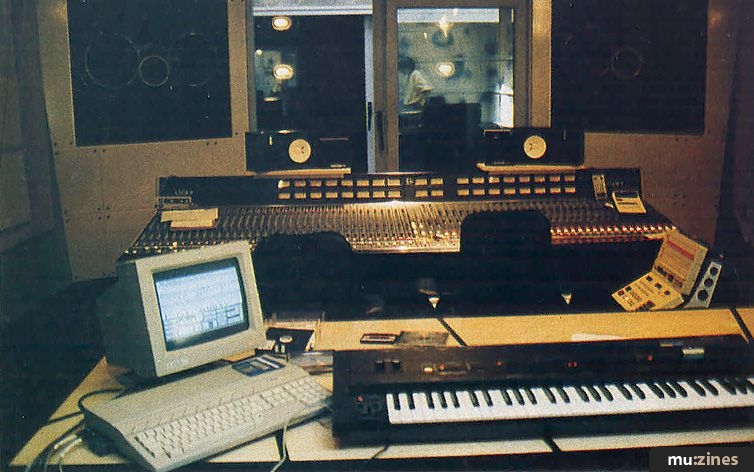
"To make the most sophisticated use of it you can do a full SMPTE-locked, Steinberg 24-track multi-sequence job, and get everything down on tape in one go. At a level below that, you can use the system as simply a means of doing some keyboard overdubs - though you can still do those in quite a sophisticated way because we have a number of sound modules linked up to a MIDI master keyboard. Or, at a level below that, you can forget about keyboards altogether and just use, say, the Akai S900 to trigger samples for drum replacement - which is a very quick and easy way of doing things, and also happens to give you access to the entire Akai sample library.
"The MIDIboard was my own choice of master keyboard, and it was chosen really on the basis of its feel. We toyed with the idea of getting a real grand piano in here, because there are always some parts which benefit from being played on a real acoustic keyboard. In the end it seemed a good idea to get a keyboard which could provide a piano-style feel, while also giving us access to much more than just a piano sound. The Kurzweil is simply a joy to play, and that's the main thing.
"The reasons for choosing Pro24 above, say, Dr T's KCS or the Iconix, were simply that it is the most popular system around. There are so many of them in use - even the Style Council are using one. So despite the fact that the software has one or two things that aren't that easy to do, it made sense for us to get something that would enable people to come with a song file disk they'd already compiled, plug in, and go - with the minimum amount of patching and cabling for their own MIDI modules, too."
So, it's back to the old pre-production scenario again. You know the theory: you buy a computer and some software, hook it up to your MIDI gear at home, record a rough (well, maybe not so rough) version of a song onto disk, and then take your disk along to your friendly local multitrack studio which happens to have a computer music system the same as yours. Bingo. But Johnson has reservations.
"This theory about pre-production is all very fine, but in my experience as an engineer, the music gets changed in the studio every time. It's not just a question of adding some live percussion - that's the sort of thing people come in for anyway - it also comes down to changing the basic program: there's something about having a load of big studio gear in front of people that suddenly makes them question the value of what they've done at home or in a smaller studio. I can scarcely remember engineering a session that has gone exactly as the programmer originally planned it - and if I have, the music has turned out to be very boring. Apart from anything else, I think it's vital that a certain amount of spontaneity is maintained in the studio, and in most cases it crops up in one form or another."
Johnson looks around him at some monolithic concrete panels which turn out to be acoustic screens (efficient ones at that), and then goes on to mention that since Orinoco is equally well geared up to record a five-piece R&B combo as it is the Depeche Modes of this world, he expects the studio's client list will be a varied one. Glancing at the vast, open playing area, carefully mapped out 'live' and 'dead' ends and gargantuan monitoring system (shells of defunct power amps, deemed too weedy for the job, litter one shelf in the control room), I'm inclined to agree with him.
And within a few weeks of the studio becoming operational - before many of the finishing touches had been brushed in - the Orinoco team had written, recorded and shot a video for a theme song for TV '87, last year's tactical voting campaign which came to prominence just too late to keep Mrs Thatcher out of No 10 for another five years. Yet although it was an abortive scheme, the studio's client, fashion designer Katherine Hamnett, must have been impressed with Orinoco's almost unique ability to tie together audio and video recording with such speed and convenience.
"We could have 48 MIDI voices being patched into their own individual inputs on the desk, using just three patch bay connectors."
FOR THE FINAL, winning element in the Orinoco formula is just that - what Johnson calls "the meshing together of audio and video technologies, in the studio as well as in the living-room".
With CD video already upon us, sales of music videos remaining steady and the hardware companies making great play of their new integrated 'audio-visual' replay systems, the men at Orinoco believe their facility to record music and visuals simultaneously - or at least in the same location - will prove irresistible to many clients.
Next-door to the audio recording studio lies the vast, open rectangle of nothing that is the Orinoco video recording space - big enough to house a band, all their equipment, 200 or so 'fans' and even a few token bouncers. You could actually put on a gig here, set up a half-dozen video cameras, record all the music directly onto that Mitsubishi, and still be able to overdub some 'audience participation' if the extras didn't make quite enough noise. Or you could cheat a bit more, recording the music in advance in the audio studio, and then getting the band to mime to the tape in the video hall, TOTP-style, in front of the mob from Rent-A-Crowd.
In Johnson's eyes, the bringing together of audio and video in this way can only be to the benefit of both forms - especially video, which has suffered terribly from that modern media virus known as Afterthought's Disease.
And as it turns out, this particular engineer has more than a few thoughts on why the music industry is currently in intensive care, labouring under a seemingly incurable malaise of non-creativity. His thoughts, not unnaturally, have turned to the new technology that he works with every day...
"One of the very funny paradoxes that we've seen is that we've had sound sampling thrust upon us, with the promise of giving us the ability to make every record sound different, and it's actually had the opposite effect - it's narrowed the field of sounds that we're hearing. Now, that's partly because people are using too many preset sounds, and partly because people are sampling things from other people's records.
"But I don't think this is happening because the equipment is too difficult to use; in fact, I think the reverse may be true. I'm worried that because so much of this technology is really quite friendly to operate, the people who are influencing the music we listen to have a more commercial interest than a musical interest. It's all very well having the best intentions of turning non-musicians into musicians, but when the non-musicians don't actually want to be musicians at all, when all they want to do is make money, than I think something has gone very wrong.
"It used to be that you paid your dues by spending 10 years learning to play your instrument, and when you finished that, you had a vested interest in making sure that you put your experience to good use by making good music. Now you pay your dues by being a band manager or a record company executive, learning to program a Steinberg, putting down a bassline and a drum machine part in no time, and then pulling some nobody in off the street to sing some bland pap over the top of it. There's just so much of that music around - I know, I've engineered some of it."
Which is an important point, when you consider that as an engineer, there must be a limit to what Johnson can do to change the course the music industry is taking. Or is there?
"It's actually surprising how much influence you can have over the way a record sounds. You play each session as it comes, of course, but as the engineer you're probably the one person without whom nothing would happen at all, so the way you go about doing your job has a crucial effect on the way the finished product sounds.
"For example, I place a lot of emphasis on creating a sense of perspective in a piece of music. Today, with all the various digital reverb systems that are around, you can create a series of different ambient spaces around each set of instruments in a mix, putting the drums in quite a big space, say, and then have another instrument appearing in a much smaller one, so that you get that feeling of excitement as the music suddenly constricts or spreads out around you. As an engineer, you can now take the listener through a number of aural environments as a track goes on.
"It's no substitute for a good song, of course, and it could be that techniques such as that are being used to try to make up for a bad song. But that's better than having a bad song and a dull recording. It's a step in the right direction."
Have no doubts. Orinoco are taking a big step in the right direction, and the studio will benefit from having this man aboard. And in all likelihood, the music industry will benefit from having Orinoco, too.
More with this topic
 Studio Diary |
 Studio Of The Month - The Padded Cell |
 At Home in the Studio - Castleridge Studios |
 Paradise Re-Found - Southlands Studio |
 The Hitch-Hiker's Guide To The Workshop |
 Studio Diary |
 Going Solo |
 Birth of a Studio - CTS Studio 4 |
 The World About Us - Real World (Part 1) |
 Studio Reproduction (Part 1) |
 Community Music |
 Studio Staff reveal - Facts on the Rak |
Browse by Topic:
Recording Studios
Publisher: Music Technology - Music Maker Publications (UK), Future Publishing.
The current copyright owner/s of this content may differ from the originally published copyright notice.
More details on copyright ownership...

Music Technology - Feb 1988
Donated & scanned by: Mike Gorman
Feature by Dan Goldstein
Help Support The Things You Love
mu:zines is the result of thousands of hours of effort, and will require many thousands more going forward to reach our goals of getting all this content online.
If you value this resource, you can support this project - it really helps!
Donations for May 2026
Issues donated this month: 0
New issues that have been donated or scanned for us this month.
Funds donated this month: £0.00
All donations and support are gratefully appreciated - thank you.
Magazines Needed - Can You Help?
Do you have any of these magazine issues?
If so, and you can donate, lend or scan them to help complete our archive, please get in touch via the Contribute page - thanks!
Please Contribute to mu:zines by supplying magazines, scanning or donating funds. Thanks!
Monetary donations go towards site running costs, and the occasional coffee for me if there's anything left over!

 @mu_zines
 RSS Feed
 Blog
Blog