


Magazine Archive
Home -> Magazines -> Issues -> Articles in this issue -> View
True Brit | |
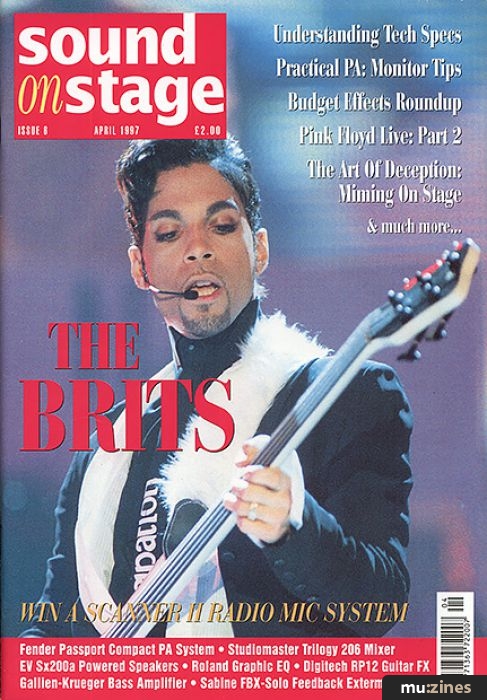
The Brit Awards '97Article from Sound On Stage, April 1997 | |
The girls were spicy and the boys were manic at this year's glittering celebration of the British pop industry. With nine acts to cater for, how did the engineers on the monitors and at front of house cope? Dimension Audio's Derrick Zieba and his colleagues told Mark Cunningham everything he really, really wanted to know.

With the exception of the deaf, dumb, and blind, no one living in the United Kingdom this February could have escaped the magnificent media hype which preceded the 1997 Brit Awards, the industry barometer for all British pop artists. Earl's Court was the venue for the second year running, and all eyes were fixed on the gleaming Bill Laslett-designed stage in the hope that a Jarvo vs. Jacko style incident might once again make the news. However, apart from a brief four-letter outburst from award presenter Elton John and some nonsensical utterance by Kula Shaker's would-be mystic Crispian Mills (neither seen by the TV audience), the show ran without controversy. If anything, host Ben Elton's normal acid wit was disappointingly tame.

After a frustrating delay, the event got off to a blistering start when the nation's favourite female act, the Spice Girls were accompanied by copious pyrotechnics for 'Wannabe'. They were followed, in between award ceremonies, by a string of diverse and outstanding performers. In order, they were Mark Morrison, Jamiroquai & Diana Ross (singing 'Upside Down'), Skunk Anansie (with an unexpected cover of The Undertones' 'Teenage Kicks'), The Short Bloke Who Was Christened Prince Rogers Nelson (aka The Artist), Fugees, Sheryl Crow, Manic Street Preachers (who stole the show with their stunning 'A Design For Life'), and finally the Bee Gees who, as recipients of their lifetime award, saw fit to play a medley of hits stretching back over 30 years.
While record industry execs and hopeful artists dined at the cost of £350 per head, and other spectators coughed up £100 to sit in the Gods, I gained a fantastic view of the proceedings on the front-of-house mix platform... stomach empty but wallet intact. It was here that I jostled for position in between six consoles, while engineers Steve Ludlum and Chris Coxhead got on with the frenzied task of balancing the sound for all of the acts, five of which were completely live, the others singing live to playback.
LEADING TIMES
It is ironic that the lead time for such an involved show is relatively short. Derrick Zieba of Dimension Audio, the audio rental company hired to provide all of the sound orientated services since 1993, says that his first contact with the BPI (the show's governing body) was last October when he was made aware of the forthcoming event's venue and date, and an outline of Dimension Audio's involvement and preliminary budgets. He said: "We generally know who the performing bands are about two weeks in advance of the show itself, and sometimes the lead time on detail for those bands in terms of line-up, miking, and special requirements can be just a few days before the event. Obviously, the show is a topical one, and the organisers want it to be as up to date as possible, so they leave it to the last moment to announce the performers. That gives us the greatest possible problem, because we are estimating everything. On top of that, there are lots of politics, which govern the way in which we operate. Nevertheless, we still come through!"
When I arrived at Earl's Court 72 hours before showtime, the sound requirements for The Artist were still a mystery to Zieba and his crew. On the Friday evening, he told me: "He is rehearsing tomorrow, but we still do not know what he needs from our mics and desk space. This is the normal pattern for The Brits. We currently have as much information as we're allowed and have estimated how we might cover the performance. We've run it down to two possible scenarios of what he wants to do and how he might stage it: one is a very live affair, the other is using track where there may be lots of dancers." It turned out to be the latter.
The pattern and style of the Brits often changes from year to year. Owing to a shortage of rehearsal time last year, there were a number of technical problems which marred the occasion, and the original intention for 1997 was to have a large percentage of performances to playback, in order to minimise risk. But following a dramatic increase in pre-production time, a reverse decision was put into action. "The live element is very good for the excitement it generates, but having all the necessary information so late in the schedule is not the ideal situation for us. It certainly keeps us on our toes," commented Zieba.

Dimension Audio's Derrick Zieba shares a laugh with Bryan Grant of Brit Row.
REHEARSALS
Rehearsals and soundchecks took place over the weekend prior to the Monday night show. Each band was given a two hour slot to rehearse their moves, while the engineers noted mix positions and TV director David Mallet assessed various camera angles for broadcast purposes. Said Zieba: "Sometimes if it is a particularly complicated setup, as it is for the Manics with their string section, we will extend that time forward and attempt to make up time in advance. The Manics are coming in early on Saturday, and their complex stage set (which combined both live and abstract video footage) will have been pre-prepared before the band start rehearsing. By and large, it is still quite a tight rehearsal schedule. We will get through every band over the weekend and have a final dress rehearsal on Monday, which we'll use to go through all the aspects of the show in running order. It's a staggered run through, and although we won't go through every number, we will rehearse the changeovers."
This was my first time at the Brits, and it was extraordinary to find that even though it was not to be broadcast to the nation until the following evening, it was run almost wholly without pauses — as if it were being aired as it happened. "Because of the lack of editing time overnight before broadcast on Carlton TV, we all have to treat it as a live event. In the case of two particular acts in the programme, there are just three minutes and six seconds to get one act totally offstage and the next act in place, set up and ready to perform. All this madness happens while awards are taking place on the same stage. That is quite a feat."
FORGING RELATIONSHIPS

At front of house, four Yamaha PM4000 consoles took care of all the acts with the exception of Jamiroquai/Diana Ross whose sound was controlled from a Midas XL3 and an XL3 16-channel stretch board.
Although Dimension Audio is no stranger to the awards, this year marked its first tie-up with Britannia Row, who were sub-contracted to supply a substantial Turbosound PA system. Said Zieba: "The size and nature of the event at Earl's Court last year determined that we had to sub-hire an enormous amount of equipment from various sources to add to the core system and contract additional crew. In any show where you are sub-hiring to that degree, clearly not all the equipment you have will be up to your desired standard. There were also problems with interfacing different boards and processing from different suppliers.
"Knowing that it would be a longer event this year with more acts, I felt that my time would be better spent on the audio design, and interfacing with the crew and television personnel. So I've booked the engineers and am overseeing the whole sound effort, while Brit Row have supplied and installed, and are servicing, the entire PA."
Apart from additional load-in and out hands, Zieba's hand-picked crew consisted of two front-of-house and two monitor engineers, four people on stage to look after the miking and setting up, plus Brit Row systems technician and troubleshooter Gerry Bradley. "The arrangement has worked absolutely brilliantly, and all the crew get on very well together. We've got the best of both worlds: Brit Row don't have any of the hassle of dealing with the TV company or trying to get information out of bands. I deal with all of that, while they deliver all the show's requirements.
Because they are such a big rock'n'roll company, Brit Row have everything that's needed in their warehouse, and so everything interfaces well together first time, and consequently, this year is a much easier ride. If I'm involved in the Brits again next year, I will certainly go down this route, and hopefully, with the relationship that has been forged between Dimension Audio and Brit Row, we will use this arrangement on other big shows of this kind."

Ben Elton moves away from his lectern and takes up an AKG hand-held mic for some gentle banter with the audience.
FLASHLIGHTS
Walking into the empty auditorium on the Friday, my eye was immediately drawn to the high-spec PA, which was noticeably more complex than the one used by The Who in the same cavernous venue last December, even though the audience was considerably smaller this time around. The system was designed around a BSS-amplified flown Turbosound Flashlight rig, the configuration of which was determined by the television-led nature of the event. With cameras ruling the roost and no space in which to stack sub-bass or front fill cabinets, Brit Row's Pete Brotzman organised for the subs to be incorporated into the flown clusters — possibly a first for rock'n'roll. In total, the front clusters featured 18 Flashlight and 16 bass cabinets, four underhung highs and two underhung mids per side. These clusters were flown at an incredible height to prevent the PA from obstructing camera views of wide stage shots. The side 'hangs' for the tribune were four Floodlight boxes and two underhung mids per side, and infills consisted of eight Meyer UPAs and four Turbosound bass cabinets per side. Delays in the upper balcony were catered for by four Floodlights per side, while the total of cabinets, left and right, in the main delay clusters amounted to 16 Flashlights and 16 bass.
But why this level of sophistication?
Zieba explained: "Firstly, this is not a rock'n'roll show. Although it contains rock'n'roll acts, it is primarily an awards event. I organise the sound for a lot of these types of shows, and unless the audience are interested in what is being said and which awards are being handed out, you lose those people, and this had been happening with the Brits over recent years. It is a very difficult task to control the level of audio on the bands as well as having the presenters' speeches well heard and well covered in the hall.

In 'monitor village', five interlinked Midas XL3s were manned by monitor chief Alan Bradshaw (right) and Gareth Williams.
"When I got involved, one of the principles that I developed for the show was to use a delayed sound system for speech, so that everybody could hear every word of what was being said in the awards ceremony and get fired up by the ad lib quips by people like the Gallagher brothers that may otherwise be lost. That kept the audience's attention and it made for a much better camera cutaway to the audience who were obviously excited. For that reason, we have designed this system to operate in a similar way. The delays, underhung speakers in the balcony, and gallery throws all guarantee that the award sections of the show are exciting to hear, regardless of the live music."
Sure enough, the system worked brilliantly for both the live music and the presentations, although Ben Elton's voice did fade into the background at times [sorry Ben, little bit of politics there!]. Despite being capable of bone crunching volume levels, as Oasis fans will know, the Flashlight PA's output was kept to a polite minimum for the benefit of the diners. "We don't want the levels to get out of hand down the front," says Zieba. "Of course, it's a massive auditorium, and so the idea is that the delay system gives the engineer on the mix platform something to mix to and allows him to generate a decent level rather than one which is uncontrolled at the front. Our aim is to keep things as even as possible throughout the hall."

The lion's share of the mixing duties fell on Chris Coxhead (left) and Steve Ludlum.
ENGINEERS
The lion's share of the mixing duties fell on Steve Ludlum and Chris Coxhead. The division of their responsibilities was very clear. Ludlum mixed most of the live bands, and in cases where bands had their own engineer (such as Jamiroquai's Rick Pope and Skunk Anansie's Dave Ramsay), he 'babysat' the desk to ensure everything went smoothly. Ideally suited to the event, not least due to his experience in both rock'n'roll and award shows, Coxhead was mixing all of the live vocal to playback performances, the walk up 'stings', VT inserts, presentations, and sections of the show when Ben Elton moved from his lectern for some hand-held mic banter.
"We might assume that most of the acts will bring their own engineers, but it isn't always the rule," said Zieba. "Two years ago when we had Madonna, we were pretty certain that Trip Khalaf would be coming from the States but he didn't arrive, so I mixed Madonna instead and John Roden did the monitors. She was very pleased too! We're never 100% sure until the day of the show exactly who is doing what, but we are well prepared for any situation."

At front of house, four Yamaha PM4000 consoles took care of all the acts with the exception of Jamiroquai/Diana Ross whose sound was controlled from a Midas XL3 and an XL3 16-channel stretch board. They were all bussed together into one main console, which formed the output for the system. A similar scheme was followed backstage in what could only be described as 'monitor village' — a mound of flightcases behind which lay five interlinked XL3s, manned by monitor chief Alan Bradshaw and Gareth Williams. Bradshaw said of the XL3: "It's extremely silent, but in a situation like this, one of us has to make sure that all the inserts on the boards not in use are out and that everything is switched on at the right time. It's not as foolproof as it may seem!"
Both up front and backstage, every artist's requirement in terms of outboard rack equipment was adhered to, especially where graphic equalisers were concerned. I have never seen so many BSS FCS-960s gathered together in one place! Other notable toys of the trade in evidence in the two engineering territories included KlarkTeknik DN-360 graphics, dbx 160A compressor/limiters, Drawmer gates and compressors, Lexicon 480L digital effects, Eventide H3000 Ultra Harmonizers, a Roland SDE-330 Space Delay (used exclusively for the Manics), Lexicon PCM-70 digital effects, Yamaha Rev 5 digital reverb, and Summit DLL-200 dual compressor/limiters. They couldn't go far wrong, could they?
Turbosound wedges were out in full force, although the Bee Gees and Mark Morrison had also requested Garwood in-ear monitors, which also proved useful for non-musical applications. Williams explained: "The in-ears are also used for our shout system, which is used during line checking by the front-of-house guys, myself, and the Manor truck in between bands. There are two engineers on stage with systems that share one frequency on the Garwoods. It's now a standard Brit Row festival policy to use in-ears for line checking, but for this type of event, this kind of system is invaluable because it is so silent and discreet.
"We regularly do festivals where we have two desks, and we are operating on the same principle, only there are five. Whereas at a festival, each band will perform for about an hour and the engineers can get into it, here the performances are literally one song in length and the changeover times are so short. So it might seem that we're putting in a lot of effort with little to show for it. That's why there is so much control backstage, because there is no time to spend on resetting a desk."

Winners of Best Group: Manic Street Preachers.
MIC CHECK
In previous years, Dimension Audio has specified the pencil-thin, television industry-standard AKG C747 microphone for show presenters. However, Zieba firmly believes that this is not the right tool for the job... "What we are dealing with are presenters who are used to rock'n'roll and familiar with a microphone with a head on it. We often suffer from instances when because someone didn't know where the mic was or where they were meant to stand, they've actually gone right down on the mic and created havoc with sound systems both in the truck and in the hall. This year we have gone for a different approach, which is to put some Neumann KM-140s on goosenecks with pop shields so that the presenters see a mic which they will definitely recognise. We hope the visual aspects of the mic will be reasonable for TV, and it will certainly give us an improved audio result."
Whilst not overtly apparent in the hall where, it has to be said, most speeches were clearly audible but a little on the thin-sounding side, I did note that the mic produced the goods for TV when I reviewed the show the next day. Blindingly obvious, however, was the excellent quality of the AKG WMS900 UHF wireless radio mic system of which eight channels were in use for singers with AKG Tri-Power C5900 hand-held transmitters. This system has captured the support of many leading names over the last couple of years, notably Mick Hucknall, Rod Stewart, and Marti Pellow, but it really came into its own when it saved the '96 Brits from certain disaster.
Derrick Zieba takes up the story: "Through the bands' own choices, we supplied Shure VHF radios with Beta 58 heads last year, and as expected they worked perfectly throughout rehearsals and during every single artist warm up. At about 6.30pm on the evening of the show, however, every microphone was suddenly blighted by interference. The trouble occurred when the doors were opened to let the audience in along with TV crews doing interviews with the artists and following celebrities around. Because the radio frequency spectrum in this country is so tight, they were using equipment that was on the same channels as our hand-held mics. The net effect was such that we had to wipe out all of the Shure mics. Interestingly, the only mics unaffected by this interference and which worked without a problem were the three AKGs we had been loaned by Harman, which Mick Hucknall insisted on using. They were his main mic, a backup, and a spare, and we did every single band that needed a hand-held with those."
Needless to say, Zieba's choice this year was enormously influenced by this reliability. "I would have been foolish to have gone with anything other than the AKG WMS900 equipment," he insisted. "They sounded great for broadcast, they suited the rock'n'roll side of the show, and Harman was kind enough this year to send down one of their engineers, Ian Oakland, with a rack of those mics for us to use. So every hand-held seen on TV, as well as the headset mics used by some artists, are all from AKG. Otherwise we go by all the bands' traditional microphone spec for drums and guitar cabinets, and follow their riders one to one. We don't interchange instrument microphones; as soon as one band is finished, their mics are put away and another set brought on for the next act."

Ian Oakland was microphone 'nursemaid' for the night, looking after the AKG WMS900 wireless mics.
Microphone 'nursemaid' Ian Oakland himself explained further about the system: "The eight hand-held mics run in TV channel 69. We actually have the capacity for 12 mics, although this would mean a fair amount of doubling up on frequencies. The way Dimension Audio have worked out the frequency allocation and plotting has allowed plenty of spares to be available at any one point during the show. The presenter will always have a spare. When the Spice Girls come on with five mics, the presenters' mics will become spares for them. The receivers are stored in a rack behind the fourth monitor desk, and there is an active omni antenna either side of the stage."
ROCK ON
Whilst sound will always be this magazine's main raison d'etre, mention must also be made of a number of other aspects of the show's production, especially Blackfriars' excellent set build, Unusual's rigging, Micky Sutcliffe's sensitive lighting design, and the 11.76 x 6.25 metre ultra high resolution Sony JTS-17 Jumbotron screen at centre rear stage supplied by Screenco through Chris Saunders at Black Pig.
So no Jarvo-like antics this year then. But the spin-off advantage was the extra emphasis placed on the attention-deserving music which, when you remove the hype, is what this event is supposed to be about, after all. Roll on '98... when Oasis win the Best Album award — as predicted here first!
SPECIAL 'K'
How does his job at the Brits compare to that on a large multi band festival? "There are radical differences, because anytime that you introduce the element of television, you are immediately working to another discipline altogether," he insists. "On a festival, you are dealing with a show as it happens, in front of a finite audience, and your eye for detail is trained to observe other aspects. Even if there are television cameras at the festival, they are only recording what they see happening live. But this show is driven by a TV director working with a TV set designer, who together have the final word about everything. They are God!
"This show is unique in that you have a very important live audience — the record industry — who are ultimately funding it. The most important consideration is what we are delivering to Carlton to broadcast the next day. What we are trying to create is the live element of rock'n'roll in a controlled environment or, if you like, rock'n'roll that is designed to suit television. In a festival situation, we would be looking for the biggest stage that we could create in a field, because we want the guy at the very back of the audience to get a feel for what's happening. At the Brits, we are tailoring a very exclusive, five star, luxury environment, combined with the freedom of a festival, and it must look good on a TV screen. In essence, we are using rock'n'roll technology to create something special by combining two disciplines."
GOIN' MOBILE
Three trucks were used for recording while a smaller truck (Mobile 4) was employed as the event's communications centre, as well as sending sub-mixes of the audience to the outside broadcast truck. Oliver, who administered the event recording effort according to Head of Sound Toby Allington's brief, said: "On a show like this, one of our most crucial responsibilities, apart from getting music on tape, is to allow the crew to be able to talk to each other. There are line checks going on at different times in different trucks, with stage engineers, production crew, and directors all wanting to communicate from various areas of the venue, so we end up with tons of comms channels. Our small truck, with its Soundcraft Sapphire desk, is perfect for dealing with that side of the event; the audience feeds and comms going to and from it use 48 channels alone. That leaves the three larger trucks to mostly concentrate on the music recording.
"There are 260 lines coming off that stage and everything is going through a splitter. We take 'one for one' on everything controlled by the band engineers, and they will return to us things like playback feeds, audience feeds, walk up stings, and VT information. In terms of how we link up with each other, there is certainly some busy two-way traffic going on."
Manor Mobile 1 acted as the main truck and, as usual, boasted a 48-channel 32 buss SSL E Series console with G Series computer, which ran in tandem with a 24-channel 16-bus API. Both desks were linked to 72 channels of API remote mic preamps, which sat on stage but were controlled in the truck by the engineer who altered the gain as he sat at the desk. Mobiles 2 and 3 operated 72-channel 48 buss Raindirk Symphony desks, which are ideal for live recording due to their silent operation and immense headroom. Another bonus of the Symphony is that it has dual mic inputs, which results in 144 channels for use on each desk. Also inside Mobile 3 was a Yamaha 02R digital console (on hire from FX Rentals), which was used to sub-mix and send out track playbacks from a SADIE system, as well as controlling the mixes of live vocals to the pre-recorded backing tracks.
Mobile 1 remained parked outside the rear of Earl's Court throughout the whole of its residence. Nevertheless, it did not miss out on the action. Of the recording procedure, Oliver said: "We'll record one of the bands on Mobile 2 in the hall, and when that is done, the multitrack tapes are sent outside to Mobile 1 to be mixed as we are recording another band. Our deadline to deliver a whole mixed show to the broadcast company by 2pm, which really means we have to complete our takes by midday. We are trying to do as much of the post-show mixing on site as we can this year, although in previous years we have provided one or two trucks and then driven the tapes to the VT editing suite at Telecine where we have run off DATs of finished mixes and immediately handed them to the vision editors. But that is a logistical nightmare, from a time point of view. To allay that time problem, we have brought in extra trucks, which allows greater freedom and better organisation between the recording of each act. We are still going to drive over to Telecine as soon as the show finishes to do any final amendments that are necessary, but working in this way means we will have a lot less to do there.

Mike Oliver (left) with engineer Dave Porter in truck no. 1.
"At the end of the day, the finished mixes are put on to DAT and laid back on to the vision mix at Telecine before being biked over to Carlton. To make sure that Carlton knows what it will all look and sound like in advance, extracts are previewed to them via ISDN, so that they can approve sections as they are being edited."
How much time is allocated for each band's mix? "It really depends on how the bands performed. Obviously, if it was a poor performance, we'll have to work on bringing it up to standard in terms of sound quality and smoothing out the rough edges with processing. But if someone plays a bum note or sings terribly, there is little we can do. Fortunately, however, the calibre of artists at the Brits normally guarantees excellent quality. The object of the exercise is to get the monitor mix as close as we can to the final product. There are, of course, many improvements, which can be made to a monitor mix. The signals will be a lot drier going to tape, although they will still have compression for level purposes. When we do the final mix, we will attempt to re-create certain flavours of the sounds heard in the hall by applying authentic reverbs, delays, and other effects. The rehearsals that we've had here have just been one or two run throughs, so we don't have the luxury of getting the sound spot on before the show and then recall it on the desk. To a certain extent, in this situation we are flying by the seat of our pants!"
Manor Mobiles has become a notable growth area within the EMI studios group. Since Oliver arrived, he has seen the company's turnover rise from £170,000 (with one truck) to an estimated 1996-97 figure of almost £750,000. This is set to increase to £1 million next year as plans to expand into other countries are put into motion. Much of this success arguably lies with the burgeoning trend among artists to record live — a side of the business which is enjoying its first major boom period since the nomadic hippie days of '70s yore. Over the last few years, Manor Mobiles has recorded a breathtaking array of live albums by artists Including Bon Jovi, Paul Weller, Sex Pistols, Plant & Page, Eric Clapton, The Cure, Van Morrison, Gary Moore, Simple Minds, and AC/DC.
So why this renaissance?
"I think artists are a lot more confident about recording live than they ever were in the past, simply because they can now trust the technology and expertise, and gauge their worth by listening to some of the great results we have produced. That confidence is evident by the number of live tracks, which now crop up on CD singles and also the proliferation of long format live videos."
COUNTDOWN TO THE BRITS
PA system arrives and is rigged; front-of-house mix position erected and equipped; multicore cabling laid.
Thursday 20th February:
Monitor control system set up with desks and processing; basic two-hour soundcheck for system EQ; delays configured.
Friday 21st February:
Further changes to system EQ; stage monitor wedges positioned; line checking through multicores on stage; Manor Mobiles linked to monitor control at 5pm; line checking with Manor Mobiles; PA ready for action; Mark Morrison rehearsal.
Saturday 22nd February:
Manic Street Preachers set up & rehearsal; further rehearsals with Fugees and The Artist.
Sunday 23rd February:
Rehearsals with Spice Girls, Skunk Anansie, Bee Gees, Jamiroquai & Diana Ross, and Sheryl Crow.
Monday 24th February:
Staggered run through rehearsal of entire show during afternoon; doors open 5.30pm, dinner commences at 7pm, show (eventually) starts at around 9.00pm and ends at 11.10pm.
Tuesday 25th February:
Overnight sound and vision editing; The Brit Awards '97 broadcast on Carlton TV at 8.00pm.
THE 15 BRIT AWARDS
| Best Male Artist: | George Michael |
| Best Female Artist: | Gabrielle |
| Best Group: | Manic Street Preachers |
| Best Album: | Everything Must Go by Manic Street Preachers |
| Best Single: | 'Wannabe' by Spice Girls |
| Best Video: | 'Say You'll Be There' by Spice Girls |
| Best Newcomer: | Kula Shaker |
| Best Dance Act: | The Prodigy |
| Best International Group: | Fugees |
| Best International Male Artist: | Beck |
| Best International Female Artist: | Sheryl Crow |
| Best International Newcomer: | Robert Miles |
| Best Soundtrack: | Trainspotting |
| Best Producer: | John Leckie |
| Outstanding Contribution to British Music: | The Bee Gees |
More with this topic
 How Many Watts? |
 Road Worthy |
 Don't Forget Your Toothbrush! - The Essential Gigging Toolkit |
 PA Column |
Sick As A Player - Here's Health |
 Stagecraft - Big George's Guide To Good Gigging |
Light Show |
 Say It Loud! - Power Amps and Loudspeakers |
 Gloria! - Gloria Estefan live in Miami |
Stage Fight |
 Sounds good, John |
 PA Column - Live Aid |
Browse by Topic:
Live
Publisher: Sound On Stage - SOS Publications Ltd.
The contents of this magazine are re-published here with the kind permission of SOS Publications Ltd.
The current copyright owner/s of this content may differ from the originally published copyright notice.
More details on copyright ownership...
Sound On Stage - Apr 1997
Feature by Mark Cunningham
Previous article in this issue:
Next article in this issue:
Help Support The Things You Love
mu:zines is the result of thousands of hours of effort, and will require many thousands more going forward to reach our goals of getting all this content online.
If you value this resource, you can support this project - it really helps!
Donations for June 2026
Issues donated this month: 0
New issues that have been donated or scanned for us this month.
Funds donated this month: £0.00
All donations and support are gratefully appreciated - thank you.
Magazines Needed - Can You Help?
Do you have any of these magazine issues?
If so, and you can donate, lend or scan them to help complete our archive, please get in touch via the Contribute page - thanks!
Please Contribute to mu:zines by supplying magazines, scanning or donating funds. Thanks!
Monetary donations go towards site running costs, and the occasional coffee for me if there's anything left over!

 @mu_zines
 RSS Feed
 Blog
Blog