


Magazine Archive
Home -> Magazines -> Issues -> Articles in this issue -> View
Using Microphones | |
Article from Home & Studio Recording, December 1983 | |
Tips on miking up drums.
Beginning with this issue, Using Microphones will deal with actual recording situations. As a starting point, one should always keep in mind that the instrument itself has to sound right in the first place and it is the instrument's acoustic properties that determine microphone choice and placement. So these acoustic properties will be pointed out. They will require certain characteristics from the microphone to do the job. This way, suitable microphones can be selected. However, proven microphone choices will be mentioned. Finally, I will also cover the use of microphone-related electronic devices.
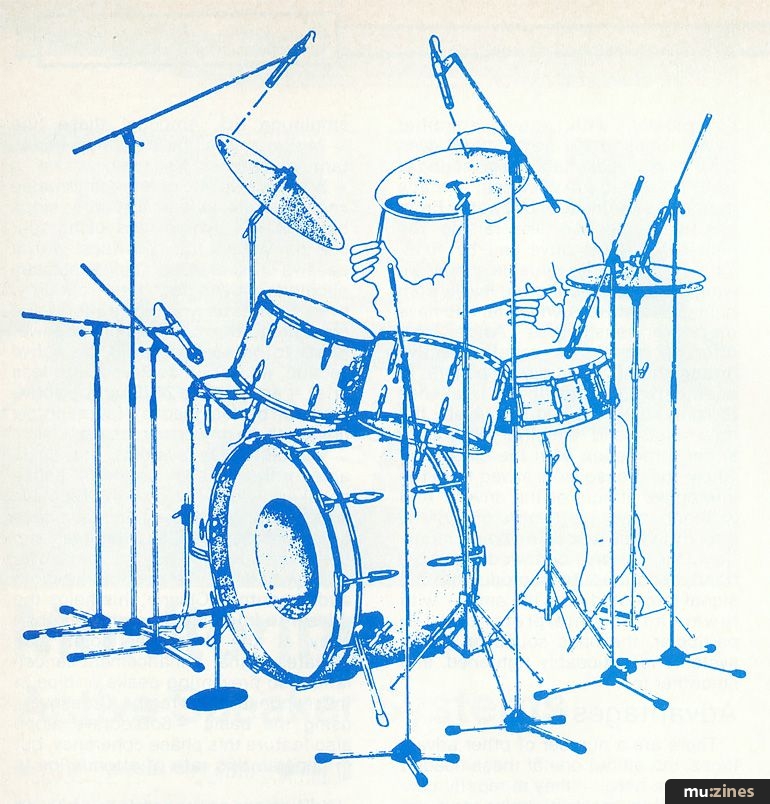
Figure 1. Typical mic placement for recording drums.
Recording Drums
Unless you are one of the many home recordists who have replaced the sweating, smoking, beer-drinking human drummer with a neat machine that will never be late or out of time, then the creation of a good drum sound is as big a challenge for you as it is for every sound engineer.
First, the drums have to be acoustically treated. Head choice, tuning and damping depend on musical style and the drummer's personal taste. But keep in mind that room acoustics and the sound of the kit work together. So your own recording room may necessitate a change of heads, tuning and (practically always) damping of the drum kit.
Close Miking
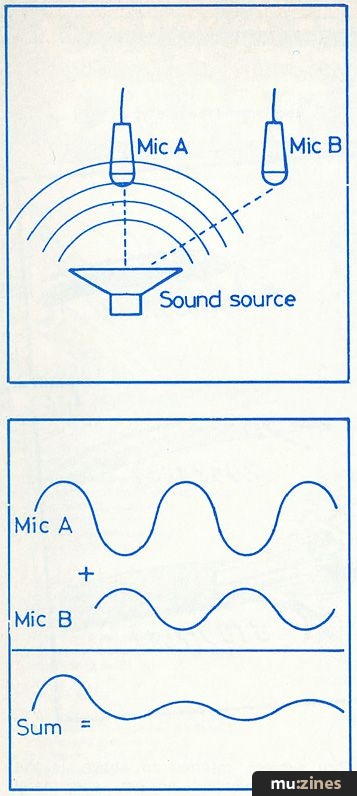
Figures 2 & 3. Phase cancellation/addition in microphones.
Figure 1 shows the usual way a drum kit is miked up for PA and studio use. Few people seem to be aware of how much spillover occurs in this setup. (Check each microphone once alone to get the feel). This means that EQing and balancing must be made with the combined sound of all microphones in mind. The overhead microphones especially contribute a lot to the sound of tom-toms and the snare drum. Also you should be aware of phase cancellation problems that can be caused by too many microphones (see figures 2 and 3).
The sound from the source is 'heard' by microphone A at full level and, weaker, by microphone B (it's a cardioid microphone as it suppresses sounds from the side). The distance from the source to microphone B is longer than that to microphone A so the sound arrives later at B, whose signal is then out of phase with A's. Added together via the mixing console, they produce a poor result, and the more microphones, the bigger the mess.
To minimise unwanted phase cancellations, the microphones should be positioned close to the sound sources and good quality microphones used: uniform side - and rear - sound suppression characteristics ('tight' polar diagram) make them easier to control.
Kick Drum
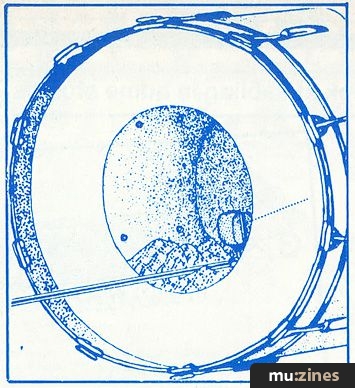
Figure 4. Bass drum.
First the heads have to be carefully damped, with a blanket, a pillow or something. The microphone usually is brought into the drum through the hole in the front head, but a recording from outside also brings good results. Try different positions!
The sound pressure level inside a bass drum is enormous, especially near the centre of the head and at a close distance to it. Therefore dynamic microphones with good bass response are the standard choice: the AKG D12 or the EV RE20. A tighter sound, emphasising the mid frequencies, can be achieved with the AKG D125 or the Sennheiser MD421. Some studios prefer the AKG D202. It doesn't have any proximity effect (bass rise at close working distances) and therefore won't change its bass response, if the distance to the head is changed.
Snare Drum
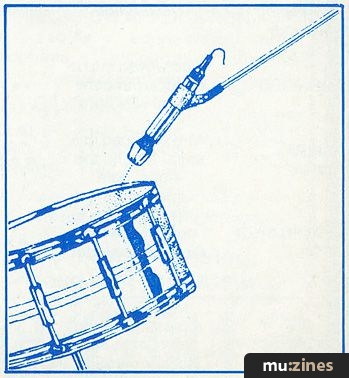
Figure 10. Snare.
The overtones of the snare drum reach up to over 16kHz, especially if picked up from below. When a good high frequency response is needed, a condenser microphone is always the best choice: Neumann KM84, AKG CK1/C460. The CK1/C460 can be fitted with a swivel adaptor for example, making it easy to get close to the snare head at a convenient microphone position.
Dynamic microphones that sound good include: AKG D125, Beyer 201, Sennheiser MD441, Shure SM57, but most dynamic mics are suitable for demo purposes. The microphone should point toward the perimeter of the head; the snare may be additionally picked up from below (try phase changes).
Hi-Hat
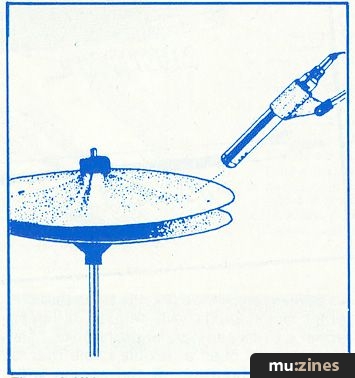
Figure 6. Hi-hat.
If you've got a quid or two to spare, you can always invest in an extra microphone for the hi-hat. But remember: one good microphone for snare and hi-hat together is by far the better choice than two bad ones.
Separation from the snare is the objective so point the microphone away from the snare, and use a microphone with a hyper-cardioid polar pattern (best off-axis attenuation) like the AKG CK3/C460. The dynamic alternative would be the Beyer M160 (ribbon mic!).
Tom-Toms
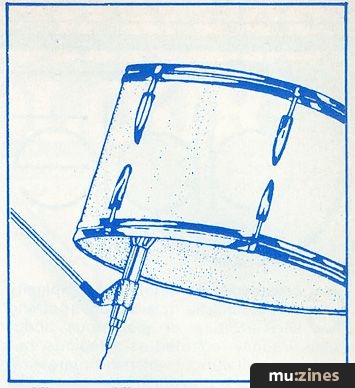
Figure 5. Tom-tom.
Tom-toms again need careful damping to get rid of the ringing. Two microphone positions exist: from above the head (2 to 4 inches away), pointed toward the perimeter of the head; or to stick the microphone inside the drum (remove bottom head). This second way gives you better separation, but requires better damping and more EQ, because resonances will be picked up louder.
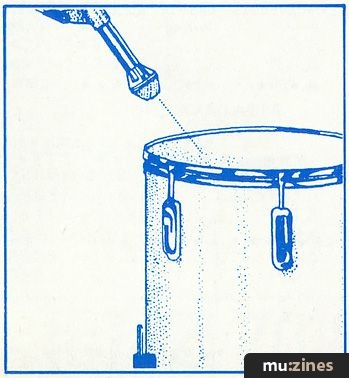
Figure 9. Floor tom.
The limited frequency range of the tom-toms makes low-cost dynamic microphones the best choice (saves you money for a good bass drum or snare microphone): AKG D80, D125, EV PL6, Shure 588 SB, 565 SD. Don't use electrets as they tend to distort pretty fast.
Cymbal/Overheads
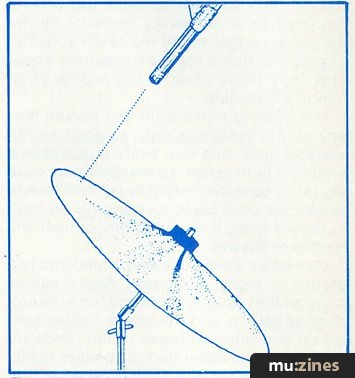
Figure 7. Cymbal.
Just like the snare drum, the cymbals deliver overtones up to above 16kHz, which should make you go for condenser microphones. Top quality dynamic types could be an alternative: AKG D224, Sennheiser MD441 for example. Positioning of the overhead microphones depends on how much sound of the whole kit you wish to be picked up. Try several positions!
By using a microphone with a figure-8 polar pattern to pick up cymbals excellent acoustic separation could be achieved, keeping sound spillage from tom-toms, snare drum etc. to a minimum. Frank Zappa used this microphone position employing AKG C414s with switchable polar patterns to great effect.
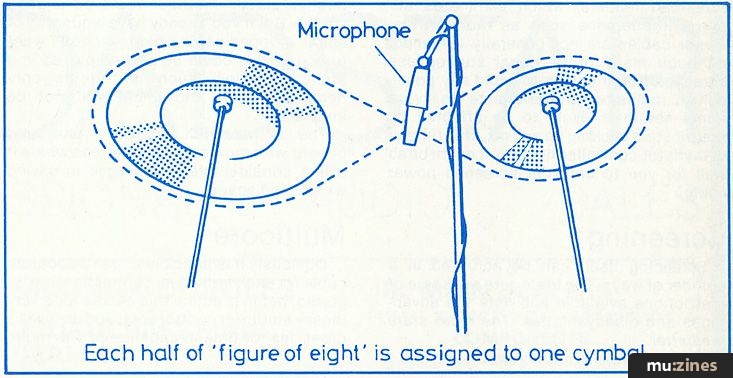
Figure 8. 'Figure of 8' pick up of two cymbals.
You can use the two overhead microphones to pick up the whole kit (except the bass drum) quite satisfactorily: bring down the overhead microphones at the drummer's back to about shoulder height, maybe one or two feet to the side from each ear, pointing at the kit. Then carefully balance the sound of the cymbals with the tom-tom and snare sound by slightly altering the microphone position. Together with the bass drum microphone this gives a good image of the drums.
This also demonstrates an alternative way of microphone positioning: to put a microphone near the musician's ears, making it 'hear' the way the musician does, is sometimes a good solution in difficult recording situations.
Saving microphone stands is one advantage if you pick up the drum kit with small electret condenser microphones. They can easily be attached to each drum or cymbal stand with tape. But they also provide good acoustic separation when used inside the bass-drum or the tom-toms. For these applications a Countryman BM101 is a good choice, since it can handle very high pressure levels (152dB). For snare drum and cymbals some alternatives are AKG C567, Beyer MCE5 or Electro-Voice C090.
On The Road
If you intend to use your microphones onstage as well, go for robust dynamic types. Condensers (you'll need them at least for overhead pick-up), when designed for onstage vocal use (eg. AKG C535), are rugged, too.
Drum risers often resonate terribly, the vibrations being transmitted via the stand to the microphone. To get good suppression of such 'structure-borne' noise, consider vocal microphones (especially for tom-toms) or use elastic microphone suspensions.
Next time I will carry on with more microphone hints.
More from these topics
 Is Analogue Multitrack Recording Dead? |
 Using A Stereo Mixer - for multitrack recording |
 Hands On: Cassette Multitracks |
 The Art Of Recording Electronic Instruments |
 Heroes (Part 1) |
 Using Microphones - Recording the Bass |
 Reading The Meter |
 Perfect vocals - how to sing them, how to mic them, how to treat them, how to tape them... |
 Hands On: Sound Tools |
 Step by Step |
 Virtual or Reality |
 Getting The Most From A 4-Track - Better Recording |
Browse by Topic:
Microphones
Recording
Publisher: Home & Studio Recording - Music Maker Publications (UK), Future Publishing.
The current copyright owner/s of this content may differ from the originally published copyright notice.
More details on copyright ownership...

Home & Studio Recording - Dec 1983
Donated & scanned by: Mike Gorman
Feature by Wolfgang Staribacher
Help Support The Things You Love
mu:zines is the result of thousands of hours of effort, and will require many thousands more going forward to reach our goals of getting all this content online.
If you value this resource, you can support this project - it really helps!
Donations for June 2026
Issues donated this month: 0
New issues that have been donated or scanned for us this month.
Funds donated this month: £0.00
All donations and support are gratefully appreciated - thank you.
Magazines Needed - Can You Help?
Do you have any of these magazine issues?
If so, and you can donate, lend or scan them to help complete our archive, please get in touch via the Contribute page - thanks!
If you're enjoying the site, please consider supporting me to help build this archive...
...with a one time Donation, or a recurring Donation of just £2 a month. It really helps - thank you!

 @mu_zines
 RSS Feed
 Blog
Blog