Welcome to the Machine
(STG Mar 97)


Magazine Archive
Home -> Magazines -> Issues -> Articles in this issue -> View
Welcome to the Machine (Part 2) | |
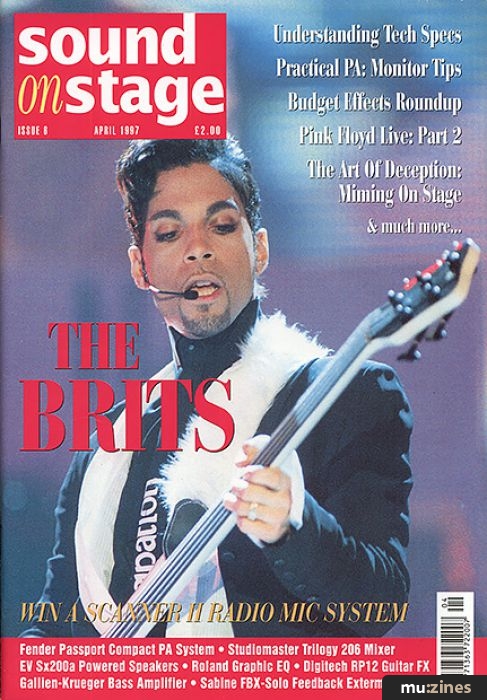
The Story of Pink Floyd's Live Sound | Pink FloydArticle from Sound On Stage, April 1997 | |
In the wake of their huge success with the Dark Side Of The Moon album and tours, Pink Floyd graduated to stadium status and helped to shape the future of top level touring sound with the formation of their own PA rental company. In the second installment of this four-part series, Mark Cunningham chronicles the band's Wish You Were Here and Animals period of the mid '70s.

Image credit: Redferns/David Redfern
After two American tours which had seen the debut of their new three-way active PA system, Pink Floyd returned to Blighty to make their only UK concert appearance of the year, at the Knebworth Festival on Saturday 5 July 1975. This performance witnessed the live premiere of the forthcoming album, Wish You Were Here, nine weeks before its release, and it came exactly seven days after the Floyd's last North American date in Toronto, the end of which was notable for a huge unplanned pyrotechnics explosion that resulted in the shattering of several nearby residents' windows!
Mick Kluczynski's foreign duties at the time included clearance of equipment into a country, arranging trucks, and organising load-ins. At the end of a tour, after the band and crew returned home, he stayed to supervise the trucking of all the equipment and then do the bookwork. With Knebworth so close, it was decided that Robbie Williams and Graeme Fleming would prepare for Knebworth in Kluczynski's absence during the early part of the week.

Pink Floyd's 1975 classic 'Shine On You Crazy Diamond' was performed live for the first time in the UK on November 4 1974 at the Usher Hall in Edinburgh — the first date of their autumn/winter British tour. Before the doors opened, the road crew posed for this rare photograph which also shows the band's second generation Allen & Heath desk, lighting console (on left), the TEAC four-track tape machine for sound effects, and the PA stacks with the front quad speakers at the right-hand side of the circular screen. Left to right: Paul Devine (lights), Graeme Fleming (Lighting Director), Peter Revell (projectionist), Coon (intercoms), Bernie Caulder (quad and drum technician), Robbie Williams, Paul Murray (projectionist), George Merryman (technician), Mick Kluczynski, Nick Rochford (truck driver), Unidentified, Mick Marshall (lights), Robin Murray (lights), Phil Taylor, two unknown truck drivers. On stage in the background, Rick Wright is seen tinkering on his grand piano.
Image credit: Courtesy Phil Taylor/David Gilmour Music Limited
Kluczynski recalls: "The gear arrived back in the UK on the Wednesday, and it got to Knebworth on the Friday morning ready for rigging. We had ordered some JBL long throw horns, the old seven-foot long fibreglass festival horns, but didn't get delivery of them until the Friday night. So literally on Saturday morning, Robbie and I were building them into the rig. We had the Floyd set up totally independent of the support bands [which included Captain Beefheart and Linda Lewis], which was the normal approach for us, although we would normally run the show for them. However, because the Floyd crew had been on tour, we ended up engineering just our own section of the show, and I brought in Trevor Jordan, Bryan Grant, and Perry Cooney (ex-IES) to look after front of house for the support bands and do the changeovers on stage, so Robbie was fresh for the Floyd."
Seth Goldman had been mixing the monitors for the band on their American dates but, as Taylor recalls, the decision was made that it was not financially viable to finance his return trip purely for the Knebworth show.

"I think Nick Mason was the one who said 'We're not paying for him to fly back for just this gig, we'll get someone else.' And we ended up using a Scottish guy from IES called Arnie Toshner. I had only been around for about a year, and I remember thinking how strange it was that a band this big would quibble about such an expense!"
While the first half of the Knebworth set was dedicated to the forthcoming album material, complete with specially commissioned Gerald Scarfe animation projections, the second set was Floyd's last ever complete live re-creation of The Dark Side Of The Moon to feature Roger Waters, and was followed by 'Echoes' and a dazzling fireworks display. Backed yet again by sax player Dick Parry, vocalists Venetta Fields and Carlena Williams, and special guest Roy Harper, who delivered his 'Have A Cigar' vocal, Floyd's performance was little short of perfect. Or at least that's how it seemed to most of the fans. Behind the scenes, however, the crew were suffering a technical nightmare.
For previous outdoor festivals, Floyd had used the Mole Richardson generator trucks that were common in the film industry, but Knebworth was the first instance where the band's crew had to book generators themselves. "None of the other acts prior to Floyd used keyboards, so voltage fluctuation didn't bother them," says Kluczynski. "But the generators that had been booked weren't stabilised, and to silence them, they were situated off stage with straw bales all around them. When the Floyd went on, the keyboards were all out of tune and sounded terrible, and then the straw caught fire! If we'd have known of the hazards, we probably would have run the keyboards from batteries, and it would have been just as effective. So Knebworth was Robbie's baptism of fire as a production manager, but you learn!"

Image credit: Redferns/Colin Fuller
This was not the first disaster to befall the Floyd that summer evening. Unlike recent shows where a model aeroplane had featured in the band's production, the plan was to book two real Spitfires to do a flypast as the introduction to the performance. Frustratingly, the planes arrived early as they needed to return to base before dark, and a rather long and embarrassing pause followed. The band were even more red-faced a few weeks earlier during their American tour when a new item in their set design did not prove quite as user-friendly as they'd hoped. Seth Goldman says: "They were always into great ideas and one of them was to cover the entire stage in a helium-filled pyramid, which served both as protection in the event of rain and also as a visual prop when it was hoisted several hundred feet above the stage. Unfortunately, it died on the first open-air gig in Fulton County Stadium, Atlanta [June 7 1975]."
As the pyramid rose up above the walls of the stadium, the wind took hold and it was blown into the car park whereupon a group of frenzied fans ripped it into pieces. "That was the end of our roof for that tour!" says Taylor of this Spinal Tap-like episode. "When we played in Milwaukee County Stadium, it poured with rain and the band had to do most of the second set with a tarpaulin just above their heads, which was supported by a few of us standing around them on the stage with eight foot scaffold poles. It was f**king hilarious but very dangerous, with two inches of water at our feet. But 'Echoes' was fantastic, because the crowd were all soaked, but suddenly they could see the band properly, and because the stage was so wet, the dry ice looked better than ever. It was just a marvellous finale!"

A side view of the stage layout for Animals.
Image credit: Pink Floyd Music Publishers Limited. Reproduced from the Pink Floyd folio Animals, available from Music Sales Limited, (Contact Details).
BRIT ROW
By 1975, Pink Floyd had accumulated a substantial arsenal of sound, lighting, projection, and staging equipment, which was now overseen by a formidable road crew. When the band returned that June from their second American tour of the year, with no imminent touring plans, they made the decision to keep their crew employed and maximise their investment in equipment by hiring it to outside parties.
For years, the Floyd's road crew led a nomadic existence, storing equipment in temporary locations, such as the fourth floor of tour management legend Rikki Farr's apartment block or in garages near Portobello Road. But now a permanent storage home had been found for the Floyd's wares in the form of a converted chapel in Britannia Row, a difficult to negotiate side street close to Roger Waters' home in Islington, North London. Britannia Row Productions was born, making its official debut at Knebworth.

Use of outboard equipment for live concerts was beginning to grow during the late 1970s, and the front-of-house racks began to include Klark Teknik DN27 graphic equalisers.
Image credit: Pink Floyd Music Publishers Limited. Reproduced from the Pink Floyd folio Animals, available from Music Sales Limited, (Contact Details).
"Brit Row was really started to give a reason to not fire the crew," explains Williams. "So they gave Mick and I the opportunity to run Britannia Row Audio, and Graeme Fleming the responsibility of Britannia Row Lighting."
"Robbie and I thought long and hard about it," adds Kluczynski. "Up until 1975, we were touring for something like nine months a year, and then it changed to six months every two years. We were on wages all that time, so for 18 months we would be doing nothing unless Dave Gilmour asked us to provide a system for a free Hyde Park gig he was doing, and it was becoming difficult to justify our existence."
In the early days, Brit Row suffered from the kind of naive business logic that the Beatles displayed with their Apple venture. As a fledgling rental facility, the organisation faced two major problems. Because Floyd rarely toured with a support band in the '70s, Williams and Kluczynski's lives had become incredibly insular, therefore forming relationships with management companies in order to pitch Brit Row business required considerable effort. Also, Brit Row was only allowed to operate with the Floyd's existing equipment; any further investment in stock had to be paid for out of profit. While their speakers and bass bins could equip as many as five average bands, with just one front-of-house desk the company could only service one tour at a time.

Roger Water's pedalboard (left) and David Gilmour's board built by Pete Cornish in 1976.
Image credit: Pete Cornish
"Until we could get far enough ahead to buy that second mixer, we were stuffed," Kluczynski says. "We had minimal foldback, so for us to actually start the company properly, we needed two monitor systems and at least another front-of-house desk. We did OK within our means though. Then the band went back on the road for half of '77, which effectively closed us down.
"Our maximum continuous touring period was 21 days, during which Steve O'Rourke could book as many shows as he wanted. So we would often tour America in four 21 day periods with two week breaks in between. To maintain some kind of presence throughout the world while we were away in '77, we split the main PA in two, one half of which was joined by another mixer and left in London for Perry Cooney to run for us. The other half went to Long Island with a view to attracting American clients, and as I had an American girlfriend, I went with it. It was bloody hard work! In the end, I was sub-contracting the gear to Tasco and other service companies, and it all started to get very messy. That's when I bailed out and went freelance." Kluczynski now runs his own successful company, MJK Productions, working on a wide range of tours and events including The Brit Awards.

During 1979, New Zealander Bryan Grant joined Britannia Row to rationalise the business and improve communications between departments.
During 1979, New Zealander Bryan Grant, formerly a sound technician with rental company IES and an advance man on Floyd's '75 tour, joined Britannia Row to rationalise the business and improve communications between departments. Kluczynski was now out of the picture, having given up hope of turning Britannia Row Inc. into a successful operation. Grant settled into devising and selling recording and touring packages to prospective clients. "We carried on like that until 1984 when Robbie Williams and I bought the equipment from the Floyd and set up Brit Rowas an independent organisation. It was then that we concentrated on audio," says Grant of the company which has since reactivated its American base and become the one of the most successful audio rental outfits in the world.
ANIMALS IN THE FLESH
During the next year off the road, David Gilmour guested on various projects, by artists including Cambridge pals Quiver, the band which featured future Floyd sidemen Willie Wilson and Tim Renwick, and backed the Sutherland Brothers on their hit 'Arms Of Mary'. As executive producer, he also assisted with demo sessions by a young Kent songstress named Catherine Bush, after which Pink Floyd reconvened in April 1976 in their own newly-built recording studios at Britannia Row to work on their next album, Animals.
On the day of its release, January 23 1977, the band played the first date of its In The Flesh European tour in Germany at Dortmund's Westfalenhalle, and later embarked on American dates which climaxed on July 6 at Montreal's semi-built Olympic Stadium. Despite the fame and fortune earned by the Floyd over the previous four years, this new production showed that creatively the band were showing no signs of complacency. Their trademark visual prop, the giant porker, made its debut on this tour as one of several inflatables, and new film footage had been shot to accompany the Animals material.

Kluczynski, who on this tour handed his effects tapes responsibilities to studio engineer Brian Humphries and took on the role of production manager, comments: "This was the first tour we did where we had to use click tracks and the music synchronised to the film, hence Roger Waters needed to wear headphones."
The In The Flesh tour marked yet another transition in Floyd's statistic-busting live career. In complete contrast to what was acceptable to the new Punk philosophies [remember Johnny Rotten's 'I Hate Pink Floyd' T-shirt?], stadiums and large arenas were now the only places which could physically accommodate the Floyd's multimedia presentations, and in many cities, they were at least doubling the sizes of their audiences. Similarly, this governed a notable increase in the size of Floyd's PA. Active crossovers came into the picture on the Wish You Were Here tour as the band introduced a new three-way active PA with Martin bins. For the 1977 tour, Bill Kelsey designed a four-way active system, which comprised of Kelsey bins, 2 x 15-inch blue fibreglass front-loaded mid cabinets, Altec horns, and JBL 075s. Augmented by additional horns and bins depending on the sizes of venues, this formed the core of the Britannia Row PA system. Karl Dallas praised the sound in Melody Maker, writing in his review of Floyd's January show at Frankfurt's 12,000 capacity Festhalle: "It all adds up to the clearest sound I have ever heard in a hall this size".

Years after the In The Flesh tour, Roger Waters commented: "As the tour went on, I felt more and more alienated from the people we were supposed to be entertaining."
Image credit: Redferns/David Redfern
On the eve of the North American leg of the tour, Kluczynski and Graeme Fleming made an advance check on the first outdoor venue, Atlanta Stadium, to gauge the extent of the PA equipment and sound power required. Kluczynski: "I walked down on to the field and started looking upwards, and up, and up... I suddenly went into a blind panic and couldn't wait to get on the phone to Robbie in London to tell him to double what we'd ordered!"
The actual configuration of the PA and the mix passing through it signified a change of direction — one which borrowed much from the techniques of The Grateful Dead and their Meyer Sound-designed system. Rather than rely on conventional backline amplification, the Dead placed PA columns along the back of the stage. Each member had sub-control of their individual instruments on stage and gave a final mixed feed directly to the front-of-house engineer. Each column of the PA contained one instrument, and then each group of columns would be repeated along the PA stacks in a huge 'wall of sound'.
"We adapted that idea, but instead of having a wall of columns along the back of the stage, we split our system left and right and made that the principle for our PA," recalls Kluczynski. "This meant we were up to 36 foot high to gain the projection required, whereas until then we had been stacking horizontally simply because of the nature of the venues. Our quad development paralleled these changes. We previously had four points, but we now eliminated the back point — because it was irrelevant — after realising that the sum total of the three quad stations should equal the whole PA, so there was an equality in volume throughout." The equipment and technical rider for the tour recommended that each of the three quad towers "should be two metres high by four metres long by two metres deep, with three metres overhead clearance".
The Phase Linear 400 and 700 amps used by the Floyd since the early '70s were re-racked at the end of 1974 by Bill Kelsey and Peter Watts, who had replaced the Phase Linear front panels with new engraved signs which read 'Pink Floyd Power Amp'. In preparation for the In The Flesh tour, the band purchased the new and more powerful Phase Linear Dual 500s, and Nigel Taylor supervised their custom racking inside a Brit Row-built 19-inch cube-shaped chassis. Each chassis, which housed two amplifiers, was designed to enable simple disconnection of wiring for servicing on a workbench.
A major change was happening in the console department in 1977. While Brian Humphries mixed at front of house with the Floyd's new custom-designed double Midas console (see box 'Mirrored Midas'), Seth Goldman engineered the monitors using a standard Midas 24:12 console, which he also remembers using in America with a variety of bands throughout 1979 as part of Britannia Row Inc's hire stock. Use of outboard equipment for live concerts was beginning to grow, and the front-of-house racks now included Klark Teknik DN27 graphic equalisers (pictured). Robbie Williams also recalls that one of the first truly influential items of outboard equipment made its debut with Floyd on the In The Flesh tour: the Eventide Harmonizer. "We got hold of it because one of Eventide's guys was a die-hard Floyd fan and he had made this huge piece of equipment. Gradually, noise gates and more and more outboard began to appear, until it looked like we were carrying a recording studio on the road."

Image credit: Redferns/David Redfern
ALIENATION
Although a real step forward technically, In The Flesh proved to be the most unhappy tour of the band's career. Now distanced from each other as individuals, the magic had long since evaporated; matters finally came to a head on the last date of the American leg. In interviews while on the road, Waters had reported his frustration at the "meaningless ritual" of live performance, where his intensely personal songs were treated with a lack of respect by "whistling, shouting, and screaming" audiences. In Montreal on July 6, he took it out on an innocent fan in the front row by spitting in his face.
"On that 1977 tour, Roger was definitely becoming unpredictable and was changing a lot as a person," says Robbie Williams. "The last gig was pretty awful, because he was shouting abuse at the audience when they wouldn't shut up during the quiet numbers."
Some years after the fateful tour, Waters commented: "We played to enormous numbers of people, most of whom could not see or hear anything. A lot of people were there just because it was the thing to do. They were having their own little shows all over the place, letting off fireworks, beating each other up and things like that. As the tour went on, I felt more and more alienated from the people we were supposed to be entertaining." Stadium rock had become such an isolating experience that he imagined building a wall between the band and its audience. Now, there was an idea.
Next month: The Wall
SLY PORKER
The legendary inflatable Floyd pig was conceived by Roger Waters and originally designed by ERG of Amsterdam in December 1976 for the photo session at Battersea Power Station which spawned the Animals album cover. The original porker went missing when it broke free from its tie lines during the shoot and flew across the Home Counties, much to the disbelief of aircraft pilots!
A replacement was made in time for the launch of the In The Flesh tour in Dortmund in January 1977, where it emerged from over the PA stacks through a cloud of black smoke during, appropriately, 'Pigs (Three Different Ones)'. It has since become a staple prop for every Floyd tour. When Roger Waters left the band in the mid-1980s, part of the settlement stipulated that he would be paid $800 every time his ex-colleagues performed live with the pig (a sow). In a bid to avoid paying this royalty (and at the same time possibly deliver a thinly-veiled sarcastic message), Gilmour and co. added testicles to the pig and claimed it was a different beast altogether. That's balls for you.
A replacement was made in time for the launch of the In The Flesh tour in Dortmund in January 1977, where it emerged from over the PA stacks through a cloud of black smoke during, appropriately, 'Pigs (Three Different Ones)'. It has since become a staple prop for every Floyd tour. When Roger Waters left the band in the mid-1980s, part of the settlement stipulated that he would be paid $800 every time his ex-colleagues performed live with the pig (a sow). In a bid to avoid paying this royalty (and at the same time possibly deliver a thinly-veiled sarcastic message), Gilmour and co. added testicles to the pig and claimed it was a different beast altogether. That's balls for you.
SNOWY WHITE

Added to the Floyd's line-up for the 1977 In The Flesh tour was guitarist Snowy White, who had impressed Steve O'Rourke with his live work for Steve Harley & Cockney Rebel and Al Stewart. Those who purchased the eight-track cartridge version of Animals will be familiar with White's brief guitar solo, which linked the two verses of a rare, composite version of 'Pigs On The Wing'.
He was hired yet again in 1980 to support Gilmour on the Wall shows as one of the 'surrogate band'; his role was made all the more difficult by his commitments with Thin Lizzy. He says: "It was a crazy period where I was learning two bands' material, which were totally different to each other, all at once. Floyd were rehearsing at Los Angeles Sports Arena, and every morning in my apartment, I would spend a couple of hours going through Lizzy songs, then polish up on the Floyd stuff before going to rehearse. It was a busy time."
White would later perform at Roger Waters' Wall extravaganza in Berlin in 1990.
PINK IRONY
Little more than two years before Pink Floyd embarked on their enormous In The Flesh stadium tour of the USA, Rick Wright said: "I don't agree with these huge shows in front of tens of thousands of people. Wembley Empire Pool is the biggest place you can play before you lose the effect."
MIRRORED MIDAS
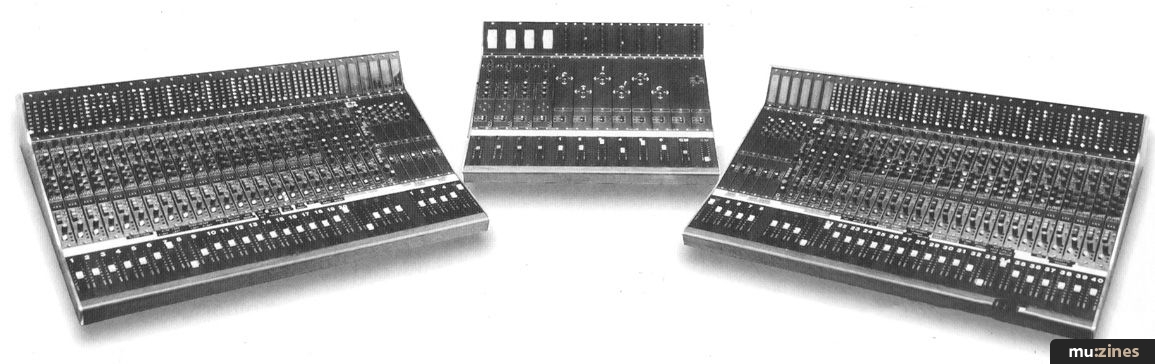
In November 1976, Midas, whose key players were Chas Brooke (of BSS fame), Geoff Byers, and Dave Kilminster, began designing a new Pink Floyd custom console, which Kluczynski describes as being a radical step forward in front-of-house control. This console as a whole, which was completed just in time for its debut on the In The Flesh tour, was formed from two separate mirror imaged desks, each side containing 20 channels but operating as one large 40-channel board. In total, there were eight stereo sub-groups and eight effects busses, and each input had three controls, which could be assigned to any of the effect busses via the buss transfer electronics.
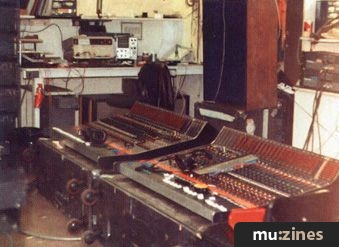
Image credit: Midas photography courtesy of David Hayden.
The left-hand desk had Inputs 1-20, effects returns 1-4, and aux masters 1-4, while the right-hand board had inputs 21-40, effects returns 5-8, and aux masters 5-8). All channels had routing switches to sub-groups S1-8 and six quad sub-groups (Q1-6). EQ was three-band with various switchable frequencies. In between the two boards sat a new Midas quad board with joystick panners for each of the quad sub-groups. This separate board had four four-channel returns for effects, each of which featured trim levels and a diamond-shaped mute switching layout.
Robbie Williams poetically describes this desk package as being "the dog's bits at the time". He adds: "It wasn't the traditional Midas grey either, it was finished in a lovely aubergine colour and really was a splendid piece of kit. By the time we ordered it, we were already operating Brit Row as a rental company, so we had our eyes on the future." Even more impressive was its multi-coloured screen printed graphics, which were applied with ultraviolet inks. A UV light unit, fitted over the meter bridge, flooded the work surface, enabling the desk to shine brilliantly (and allow foolproof operation by the engineers) in the darkness of an auditorium. "It looked absolutely stunning," says Chas Brooke. "No one had done that before, and probably no one since, because it cost a fortune. Manufacturing such an elaborate console meant, of course, that it was impossible to make any money out of the exercise, but it was definitely worth the effort."

The console was refurbished after the Alexandra Palace fire in January 1981.
Image credit: Midas photography courtesy of David Hayden.
The quality of this unusual console package owed much to its state-of-the-art op-amp, the Philips TDA 1034, which was the forerunner of today's standard 5532 and 5534 op-amps. Says Brooke: "This was a very expensive, ground-breaking, military specification linear op-amp in a metal case (unlike today's more common plastic-cased variety), and we decided that Pink Floyd deserved it for this console. As such, this was one of the very first consoles to use it."
The console is now owned by a small rental company in France.
Series - "Pink Floyd Live"
This is the last part in this series. The first article in this series is:

All parts in this series:
Part 1 | Part 2 (Viewing)
More with this artist
 That Was Then (Pink Floyd) |
More from related artists
 Pink Floyd (Dave Gilmour) |
 Pink Floyd (Rick Wright) |
 The Producers (Joe Boyd) |
 The Alan Parsons Project (Alan Parsons) |
 |
More with this topic
 Into the Music |
 Road Worthy |
 Live Wire - Miking Up |
 Bandstand - Redd Kross |
 Live End - Do It Yourself with National Music Day (Part 1) |
 Practical PA - Part 1: Introduction To PA (Part 1) |
 Using Backing Tracks - Pros & Cons of Backing Tape Formats |
 Live End - Live Music for the Hi-Tech Musician |
 PA Column |
 PA Column |
MIDI Lighting Control - Taking MIDI Beyond The Music |
Hardware Or Software? - Sequencing On Stage |
Browse by Topic:
Live
Publisher: Sound On Stage - SOS Publications Ltd.
The contents of this magazine are re-published here with the kind permission of SOS Publications Ltd.
The current copyright owner/s of this content may differ from the originally published copyright notice.
More details on copyright ownership...
Sound On Stage - Apr 1997
Topic:
Live
Artist:
Pink Floyd
Related Artists:
Dave Gilmour
Rick Wright
Alan Parsons
Joe Boyd
Series:
Pink Floyd Live
Part 1 | Part 2 (Viewing)
Feature by Mark Cunningham
Help Support The Things You Love
mu:zines is the result of thousands of hours of effort, and will require many thousands more going forward to reach our goals of getting all this content online.
If you value this resource, you can support this project - it really helps!
Donations for August 2026
Issues donated this month: 0
New issues that have been donated or scanned for us this month.
Funds donated this month: £0.00
All donations and support are gratefully appreciated - thank you.
Magazines Needed - Can You Help?
Do you have any of these magazine issues?
If so, and you can donate, lend or scan them to help complete our archive, please get in touch via the Contribute page - thanks!
If you're enjoying the site, please consider supporting me to help build this archive...
...with a one time Donation, or a recurring Donation of just £2 a month. It really helps - thank you!

 @mu_zines
 RSS Feed
 Blog
Blog