


Magazine Archive
Home -> Magazines -> Issues -> Articles in this issue -> View
Yamaha SPX90 | |
Article from Making Music, April 1986 | |
Multi-Effects Unit
OPINION
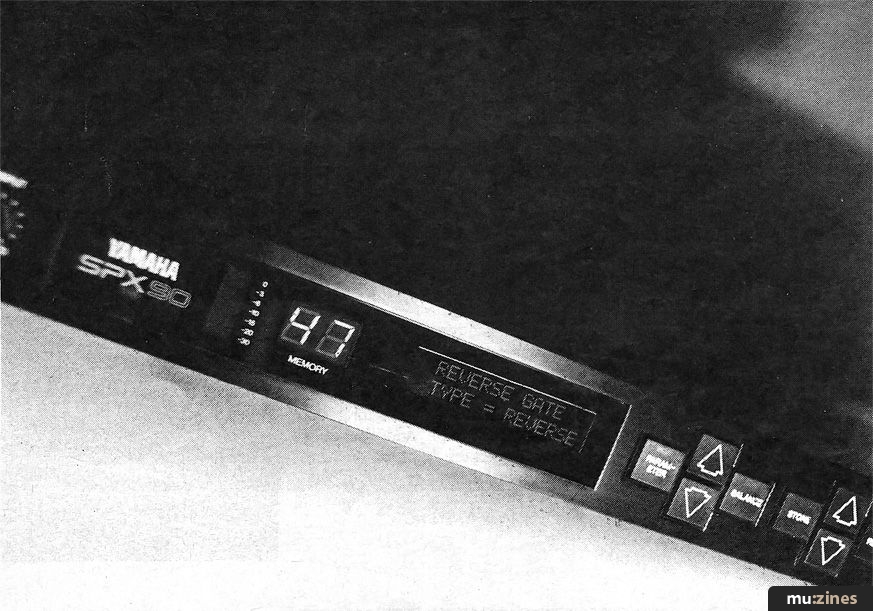
I have seen the future of home recording, and it's squatting under my Portastudio. It's 19in wide, 1½ high, and 99 seconds long, and is made by Yamaha, who call it the SPX90 Digital Multi-Effect Processor. Lots of Effects. One box. See?
The God-like proportions of the SPX90 will give you - in glorious stereo from a single mono input - reverb, delay, echo, flange, chorus, phasing, tremolo, vibrato, noise gates, compression, pitch changing, basic sampling, panning, and parametric EQ, all stored in the form of 30 highly usable permanent presets. Not only are these each widely variable in several different ways, but up to 60 of your own edited programs can be stored in the available memory space.
However, like all Gods, the SPX90 has a limitation: it will (perhaps unsurprisingly) only perform one function at a time (although it can gate its own reverb for those bingy-bangy disco drum sounds). But then Yamaha don't claim it can turn water into wine. Quite.
It's still very clever. There are six very good preset reverbs, each with five variable parameters, including three filters, predelay, and reverb length (from 300mS up to a magnificently daft 99 seconds). Their names - 'Hall', 'Room', for example - accurately describe the sounds they recreate. 'Plate' (imitating traditional plate reverb units) works well on percussion, while 'Vocal' is obviously intended for singing at. 'Early Ref.' gives more complex reverb reflections, including the peculiar and unnatural 'Random' and 'Reverse' setting.
Apart from the excellent reverbs, the other SPX90 echo-related presets include Stereo Delay, Stereo Echo, and Delay Vibrato (good for fattening keyboard lead lines). The modulation presets are Stereo Flanges A and B, two rich Choruses, Stereo Phasing (not quite up to Sixties' psychedelic wooshing), Tremolo, and the aptly named Symphonic, which provides a wonderfully lush chorus.
The above are all effects that you might reasonably expect from a good quality DDL. But the SPX90 also provides a Noise Gate, a Compressor, four types of harmonising or Pitch Change, two types of sampling (Freeze A can be edited, while Freeze B is pitch-controllable via MIDI), Automatic Panning, Triggered Panning, and a Parametric in a pear tree.
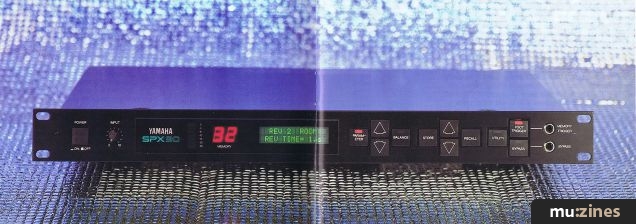
It's simplicity itself to use. Plug your mixer's effects send (or an instrument) into the back of the SPX90, and connect the outputs as a stereo pair, panned hard left and right. Input is set via a line (-20dB/ +4dB) selector and level control, with a seven segment green and red LED to indicate the onset of distortion - however, the signal on our model did begin to distort before it reached the suggested operating level.
Programs are changed with increment/decrement keys (Yamahaspeak for up and down buttons) which don't allow for instant changes between setting - you whizz up or down through the numbers and press 'Recall' to engage the program (unless you use MIDI or the optional remote control unit which permit instant access).
The name and parameters of each program are shown in the green LCD in the centre of the SPX90. A key steps you through the parameters which are themselves instantly accessible via another pair of increment/decrement buttons. Once you've altered a preset program to create your own whirling maelstrom of affected sound, the new setting is stored by selecting an unused program number, then pressing the 'Store' key, rather than 'Recall'. You can even name your own progs with the tide edit facility - up to 16 letters, numbers, or thoughtfully provided Japanese characters.
DECISION
SPEC
- PRICE £599
- DESCRIPTION Digital multi-effects unit
- BANDWIDTH 20Hz-12kHz
- MIDI FACILITIES In/Thru; MIDI program switching
- CONTROLS Input/Level/Parameter Select/Parameter Increment & Decrement/Balance & Output Selector/Program Store/Program Increment & Decrement/Program Recall/Utility Key/Foot Trigger Select/Bypass/Output Level Select/Input Level Select
- OUTPUT Stereo from mono output
- COLOUR Sleek black with pretty coloured LEDs
The £599 question has to be how well does it do all these things? To which the answer is "almost very". If I was a real moaner, I could pick holes in the performance of the SPX90: the reverb sound is slightly gritty, lacking the smoothness of purpose built units; the pitch change programs - all four of them - are difficult to tune, and don't give a particularly clean signal; and you can't trigger the pan with an external signal other that the footswitch or MIDI. See, there are things wrong with it.
But taken against price and all the other excellent facilities on offer, these quibbles shrivel and disappear. It's not an AMS, nor is it even a Rev 7 (the hippest medium price digital reverb recently at about £900), but then the SPX90 will do things that even these exalted beasts shirk from.
It would take five separate effects units (which would collectively cost you almost as much as two SRX90s) to cover all the functions that one SPX90 offers. The problem of not being able to use two effects at a time (flanging your reverb, compressing your gated drum sound) is a disadvantage, though even this is not insurmountable - simply record the effect you want affected, then apply the second SPX90 program.
While some of the effect might not be up to 16-track studio standard, for 8- and 4-track use, the SPX90 is going to prove a vital piece of equipment, which could well transform the sound and quality of home recorded demos. Now go back to your shop and ask to try one out.
Also featuring gear in this article

Fade away and radiate
(MX May 95)

Hands On: Yamaha SPX90
(SOS Dec 91)


Jack Of All Trades - Yamaha SPX90
(HSR May 86)

Mono Mode (Part 4)
(MT Nov 86)

The Power Behind the Button - Yamaha SPX90
(EMM May 86)

Trigger Converter for the Yamaha SPX-90
(HSR Jul 86)
Yamaha SPX90
(SOS Apr 86)

Yamaha SPX90
(12T May 86)

Yamaha SPX90 Effects Processor - Studio Test
(IM May 86)

Yamaha SPX90 Multi-Effect Processor
(EMM Mar 86)
Browse category: Studio/Rack FX > Yamaha
Publisher: Making Music - Track Record Publishing Ltd, Nexus Media Ltd.
The current copyright owner/s of this content may differ from the originally published copyright notice.
More details on copyright ownership...

Making Music - Apr 1986
Review by Jon Lewin
Ads for Gear in this article:

Previous article in this issue:
Next article in this issue:
Help Support The Things You Love
mu:zines is the result of thousands of hours of effort, and will require many thousands more going forward to reach our goals of getting all this content online.
If you value this resource, you can support this project - it really helps!
Donations for May 2026
Issues donated this month: 0
New issues that have been donated or scanned for us this month.
Funds donated this month: £0.00
All donations and support are gratefully appreciated - thank you.
Magazines Needed - Can You Help?
Do you have any of these magazine issues?
If so, and you can donate, lend or scan them to help complete our archive, please get in touch via the Contribute page - thanks!
Please Contribute to mu:zines by supplying magazines, scanning or donating funds. Thanks!
Monetary donations go towards site running costs, and the occasional coffee for me if there's anything left over!

 @mu_zines
 RSS Feed
 Blog
Blog