

Magazine Archive
Home -> Magazines -> Issues -> Articles in this issue -> View
Barcus Berry BBE 202 | |
Article from Sound Engineer and Producer, October 1986 | |
A 'Differential Load Reactance Compensator' that restores brightness and clarity to reproduced sounds
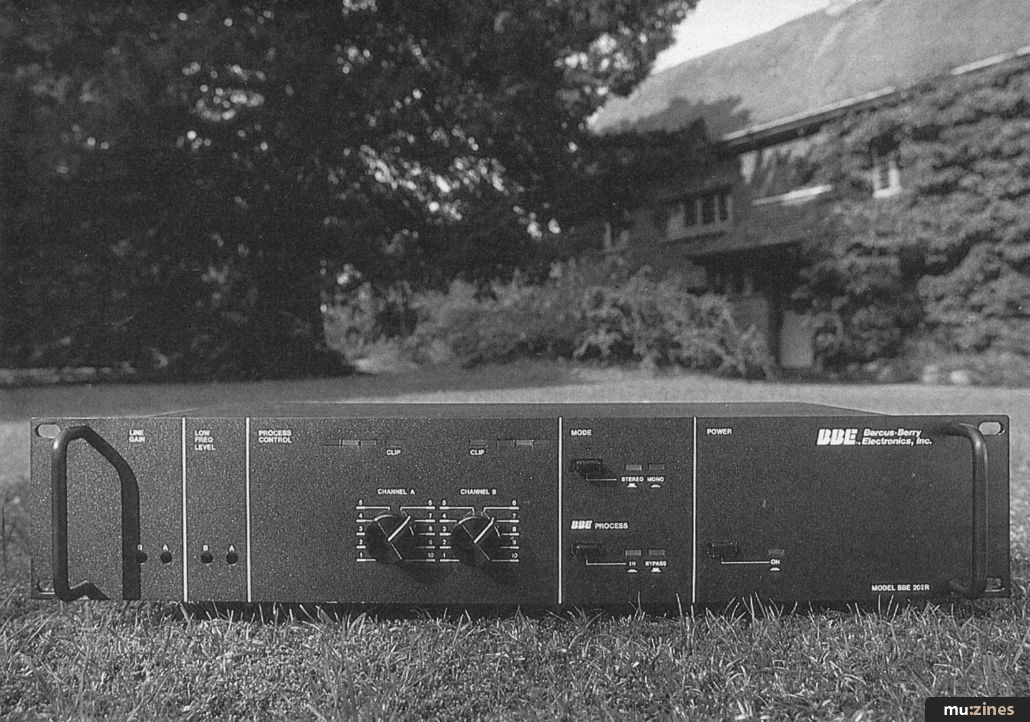
Image credit: Barry Marsden
Barcus Berry call its new product a 'Differential Load Reactance Compensator'. If this doesn't make you any the wiser as to what it actually does, then you can think of the BBE 202 as a kind of aural exciter, restoring brightness and clarity to reproduced sounds without, hopefully, altering tonal balance or adding harshness.
It comes in a black 19" rackmounting unit which occupies 2U of rackspace and is 7" deep. Its front panel controls simply consist of a pair of Process Control knobs, a stereo/mono switch, a bypass switch, and the power on/off switch. Additionally it has pre-sets for gain matching and low frequency response adjustments. However, once it is set up you should only ever need to adjust the process control knobs during normal operation.
The BBE 202 operates on a different principle to more typical aural exciters. What it does is to firstly anticipate the kind of 'interface error' that will occur between the amplifier and speakers for a given sound, and it will then harmonically 'pre-compensate' the sound to arrive at an 'idealised' solution to the amplifier/speaker interface problem.
Actually this is an enormously complex operation to perform as it must take into account all kinds of variables such as differing phase lag discrepancies ranging from as much as 45 degrees at 5kHz to 60 degrees at 20kHz, and how these phase discrepancies colour or muddy a given frequency.
All this theory, however, would suggest that the BBE 202 is designed primarily as an interface to improve speaker performance. However, it has many more exciting potential uses.
Firstly, it can be used to magical effect as a kind of 'bandwidth expander' for medium-bandwidth samplers. If you have a sample with, for example, a 10kHz bandwidth, when this is processed by the BBE 202 it should become much clearer. Also, if the sample is several generations old (a choir sampled from an LP which may have originated from a Fairlight sample...), then the BBE 202 can have quite a dramatic effect by restoring the original purity and definition to the sample.
Other areas in which the 202 can be used might be in cassette copying, and when mixing mediocre multi tracks where you would otherwise find yourself adding treble to most of the tracks.
Certain instruments respond better to Barcus Berry processing than others. Clean guitar sounds in particular can get a lot more edge, as they invariably suffer from pickup/noisy-pots/dodgy-lead problems.
Vocals also tend to benefit from some processing. I was having slight trouble with a voice-over that was lacking in presence yet was not short of sibilance. To begin with, I tried some de-essing with EQ, and although this solved some of the problems it reduced the intelligibility of the voice-over track. However, when I plugged in the Barcus Berry BBE 202 I was able to restore clarity by merely tweaking the process control knob on the front panel of the unit.
Another situation that the BBE 202 proved its worth was in helping clean up a three generations old lead vocal. Whilst working with an inexperienced female vocalist, I had recorded 10 to 15 vocal takes over a week on a slave reel in order to get as fine a vocal performance as possible. From then I made a composite vocal track its own track, then copied it to digital and spun it into the master multi track. Normally this vocal track would then have required very careful EQing, compressing, and possibly gating, in order that it would not sound too flat from generation loss. Again, the Barcus Berry came to the rescue, and although the vocal track still needed a bit of tweaking the eventual result was excellent, and didn't require any noise-gating. The BBE 202, while adding brightness, didn't audibly increase the background noise.
As the BBE 202 can be thought of as a kind of 'phase corrector', it has the advantage of only acting on a sound once; i.e. if you process a sound as it is being recorded onto multi track, and then process it a second time in the mix (or again whilst copying to cassette), the BBE 202 will only process the sound once and will not be increasing, or doubling, the effect each time it is reprocessed.
The validity of signal processors of this type are difficult to assess as so many people either look at them with suspicion, or else use them in so many different ways. I was talking to a fellow engineer about psycho-acoustic processors in general and his response to the question of their general validity was to say that although they are undeniably 'gimmicks', in certain respects he would never consider recording a hi-hat without one!
CONCLUSION
I am not sure as to whom this product should be recommended. It is not particularly inexpensive, yet it can both subtly clarify and enhance a mix, as well as dramatically improve the apparent bandwidth of medium bandwidth samplers such as the Emu-II.
For studios which do a lot of work with samplers I could easily imagine the BBE 202 becoming an essential part of outboard gear, while cassette copying suites could also use the BBE 202 to pre-compensate for the loss of dynamics that results from cassette duplication.
Overall, the sheer multiplicity of applications makes it worth considering if you're looking to uprate your outboard.
DATA
| PRICE: | £595 |
| INPUT: | XLR 22k2 (balanced or unbalanced) |
| Impedance: | Hi Z 50kΩ (unbalanced) |
| Nominal Input Level: | -10dBV to +8dBV |
| Maximum Input Level: | +20dBV (nominal) |
| OUTPUT | |
| Impedance (load): | 2500 (balanced or unbalanced) |
| Nominal Output Level: | +4dBm |
| Maximum Output Level: | 7.75 RMS into 600Ω load |
| Frequency Response – (Bypass) | +0.1dB 5Hz to 20kHz |
| THD (Bypass): | >0.1 per cent @ +4dBm |
| Noise (Bypass): | 100dB below max rated input/output |
Publisher: Sound Engineer and Producer - Media Week Ltd.
The current copyright owner/s of this content may differ from the originally published copyright notice.
More details on copyright ownership...

Sound Engineer and Producer - Oct 1986
Donated by: Chris Maund
Review by Curtis Schwartz
Help Support The Things You Love
mu:zines is the result of thousands of hours of effort, and will require many thousands more going forward to reach our goals of getting all this content online.
If you value this resource, you can support this project - it really helps!
Donations for August 2026
Issues donated this month: 0
New issues that have been donated or scanned for us this month.
Funds donated this month: £0.00
All donations and support are gratefully appreciated - thank you.
Magazines Needed - Can You Help?
Do you have any of these magazine issues?
If so, and you can donate, lend or scan them to help complete our archive, please get in touch via the Contribute page - thanks!
If you're enjoying the site, please consider supporting me to help build this archive...
...with a one time Donation, or a recurring Donation of just £2 a month. It really helps - thank you!

 @mu_zines
 RSS Feed
 Blog
Blog