


Magazine Archive
Home -> Magazines -> Issues -> Articles in this issue -> View
British Music Fair Review | |
Article from International Musician & Recording World, October 1986 | |
The assembled masses of the IM review department wax lyrical over their selected favourites from this year's music fair.
IM's motley crew select their own highlights from the 1986 British Music Fair
If there's one memory that lingers from this year's BMF it's the sight of groups of guitarists huddled around headphone consoles, silently mouthing unrecognisable songs, accompanied by nothing more disturbing than the faint sound of plectrum hitting unamplified strings. It was hard to see how much it mattered what particular instrument each person was playing, but at least everybody could get to one. Despite the huge number of people attending — up by 70% to 24,000 from the previous year — everything remained remarkably accessible and understandable.
It was obvious that a lot of work had gone into this year's collection of stands; a lot of exhibitors had arranged demonstrations so that their new crop of instruments could be demonstrated by those who were familiar with them, whilst the generally superior organisation and soundproof booths ensured that there was little interference between the various events.
Overall, the impression of most of the equipment on show was that it was in the nature of consolidation rather than revolution: further to that was the fact that much of the equipment had been seen in some form at Frankfurt or NAMM. Still, for most of the dealers and members of the public this was not a disadvantage as it was still their first chance to get their hands on the equipment they'd be selling and buying over the rest of the year.
The rash of affordable samplers that had appeared at Frankfurt were strongly in evidence; a few years back we naively thought when all the big Japanese firms committed themselves to samplers, they'd all bring out machines with CD bandwidth and multisampling for the price of a Squier Strat. What we got instead was a set of machines that are thoroughly thought out and relatively affordable which perform more than just basic sampling functions. Many of those in evidence were multi-timbral, whilst one noticeable feature was the emphasis in many machines on processing sampled sounds, along with more sophisticated looping and editing techniques.
A second noticeable feature was that, rather than moaning about any alleged MIDI shortcomings, a lot of work was being dedicated to MIDI processing. Systems for MIDI management were in evidence from most major keyboard manufacturers, and this movement complements that of the growth in the use of expanders.
The rash of sampling pianos first manifested at Frankfurt were shown for the first time in Britain along with several new additions. It does seem rather surprising, that the manufacturers of several of these did not incorporate more versatile MIDI specifications, having gone to the trouble of providing a weighted keyboard. It will be interesting to see if the technique of multisampling for dynamics, which is already found in these pianos, will spread to conventional samplers to give user-programmable independent sampling for both dynamics and pitch.
Lastly on the MIDI front, this esteemed protocol is now available to yer average guitarist, provided of course that he's got the same amount of money to play with as the keyboard player. All of the guitar-to-MIDI systems in evidence were attracting a great deal of interest; there seems to be a fair number of guitarists around already in possession of some form of MIDI keyboard. Pitch-to-MIDI conversion is a tricky operation which has benefitted from considerable research; otherwise the guitarist was pretty ill-served unless he was particularly enamoured of Stratocaster copies with Jackson headstocks. It was also profoundly depressing to note that Gibson, via Epiphone, were one of the companies putting their name to such derivative instruments. A lot of the American guitar makers coming up with new instruments weren't at the BMF anyway, you had to go across the road for them. At least there were quite a few new amplifiers on show, and yes, you could get them with MIDI.
All in all, there was no impression of one single growth area, just development and improvement of existing technology; drum machines are getting more versatile and cheaper, lots of digital effects that will do more for less, portastudios with a few extra capabilities... Anyway, rather than just waffling on generally about what was at the show, which we largely covered in the preview, this year we've asked our contributors to cover in a bit more detail a few of the products which they personally found interesting or exciting.
Critic's Choice — Tony Mills
As usual, keyboard manufacturers were well represented at the BMF, but not many of them chose the show to reveal their new products. Akai did have a new £1,000 sampling keyboard, the VX3000, but that's basically a multi-timbral S612 (it's compatible with existing S612 disks) combined with an MX73 master keyboard. Kawai showed the expander version of their K3 'Freewave' synth, but the synth itself had been seen months ago at Frankfurt and NAMM, as had Roland's S10 and S50 sampling keyboards and E-Mu's Emax.
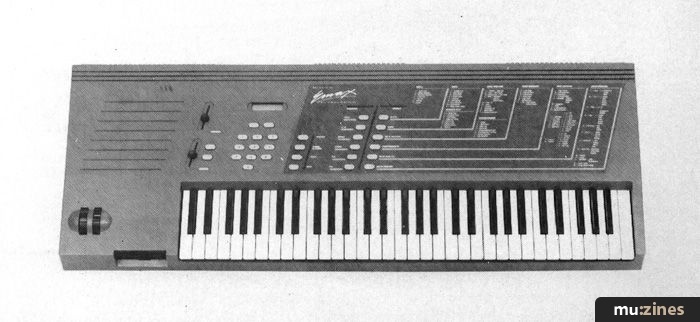
The 'Max factor
Emax is a promising machine though, and like the new Sequential line was shown in a hotel outside the BMF itself. It's basically a stripped-down Emulator II with all the advantages of three or four years' worth of development. It offers 19 second sampling at full bandwidth, multiple outputs, a simple polyphonic sequencer and complex arpeggiator, and hideous styling dating back to the 1950s (but that's just a matter of taste...)
Emax uses 3.5" disks like the Prophet 2000 and costs about the same — around £2,000. A mockup expander version was on show and a full dealer network is now being set up.
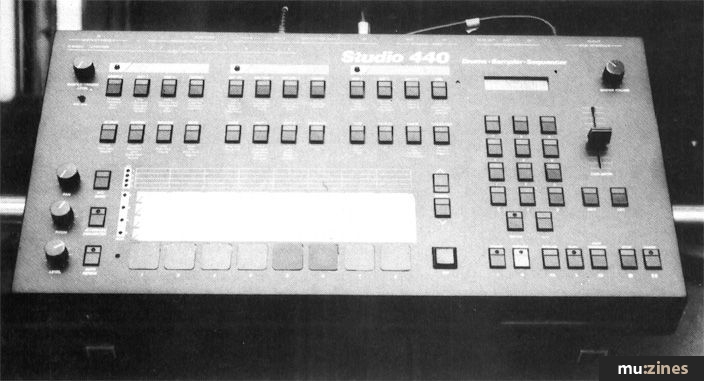
But can it tell jokes? Sequential's mega machine
Sequential's new toy was the Studio 440, and this one really was receiving a world preview since it wasn't ready in time for the NAMM show. It's a combined sequencer/sampler/drum machine similar to the Linn 9000 and is compatible with existing Prophet 2000/2002 disks. Sampled drum sounds can be combined with instrumental sounds and the sequencer section can control external instruments. The sequencer software isn't actually written yet so it's not easy to get an idea of capacity. However, we do know that the price will be around £3,000, which halves the cost of the Linn 9000 (which is now unobtainable anyway.) The problem is that Akai will be launching their 'Akai by Roger Linn' lines before long so there'll be a little competition about.
Star of the show on the keyboard front was undoubtedly the Ensoniq ESQ-1 which was around in prototype version at Frankfurt but which made a real impact at Olympia. It's eight-note polyphonic, multitimbral and based on a combination of digitally-produced waveforms and sampled waveforms. The large LED display is surrounded by 'soft' buttons, which (apart from being quite squashy) take on different functions according to the current display. Their main function is to choose the sounds in use at any one time, and there's an outstanding selection of PPG-like digital effects, percussion, standard chordal stuff (strings, brass etc) and complex Oberheim-like analogue sounds.
The ESQ-1's built-in sequencer is enormously powerful and can be expanded with a plug-in cartridge, making the instrument an ideal compositional device. If only, like the Emax, it had multiple outputs... Elsewhere in this issue is the full review.
Critic's Choice — Bob Henrit
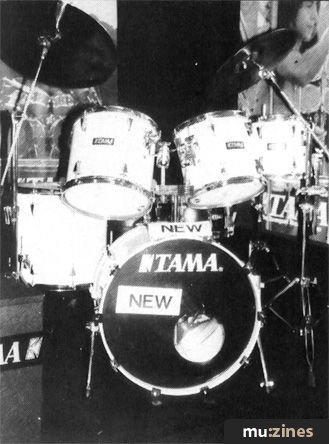
Tama's revamped line
This year's British Music Fair seemed to have more to do with 'musical chairs' than it had to do with really new, and up to date percussion instruments. Fletcher, Coppock and Newman added Tama drums to their Zildjian cymbals, while Premier added Paiste cymbals to their drums. I must say that I was very surprised by the Tama display. If it hadn't been for their logo I don't believe I'd have recognised them. Everything has been changed; I won't know if it's for the better until I do a proper 'check' but I understand that we were treated to a display which the rest of the world won't actually get to see until February '87.
Anyway, Tama have definitely gone the whole hog. Shells have been changed; new lines have been introduced and old ones discarded; and just about all the fittings have been changed — including the nut-boxes. I heard one of the new sets being played and couldn't honestly say that it sounded fundamentally different, but it did seem somewhat thicker than before. Anyway, in the very near future I'll be bringing you the word on Artstar 2. (You don't actually have to have this set looking like a piece of fifties furniture anymore either which is something of an improvement.)
Premier have taken over the Paiste cymbal line at a time when the Swiss company have a very exciting new line to offer. Paiste 3000 is a very up-market instrument aimed at the professional or discerning drum enthusiast. We all saw it at Frankfurt, but it's not until now that were actually going to be able to buy them over here. Our test on them should be out very soon. I suppose one could describe 3000 as a super-duper eighties version of 2002; a more 'mature' cymbal. Certainly it's made in roughly the same way, although its hammering, shaving and some of its profiles are different. The resulting sound though is definitely deeper and richer. This is because the tone colours at both ends of the sonic spectrum have been extended at the same time. This means that even though they have a rich sound, they still manage to 'cut through'. Paiste's liaison with their endorsement artists had a lot to do with the development of the 3000 range. It appears that these chaps demanded an instrument warmer than 2002, and stronger than 602. 3000 is the result of this.
Now, since I'm not allowed too much space for this article I'll get on with talking about the new goodies from the world of Simmons. Unfortunately extended hands-on experience of these has not been possible yet, but I have heard them in action. There are two new products on the market: SPM8:2 and MTX 9. The first product is an 8 into 2 mixer which is MIDI controlled. Obviously it's designed for drums, but could be used for keyboards if you so desired. It has 50 user memory patches and all its operating instructions like eq, pan, effects level, may be stored there. You may also, courtesy of the LFO function, cross fade between patches and allow your drums to pan faster or slower depending on how hard you hit them. The magic of MIDI will allow all sorts of other sounds to be switched in providing, of course, you have a MIDI set up. MTX 9 is, as its name suggests, designed to be used with SDS 9. It's a drum expander which gives access via MIDI to 36 digitally sampled drum and percussion sounds. The usual sounds are here such as woodblocks, cabasas, cowbells, congas, and lots of different toms and things. It has three channels to which you may switch any of the voices. Therefore, in one little package Simmons have created what amounts to a 'caseful' of percussion sounds which the drummer may use in the control room for overdubs via direct injection; all he needs to do is join two or three pads to it. Furthermore, he can change pitches, dynamics, decays and levels, all of which will effectively give him even more sounds. MTX 9 is also a programmable mixer which will allow the player to blend sounds together from its own samples and SDS9 too, thus rendering it even more useful since up to 20 of these combinations of sounds may be stored and recalled via footswitch. But, to make it even better it has its own controllable echos. At £399, I feel sure we'll see lots of these in recording studios in the very near future.
There were other drummy things at the show like Pearl's Syncussion X, Yamaha's Power Road drums, and some new budget cymbals from Zildjian which we'll also get to in depth in the fullness of time...
Critic's Choice — Jim Betteridge
It used to be that the manufacturers would wait until trade shows to launch new products, but with the marketplace growing ever fiercer it seems that they now tend to let the cat out of the bag as soon as it's ready — or even slightly before. Hence, there were relatively few sources of amazement at the BMF that hadn't already been mentioned in previous dispatches.
A noteworthy exception to this was the successor to the very excellent Midiverb — the Midifex. Housed in an identical plastic box and with identical controls, two-character LED display and an identical price tag of £399, the Midifex offers 63 high quality time-based effects in full stereo (two in, two out) or for use with an auxiliary send from a mixer (one in, two out.) Effects include variously equalised repeats with names such as 'Echo Long HPF Wide', indicating a single repeat with along time delay, going through a highpass filter to make it thin and bright and a wide stereo image. In addition to 'Long' there are medium, short and extra short delays with single, double, triple or multiple repeats as if you've turned the feedback control up. There are also stranger effects including reverse, pan and 'bloom' reverb but, presumably to preclude the possibility of the Midifex overlapping too much into the Midiverb's market, there is only one straight reverb effect and one gated reverb effect. As with the Midiverb, it's all presets and so there's no possibility of adjusting the timing of repeats to fit your tune. This fact doesn't stop it being great value but it isn't quite as stunningly wonderful in practice as the Midiverb.
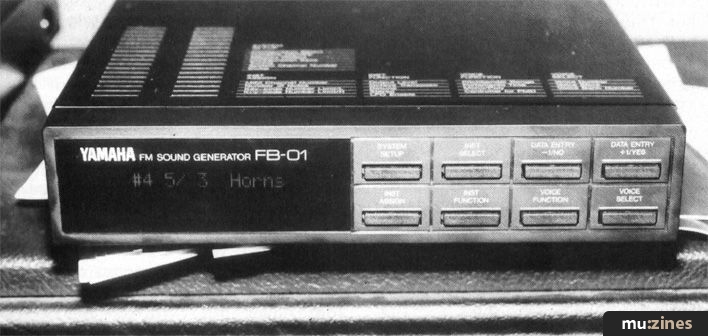
Not a hifi — the FB01
Yamaha, as always, had a few interesting new things including the FB-01 FM Sound Generator which is basically an FM preset expander in a half-rack size case which, though not unattractive, is a break-away from the normal Yamaha line in cosmetics looking more like a car hi fi system than a musical instrument. It has 240 preset FM sounds (four operators as per the DX-21, DX-100 et al) plus a further 96 memories in which you can store any order of these voices you require for performance. Each of the 240 sound memories includes individually programmable pitch bend, octave transpose and detune information, but unfortunately the actual sounds themselves can't be edited without the aid of one of Yamaha's CX-5M computers and the new software package that should be available soon at around £40. In practice I don't actually think that lack of programmability is that much of a problem as most people will probably be more interested in presets than programming anyway.
A great feature of the FB-01 is that of being able to work in the MIDI Mono mode, and there are four preset configurations with regard to how the eight available notes can be divided up: a single voice mode with eight-note polyphony over the entire keyboard; a keyboard split mode providing two voices with four-note polyphony; a dual mode where the two voices are layered on top of each other over the whole keyboard with four-note polyphony; and finally a Mono mode which allows you to assign a different voice to each of the eight notes and control them individually — as you can with the Casio CZ range. This means that you can either use a sequencer for multi-timbral arrangements, or split the keyboard of another MIDI instrument (with its own volume turned down) up to eight times. The limitation here is that the FB-01 only has a stereo output and there is no way to balance the relative levels of the eight voices; but even so it still brings multi-timbral FM down from the likes of the TX816 to an affordable level. In addition to the four preset configurations there are a further 16 user programmable configuration memories which allow the eight notes to be split in any way required and stored for instant recall. At £299 (and probably less in the shops), it's got to be a winner.
Also from Yamaha was the QX-5 sequencer which fits neatly between the QX-1 and the QX-21. It looks similar to the '21 but has four times the clock resolution, eight tracks, most of the editing facilities of the QX-1, 20,000 note capacity (15,000 with touch etc), a superior backlit LCD display, the facility to move individual tracks minutely to introduce 'human feel', as with the QX-1, and will record system exclusive data. A very attractive package at £449 (again, probably less in the shops).
Critic's Choice — Paul Trynka
In the world of amplification nobody's quite as geared up to producing masses of new products from the R&D department, but there were a fair amount of interesting products on show all the same. You might well have seen MIDI amplifiers knocking around before, but the Dynacord Reference, a programmable valve guitar combo, and the Peavey Programax 10, which offers pretty much the normal Peavey tranny amp features, again with the advantage of programmability, were new to quite a lot of people. Dean Markley amplification was much in evidence, and we've got a review example which you'll hear about soon enough. Quite a few British manufacturers were obviously intent on producing amplifiers a bit different from a plain ol' tranny amp with chunky plastic corners; Custom Sound amplifiers have been revamped with new styling and circuitry, one of which is reviewed elsewhere in this issue. Carlsbro were showing some quite impressive new products. There were two new 90W combos, the Rebel 8 and the Rebel 12 which are transistor amplifiers with channel switching and dual 8"and single 12" speakers respectively.
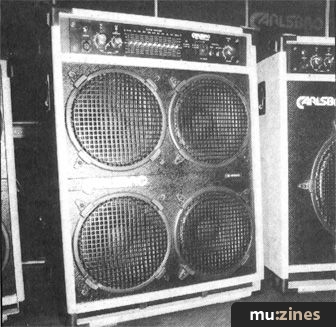
Deluxe but derivative; Carlsbro's new bass amps
I had a chance to examine the new Carlsbro range of bass amplification more closely. These are all based around the same 150W head which follows the modern, and laudable fashion of using a graphic eq section with no additional tone controls. The facilities are pretty comprehensive; eq may be selected either as pre-shaped or through the 11-band graphic. There are both 1/4" phono and XLR inputs, a compressor which is controlled by the input gains, which are marked pre and post, meaning pre compressor and post compressor. The Preamp volume is set by the post control, and the amount of compression is set by the pre control; the higher the setting, the less the amount of compression, which is actually the opposite of what I'd expect, but in any case works perfectly well and gives a good range of control. There are LEDs for power amp overload and preamp level to ensure that optimum s/n can be achieved, and overall volume levels are set by the power amp volume control. There's a DI out which can be switched to pre and post eq, and effects send and return sockets. I did try out the amp with an EMG-equipped bass, which is obviously a low noise instrument, but the whole system seemed admirably noise free and tonally versatile if obviously derivative, so if you're in the market for a high quality bass amp this head, at £303 is worth checking out; it's also available as a combo with a variety of speaker configurations.
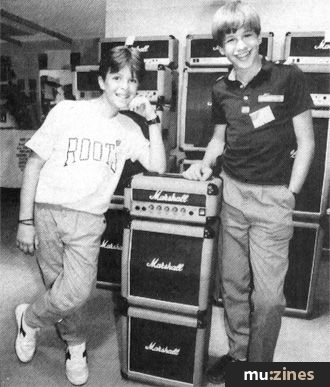
Marshall in giant kids shock
Of interest on a more diminutive level is the Marshall Microstack, which is based around the Lead 12 practice amp but actually comes as a little amp head just big enough for the Marshall logo with two little speaker cabinets, each loaded with 10" Celestions. It's fairly basic on the controls front, but has a pretty good tranny overdrive sound, and let's face it, has got to be flasher than the average practice amp, and should provide a bit more spread too, due to the pair of speakers. Forget the stack you can fit in your mini, for the under seventeens, this is a stack you can fit in your bicycle pannier. At £149 though, it's going to take you a few paper rounds to pay for it.
Critic's Choice — Tony Reed
Whilst there was very little at the show that was startling, there was plenty that was good. More power for less money seemed to be the general trend, and nowhere was this more apparent than in the field of MIDI. Definitely a bit of a growth area, MIDI management now offers possibilities far beyond the relatively simple inter-machine connection originally envisaged. In addition to Akai's MIDI effects (reviewed last month) and Yamaha's MIDI control station, there were a plethora of patch bays, interfaces and little black boxes purporting to do something wonderful for your MIDI machines. The one that caught my eye though was Bokse's (pronounced Box) MH-2 MIDI Humaniser, part of an extensive range of syncing devices taking in a SMPTE generator, a multipurpose synchronizer, and programmable MIDI patchbays, to be found on Sound Technology's stand alongside the Alesis MIDIverb and MIDIfex, Oberheim matrisynths, and other products which the company handle in the UK.
The Humaniser, retailing at £365, can, by following a 'Tap Tempo' played on a touch-sensitive pad on the front of the device, or by taking audio in off mike or tape, generate a sync-to-tape signal for music which has already been recorded. So if you've got a naff acoustic drum sound on your master tape, simply tap along to the rest of the song as it plays, and go back and replace the sounds with a drum machine, AMS samples, or whatever you like — perfectly synced to a track which started off without a sync track.
The Humaniser, as its name suggests, can also generate a 'human feel' sync and MIDI clock code for any sequencer or drum machine by the same method, and as a bonus, accepts virtually any pulse input, including Din Sync and 24-pulse clocks. A nice feature is the Humaniser's ability to discriminate between genuine tempo changes and sudden triplets. In tandem with the same company's Universal Synchroniser (£395) you should now be able to provide synchronous drive to virtually any machine past or present, at a less than staggering cost. A lot of flexibility, for even the smaller studios to think about...
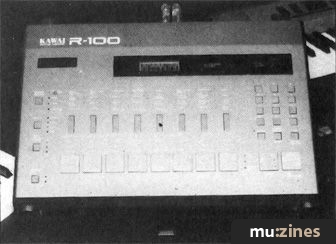
An unsung hero; Kawai's brill drum machine
The one genuine surprise for me at the show however, was Kawai's first entry into the pro drum machine market, with their R100 machine. Inevitably overshadowed by the all-singing, all-dancing Korg DDD-1 (reviewed elsewhere in this issue) in fact the R100 is ahead of it in some areas, offering 24 sounds to the DDD-1's 18, a larger internal memory, MIDI and DIN sync and external footpedal control of its hi hat, making it a particularly apt partner for MIDI drum pads. Like the DDD-1, it is dynamic (the harder you hit the buttons, the louder the sound) and each voice can be independently tuned, greatly expanding the actual range of onboard sounds. The R100 can sync to tape, and can dump its memory to both tape and cartridge. Unlike the DDD-1, there appears to be no easy way to add in new sounds, and there is no sampling option. On the other hand it does, at £595, cost over £200 less, and at almost any other time would have attracted a lot of publicity on its own account. If the finer points of the DDD-1 leave you cold, check out the R-100. You could be very pleasantly surprised...
Critic's Choice — Dave Burrluck
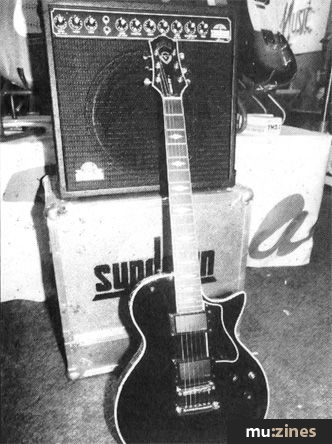
Guild Nightbird; recently migrated to the UK
The return of Guild guitars to healthy British distribution is a welcome sight. It is rare that an American company can provide such a wide catalogue of designs — from arch-top to solid bodies — all with that 'classic' Guild touch.
One of their most interesting designs could easily be overlooked — the Nightbird. On first glance it appears to be a Les Paul copy, and you can't get more un-hip than that! However, closer inspection reveals a construction that features hollowed sound chambers in the Mahogany body faced with a spruce top designed to give a 'semi' tone yet with solid body warmth and sustain.
With a lightweight feel due to the construction, the Nightbird plays very well with a slim neck and bound 22 fret ebony board. Grover machines and EMG humbuckers were fitted on the sample I tried, although Kent Armstrong units are also offered. The instrument was designed by George Gruhn and has already had quite an impact in the States with the likes of Arlen Roth. It's strange how a 'traditional' design can seem so interesting in '86. Prices start from £895 through Blue Suede Music.
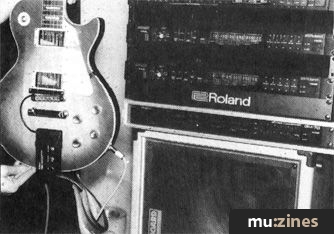
MIDI that geetar; Roland GK1/GM70 setup
Since Frankfurt '86 the guitar-to-MIDI race has exploded in a manner that makes the 100 metre dash look slow! With the trend leaning towards the guitar-to-MIDI converter as opposed to a specially made guitar synth controller, Roland launched a prototype of their new GK-1 synth driver and GM-70 GR MIDI converter. The GK-1 features a GR hex pickup and driver module which can be fitted to any guitar without the necessity for routing or re-wiring. Alone it will drive the GR-700 guitar synth by sending out the standard G-24 bus signal.
However, when linked up to the rack mount GM-70 any MIDI instrument can be controlled. The prototype system was fitted on a Les Paul and the driver is certainly neat. Mark Woods — Roland's guitar demo man — had this to say of the system.
"The advantages include pitch-bend, so firstly it's a more 'guitar-istic' way of controlling MIDI than the GR-700. The tracking is good, it's glitch free although as it's fitted to a Les Paul I don't know what it's like with a wham bar."
The GM-70 offers conversion from any G-24 bus signal to MIDI so the applications for Roland owners is very obvious. A patch memory allows storage of 64 different settings which include MIDI channel, programme change, string selection, bend range, key transpose and Poly/Mono mode. There is also a four MIDI channel transmission allowing simultaneous control of four different sound sources.
As a system alone the GK-1 and GM-70 will function fine although Mark Woods sees it in conjunction with the GR-700, as without that random programme access would be difficult for on-stage use. Prices are £190 for the GK-1 and £695 for the GM-70, availability has not yet been fixed.
The full range of the American designed and Japanese made Charvel guitars and basses at last made their public debut. With eight guitar and three bass models on show the Charvel range starts at £259 and peaks at £739 with the model 6 guitar. This is the one modelled on the Jackson Soloist, with the thinned Strat body, active eq and Kahler Standard trem. Without a doubt a beauty, but then it should be.
The Jackson instruments — handmade in the States — will be available, but expect prices to start from £1,200. If you have the time and the money, not only will the standard ones be imported but also any custom machine of your dreams!
While being very impressed with the standard of the Charvel it must be noted that virtually every Japanese maker already has a Jackson/Charvel copy available and that this design is undoubtedly the most popular, certainly at the BMF. The price of some of these Japanese models is also very high, far in excess of what British makers themselves could offer. It is a sobering thought that so many Japanese instruments of this type are being imported when our own industry can provide such healthy competition around the £600 price! The Charvel and Jackson lines are available through John Hornby Skewes.
Alternative Guitar Exhibition
For a start Kramer had a selection of their range on display including the Baretta, as used by Eddie Van Halen, and the Liberty which has a striking airbrushed picture of the Statue Of Liberty as its standard finish!
Hamer too had a number of models on show including a few of their replicas as well as their own designs, such as the Chapperal, the Phantom and the Steve Stevens models, all of which are worth seeing.
The prestigious Schecter were there with some beautiful guitars and some hair raising prices. Even so the models on show were quite wonderful, but if nothing caught your eye then you could, as with a lot of manufacturers with equipment on display, have one tailored to your requirements. This, however, is even more pricey than an off the peg job.
Dobro, the guitar, beloved of rhinestone cowboys and Dire Straits fans alike, had a couple of models out, though not surprisingly nothing new. But does anybody need a new steel guitar? Nah.
The Kinkade brothers were displaying their range of hand built acoustic instruments including an acoustic bass and a beautiful, and hideously expensive, Jazz model which caught a few eyes but no hands in wallets.
Next to them the Dreadnought Guitar Co were showing of a selection of the legendary Martin guitars with not one of them going for under £650. They also had some of the Japanese-made Kentucky mandolins which also seemed to draw a fair bit of interest.
Gallien Kruger were displaying their new amps which, are much-loved by Rods mega-stars. I didn't hear one but I'm assured that they are very good. Kahler had their wonderful tremolos unceremoniously dumped on a table stuck in a corner, but it doesn't really matter as half the guitars had them on anyway.
There were accessories of every description dotted about all over the place, much too numerous to mention them all. It seems as though they got left out a bit which is a shame because everything was worth a look and it was all only a minute's walk away from the BMF. Still, maybe next year they will get it all under one roof, or at least advertise it enough so everyone knows where to look.
Publisher: International Musician & Recording World - Cover Publications Ltd, Northern & Shell Ltd.
The current copyright owner/s of this content may differ from the originally published copyright notice.
More details on copyright ownership...

International Musician - Oct 1986
Donated & scanned by: Mike Gorman
Show Report by Mark Jenkins writing as Tony Mills, Bob Henrit, Jim Betteridge, Paul Trynka, Tony Reed, Dave Burrluck, Chris Holland-Hill
Help Support The Things You Love
mu:zines is the result of thousands of hours of effort, and will require many thousands more going forward to reach our goals of getting all this content online.
If you value this resource, you can support this project - it really helps!
Donations for April 2026
Issues donated this month: 0
New issues that have been donated or scanned for us this month.
Funds donated this month: £0.00
All donations and support are gratefully appreciated - thank you.
Magazines Needed - Can You Help?
Do you have any of these magazine issues?
If so, and you can donate, lend or scan them to help complete our archive, please get in touch via the Contribute page - thanks!
If you're enjoying the site, please consider supporting me to help build this archive...
...with a one time Donation, or a recurring Donation of just £2 a month. It really helps - thank you!

 @mu_zines
 RSS Feed
 Blog
Blog