C-ducer Saxman & Sax FX Unit - Microphones
(HSR Sep 84)


Magazine Archive
Home -> Magazines -> Issues -> Articles in this issue -> View
C-Ducer Saxman & Sax System | |
Article from Music UK, December 1983 | |
Chris Davis, Our Sax Maniac Reports
The Saxman pickup and Sax System effects unit with VCF, ADT and Octave-Divide are two new products from C-Tape Developments, who are already well known for their C-ducer guitar transducers, and I was rather excited at the prospect of getting hold of a pair to try out for review purposes.
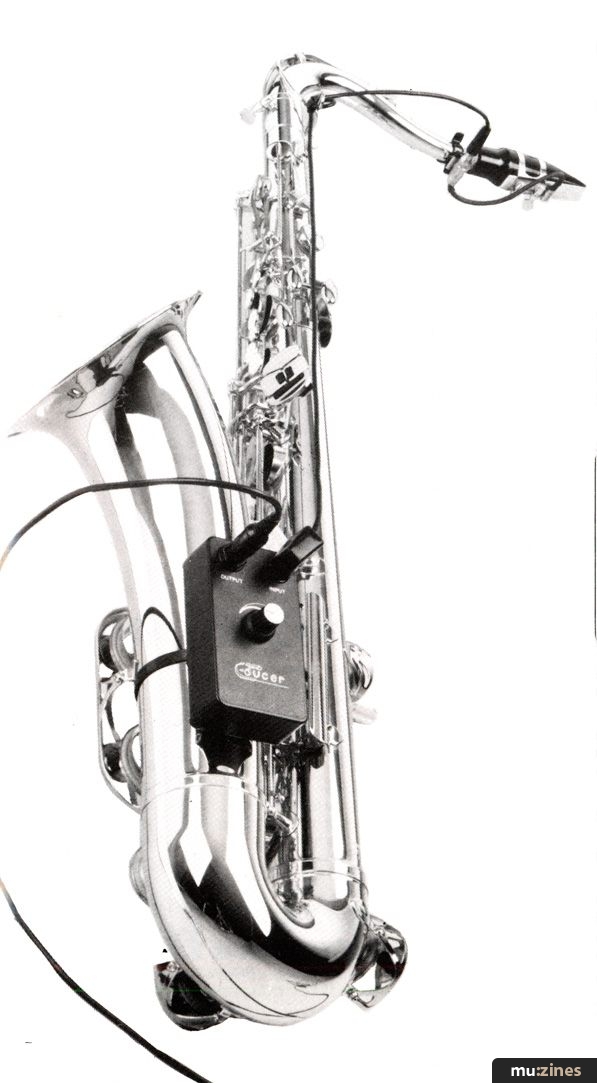
"SAXMAN" TRANSDUCER PICKUP
RRP £69.50 inc. VAT.
Described as a "transducer system for saxophone or clarinet", this is a miniature pickup which sticks to the reed with a small blob of blu-tac type stuff, or "flexible compound" as C-Tape call it. It's also held in place by a metal tag which fits between the reed and the ligature, and the unit is completed by a pre-amp which boosts the signal and has a volume control fitting on the bell of the sax, on your belt, or on a special clip attached to the mike stand. The lead is threaded along the sax from pickup to pre-amp by connectors and clips — all provided — which work quite neatly.
I did find the whole setting-up process a little bit fiddly and time-consuming at first. However, this became quicker and easier with a bit of practice, and after the first few times it was fine.
I found I preferred to have the pre-amp clipped to my belt, as this gave me more freedom of movement than fixing it to the mike stand and was also, I felt, safer than having the device clipped to a strap round the bell. (If a horrible, hairy guitarist — or even a stupid sax-player — happened to step on your lead at the wrong moment, I reckon you could get your bell bent!)
In operation, the pickup did its job extremely well. It sticks on to the reed in the same way as the Barcus Berry sax pickup, but the addition of the metal tag anchoring it from the ligature is excellent, and so simple! You don't have to fiddle about with elastic bands etc., at the risk of breaking reeds, and normal blowing is not interfered with.
One thing, however, that I noted — especially when using the pickup with the VCF and Octave Divide effects — was that the amount of flexible compound used between the transducer and reed is absolutely critical, and some experimentation and trial-and-error are required to get the best results.
A word of warning here for any player who has never tried a pickup of this kind for sax. No bug or pickup which operates from this end of the sax. i.e. from the reed, mouthpiece or neck, ever reproduces the "true" sound of the sax even half as well as a microphone does. The C-ducer is no worse in this respect than any other I've tried, however — in fact it's better than drilled-into-the-mouthpiece types. It's a strong clear sound, but boxy and a bit harsh and flat compared with the true tone. For some reason, larger saxes suffer more in this department than smaller ones. Clarinet and soprano sound quite like themselves (only with a bit missing somewhere), but tenor sounds very strange! But if you play in a really loud band, and you just haven't been able to get your sax loud enough onstage, out front or both, then perhaps the C-ducer would be the answer, because it's possible to get much more volume before acoustic feedback occurs. You could always use a mike for out front and a C-ducer pickup for your monitors of course — then the audience would hear your true sound, and at least you'd know what notes you were playing! I don't think the C-ducer is intended to replace a mike, however. What it is supposed to do — and succeeds in doing — is provide a much stronger signal than a mike, which will trigger effects and allow you to go electric. When you're using effects you are obviously not trying to capture the true sound, so the inability of the pickup to reproduce an exact sax sound doesn't matter so much.
"SAX SYSTEM" EFFECTS UNIT
RRP £196.00 inc. VAT.
This is a mains operated box, about 15"x 10"x2", with one jack input and two jack outputs. It has four channels; one for direct, straight sound, one for VCF (Voltage Controlled Filter) effect, one for ADT (Automatic Double-Tracking), and one for Octave-Divide. Each channel has its own on/ off footswitch, an LED which lights when it's on, and a volume control. In addition to this there is an "Effect" control on the VCF channel, and Depth and Speed controls on the ADT. Two further LEDs near the input jack indicate when the unit as a whole is switched on, and there's also a level-setting light which flashes when the right amount of signal is coming in. I was sad that all the LEDs were red — I thought a different colour for each effect would have been lovely! Even so, the box looks smashing when it's all cranked up ready to go on a darkened stage!
Each effect channel has a switch allowing you to route it to output 1 or 2, while the direct channel is permanently routed to output 1. Apart from enabling you to "go stereo", this is useful in that it means you can use separate channels on your mixer or mixer-amp for direct and effect sounds on different Eq settings, or with reverb, echo etc.
Now let's look at each of the effects separately.
"I DON'T THINK THE C-DUCER IS INTENDED TO REPLACE A MIKE..."
VCF
Voltage Controlled Filter, also known as envelope follow, but best described as an automatic or touch-sensitive wah. You get a wah on just about every note you play, and the harder you attack the note, the more of a wah you get! You can also learn to change the tone of the wah by the way you attack the note.
There is one control on the VCF channel — "Effect" — which really just changes the tone of the wah from smooth to harsh. I found that I had as much control as I would want on this effect — it worked very well once the signal was coming in just right with the setting level light flickering, and I found the tone of it improved once I'd experimented with the amount of flexible compound used to stick the bug to the reed.
ADT
Automatic Double-Tracking. This effect doubles the signal, placing the second note slightly apart from the original in time and pitch. There are two controls on it apart from volume: Depth, which controls the pitch variation, or "sweep", of the effect, and Speed, which makes the note sweep, or oscillate, faster or slower. The result is to thicken and electrify the sound, and I thought this effect worked very well too, with absolutely no problems.
OCTAVE-DIVIDE
This produces a note an octave below that played on the sax. Here, the amount of compound between reed and bug is super-critical. Before I got it right, the lower octave was cutting out on top C on my alto, but after some experiment it was solid right up to the top, and even on some of the first harmonics! So this effect worked well too, although I couldn't agree with the claim in the instructions that it is best "used with direct or ADT (or both together) to provide section sounds". It never really makes the sax sound like two saxes, because the lower octave is more like an electronic keyboard note than a sax played an octave lower. It's a sound that might be used instead of a section, but it's never going to sound like a section.
All the effects had a low noise level, which was fine for live work and, I imagine, would be quite acceptable for home recording or in a demo studio. The unit seemed to me to be exceptionally well put together and laid out, so that it was very simple to set up and efficient in use. The effects system operates between the C-ducer pre-amp and the mixer or amp input, and the level-setting light and individual channel volume controls allow you to set your pre amp volume level etc. volume level and balence the effects with the straight sound very quickly, after which you can just dive from one effect to another by stamping on the footswitch, seeing at a glance which channels are on from the LEDs.
Although C-tape obviously intend the effects unit specifically for use with their pickup, there are other ways of using it. I tried it just with a mike, either in line before the mixer input or on the effects send and return loop on the mixer. This is fine either way with the ADT, but harder to do with VCF or Octave-Divide, as the mike signal won't trigger the effect. If you boost it with the pre-amp or the effects send from the mixer you can make the effects work, but I found that I got too much feedback and strange noises caused by the effects being triggered by other nasty things, like drums, for this to be practical on stage.
Another possibility which I liked a lot better was to use a mike for the direct sound and the pickup for the effects, with the direct channel on the effects unit not being used. This makes things slightly more complicated, of course, but the end result is a better sound which makes the effort worth it in my opinion. To do this, you need two channels on a mixer or amp, and you have to stand rooted to the spot by the microphone again, of course, unless you have a clip-on type of mike. One of the joys of going completely electric with the C-ducer system is that you are freed from the mike stand to leap about the stage!
To conclude then, we have from C-Tape a good pickup which requires no modifications to mouthpiece or sax, and a well laid-out and efficient effects unit incorporating three of the most useful effects for saxophone. In my book, they both represent pretty good value for money.
Also featuring gear in this article

Browse category: Microphone > C-Tape Developments
Browse category: Studio/Rack FX > C-Tape Developments
Publisher: Music UK - Folly Publications
The current copyright owner/s of this content may differ from the originally published copyright notice.
More details on copyright ownership...

Music UK - Dec 1983
Gear in this article:
Microphone > C-Tape Developments > C-Ducer Saxman
Studio/Rack FX > C-Tape Developments > Sax System
Gear Tags:
Review by Chris Davis
Ads for Gear in this article:

Previous article in this issue:
Next article in this issue:
Help Support The Things You Love
mu:zines is the result of thousands of hours of effort, and will require many thousands more going forward to reach our goals of getting all this content online.
If you value this resource, you can support this project - it really helps!
Donations for September 2026
Issues donated this month: 0
New issues that have been donated or scanned for us this month.
Funds donated this month: £0.00
All donations and support are gratefully appreciated - thank you.
Magazines Needed - Can You Help?
Do you have any of these magazine issues?
If so, and you can donate, lend or scan them to help complete our archive, please get in touch via the Contribute page - thanks!
If you're enjoying the site, please consider supporting me to help build this archive...
...with a one time Donation, or a recurring Donation of just £2 a month. It really helps - thank you!

 @mu_zines
 RSS Feed
 Blog
Blog