


Magazine Archive
Home -> Magazines -> Issues -> Articles in this issue -> View
Format of the Future? | |
Philips DCC 900 Digital Cassette RecorderArticle from Recording Musician, October 1992 | |
Philips' new consumer tape format tested under studio conditions.
Though designed for the hi-fi market, Digital Compact Cassette recorders boast near-CD sound quality and the ability to play existing analogue cassettes. But does DCC have anything to offer for the home recordist? Paul White takes DCC into the studio, with interesting results.
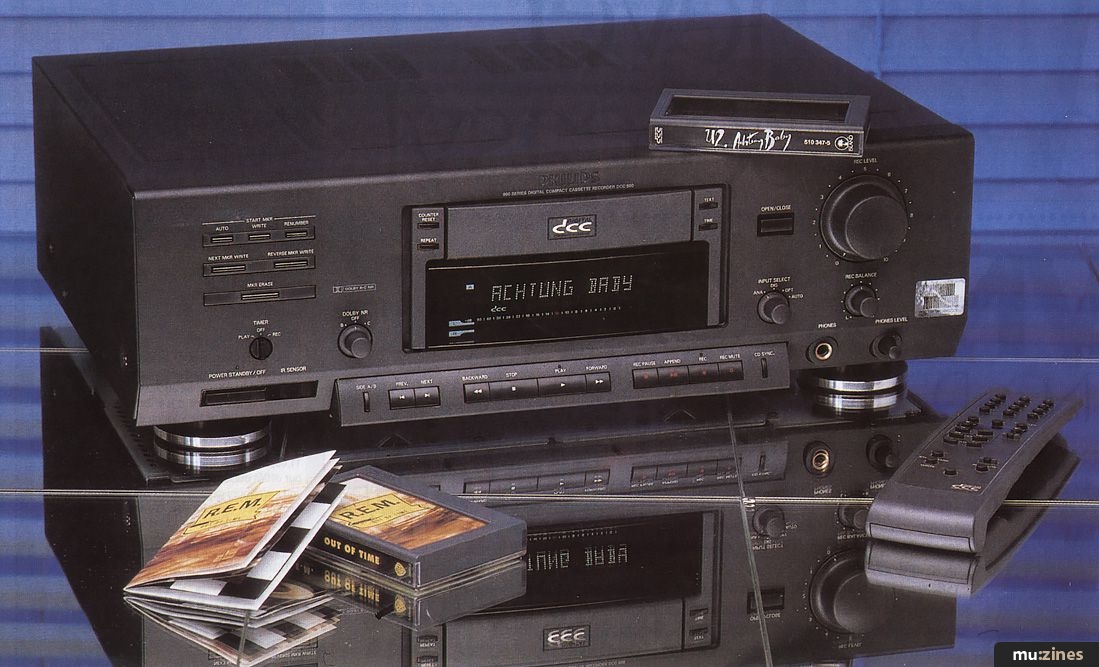
Philips have a reputation for innovation — the original compact cassette was theirs — and now they feel the time is right to introduce digital recording into the home audio market. That being the case, why is RM interested? For this simple reason — if a low-cost domestic digital recorder can offer sound quality subjectively indistinguishable (or very nearly so) from CD, then a lot of home studios will have access to a mastering format that is significantly better than anything they have used before, with the exception of DAT. Additionally, if the format catches on, as Philips are sure it will, then we will all have a far more accurate medium on which to distribute our demos and short-run private releases.
Though DCC machines can replay existing analogue cassettes, digital recordings are made on special DCC cassettes which closely resemble miniature video tapes complete with self-closing protective shutters. These are similar in overall size to the analogue cassette, (the machine is also capable of playing pre-recorded analogue cassettes), and the machines run at the same tape speed as existing cassette machines — 4.76 cms per second. Unlike DAT, which uses a rotating head system similar to that employed in video recorders, DCC employs a stationary, multisection 'thick film' head, which records the digital data as a series of parallel tracks. This digital head is combined with an analogue playback head, and the whole assembly rotates through 180 degrees when the first side of the tape has played to the end, in order to allow the second side to be played without the need to physically turn over the tape.
Even using nine parallel data tracks (eight for audio data and one for control data, text storage and suchlike), the available recording bit rate falls far short of that required to store 16-bit linear, stereo recordings at the 44.1kHz sampling rate used in the CD and professional DAT formats, which brings us to one of the most interesting — and contentious — aspects of DCC: data compression (see box for details).
The DCC 900 Recorder
In many ways, the actual product under review is far less relevant than the DCC system itself, as many different DCC players will undoubtedly come onto the market once the format has become established. Furthermore, the model under review is a pre-production version and some of its features 'hiccup' occasionally, though its audio performance should be representative of production models.
This particular model is styled somewhere between a CD player and a cassette deck, the tape being inserted via a CD-style motorised tray above the display panel. I must confess that the machine is larger than I anticipated, though how much of this is for styling reasons I don't know. Included in the package is a very stylish infra-red remote controller which includes a remote volume control.
There are a few more interconnections than you might find on a typical stereo cassette deck because, in addition to the analogue inputs and outputs, there's digital in and out both on optical and SPDIF phonos. Additionally, there's a fixed level analogue output and a further one which varies in level according to the remote level control setting.
The transport controls are similar to those found on a conventional cassette deck, except that to go into record, you press Rec Pause followed by Record, rather than pressing Play and Record together. Because the machine is digital, care must be taken when setting the record level to ensure that the signal never exceeds 0VU — unlike analogue recorders, the onset of distortion is instant in digital recording once the signal goes beyond this point. There's a nominal red marker at the -12dB level, and it is suggested that this is used for general recording work in order to leave 12dB of safety margin.
DCC implements a subcode system, to mark individual sections of music so that they can be searched for automatically, in the same way as they are on DAT machines. Normally, this would be left set to Auto mode, which detects pauses of more than a few seconds in duration and then assumes that a new track has started when the signal next exceeds the threshold. It is possible that music with very quiet passages could fool this system, so a manual option is provided which includes the ability to erase existing markers and replace them with new ones in different positions. There's also a facility to renumber the markers after editing; this simply involves running the tape from the start and letting the electronics cope with assigning the new numbers. Forward and backward search buttons allow the user to search out specific selections and, in this respect, the operation is very similar to an analogue recorder fitted with programme search. The advantage of a digital system, however, is that each section of music can have its own number and that the tape counter runs in real time locked to the tape's subcode. On future models, it may also be possible to name tracks and have their titles come up in the display as they are playing — the format certainly makes provision for this.
"The top half of the head records nine tracks of digital data while the bottom section is a fairly conventional analogue, stereo playback head."
One less welcome provision made by digital technology is SCMS, the Serial Copy Management system. This only affects recordings made via the digital inputs and has the effect of electronically tagging a the tape so that future digital copies are automatically prohibited. This is an obvious anti-piracy feature, but it can be inconvenient when you want to clone your own work. For example, the machine will let you make one digital copy of a DCC tape or CD, so you can borrow a friend's machine and digitally copy your tracks from your master tape to a new tape, putting them in the right order as you do so. However, the compiled master will be given an SCMS code which prevents you from making further digital clones of your compiled master tape, even though you own the copyright and are doing nothing illegal. You can copy via the analogue inputs and outputs, but this means setting levels and involves some quality loss, albeit not much. The quality loss aspect of copying via analogue is a point of concern when using PASC-encoded data (see box for details of PASC encoding), as copying in this way means that your material has been subjected to PASC data reduction twice. Subjective tests indicate that the system is quite resilient, but I'd be inclined to make digital clones where at all possible. One way around the problem is to buy one of the copycode 'strippers' currently available. The fact that such a device is available rather makes a mockery of SCMS in the first place, as professional pirates are not going to think twice about spending £150 on a device that lets them beat the system, while the poor enthusiast is having to pay the same in order to perform an operation that he or she is perfectly entitled to do in law.
Taking Sides
Because the tape is never turned over, (the head does the turning over) there is a button for manually selecting side A and side B. In the event that a tape plays to the end, it automatically switches to the other side, the head flips, and the direction of play is reversed. I must confess to feeling a little uncomfortable about the concept of a flippable head, especially when alignment is so important, but only time will tell if my misgivings have any foundation. On a more positive note, if the head alignment remains accurate enough for the digital recording part of the system, the analogue replay head may well be better aligned than in many production analogue-only cassette machines. Analogue tapes can be played back but not recorded, the idea being that the machine is 'backwards-compatible' with your existing cassette collection. The review model has switchable Dolby B and C noise reduction which should take care of most commercial and home recorded tapes, though Dolby S is not supported. In terms of quality, the analogue playback is subjectively OK but not particularly exciting. Tapes recorded on several machines were tried, in addition to pre-recorded cassettes, and though the result was quite bright, it didn't seem entirely accurate.
Sound Quality
Most CD and DAT players, when directly compared, produce slightly different sounds — and sometimes more than slightly different. Most of this is down to convertor resolution or the quality of filtering, and as these components improve, the differences should become less marked. Comparing DCC against DAT and CD shows a subjective difference no greater than that between different CD players, and though some 'golden eared' listeners profess to be able to hear a difference on some types of music, I found that for typical pop music, including my own mixes, there was little to choose between the straight sound of the DAT master and the data-compressed sound of DCC. If anything, the PASC data compression system smooths out transient detail very slightly, but as many commercial mixes are noxiously harsh, this might not be a bad thing. In any event, I wouldn't want to put money on which was DAT and which was DCC in a blind test! Operationally, the machine is straightforward enough, but I did find that there was a fair amount of clunking and whirring when going into play mode. You expect this in a DAT machine, where the tape has to be threaded around the heads, but I must confess to being surprised that a stationary head system behaved similarly.
Verdict
Currently, DCC machines are likely to be no cheaper than the cheaper DAT machines, which means that DAT offers better mastering quality for the price on paper, even if the subjective difference is negligible. However, DCC is an upcoming consumer format, and in that respect, prices must fall to attract a mass market. Furthermore, as DCC machines proliferate, there will be more opportunity to distribute demos and private record projects on DCC, which is far preferable to analogue cassettes with all their vagaries, imperfections and incompatibilities.
"If anything, the PASC data compression system smooths out transient detail very slightly, but as many commercial mixes are noxiously harsh, this might not be a bad thing."
The only fly on Philips' horizon, to mix metaphors, is Sony's MiniDisc system, which uses a similar (though, apparently, not identical) type of data compression system, and is expected to produce essentially the same sound quality using re-recordable, miniature discs instead of tape. From a technical viewpoint, disc is more elegant than tape because track access is virtually instantaneous and the non-contact nature of the system eliminates the media wear problem inherent in all tape-based recorders. The blank media should be a similar price, the maximum recording time in both cases is sufficient for a complete album, and with a disc, you don't have to stop and reverse to get to side B. Both formats promise a large library of pre-recorded material and both companies are working on in-car players.
Which system comes out on top depends largely on price and marketing — it's not always the best system that wins, as the VHS/Betamax fiasco confirmed. DCC looks like being first in the marketplace and has the benefit of being able to play existing analogue cassettes; if the price is attractive, it would be logical for people to upgrade to DCC when their existing cassette machine comes to the end of its natural life. MiniDisc, on the other hand, looks as though it will be several months later than DCC, and though the disc medium is altogether more elegant than tape, there is obviously no compatibility with analogue cassettes and, apparently, no plans to build a MiniDisc player with an integral analogue cassette drive.
PHILIPS DCC 900
- Sound quality approaches that of CD
- Plays existing analogue cassettes
- Good search facilities
CONS
- Expensive, even compared to budget DAT machines.
- Analogue playback section only adequate.
- Blank tapes cost significantly more than analogue cassettes.
- SCMS copy code system limits the digital cloning of tapes.
PERFORMANCE 8/10
VALUE FOR MONEY 5/10
Speaking purely for myself, anything that can eliminate analogue cassettes once and for all can be nothing but good news. Despite the fact that the analogue cassette format can be made to produce excellent results, the reality of the situation is that most don't; their alignments are usually well out of true from the day they are bought, noise reduction systems never seem compatible from one machine to the next, and speeds vary alarmingly from sample to sample. With any digital system, head alignment problems are no longer relevant unless they are severe enough to prevent the machine from working, while wow and flutter is immeasurably low, due to the crystal clocking of data. Whatever the pros and cons of the PASC data reduction system, DCC represents a quantum leap in terms of consistency and overall quality. It could be just what we need to bring domestic recording up to date with the rest of our audio technology.
As regards this machine in particular, it isn't cheap, at a little under £500 and, while that is less costly than most analogue open reel machines and even cheaper than some state-of-the-art analogue cassette decks, you can buy a DAT recorder for rather less. For small studio mastering, I'd be inclined to stick with DAT at the moment, but if DCC proves popular with the consumer market, then the prices will fall and DCC will start to look a lot more attractive.
PASC Data Compression: How Does DCC Do It?
Because music comprises varying frequencies rather than continuously occupying all the spectrum at an equal level, all of the time, (as is the case with white noise), it is apparently unnecessary to use a sampling system that provides 16-bit resolution at all times. Far more economical in terms of data rate is a system which provides high resolution when it is needed and less resolution when there is little information or periods of silence.
To accomplish this feat of data reduction, the input signal is first passed through a conventional analogue to digital converter which can operate at any of the standard sample rates of 32kHz, 44.1kHz and 48kHz. Next comes the PASC processor, which separates the signal into 32 frequency-dependent sub-bands by means of digital filters. The threshold of hearing for each band will continually vary, depending on what is going on in the other bands, so the system simply determines which bands fall below the threshold at any given time and discards them. Effectively, the PASC processor has an available number of bits it can allocate at any one time, rather like the polyphony of a synthesiser, and it distributes these amongst the bands where they are needed — though it is not made clear whether a musical situation could arise that would require more bits than are available. I would imagine that under such circumstances, the recorded sound would depart from the original to some extent, but not in a way that would cause audible distortion — even though any departure from the original waveform is, technically speaking, distortion.
On the plus side, PASC can allocate up to 18 bits to a frequency band, so the theoretical dynamic range actually exceeds CD and DAT by 12dB, even though we find that the compression process has reduced the amount of data to only a quarter of that used by DAT and CD.
Error Correction
Small tape errors can be likened to missing letters and are recoverable, but if a surface blemish or passing piece of dirt corrupts many consecutive pieces of data, as is quite possible, then how can the missing data be reconstructed?
Going back to the newspaper analogy, the error correction encoder performs the digital equivalent of chopping the newspaper up into small squares and reassembling it in a seemingly random order. It now looks like utter garbage, but don't let that put you off. Now, along comes our vandal and cuts a hole in the page, just like last time. Now the clever bit — the error correction decoder remembers where it originally put all the little squares of paper and reassembles the page as it was before. The hole is still there, but now it's distributed around the page as lots of tiny holes because of the shuffling process, which means that we can once again deduce the missing data from the words and letters on each side of the tiny holes. Admittedly this is a simplified representation of the concept, but it serves to illustrate the underlying logic of the method. In real life, error correction systems can deal easily with small errors, and the original data is reconstructed without a flaw. Larger errors involve a degree of electronic guesswork; this process is known as error concealment rather than error correction. It results in a momentary increase in distortion as the errors are 'fudged' over, but unless such errors are excessively frequent, the process is not apparent to the listener. Finally, really serious errors, such as might be caused by a large area of tape surface damage, are unrecoverable and the system can do no better than mute the audio output until the error has passed. Things should never get this bad, but muting will occur in the case of faulty or damaged tape, just as an audible dropout will occur with damaged analogue tape.
Further Information
Philips DCC 900 £499 including VAT.
Philips Consumer Electronics, (Contact Details).
Also featuring gear in this article

Browse category: Cassette (Stereo) > Philips
Publisher: Recording Musician - SOS Publications Ltd.
The contents of this magazine are re-published here with the kind permission of SOS Publications Ltd.
The current copyright owner/s of this content may differ from the originally published copyright notice.
More details on copyright ownership...
Recording Musician - Oct 1992
Review by Paul White
Help Support The Things You Love
mu:zines is the result of thousands of hours of effort, and will require many thousands more going forward to reach our goals of getting all this content online.
If you value this resource, you can support this project - it really helps!
Donations for July 2026
Issues donated this month: 0
New issues that have been donated or scanned for us this month.
Funds donated this month: £0.00
All donations and support are gratefully appreciated - thank you.
Magazines Needed - Can You Help?
Do you have any of these magazine issues?
If so, and you can donate, lend or scan them to help complete our archive, please get in touch via the Contribute page - thanks!
If you're enjoying the site, please consider supporting me to help build this archive...
...with a one time Donation, or a recurring Donation of just £2 a month. It really helps - thank you!

 @mu_zines
 RSS Feed
 Blog
Blog