Soul Searching (Soul II Soul)
(MT Jun 89)


Magazine Archive
Home -> Magazines -> Issues -> Articles in this issue -> View
In The Studio With Soul II Soul | |
Soul II SoulArticle from Sound On Sound, April 1992 | |
As Soul II Soul return this month with a third album, Paul Ireson reports from their private studio on the writing and recording of more club classics.

Will Mowatt and Eugene Ellis in Soul II Soul's main studio control room.
Image credit: Adrian Wilson
Since the release of their landmark debut album, Club Classics Volume 1, we've not seen as much of Soul II Soul as their auspicious debut suggested we would. A second album, 1990 A New Decade, was less impressive, and Soul II Soul's media presence has been somewhat lower since the heady days of 1989. However, one reason for this is perhaps that the energies of the collective - there is no other satisfactory term for the loose coalition of DJs and musicians led by Jazzie B - have been directed into building a large private studio in Camden and into work on other acts on Funki Dred records.
That studio has been kept busy since early 1991 working on their third album, due for release in mid-April, and when Will Mowatt, responsible for writing most of the new material, issued an invitation to see work in progress, it was an offer I could hardly refuse.
The focal point of all Soul II Soul's creative and business activity - and the latter is an important side of Soul II Soul - is Jazzie B. Core posse members include DJs Daddae Harvey, Q, Aitch (Haydn Browne), Sparky, and Crime. Will Mowatt was working with the group as a session player and programmer before his involvement deepened: "Jazzie took me aside at Swanyard a while back and said would I like to be involved in the next album. I thought very carefully — for about 10 nanoseconds — before saying 'YES!' That was to be as a session player, but we were churning out idea after idea, so I became a collaborator."
A quick studio tour starts with the machine room, containing Sony 48-track digital and Saturn 24-track analogue multitracks, and also equipment to provide a small programming facility. There's a Seck desk, a Fostex 8-track, Prophet VS synth, a Technics turntable, an Atari ST running Notator, an Akai S1000, a Studio Electronics MIDImini (a rackmount MIDI module with MiniMoog electronics), and an Ensoniq VFX. Will professes a strong preference for instruments like the MIDImini: "I use my gear in a very particular way, to get a particular sound. Keyboards that are jacks of all trades and master of none are not interesting. The MIDImini is wonderful, so simple — I use it all the time. So are the Prophet VS, Akai S1000, and Rhodes MK80."
The Prophet VS hasn't seen much action lately. "It was always easier to get the sound I wanted on another instrument. It's great for film work, but when you've got a lot of toys, you can afford to say 'I don't want to use that'. In the same way, we have the luxury of being able to say 'this brass sample is good, but let's get Aswad's brass section, or UB40's'. But we don't get extra people in just for their sound; it's for their slant on things. That's why we get Louis Jardim. He's the best percussionist you can get. Soul II Soul without him isn't Soul II Soul."
Next door in Studio II, Derek DeMondo is writing material for an album by Kofi, an established Jamaican lovers' rock artist now signed to Funki Dred. There's a Soundtracs Megas desk, Genelec monitors, and a rack of equipment including the inevitable S1000, another MIDImini, a Proformance piano module, and a Roland rack mixer. A Korg M1 is the master keyboard.
In Studio 1, engineer Eugene Ellis (aka 'Eugenius') and assistant Ian Clarke are seated at the imposing Trident Di-An console, setting up for a session to further develop one of the album tracks. The Di-An is one of only two ever produced, and the only one still in use. Both main and nearfield monitors are Genelecs; Eugene singles out the nearfields for praise for the completeness of their sound. The Di-An features an assignable control interface - you can only work on one channel at a time, via the console equivalent of digital parameter access. One of its main benefits is its total recall. "In fact it's the only desk that has total recall in a matter of seconds, as much time as it takes to load from disk," says Eugene. "It's also got Diskmix moving fader automation. I always like to compare it with SSL, which is the best, and it compares well. There are a few things I'd like to have that it doesn't do, but there's nothing that impedes you. What it does do, which the SSL can't do, is actually edit cuts and things offline, which for what we're doing now is almost critical, because everything's so precise, very in your face."
The desk's major failing is the assignable control system, which restricts the engineer to doing only do one thing at a time. "Also, you don't want to do stuff like EQ changes in real time in a mix, because of digital clicking over the audio channel. If the material's critical, you can hear the clicks from mute switching and so-on, but if a whole mix is blaring at you it won't matter."
The Sony digital machine is a suitable partner for the desk, in Eugene's view. "On this project we wanted a polished, up-front, go-for-it sound, which digital gives us. If we were doing reggae, analogue would be better and I still like to hear vocals and bass, for example, on analogue tape. The concept of digital is another thing altogether, but as a digital machine the Sony's great."
At the back of the control room is Will's keyboard rig — "my working tools". An Atari Stacy laptop runs Notator, and a Rhodes MK80 is used as a controller keyboard. The main sound sources are a third MIDImini, a Matrix 1000, an Akai S1100 plus an S1100EX voice expander, a Korg M1 REX, and a Yamaha TX816. In describing his modus operandi, Will stresses the importance of speed and efficiency, and insists he has very little time for programming sounds. "I work very quickly, and I'm more interested in getting the vibe down rather than tweaking sounds. If a sound needs editing, I'll use a sound on an instrument which I can edit quickly. I use the Oberheim OB8 [currently propped up beside the racked gear] a lot, I love the M1, and the Matrix 1000 never runs out of sound. Hands on is important; being able to interact with the instrument."
Analogue is certainly alive, and kicking in the best sense of the word, in Camden. "We've got three MIDIminis because they're so important. It's the ultimate bass sound. The OB8 is also great. In the old days, just like you used to be a Beatles or a Stones fan, so you were an OB8 fan, or Prophet fan, or a Jupiter fan. I was a committed Oberheim man, and I'm now waiting for an OBMX. There are certain things which I must have, and for a committed Oberheim man, the OBMX is a must. I've made the space already."
The idea of using everything for its strengths applies as much to modern gear as older kit. "I never use the M1REX in Combi, only in Program mode. I use it for a particular thing — use the preset, and put it in the mix so it sits there nicely. I don't try and disguise it. The 'Gamelan' preset is great. 'Soft Electric Piano', on one of the cards, is great, so is 'Organ 4', and 'Pick Bass' of course. If you double 'Pick Bass' with a MiniMoog, you have the most shattering bass sound."
An Emu Proformance 1 piano module is also in use. "As far as present technology goes, it's very good, but I can't wait for the next generation. I'd pay any price for a really good piano module, and I just haven't found one yet."
An S1100 has only just replaced the S1000. "Both total workhorses, can't fault them for what they do. The good thing about the 1100 is the sound, and the fact that you can boost program outputs by 12dB. The other reason I got the 1100 is for the Mac front end that's coming out."
SONGWRITING
The writing process is collaborative. "Jazzie and I are in the room at the same time; I control the music, he's the producer. Haydn Browne, one of the DJs, does lyrics, and there are also contributions from Rick Clarke, one of our singers on the album. It's a conventional writing operation in a way, but coloured by the way Jazzie likes to work. I'm proud to say this is actually the first writing I've done - of proper pop songs for the pop market. But 10 years experience as a session player has built up, and now it's kind of burst under its own pressure - I'm churning the songs out."
"The bassline is what Soul II Soul are renowned for - they're always new, never re-cycled. Once you ve got the basic groove with the bassline, it's telling you you what it needs."
Production is Jazzie's domain. "He knows what he wants to hear on his album," says Will. "It's his head on the block, his name that is associated with the project. But up to a point everyone has their influence, and it's inevitable that Eugenius should have a large influence on the sound of the album." As on the day of the interview, people are constantly drifting in and out of the control room, providing a human thermometer to check on a track's health. "Jazzie will turn round to people in the control room to ask their opinion. Or if people are nodding their heads - that's how you can tell it's good. Most here are people of few words, but deep stirrings inside."
THE SOUL II SOUL SOUND
One of the axes of the Soul II Soul sound, according to Will, is the right combination of the rough and the smooth. "Although Soul II Soul is rootsy, earthy, African, and very real, with Eugene and me at the controls, we really listen out for bad notes, flamming notes, all those little errors. We get it right technically. But we always keep an eye on the feel, and sometimes we'll deliberately leave something undone. Instinct can say 'that's a bit rough, but it sounds right' - and if you have the right instinct, you save days of work.
"We work on all the songs at the same time, pushing them all along. Even if you work digitally, things happen to songs on tape if you leave them for a few days. You can listen to a song you recorded a few days earlier and the song is then telling you what it needs, or that it's ready. It's uncanny."
Another important part of the process is what Will describes as 'scavenging'. "We work like scavengers, but on our own work rather than on others. Gary Barnacle came in and did a good performance on one track. We saw how it fitted, sampled and re-used bits, then gave Gary his head on an instrumental - that gave us a slamming track." Other session contributors included Louis Jardim (percussion on almost every track), two guitarists, both on tracks that didn't make it on to the album, a choir, and male and female backing singers. A drummer and bassist were also tried. The latter didn't work out, but some of the live drums ended up sampled and incorporated in tracks.
TRACK BY TRACK
By this time Eugene is almost ready to start work, which provides a chance to analyze one of the album tracks, at this stage just known as 'Jazzie's Groove', in a bit more detail. "We started off with a fundamental groove," begins Will. "Normally that's drums and bass, maybe a sampled loop. The loops we use are very obscure, and no-one knows what they are and we'll sometimes re-create loops; it depends. But we're not like a rap band where all you hear is loops. We've really gone quite musical with this album, then pared it down and roughed it up with the traditional Soul II Soul elements. With this track, we began with a reggae bass line. All my basses were from the MIDImini, and this was actually a sine wave. We don't often try that, because it's hard to get the level to tape."
Eugene points out that basslines do sound better on analogue tape, because of the natural compression, but that it's hardly a problem on digital. "I've got little secrets that help the MIDImini's bass sound," adds Will. "One of them is that I always use 16' on Osc 1 and 8' on Osc 2 turned down a bit. Works great, and you never get beating problems, What we did here, to pick out the bass, was to use the M1's 'Pick Bass' sound, doubling the MIDImini. It adds definition to the bass and gives that plucked, reggae feel.
"The bassline is what Soul II Soul are renowned for - they're always new, never re-cycled. Once you've got the basic groove with the bassline, it's telling you you what it needs. On this track we thought of adding brass, and decided to go back to 'Missing You' from the last album and use the live brass that we recorded for the 12" version, which hardly anyone heard. It was at a different speed, and in a different key to the groove, so I rerecorded the groove at the right tempo and key.
Creative energies are directed, however, by other members of Soul II Soul, ensuring that the direction of the music is more 'corporate' than individual - it will carry the distinctive hallmark sound of Soul II Soul. "It's very important for us to go to clubs to check out what other DJs are doing, what people are dancing to. I'm lucky that I'm working with Jazzie, who's a professional DJ, as are the other people here: Q, Aitch, Tyrone, Crime. They know what they'd like to hear in the clubs, and I can retreat into my area, of translating that into something we can use. It isn't so crucial that I know what the market is going; they can nudge you in the right direction."
"I sampled the brass on the S1000, topped and tailed it, and flew it back in at the appropriate places. That's pretty standard. What we do to some tracks is pretty hair-raising, from giving it swing, to imposing strict time, whilst keeping the same vocal delivery. We've become past masters at using the same bassline for the whole track, all the way through - I need to be very musical so that I know what different chords will work with a vocal performance, so if one idea doesn't work I can come up with something else. Same with Eugene - if something doesn't work technically, he'll try the next thing. I'm dripping with musicalities, he's dripping with technicalities."
Over the groove are chopping reggae organ and piano lines, and an intoned vocal by Jazzie B. After a few seconds I realise that it's more than merely similar to the vocal on 'Jazzie's Groove' on Club Classics', it's identical. The idea is that a new, but similar, vocal will replace it shortly, but in the meantime this serves as a guide, topping off the feel of the track. "We just dropped it in and it really worked. We've been very lucky in that everything we just tried at random has worked. Our working method is like creating a patchwork of different things, throwing them up in the air and seeing how they fall. And we do give them a nudge on the way down." As it happens, by the time the track makes it on to the album, it will have lost the vocal completely, to become an instrumental called 'Mood' with Snake Davis on sax.
"The bubbly organ line uses a sine wave from the Akai. The piano is Proformance. Unusually, I used the Rhodes MK80 here, for a phased piano chop sound. The pad is Akai. All the strings are Akai. The drums are all Akai, apart from the percussion which is Louis. The gentle pad/string sound is M1. There's a lot of velvet glove and iron fist on this album. That to me is what Soul II Soul is all about - the power of the roots beating out underneath this shimmering textural surface. You can also think of it quite coldly - that little pad, shimmering away, attracts one type of person. The groove attracts another."
But do you think of music in that way. "Absolutely. But again it's instinct. I'm putting it into words now, because you're asking me, but normally you feel these things."
When you break down a track like this, it actually seems very simple, but Will stresses that this belies the work that goes into it... "It's like a swan, calm on the surface, but paddling furiously underneath. We sweat blood to get this smooth, powerful sound. It's taken us six months to record 12 tracks - two tracks a month. We never work weekends, but we work long hours during the week, and we work at an organic pace. If something isn't working, we let it mature on tape and come back to it. There's no question of pushing it."
The hours may be long, but Will Mowatt is not about to swap places with anyone. "I haven't seen my wife during the week for six months. But the compensation is... well, some people would say they're coming up with something worthwhile that they enjoy. OK, fair enough, but it doesn't feed you. The compensations are definitely financial, definitely to do with vanity - I've no qualms about saying that. You like your name to be associated with work like this, and in one fell swoop I've gone from being an ivory tickler to a collaborator on a major album. It's the best feeling in the world."
WILL MOWATT'S KEYBOARD RIG
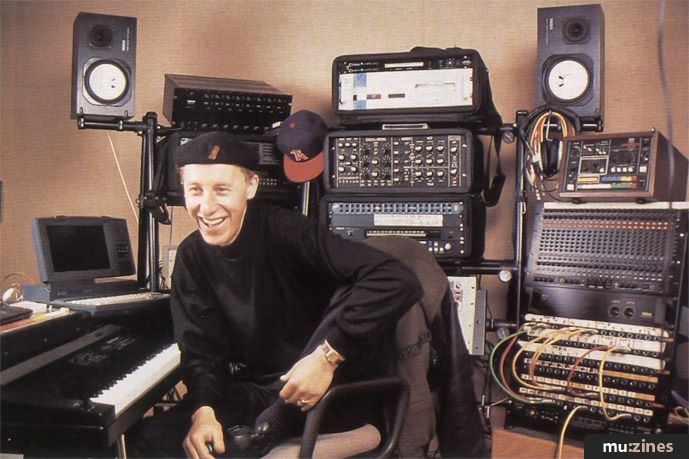
Image credit: Adrian Wilson
• Atari Stacy 4, running C-Lab Notator; sync by Unitor and ExPort. "The heart and brains of the system. Very quick for writing, very tight sync with Unitor."
• Macintosh PowerBook 170 running Notator Logic; sync by MOTU's MIDI Time Piece. "The PowerBook is just so useful. I travel everywhere with it so the odd half-hour is always turned to my advantage (I'm responsible for all of C-lab's English language manuals, and I run a fast modem for instant communication with colleagues in Germany and the States). Notator Logic is the next logical step in the field of Mac-based sequencing. Its Environment window displays your virtual MIDI system complete with instruments and onscreen patchcords for intuitive operation. The score editor starts where Notator is at present. The main difference for people moving to it from Notator is that you are invited to think in linear terms rather than in patterns, though you can work with a pattern concept if you prefer."
• Atari 1040 STE
• Macintosh SE30 running Akai 1100 front end.
• Roland TR808. "Useful when used sparingly. Nice to have the original sound there instead of using samples."
• Roland CR78 CompuRhythm. "I'm a great fan of this box, ever since Tony Mansfield and New Musik used it all those years ago. By the way, Tony — I want to speak to you if you're reading this."
• Yamaha TX816.
• Korg M1 REX.
• Emu Proformance/1 Piano module
• Oberheim Matrix 1000.
• Russian Dragon trigger comparer.
• DACS MIDI patchbay.
• Roland A110. "Thru box with a sexy keyboard graphic that shows what notes are playing. Keyboard players need all the help they can get to attract the opposite sex, since we're always buried behind gear and no-one sees us!"
• Real Time Logic Event.
• MIDImini x 2. "A fundamental synth that provides more balls and kick than something that has a lot of balls and kick."
• Ensoniq VFX-SD
• Sequential Circuits VS. "One of the greats. I used it for the bass on D-Mob's 'We Call It Acieeed'."
• Akai S1100
• Akai S1100 EX
• Akai S1000 x 3. "Used daily for everything. Only one really bad fault: the coherence between the left and right sides of a stereo pair of sounds is not good enough. Even when you have note-on sample coherence = ON, the hardware still allows too much tolerance between between the two, which leads to out-of-phase problems in, say, a stereo drum loop."
• DAC 600MB magneto-optical cartridge drive
• PLI 45MB hard disk cartridge drive. "This and the DAC are used for the Akais, and for backing up the Macs' data. The joy of having an optical cannot be overstated."
• Roland Rhodes MK80.
• Oberheim OB8. "Another one of the greats, with the ideal user surface."
• Holding Swordfish MIDI controller. "The mystery instrument. Unique."
"I monitor my rig through a Roland M480 48-channel racked line mixer, with patchbay, going through a Yamaha power amp and Yamaha NS10M speakers. I can operate my rig independently of the Di-An for quick auditioning without bothering Eugene, or for programming/writing when the studio isn't being used."
EUGENE ELLIS' OUTBOARD GEAR
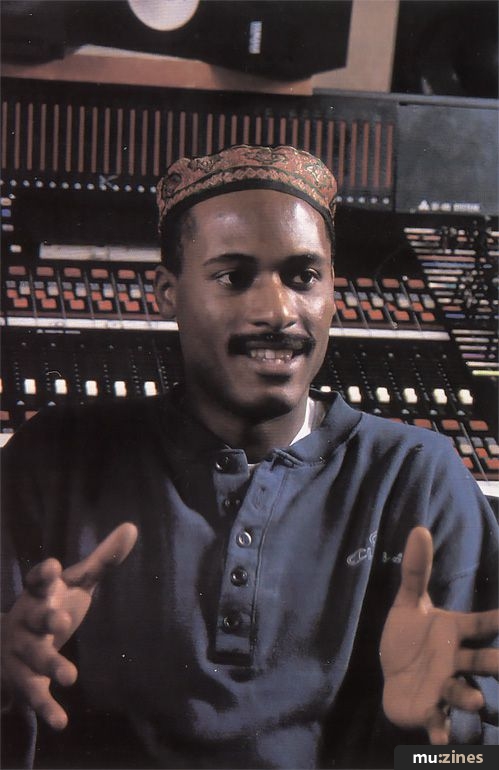
Image credit: Adrian Wilson
"I don't need all that much outboard - just two or three reverbs, and compression. We've got two PCM70s, a Yamaha Rev 7, and a Lexicon 480L." You could certainly choose worse reverbs to be stuck on a desert island with. "The PCM70 is my favourite. I use the PCM70s a lot for percussion, with the 'Locker Room' program. There's also a really nice program on the 480 that I use a lot, that uses harmoniser plus a little bit of reverb... Everything else gets used as and when it's needed. There's an Eventide H3000, though I haven't had much call for it - it does amazing things but you don't really use it much. Same with the TC Electronic spatial expander. There's a great TC EQ as well, but I've got good EQ on the desk so that doesn't get used much either. However, I get the odd Pultec in now and then."
A Calrec Soundfield is the studio's main mic, with a U87 as back-up for those rare occasions when the Calrec doesn't suit a particular vocalist. Summit compressors are preferred over Uries, "especially for bass - gives it more of an analogue sound."
More with this artist
 |
Publisher: Sound On Sound - SOS Publications Ltd.
The contents of this magazine are re-published here with the kind permission of SOS Publications Ltd.
The current copyright owner/s of this content may differ from the originally published copyright notice.
More details on copyright ownership...

Sound On Sound - Apr 1992
Interview by Paul Ireson
Previous article in this issue:
Next article in this issue:
Help Support The Things You Love
mu:zines is the result of thousands of hours of effort, and will require many thousands more going forward to reach our goals of getting all this content online.
If you value this resource, you can support this project - it really helps!
Donations for September 2026
Issues donated this month: 0
New issues that have been donated or scanned for us this month.
Funds donated this month: £0.00
All donations and support are gratefully appreciated - thank you.
Magazines Needed - Can You Help?
Do you have any of these magazine issues?
If so, and you can donate, lend or scan them to help complete our archive, please get in touch via the Contribute page - thanks!
Please Contribute to mu:zines by supplying magazines, scanning or donating funds. Thanks!
Monetary donations go towards site running costs, and the occasional coffee for me if there's anything left over!

 @mu_zines
 RSS Feed
 Blog
Blog