


Magazine Archive
Home -> Magazines -> Issues -> Articles in this issue -> View
Klark-Teknik DN34 | |
Equipment: ANALOGUE TIME PROCESSORArticle from Sound International, June 1979 | |

The DN 34 analogue time processor is designed to provide high quality audio delays up to 52 ms with a large degree of flexibility as to the control of the length of the delay. This makes it eminently suitable for such applications as phasing and automatic double tracking. It features two independent delay lines each with their own controls to allow a much closer similarity to the original 'tape phasing' to be achieved, and the ability to couple the delays in series or parallel makes automatic 'triple tracking' easily possible, while a whole range of other useful effects can be obtained, notably a good 'Leslie' effect. Only one output is provided, however, offering a mixture of the outputs of the two delay lines and the original input signal. A slow-speed control oscillator with various waveforms is also provided, while an external control input for each delay block is available on the back panel.
The unit is housed in a 19in rackmounting case, the back panel carrying the input and output XLR connectors, an IEC mains socket, and a 6-pole DIN accessory socket which, in addition to the control voltage inputs mentioned above, also provides a signal from after the input level control, for use with external devices such as envelope shapers, and, most usefully, ±15V power rails (for external devices) which can supply up to 20 mA.

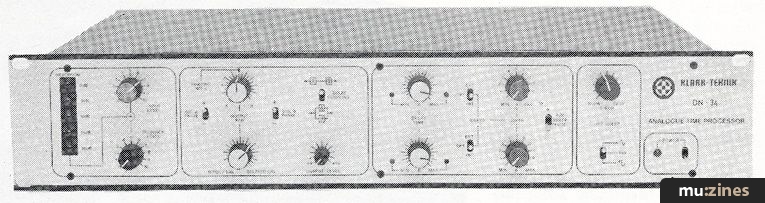
FIG.1 DN34 FRONT PANEL
As can be seen from fig 1, the front panel is neat and well-ordered — straightforward to use and extremely well conceived. First it will be seen that all the knobs related to the signal are on the left hand side of the unit, while those controlling the delay lines are on the right. With reference to the block diagram (fig 2) it is clear that the input signal has a level control whose output is summed with that of the feedback control prior to the level indicator so that there are no hidden quantities entering the delay line. The level meter is calibrated in 5dB steps, with a red LED at the top which comes on 1dB below the threshold of limiting. This circuit is peak-sensing with relatively slow decay so that the input level can easily be optimised. After this the signal passes through the first stage of a noise-reducing system which has been specially evolved for the unit (and of which more anon), through the delay blocks and the phase reversal option provided. After the first delay section the signal is fed into the second if the series arrangement is selected; alternatively the second is fed from the input filter. The outputs of the delay sections are then fed into a 'pan' control which allows the user to balance their relative contributions, after which the output passes through the noise reduction de-processor to restore the signal's dynamics, and finally to a control which 'pans' between the resultant delayed signal and the original input signal.
The times of the delay sections are voltage-controlled by the resultant of a fixed voltage supplied by the manual control, plus a proportion of a varying control voltage from the depth control. The voltage supplied to the depth control may come from the internal oscillator or an external source. If the internal oscillator is used, a switch can be thrown to make the times sweep with each other (in phase) or against each other. The internal oscillator is common to both channels and has a speed control and switch allowing selection of the three available waveform shapes: square, triangular, or exponential. On the front panel are two LEDs on either side of the manual control which light up when the delay line is near its maximum or minimum length. If the manual control is set mid-way and the depth control to maximum, these give an impression of the speed of the internal oscillator.
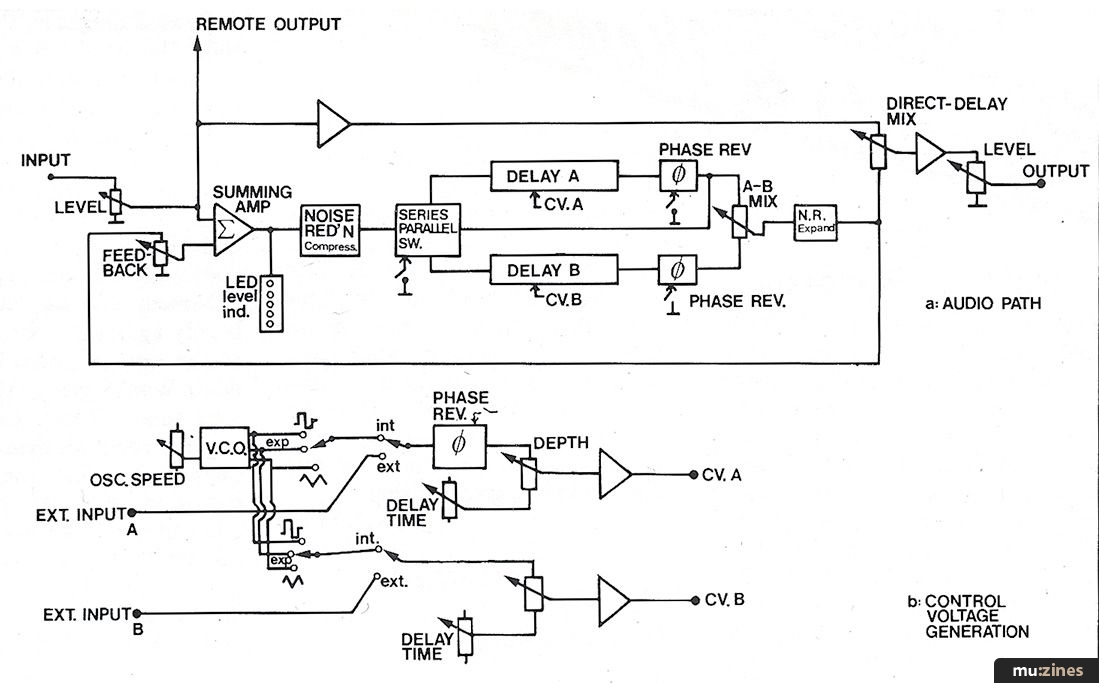
FIG.2 DN34 BLOCK DIAGRAM (Heavily simplified)
It is a great pleasure to review an item of this type which has been so well engineered. The quality of manufacture is very impressive, and the interior reveals an equally neat and clean aspect as the exterior, although I pondered over the use of a single-pole mains switch — does this comply with BS 415? I doubt it! Still, very few other devices do either. I found the unit very easy to use, and the control of the various functions very clear. All the control pots have been well-chosen so as to have good 'feel', there is no need to blow at the knob in the final stages of setting up a sound, which of course makes the reproduction of a previous setting easy to achieve. Also, the range of control is more than adequate. The manual supplied with the DN 34 is very well written, with all the effects clearly set out and all the operating parameters clearly stated. It also includes some useful suggestions for starting points for various sounds, all of which proved interesting.
The use of two delay lines to produce tape phasing simulations is very effective, and if the phase-reverse switch on one of the delays is used, complete cancellation can be obtained. I suspect that this was the reason for providing an exponential waveform on the internal oscillator, which means that if the unit is used in this mode it will not dwell on the point of total cancellation, with its attendant loss of signal as is the case with the more usual sine waveform. But although I can fully appreciate the thought that went into this aspect of the unit, I must admit that I would have preferred to have had a sinewave control in addition, as the exponential one did not correspond to my personal taste.
I also found that, while fully aware that the intention was to keep this unit simple and straightforward, I regretted that a second output was not made available to allow various so-called 'stereo effects' to be achieved, and also that a second internal slow-speed oscillator and envelope follower were not provided. 1 heard rumours that these might be provided in the form of an accessory box, but it seems a pity not to have them 'on board', as nowadays space in the devices rack tends to be severely limited in the control room. The reason that I would have liked to see the second oscillator is that this would have made a whole lot of chorus effects possible; of course you can always hook another oscillator in, and I suppose that a limit must be set, but still... I would have liked them to be there.
In use, I found that a good range of 'automatic double tracking' effects were obtainable, which could be changed subtly by the output 'pan' controls; truly an excellent configuration here. Modulating the delay lines a little at high speed makes it sound like the old fashioned tape method which in some ways is much more convincing. Adding feedback to all the effects drastically changes them, while a heavy-handed dose makes the whole lot take off towards Uranus for those who like space sounds. I was also most struck by the various 'doppler-shift' effects that can be obtained, and I found a 'doppler' effect that really sounded like a Leslie cabinet — exceptionally effective on acoustic guitar. Interestingly, if the doppler shifts are arranged to go in opposite directions by using the phase reverse switch on the oscillator, very pronounced effects may be used without the pitch change being oppressive, as this aspect of the effect appears to cancel out. All in all, despite the reservations mentioned above, I found the unit to be really excellent, allowing a tremendous range of effects, and I grew more fond of it as I got used to it.
I should also mention the other outstanding feature of this device, which is the sheer quality of the sound through it. As is obvious from the name, the electronic delays used in the DN 34 are analogue in nature, of the 'bucket brigade' variety. A detailed discussion of this technology would be out of place here, but I should mention that the delay stages consist of a series of storage elements, through which samples of the audio signal are passed. Thus, the signal is subject to degradation and increase in noise as well as the frequency response restrictions that all electronic delay devices have to contend with. The dynamic range of analogue delay chips is not that fantastic either, and this normally leads to design compromises which are only too familiar: a noisy device with a frequency response that, at maximum delay length, may just achieve a few kHz, and distortion figures that, were they published, would make even the hardy blanch. But due to the superb specially-evolved noise-reduction system employed here, it has proved possible to use a total of no less than 16 512-stage delays, achieving a maximum delay of 52ms with both lines in series, and yet have a frequency response that is only 4 dB down at 15 kHz, distortion of about 0-2% and a noise level of -90-odd, a truly remarkable performance. But this does not only happen on paper. I found that the delay-only signal was almost indistinguishable from the input signal in quality. And as to the noise reduction system, which I understand to be a band-split linear compander system (eh?), try as I might, with all the ruses I could think of, it refused to reveal even the most fleeting glance of any unbecoming vices. I wonder what it would sound like on my Teac...
A superb quality unit, with bonus marks for just about every aspect of its design and controllability. A lot of intelligent thought has gone into making this unit just what it should be, but I still wish they'd put in that second oscillator, second output and the sine wave output. Then it would have been perfect. Buy one — you'll like it!
A technical review of the DN34 by Hugh Ford appears in the July issue of Studio Sound.
George Chkiantz is a freelance recording engineer generally credited with the 'rediscovery' of phasing in the late sixties
Publisher: Sound International - Link House Publications
The current copyright owner/s of this content may differ from the originally published copyright notice.
More details on copyright ownership...

Sound International - Jun 1979
Donated & scanned by: David Thompson
Review by George Chkiantz
Previous article in this issue:
Next article in this issue:
Help Support The Things You Love
mu:zines is the result of thousands of hours of effort, and will require many thousands more going forward to reach our goals of getting all this content online.
If you value this resource, you can support this project - it really helps!
Donations for May 2026
Issues donated this month: 0
New issues that have been donated or scanned for us this month.
Funds donated this month: £0.00
All donations and support are gratefully appreciated - thank you.
Magazines Needed - Can You Help?
Do you have any of these magazine issues?
If so, and you can donate, lend or scan them to help complete our archive, please get in touch via the Contribute page - thanks!
Please Contribute to mu:zines by supplying magazines, scanning or donating funds. Thanks!
Monetary donations go towards site running costs, and the occasional coffee for me if there's anything left over!

 @mu_zines
 RSS Feed
 Blog
Blog