


Magazine Archive
Home -> Magazines -> Issues -> Articles in this issue -> View
MPI Feeling Partner | |
Arranging/Sequencing SoftwareArticle from Sound On Sound, April 1992 | |
Martin Russ tries adding a French accent to his music, with Feeling Partner's blend of arranging, harmonising and sequencing for the ST.
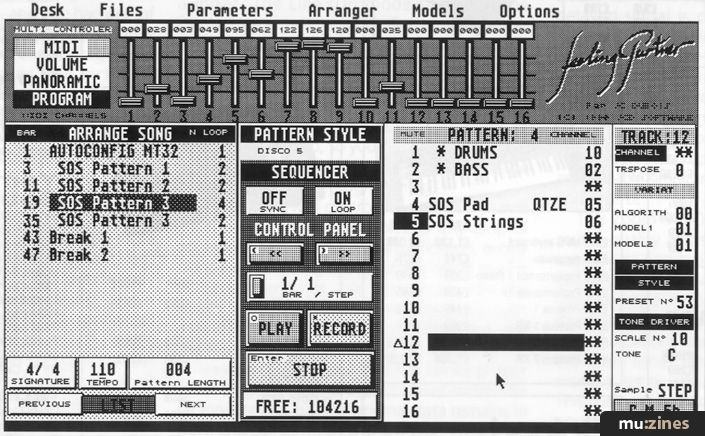
Zut alors, but the name is a give-away — Feeling Partner must be from France. Yew cahn awlmowest ear zee mewzeek een zee nayme. But don't be misled. Feeling Partner is not just another 'backing band' program; instead it takes many of the ideas of auto-accompaniment and puts them into an integrated environment with a basic 16-track sequencer. The result is that the program behaves like a harmonising arranger which works with you, instead of a normal sequencer which needs careful forethought and precise instructions to do anything.
Band-in-a-Box and Freestyle (reviewed in SOS July '91 and December '91 respectively) approach songs from a 'fake sheet' approach. You place chords one after another in a progression, and the resultant song is exported via a MIDI File for further manipulation in your sequencer. Using the fake sheet metaphor gives immediate access to the overall structure of the song, and lets you make rapid changes to the chords — in fact, it can encourage you to explore progressions that you might ordinarily ignore.
Feeling Partner is different. You assemble the instrumentation you want, and then control those instruments, either with your real-time performance or with a guide track (called a Track Driver by the program) that you record yourself; you arrange the resulting Patterns into a song, which is then played back from within Feeling Partner. In fact, although you can import and export Patterns via MIDI Files, you can't do the same with songs, so Feeling Partner's sequencer really is intended to be your sequencing platform for this type of application (The review version, V1.52, was not MROS or SoftLink compatible.) Despite this limitation, it works, and is very musical — even to one like myself who is addicted to graphical environments!
What you play on the 'guide' track forms the chordal structure of the resulting pattern — there is no graphical fake sheet. You hear what you play, the program then harmonises to it, and you arrange the results. Having used both methods, Feeling Partner certainly seems to be less clinical and 'computer-technical' in operation, as well as more spontaneous to a 'player'.
The main screen design probably owes some of its layout inspiration to the Germanic logic of C-Lab's pre-V3.1 Creator/Notator package. The arranging/pattern selection is on the left, whilst on the right are the 16 tracks, with additional controls and the 'tape transport' buttons in the gaps. The upper portion of the screen is occupied by 16 very useful MIDI channel-based sliders which control MIDI Volume, MIDI Pan and MIDI Program Changes, in real-time. The translation of "Pan" as "Panoramic" is one of the few Franglicisms to slip through the translation process — the manual is very English in feel, and it is quite difficult to tell that it has been translated.
Feeling Partner provides 74 preset musical Styles, six pre-defined harmonising Instruments (drums, bass, strings, piano, guitar and brass) and a large library of two-bar sequences (called Models by Feeling Partner), but the Instruments, Models, and the way that the two-bars are played (the program's 'algorithms' control this) can all be easily re-defined, which opens the way for extensive personal customisation.
The harmonising facility, whether it's being driven from one of your recorded tracks or in real time from a MIDI input, recognises 12 types of chords (no 9ths, 11ths or 13ths), and can operate on a step or bar basis. The harmonise 'per step' feature is much better than the one or two chords per bar which many auto-accompaniment programs offer. You can change Styles or Models whilst the pattern or song is playing, and the program correctly gives a higher priority to dealing with MIDI than to graphics, which makes the menus seems slightly sluggish in response to mouse movements.
Track editing is based on a simple list of MIDI events, with a rather primitive scrolling arrangement, whilst the process of arranging is achieved via a list of patterns and the number of times they repeat. Transposition intervals are defined in terms of note values rather than musical intervals (eg. '+3' instead of a minor third), which is actually somewhat out of character with the very musical feel of the program, and you can quantise to between 4 and 192 ticks (the basic resolution is 384 ticks to a bar). You copy and erase tracks (or Patterns) by dragging them, either to a new position or out of the window. Changing the values of parameters is achieved with the two mouse buttons (left = increase, right = decrease).
I would have preferred scroll bars to move around in lists, and more conventional dialogue boxes (for example, you can only exit from the track edit box by pressing the Return key) and despite the many real-time facilities you do have to stop the sequencer to perform some of the track 'house-keeping' functions.
Feeling Partner offers the sequencer user a familiar way of arranging songs quickly, with the help of auto-accompaniment and harmonisation features. Instead of having to load a pre-generated MIDI File into your sequencer and then add or edit the music to get what you want, Feeling Partner does all the essentials in one go. Although not as graphically-oriented as some ST programs, the musicality and spontaneity is excellent, and I felt at home very quickly. This program can be thoroughly recommended for all but the most demanding of professional users — magnifique!
Further information
£175 inc VAT.
Music Pro Import (UK), (Contact Details).
Also featuring gear in this article

JCD Feeling Partner - Atari ST Software
(MT Apr 92)
Browse category: Software: Accompaniment > JCD Software
Publisher: Sound On Sound - SOS Publications Ltd.
The contents of this magazine are re-published here with the kind permission of SOS Publications Ltd.
The current copyright owner/s of this content may differ from the originally published copyright notice.
More details on copyright ownership...

Sound On Sound - Apr 1992
Review by Martin Russ
Ads for Gear in this article:

Help Support The Things You Love
mu:zines is the result of thousands of hours of effort, and will require many thousands more going forward to reach our goals of getting all this content online.
If you value this resource, you can support this project - it really helps!
Donations for May 2026
Issues donated this month: 0
New issues that have been donated or scanned for us this month.
Funds donated this month: £0.00
All donations and support are gratefully appreciated - thank you.
Magazines Needed - Can You Help?
Do you have any of these magazine issues?
If so, and you can donate, lend or scan them to help complete our archive, please get in touch via the Contribute page - thanks!
Please Contribute to mu:zines by supplying magazines, scanning or donating funds. Thanks!
Monetary donations go towards site running costs, and the occasional coffee for me if there's anything left over!

 @mu_zines
 RSS Feed
 Blog
Blog