


Magazine Archive
Home -> Magazines -> Issues -> Articles in this issue -> View
News | |
Studios and RecordingArticle from Sound International, September 1978 | |
Pages to the power of three, taking in Stevie's Peavey, CB, guitar gallery, and more.
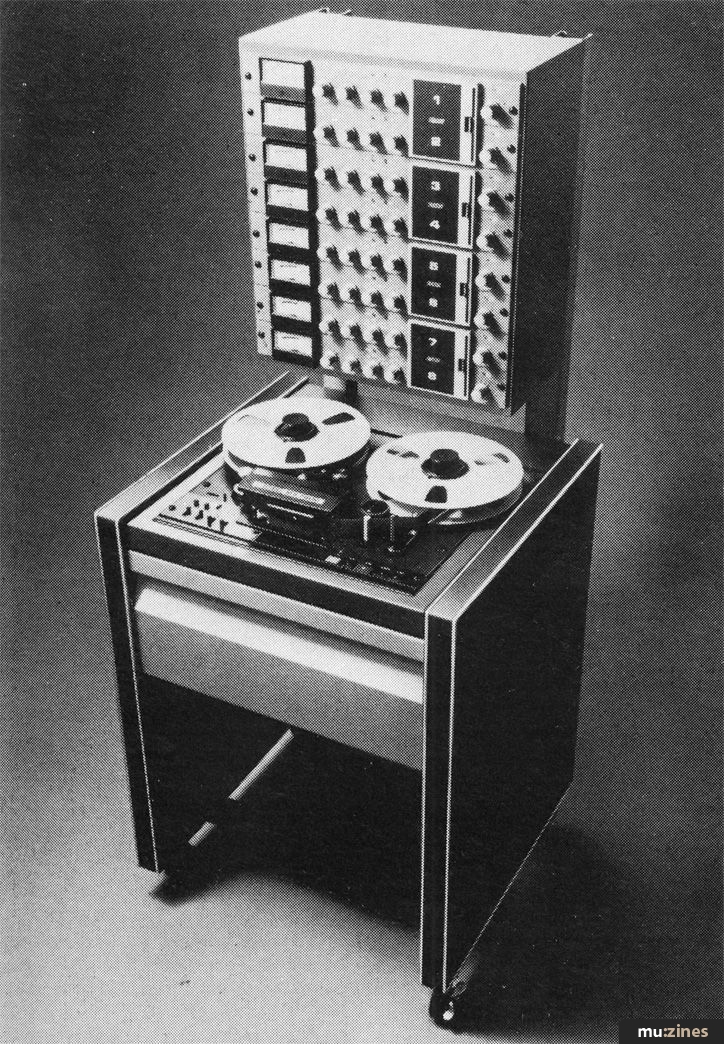
Otari MX-7800
Otari eight-track
This year's APRS exhibition in London provided a nice opportunity to explore the workings of the new Otari MX-7800 8-track on 1in tape machine complete with its optional tape timer, remote control unit and autolocator (really!). The machine is exceedingly easy to operate, with full logic control, motion sensing and dynamic braking doing their best to make sure the tape is handled correctly. In addition, setting the machine up for correct monitoring during drop-ins is greatly simplified by automatic switching between input and sync to match the mode selected — record, sync or reproduce. Thus all you need to do is set up 'safe' or 'ready' as appropriate on each track, hit the record button at the required point and the output from those tracks being dropped in will automatically flip to line in. All on one switch.
The transport is available with a choice of two operating speeds — either 7½/15 or 15/30 in/s — and features a direct-drive dc servo-controlled capstan motor. This not only holds the wow and flutter down (less than 0.04% NAB-weighted at 30in/s) but also allows a 12% varispeed to be incorporated. The tape path is a trifle bizarre, involving an S-shaped detour from the feed spool to the head block, and may be something to do with the 'constant tension system' claimed to improve tape handling.
Electronics for the eight tracks are housed in a penthouse arrangement over the horizontally-mounted deck, the calibration controls being mounted behind neat plastic doors out of harm's way. A built-in oscillator with preset frequencies of 700 and 5KHz should help to speed up routine machine alignment.
The optional CR706 remote control unit duplicates all the normal deck controls (play, rewind etc) and also allows the mode of each track to be selected once the 'remote' mode has been selected on the relevant electronics module. Nine three-position switches are provided — fitted, incidentally, with nice 'n big handles — one for each track plus a master controlling all tracks simultaneously. One position is record 'ready', another 'safe' (sync replay) and the other reproduce. Three rows of LEDs indicate the monitor status of each track (input, sync or replay), the input lamp flashing to show 'ready' and remaining on to indicate record has been entered on a particular track. Sounds a mite complicated, but super-easy to understand once you've run through it a couple of times. The remote control also duplicates the coarse and fine varispeed controls found on the transport, plus the 'fixed/vari' switch.
The CT501 tape timer comprises a digital LED readout of elapsed time in minutes, seconds and tenths of a second. A return-to-zero feature — in fact, more accurately described as a 'stop-at-zero' — is very useful when you need to return to the same point on the tape over and over again during a mixdown or while trying to perfect a drop in.
Two memories or 'locations' are provided on the X-2171 autolocator. The tape can be made to shuttle between these two locations, or start at point A, do something different at location B (such as drop into the record mode) and then do something else at point C (like drop out or stop or return to A etc). Or the tape can be made to journey to either of the two preset locations. All very comprehensive and a very useful accessory for the busy 8-track studio where for reasons of economy you may be running the control room on your own, and cannot be bothered to keep punching up multiple passes on the remote control unit.
What about the cost? The UK prices for the machine plus options are as follows: the MX-7800 8-track will set you back about £5000; the tape timer about £180; the remote control about £200; and the autolocator around £250.
Further details can be obtained from Otari Corp, (Contact Details); and C E Hammond & Co Ltd, (Contact Details).
Surrey Electronics
Every so often a little company pops up producing exceptionally high-quality gear at good prices, but in a very subtle way: so subtle in fact that almost nobody has heard of them. Surrey Electronics is one such company.
Run by Trevor Brook from the depths of Surrey, in South-East England, as the name suggests, Surrey Electronics are perhaps best known for their high-quality PPM cards, which, with the appropriate Ernest Turner movements, fulfil the requirements of both BBC and IBA and broadcasting organisations of other countries. These cards, built under licence from the BBC, are used by some top console manufacturers as standard fittings — not surprisingly, because they're very good.
Surrey Electronics primarily produce equipment for broadcasting applications, including a Peak Deviation Meter and chart recorder (see how much over the top Capital is this week?...) and a distribution amplifier. They also manufacture a couple of high-quality disc preamps, the Stereo Disc Amplifier 2 and SDA-3, both of which raise the output of a cartridge to line level with negligible noise and distortion; the SDA-3 being an 'economy' model. Both useful, not only for broadcasters, but also for copy-rooms and anywhere needing good disc-transcription facilities. Surrey Electronics also produce a couple of frequency shifters: the Stabilizer, which minimises PA howl-round by shifting input frequencies between 1 and 10Hz, and the Spectrum Shifter, which shifts between 0.1Hz and 1KHz for special effects.
Surrey Electronics: Trevor Brook and John Hulin, The Forge, (Contact Details).
Brenell Console 8
Following the success of the well-known Mini 8 one-inch machine, Allen and Heath-Brenell Ltd have introduced a new model: the Console 8. Where the original machine was designed for vertical operation in semi-portable conditions, the new 8-track machine is designed for permanent installations.
The Console 8 is based on the Mini 8 transport and features fully-modular audio electronics by Brenell or Richardson, switchable NAB/IEC eq, and individual sync and replay outputs. Meters and record switching are mounted in a penthouse. The deck is fully logic-controlled and features constant tension and a digital position indicator/timer. The deck pivots for easy access. The machine includes provision for dbx or MXR compansion systems for noise reduction.
Also available are a varispeed unit giving 30% speed adjustment, and a remote-control box with full record switching, transport control and return to zero facilities.
Also newly available from the same company are two new mixers, the SR20 and SR28, designed for live mixing. Routing is via eight busses to any combination of four subgroups, stereo master faders or auxiliary masters.
The SR series desks are fully modular, making updates and servicing a simple matter, even in the field. They feature three-band eq with parametric midrange, mic/line switching with 20/12dB pad and rumble filter, and phantom-power outputs (normally 12v, but with 48v available as an option). PFL on everything imaginable is also included, as are eight mono and one stereo echo returns. The 20 and 28-channel desks are available with flight-cases and multicore cable interface.
Allen and Heath-Brenell Ltd, (Contact Details).
Publisher: Sound International - Link House Publications
The current copyright owner/s of this content may differ from the originally published copyright notice.
More details on copyright ownership...
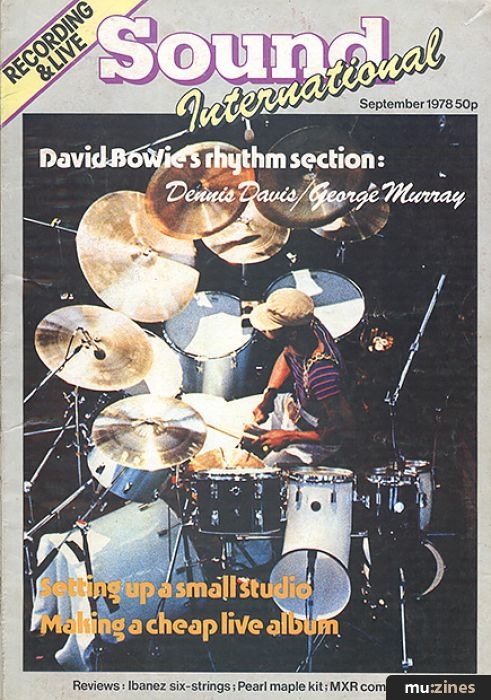
Sound International - Sep 1978
Donated & scanned by: Mike Gorman
News by Mel Lambert
Help Support The Things You Love
mu:zines is the result of thousands of hours of effort, and will require many thousands more going forward to reach our goals of getting all this content online.
If you value this resource, you can support this project - it really helps!
Donations for April 2026
Issues donated this month: 0
New issues that have been donated or scanned for us this month.
Funds donated this month: £0.00
All donations and support are gratefully appreciated - thank you.
Magazines Needed - Can You Help?
Do you have any of these magazine issues?
If so, and you can donate, lend or scan them to help complete our archive, please get in touch via the Contribute page - thanks!
Please Contribute to mu:zines by supplying magazines, scanning or donating funds. Thanks!
Monetary donations go towards site running costs, and the occasional coffee for me if there's anything left over!

 @mu_zines
 RSS Feed
 Blog
Blog