


Magazine Archive
Home -> Magazines -> Issues -> Articles in this issue -> View
One Step Beyond | |
Roland SDE330 Dimensional DelayArticle from Sound On Sound, October 1993 | |
Dave Lockwood goes in search of an extra dimension with the help of Roland's new digital delay.
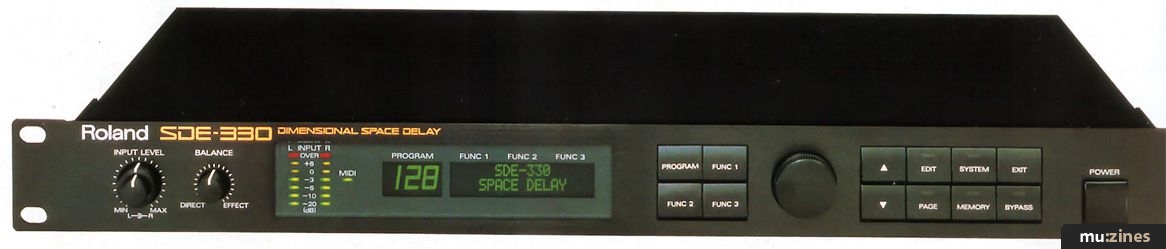
Roland's SDE330 Dimensional Space Delay is a companion unit to their SRV330 Reverb (reviewed SOS August), incorporating processing based on Roland's RSS '3D' sound technology — a system able to create the illusion of sounds originating from well beyond the width of the normal loudspeaker soundstage, to the extent that it can sometimes appear to be coming from behind the listening position.
The SDE330 does not offer real-time panning effects like RSS — its 'three-dimensional' element consists actually of settings for 'Azimuth' (static left/right placement), and 'Elevation' (this allows you to set the vertical positioning of the sound over a range of 60 degrees up or down). RSS it certainly isn't, but what it does seem to allow you to do is separate an effect from its original signal in a way that no simple delay processor in my experience quite does. In practice, I found that delay effects I might previously have wanted to 'sit back' a little, perhaps rolling-off some top end to tame them, could be left at full bandwidth without cluttering the signal; indeed, they would be somehow — I hesitate to use the word psychoacoustically, but I can think of no other more suitable — perceptibly removed from the original. You might not be able to get echoes to 'dance round the room', but the 'dimensional' aspect of the SDE330 seems to be doing something subjectively useful.
After all the multi-effects units we have been inundated with over the last few years, dedicated processors, designed primarily to perform one function such as reverb or delay, are very much making a come-back. It is not that there is anything inherently wrong with the concept of the versatile all-rounder, but in practice, when you've paid a lot of money for, say, a high quality reverb, the chances are that you'll want it to do precisely that for most of the time, however much else it may be able to do. Having said this, the SDE-330 does offer other effects in addition to delay but — with the exception of its Pitch Shifter — they are all recognisably delay-related.
PERSPECTIVE
With the incorporation of a modulation stage in some of its algorithms, the SDE330 is able to offer chorus and flanging effects (based on modulated short delay times). A choice of triangle or sine wave for the modulating LFO allows maximum flexibility in all the modulation-based effects. A Pitch Shifter is also incorporated in two algorithms; interestingly, one with and one without the '3D' processing stage, enabling easy direct comparison between them. I found that whether or not you can hear any difference depends very much on your monitoring environment. An over-live room, and particularly an over-reflective surface behind the listening position, seems to be enough to inhibit the 'dimensional', out-of-speaker effect altogether, limiting it merely to a heightened sense of perspective, or perhaps depth — still useful, nonetheless. When you collapse the whole thing to mono on a '3D' effect, nothing more untoward seems to happen than with any normal stereo source.
Bearing in mind the significant difference between a simple mono chorus and a stereo version of the same thing, I half expected a 'dimensional' 3D chorus to be utterly spectacular — an effect with a whole new order of spaciousness. Unfortunately it wasn't. Whilst still undoubtedly a good chorus for a digital unit, I certainly didn't feel it was giving us anything we haven't heard before.
The SDE330 multitap delays offer some particularly good effects, however — herein, I think, lie some of the strongest implementations of the dimensional processing. These programs seem able to give the signal a unique sense of size, placement and solidity. Whether you are hearing anything 3D or not, this is worth having.
Another particular highlight of the SDE330, for me, is the gently modulated long delay. Nothing before has ever got this close to replicating the random detuning provided by the speed variations of old-fashioned tape echo units. There was a richness about the way this effect used to be generated that almost made the noise and the unreliability worth putting up with. I seem to remember Roland have imitated this feel before, in their digital re-issue of the Space Echo — but I think this is better.
FAMILIAR
The SDE330 is nothing if not familiar in its construction and layout, being housed in a 1U matt-black rack chassis, with a two-line LCD window in the centre of the front panel. The backlit display shows both the program number, program name and the algorithm from which it was derived, during normal usage. This switches over to parameter names and values during editing.
Unbalanced jacks handle both the inputs and outputs, with the signal path following the usual stereo in, stereo out format. Unusually, it is possible to independently switch the inputs and outputs between +4dBu and -20dBV operation. The absence of a -10dBV setting is, in practice, no problem, as the input and output level controls provide more than adequate adjustment to interface with a -10dBv desk. Bypass and Control footswitch jacks are also provided, in addition to a pedal input for real-time parameter control. MIDI In, Out and Thru sockets, and the captive mains lead (with UK plug), complete the connection facilities. MIDI In is not just for simple program selection — the SDE330 incorporates sophisticated and effectively implemented real-time control of effects via MIDI.
Sixteen-bit, 44.1kHz sampling is no more than we have come to expect these days, but the SDE330 is nonetheless an audibly impressive performer. The delta-sigma converters are probably responsible for the subjectively clean sound of the unit, at any drive level short of clipping — an important consideration when you think that effects units invariably have their input level controls set for the maximum level they are likely to receive, but then spend the majority of their time receiving a significantly smaller signal. The level meter bargraphs' legending encourages working at a fairly conservative level — nominal zero being a long way below digital clip point.
The SDE330 is provided with 300 program locations, filled with duplicates of the 100 factory presets. Locations 1-200 can be modified and stored as user programs. Programs can be selected serially by means of the rotary alpha dial, or the data increment/decrement switches (with the usual system of holding one switch whilst pressing the other to increase the scroll rate). A memorised MIDI program mapping system is incorporated to allow access to the numbers above 127 via standard MIDI Program Change messages.
PERSONALISED EDITING
The SDE330 has 19 algorithms, all of which include a parametric EQ block and real-time MIDI control assignments. The parameters available for editing depend on the algorithm selected, but the display window works on the now familiar page-like system. A maximum of three values are visible at any one time, but the operating system will actually allow you to specify the order in which the parameters are displayed. Thus, those you most often need for editing can be programmed to always come up first, with the less well-used ones further down the listing. This is a useful feature, allowing you to really personalise the unit to your way of working — I always like to tweak the base delay time of a chorus to customise the effect, rather than adjusting the usual depth or speed, yet that is never a 'top page' parameter. The SDE330 allows me to make it the first thing I access in edit — excellent.
MIDI real-time control assignments — still under-used as a creative tool — are accessed right at the end of the parameter listing. The balance between effect and direct signals is actually always accessible via the front panel Balance knob, but the overall effect level for each program is memorised.
Editing is simple, with three Function buttons used to select one of the three visible parameters to be edited. The value of that parameter may then be changed via the data entry knob or the simultaneous Inc/Dec keys. Edited programs may be compared with the original before being stored. Parameter ranges are sensible without being restrictive — ultra-fine resolution is available if needed, with 0.01ms increments within the Precision Delay algorithm, and individual cent steps on the pitch shifter. Even the most obsessive of programmers would not be frustrated by the SDE330's potential for fine-tuning an effect.
Stepping through the programs, the SDE330 maintains the current selection until you stop scrolling, so there is no audible glitching in the output. Individual program selection, from the front panel or via MIDI is, however, a little slow, with a delay of about half a second before the new program is cleanly switched in.
MIDI real-time control, however, seems to be about as vice-free as you could expect — give the SDE330 clean, contiguous data and it will respond suitably. Give it conflicting or fragmented MIDI garbage and it will, quite understandably, audibly complain.
CONCLUSION
Roland are to be praised for continuing to push at the boundaries of audio processing with their Dimensional series — this is certainly more than just a re-packaging of the same tired old effects. It is inevitable that spin-offs from RSS technology will continue to filter down into more economically priced systems — this perhaps is just the beginning.
The longer I used the SDE330, the less I found I worried about what its 'dimensional' aspect may or may not have been doing, and the more I liked it! It is an excellent-sounding delay unit, with a host of instantly very usable presets, and one or two rather special ones. The price, however, may be regarded as a little on the high side for a dedicated delay unit, unless the SDE330's 'unique selling point', its dimensional processing, is seen as being of real value in your projected application. In summary, if I hadn't known that this unit was an RSS spin-off, I doubt if I would have taken the trouble to set up the monitoring conditions required to maximise the chances of hearing the spatial effect — you really do have make sure that you are are in the right position, and that the rear wall is not reflective, before you will hear anything remotely 'dimensional'. What I couldn't possibly fail to have noticed however, is the conspicuously clean, transparent sound of the unit, and the sheer usefulness of some of the effects in real applications. Whichever way you look at it, the SDE330 is a strong performer which deserves to be assessed on audible merit.
Further Information
Roland SDE330 £699 inc VAT.
Roland UK Ltd, (Contact Details).
ROLAND SDE330 £699
• Useful range of effects.
• Simple user interface.
• Good audio performance.
• Easy to use real-time MIDI control.
CONS
• 3D spatial element rather subtle.
• Could be seen as expensive for a dedicated delay.
SUMMARY
Excellent sounding device with quick and easy access to important parameters. Like its companion SRV330 reverb, this unit undoubtedly offers professional-standard performance.
REAL-TIME MIDI CONTROL
Within each preset, up to five effects parameters may be assigned to real-time control, with the control sources including both MIDI, and the rear-panel switch and pedal inputs. Sources of control data can be mapped to any of the parameters within the algorithm on which the patch is based. Multiple assignments to the same parameter are allowed, but, as always, it is important to avoid discontinuities in the data whilst audio is present in order to avoid audible glitching. Sensibly, programs are always recalled with real-time data defaulted to normal, responding only when a change in an assigned value is detected. Maximum and minimum parameter value limits may be defined for real time control assignments — the usual trick of swapping the upper and lower values in order to reverse the control direction is also possible. The SDE330 is strong in this area; its real-time control assignments are easy to program, and vice-free in operation.
SPECIFICATION
| Converters: | 16-bit, delta-sigma, 44.1kHz | |
| Frequency Response | (effect): | 20Hz to 20kHz |
| (Dry): | 5Hz to 70kHz | |
| THD: | 0.02% or less at 1kHz | |
| Dynamic range: | 90dB or better | |
| Audio connections: | Unbalanced ¼" Jack | |
| Input Range: | -20/+4dBm | |
| Input Impedance | (-20dB setting): | 300 kohms |
| (+4dB setting): | 10k ohms | |
| Output Range: | -20/+4dBm | |
| User Memories: | 1 to 200 | |
| Preset Memories: | 201 to 300 |
EXAMPLE SDE330 PARAMETERS
| • Delay Time L/R: | 0.7 to 1400ms |
| • Level L/R: | -100 to 100 |
| • Feedback Level L/R: | -100 to 100 |
| • Cross Feedback Level L/R: | -100 to 100 |
| • Feedback HF Damping (Freq) L/R: | 250Hz to 16kHz |
| • Feedback HF Damping (Gain) L/R: | -20dB to 0dB |
| • Azimuth L/R: | L180 R180 |
| • Elevation L/R: | -60 +60 degrees |
| • LFO Waveform: | Triangle, Sine, Sync, Inverted |
| • LFO Rate: | 0.01 Hz to 10.0Hz |
| • LFO Depth: | 0 to 100 |
| • Effect Output Level: | 0 to 100 |
| • Tempo: | 25 to 250bpm |
| • Tempo Source: | Manual, MIDI, Control switch |
| • Delay Time as Note L/R: | 1/16 to 1/4 |
(The Equaliser and real-time MIDI Control Assignments are incorporated in all algorithms). | |
EQUALISER: 3-BAND, TRUE PARAMETRIC: | |
| • Frequency: | 20Hz to 2kHz |
| 200Hz to 8kHz | |
| 1.5kHz to 20kHz | |
| • Gain: | +/-12dB |
| • Q: | 0.3 to 10 |
SDE330 ALGORITHMS
- SIMPLE 3D DELAY: a mono input algorithm, with modulation available to create chorus or flanging. The incorporation of a 3D stage allows spatial positioning.
- STEREO 3D DELAY: a stereo delay with independent left and right delay times. Cross feedback or modulation can be applied for complex effects, and 3D positioning is incorporated.
- 8-TAP 3D DELAY: a multitap with eight independently adjustable delays in parallel, each one able to be positioned via the 3D parameter.
- QUAD 3D DELAY: four independent delays in series, each with spatial positioning.
- DUCK 3D DELAY: two conventional delays with an output level control governed by the envelope of the input signal. A 3D parameter allows each delay to be positioned.
- PITCH SHIFTER 3D DELAY: four independent delays, each feeding a separate pitch shifter process, followed by a 3D stage.
- REVERSE 3D DELAY: the input is recorded for the duration of the delay setting, and is then played back in reverse. Raising the feedback level results in alternating backwards and forwards playback. The spatial position of each delay can be set via the 3D parameters.
- MONO 3D NON-LINEAR: a mono-input multitap with up to 39 delays. An output envelope can be specified, as can an overall 3D spatial positioning.
- STEREO 3D NON-LINEAR: as above, with independent left and right inputs, and 30 taps.
- PRECISION DELAY: a stereo delay with 0.01 ms increments.
(All 3D algorithms have an equivalent 'non-3D' version in which the spatial processing block is replaced by a simple pan parameter).
Publisher: Sound On Sound - SOS Publications Ltd.
The contents of this magazine are re-published here with the kind permission of SOS Publications Ltd.
The current copyright owner/s of this content may differ from the originally published copyright notice.
More details on copyright ownership...

Sound On Sound - Oct 1993
Review by Dave Lockwood
Help Support The Things You Love
mu:zines is the result of thousands of hours of effort, and will require many thousands more going forward to reach our goals of getting all this content online.
If you value this resource, you can support this project - it really helps!
Donations for October 2026
Issues donated this month: 0
New issues that have been donated or scanned for us this month.
Funds donated this month: £0.00
All donations and support are gratefully appreciated - thank you.
Magazines Needed - Can You Help?
Do you have any of these magazine issues?
If so, and you can donate, lend or scan them to help complete our archive, please get in touch via the Contribute page - thanks!
Please Contribute to mu:zines by supplying magazines, scanning or donating funds. Thanks!
Monetary donations go towards site running costs, and the occasional coffee for me if there's anything left over!

 @mu_zines
 RSS Feed
 Blog
Blog