


Magazine Archive
Home -> Magazines -> Issues -> Articles in this issue -> View
Article Group: | |
Pop Goes MIDI | |
Article from International Musician & Recording World, June 1986 | |
Complete MIDI set-up for the small band.
In 1986, if you play an instrument you can access MIDI. Here are some Roland based suggestions as to how a contemporary pop outfit can take advantage of the new technology
The popularity of the classic garage band consisting of guitar, bass, drums, and keyboards will never die. Now however, classic forms such as the garage band have within their grasp the chance of expanding and re-establishing themselves with a powerful new twist: MIDI.
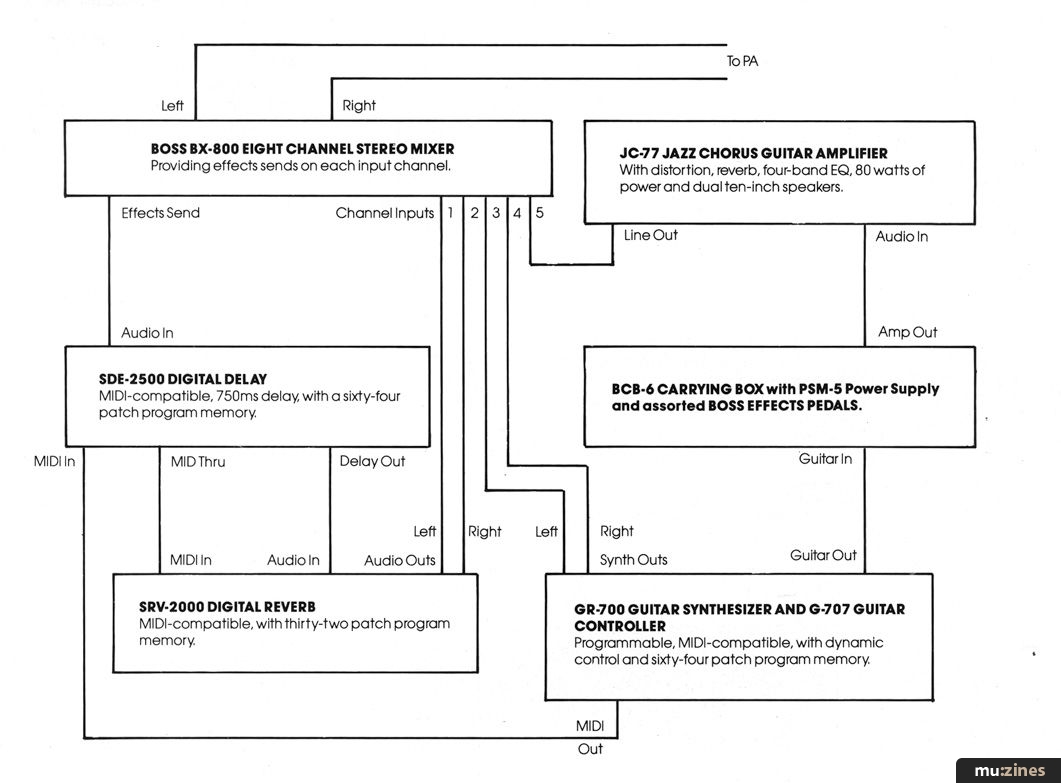
With the current additions to its ever-widening line pf MIDI instruments, Roland have made possible a complete MIDI pop band. Starting with the GR System – already becoming a classic in its own right – Roland showed guitarists how synthesis with MIDI could expand their range of expression, giving the guitar a quantum leap forward as part of a band's instrumental lineup. With BOSS effects pedals creating even more possibilities, the quality of your guitar sound becomes complete with the addition of Roland's MIDI-controllable Digital Delay and Digital Reverb.
Of course, keyboardists have enjoyed both synthesis and MIDI for some time now. Each year the degree of control expands as MIDI's power is further explored, and more exciting sound modules (such as Roland's MKS series) are added. A keyboardist's onstage setup becomes streamlined with the addition of a MIDI sequencer reliably controlled and kept spot-on with the very affordable SBX-10 Sync Box. Using an MSQ-700, much of a performance can be sequenced beforehand, and the "live" quality of the playing is still captured through MIDI. The need for multiple keyboards to clutter the stage is eliminated. All you need now is one master keyboard to switch between any MIDI sound module you choose while playing live.
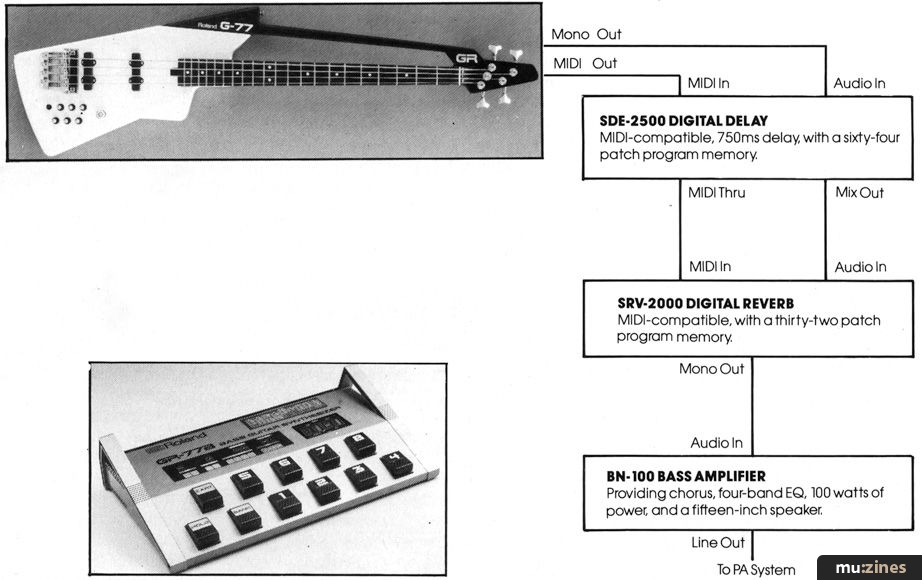
The backbone of every band is the rhythm section. For them Roland introduces the new GR-77B Bass Guitar Synthesizer, the DDR-30 rack mounted Digital Drums with the PD-10 Bass Drum Pad and PD-20 Snare/Tom Pads, and the PAD-8 Octapad. Now bassists, drummers, and percussionists can explode into the world of MIDI. Create a bass sound like no other; store the sounds of multiple drum kits – each unique and distinctive – in the DDR-30's memory (or load in even more from optional memory cartridges); play any MIDI device from the Octapad controller, which features complete MIDI channel assign capability for individual pads as well as on-board memory for patch presets.
Putting all these devices together makes individual musicians more versatile than they have ever been before. Here are some examples.
MIDI GUITARIST
MIDI DRUMS

DDR-30 DIGITAL DRUMS PD-10 BASS DRUM PAD AND PD-20 SNARE/TOM PAD
The rack-mountable DDR-30 Digital Drum module provides realistic digital drum sounds for Roland's MIDI-compatible Digital Drum System, which includes two types of drum pads designed especially to be used with the DDR-30, the PD-10 Bass Drum Pad and the PD-20 Snare Drum/Tom Pad. Four PCM digital preset sounds are provided for each of the DDR-30's six drum voices; bass drum, snare drum, and four toms. The Edit function permits the modification of preset sounds. The sixteen programmable parameters include five voice parameters, four pitch parameters, five gate parameters, and two equalizer parameters. As many as eight modifications of preset sounds for each voice can be stored in the DDR-30's memory. Sixty-four additional preset sounds can be stored in external memory, an optional M-16C cartridge. The voices of the DDR-30 are triggered by signals appearing at the Pad Trigger In Jacks provided for each voice, or at the MIDI In jack. This fully MIDI-compatible unit features MIDI In, Out and Thru connectors. Sensitivity is programmable for each voice, and individual outputs are provided for each voice, as well as stereo Mix Out jacks. DP-2 footswitches may be used to shift between banks and patches.
PAD-8 OCTAPAD MIDI PAD CONTROLLER
A MIDI-compatible pad controller, the PAD-8 features eight touch-sensitive pads with the natural feel of a drum head. With a MIDI note number (0 to 127) and MIDI channel independently assignable to each pad, any MIDI sound source from a MIDI drum machine to a MIDI synthesizer, can be triggered by hitting a pad. The PAD-8 can be used to load tracks into a hardware or software MIDI sequencer, capturing all the nuances of a performance. Touch sensitivity, curve of response, minimum velocity, and gate time are programmable for each pad. These performance parameters can be adjusted while listening to the actual sound. Four different pad setting combinations can be stored in the PAD-8's memory as Patch Presets. As many as six external pads can be connected and programmed. The PAD-8 can send MIDI program change messages (0 to 127) to any MIDI device connected at MIDI Out. DP-2 footswitches may be used to implement patch shifts and program changes.
SBX-10 SYNC BOX/CONVERTER
The SBX-10 synchronises previously incompatible synthesizers, sequencers, drum machines, and other electronic devices employing different sync methods. MIDI and DIN-Sync (24 or 48, 96 or 120 pulses per quarter note) signals are accepted by the SBX-10. All devices connected to its two MIDI Out connectors, two DIN-Sync jacks (24 pulses per quarter note), and two Time Base Out jacks (48, 96 or 120 pulses per quarter note, selectable for each output) are then simultaneously synchronised. Tempo is programmable, for music up to 1,024 quarter notes in length, by using the tap button or by feeding an audio click track into the click input jack. Thus, various sequencers and drum machines can be perfectly synchronised with subtle changes in tempo programmed into the SBX-10. Synchronisation with a tape recorder is achieved through the use of an audio click signal. The SBX-10 also features a built-in metronome.
MIDI BASS
GR-77B BASS GUITAR SYNTHESIZER AND CONTROLLER
The GR Bass system combines the expressiveness of the guitar with the limitless variety of sound that a synthesizer can provide. A programmable, four-voice polyphonic bass synthesizer, the GR-77B features sixty-four sounds in internal memory and sixty-four sounds in external memory, with an optional M-16C Memory Cartridge. Modelled after the sound data format of the JX-8P each sound program has forty-five parameters. Programming is accomplished using the GR-77B's Edit function or, more efficiently, by using the optional PG-800 programmer. A separate CPU for each string provides improved tracking. The hold function, synthesizer sound, and pitch bend are programmable for each string. MIDI Out allows the GR-77B to transmit MIDI information for key, velocity, program change, and hold. The MIDI channel is completely assignable. Stereo XLR and phone jack outputs are provided. An optional FV-200 Volume Pedal can be used to control pitch or VCF.
More from these topics
 MIDI Basics - First Steps In Multi-timbrality |
 Computer Music - The Next Generation |
 Jammin |
 Good Enough For The Pro? - Thoughts on MIDI's Next Decade |
 BeeBMIDI Monitor (Part 1) |
General MIDI - Who? What? Why? When? |
Step by Step |
 The MIDI 1.0 Specification |
Technical Introduction |
 Technically Speaking |
 Orchestrating with MIDI (Part 1) |
 Review |
Browse by Topic:
Advertisement Feature
MIDI
Publisher: International Musician & Recording World - Cover Publications Ltd, Northern & Shell Ltd.
The current copyright owner/s of this content may differ from the originally published copyright notice.
More details on copyright ownership...

International Musician - Jun 1986
Roland Newslink - Summer 86
Feature
Previous article in this issue:
Next article in this issue:
Help Support The Things You Love
mu:zines is the result of thousands of hours of effort, and will require many thousands more going forward to reach our goals of getting all this content online.
If you value this resource, you can support this project - it really helps!
Donations for May 2026
Issues donated this month: 0
New issues that have been donated or scanned for us this month.
Funds donated this month: £0.00
All donations and support are gratefully appreciated - thank you.
Magazines Needed - Can You Help?
Do you have any of these magazine issues?
If so, and you can donate, lend or scan them to help complete our archive, please get in touch via the Contribute page - thanks!
Please Contribute to mu:zines by supplying magazines, scanning or donating funds. Thanks!
Monetary donations go towards site running costs, and the occasional coffee for me if there's anything left over!

 @mu_zines
 RSS Feed
 Blog
Blog