


Magazine Archive
Home -> Magazines -> Issues -> Articles in this issue -> View
Power in the Near-Field | |
Audio Electronics Powered MonitorsArticle from Home & Studio Recording, September 1986 | |
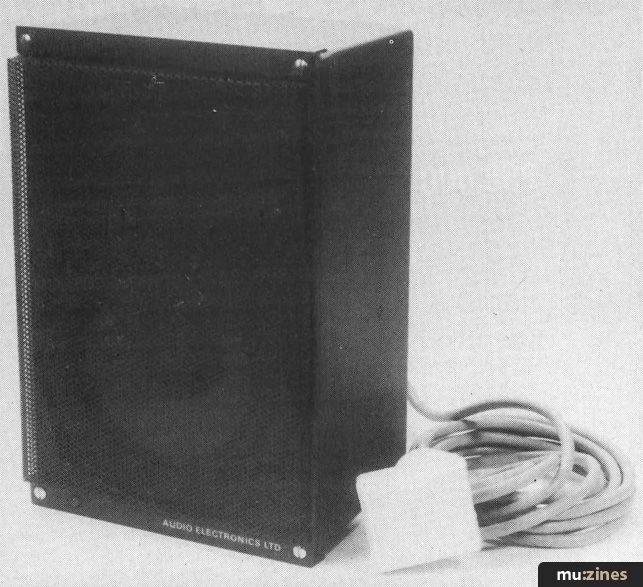
A pair of these wouldn't go amiss on the end of anyones mixing console.
No studio is complete without its near-field monitors. Self-powered models offer several advantages.
It is a generally accepted fact that the studio owner involved in any serious mixing will find himself in need of near-field monitors. Near-field monitoring on small, restricted-range speakers helps to position sounds within the stereo field, and also provides some degree of assurance that the final mix will sound acceptable on indifferent domestic monitors and small radio sets. You may question the necessity for self-powered monitors if you already have a power amplifier to drive your main monitors. However, just switching between speakers driven from a common amplifier can be a problem due to the difference in sensitivity and power handling capability between the two types of speaker system. Moreover, the near-field speakers will be several feet in front of the main monitors and so the machinations of the inverse square law dictate that these should be run at a lower power. (They're nearer so they sound louder.) One solution is to use self-powered monitors fitted with their own gain controls so that when selected, their output relative to the main monitors is as the engineer would wish it to be. Conversely, a small home studio could use small powered monitors for all its monitoring requirements and then add a full-range system at a later date.
Well, having attempted to justify the concept, I'll move onto the monitors in question.
Audio Electronics — the Truth
Audio Electronics is a British firm specialising in sound reinforcement products. They also manufacture drive units. This particular design uses one of their 20W, 4" drivers in conjunction with a 1" soft domed tweeter driven by a 13W solid state amplifier. The whole thing is built into a cast alloy case which is fitted with a protective grille and a carrying handle and is surprisingly heavy. Measuring roughly 6" x 9" x 4½", the case is fitted with a recessed rear panel which houses the captive mains lead, input jack socket and Volume control.
Let's try it
The input stage of these monitors is sensitive enough to accept the output from all conventional mixing desks and even some musical instruments, but a pre-amplified version will be available shortly at minimal extra cost for those interested in this latter application. If your mixer doesn't provide switching for two sets of monitors, these will run quite happily from the headphone outlet, and when off duty can transform your Walkman into a complete little stereo system.
Sound quality is what we are mainly concerned with, and despite their modest power rating, these monitors are surprisingly loud due to the efficient drivers employed. As you'd expect, the low bass performance is not particularly impressive but they still pack a fair punch for their size. After all, they are attempting to simulate the average domestic monitor or ghetto blaster on the street, so it's hardly surprising that they deliver less of a kick than your main monitors.
I would characterise the sound as bright and detailed, but definitely not harsh. Some bright monitors do tend to sound strident when confronted with programme material containing cymbals, but these sounded quite airy.
One thing that you do need to take care over is ground loops, because these monitors are fitted with an earth wire. Rather than just disconnecting the earth, which is bad practice from the safety point of view, (sudden death is nature's way of telling you to slow down) you could disconnect the screen of the cable feeding the monitors or at least insert a series resistor of about 10OΩ in the screen lead which should do the trick. Of course you may not find any problem at all but personally, my mixing desk seems to resent any other earthed equipment in the same street.
Summary
These monitors do their job better than most when you consider their sensible price. They are extremely sturdy yet qu ite attractive in a techno sort of way and can also be pressed into service as personal monitors and hi-fi extensions when required. Due to their small size, their imaging is good and their detailed sound means that noise or distortion won't slip past undetected. Within the limits imposed by compact near-field monitor design, these are pretty impressive and definitely worth taking a close look at.
The Audio Electronics Micro Monitors cost £171.66 including VAT and UK delivery.
Further information is available from: Audio Electronics, (Contact Details).
Publisher: Home & Studio Recording - Music Maker Publications (UK), Future Publishing.
The current copyright owner/s of this content may differ from the originally published copyright notice.
More details on copyright ownership...

Home & Studio Recording - Sep 1986
Donated & scanned by: Mike Gorman
Gear in this article:
Review by Paul White
Help Support The Things You Love
mu:zines is the result of thousands of hours of effort, and will require many thousands more going forward to reach our goals of getting all this content online.
If you value this resource, you can support this project - it really helps!
Donations for April 2026
Issues donated this month: 0
New issues that have been donated or scanned for us this month.
Funds donated this month: £0.00
All donations and support are gratefully appreciated - thank you.
Magazines Needed - Can You Help?
Do you have any of these magazine issues?
If so, and you can donate, lend or scan them to help complete our archive, please get in touch via the Contribute page - thanks!
If you're enjoying the site, please consider supporting me to help build this archive...
...with a one time Donation, or a recurring Donation of just £2 a month. It really helps - thank you!

 @mu_zines
 RSS Feed
 Blog
Blog