


Magazine Archive
Home -> Magazines -> Issues -> Articles in this issue -> View
Process of Elimination | |
ARX AFW-1 Anti-Feedback WorkstationArticle from Sound On Stage, February 1997 | |
In the course of his efforts to defeat one of two Public Enemies, Mike Crofts harnesses the power of the AFW-1 Anti-Feedback Workstation from ARX.
In the world of sound reinforcement, there are probably only two serious contenders for the title of Public Enemy Number One: the band which demands 18 separate, monstrously loud foldback mixes even when performing in the local youth club, and the dreaded f-word — feedback. For the time being, let us leave the band (bless them) to their collective, obsessive monitor syndrome, and apply ourselves to the pursuit of something much more rewarding: How To Conquer Feedback.
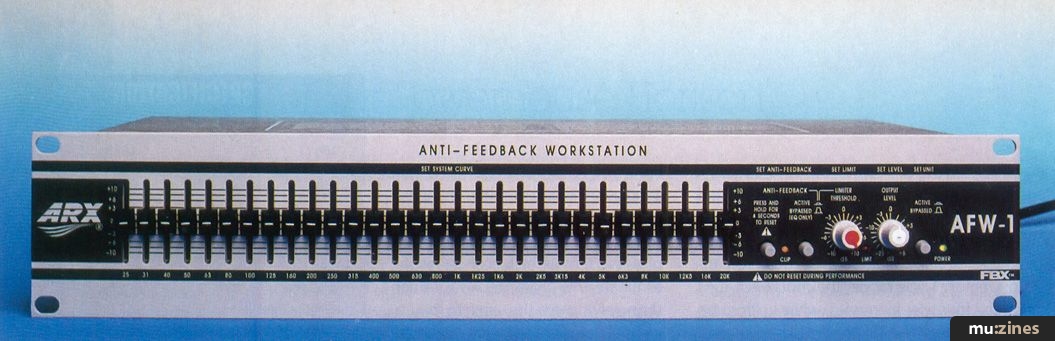
Enter the AFW-1 Anti-Feedback Workstation from ARX. A single-channel rackmount signal processor, the ARX AFW-1 contains a 30-band graphic equaliser together with a nine-filter automatic feedback eliminator, plus a peak limiter circuit to keep the system level under control.
The principle of using digital filters to overcome feedback is based upon the use of very narrow bandwidth circuits, which can be assigned to and effectively attenuate those frequencies at which feedback occurs in any particular application, without having any untoward effect on the overall 'wanted' signal being amplified. In this way, a significant increase in the amount of system gain will be possible before feedback starts to occur; the whole PA system tends to be much more stable in operation, and generally sounds much better into the bargain due to the elimination of ringing frequencies. The anti-feedback section of the AFW-1 uses the proven Sabine FBX Feedback Exterminator circuitry (from the FBX-1820), which has benefited from considerable development in this field.
MEET THE PANEL
Much of the front panel is taken up by the 30 graphic EQ controls, which are third-octave filters providing 10dB of cut or boost at a standard range of centre frequencies from 25Hz to 20kHz. The anti-feedback circuitry contains nine digital filters, which can operate between 51 Hz and 17kHz and to a depth of -40dB. Six of these filters are fixed, which means that they automatically seek and attenuate feedback frequencies, then remain locked on to those settings; the remaining three, which are dynamic filters, will be left 'floating' in order to momentarily knock out feedback frequencies during operation and are then released (on a first in, first out basis) to be automatically redeployed as required.
The fixed filters, once set, will retain their settings in memory when switched off, which is really useful either when powering-down between soundcheck and performance or for use in fixed installations, for example churches, theatres etc. If required, the filters can be cleared by holding in the reset button for four seconds (while the associated LED helpfully flashes four times). The filter section can be bypassed — leaving the graphic equaliser in circuit — by a switch next to the reset button. The filter width is globally switchable between one-tenth and one-fifth octave, but can only be changed when the unit is switched off, after which all filters will need to be reset.
TAKE IT TO THE LIMIT
The peak limiter control sets a ceiling on the output level, with an adjustable threshold which can be set to operate anywhere between -10dB and +10dB, and its operation is signalled by an amber LED. The attack and release times of the limiter circuit, which are preset, are dependent upon the signal being passed through the unit. Another LED alongside indicates imminent clipping, and this is monitored at various critical points throughout the AFW-1's circuitry. On the right-hand end of the front panel is the output level control, accompanied by a unit bypass switch, which is a complete hard-wire bypass of all functions, and connects the inputs directly to the outputs.
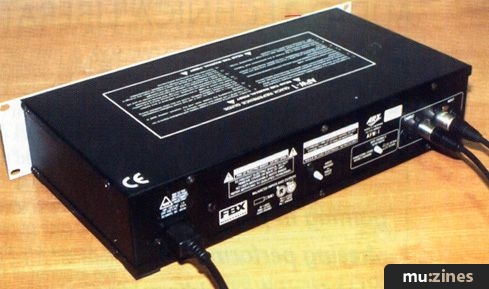
On the rear panel, both XLR and jacks are provided for the balanced input and output connections (pin configurations are printed on the panel, a very handy touch), and next to these is the filter width selector switch, followed by an audio ground lift switch. Power is supplied to the unit via a standard IEC mains connector, with a voltage selector panel underneath for 240V or 110V operation. Input and output impedances are 20kOhm and 300 Ohm respectively, with a nominal operating level of +4dB.
To make it work, all you do is connect the AFW-1 between the output from your mixer and the input to your power amp, or in an effects loop — in other words, where an ordinary graphic equaliser would normally go — and follow the instructions in the manual, which is written in a particularly helpful and easy to read style. In case, you're a very busy person who doesn't have time to read it all the way through, or you don't have the instruction book to hand, there is a clear, step by step setting-up procedure printed on the top cover of the unit itself. This is a particularly good idea and should be idiotproof enough for even the most trying situation.
THREE STEPS TO HEAVEN
Step one: you adjust the limiter threshold, initially to its lowest setting of -10dB. Two: the graphic equaliser is set to provide the best response for the environment, by operating at a nice low level, free from any feedback, howling or ringing. The manual is a good source of advice here and, in particular, warns against drastic overuse of the controls — a smooth and not too pronounced curve should be the objective.
The third and final step: with the AFW-1 in circuit (filters having been reset) and the microphone channels open, the master level is slowly (very slowly) increased until feedback starts to occur. Within a second or so, there is a small click as the filter locks on, and the feedback simply goes away! A further increase in level will trigger more feedback — this time at a different frequency — which will be summarily dispatched in the same way, and so on until six filters have been locked on and assigned to feedback frequencies. These filters (the fixed filters) will remain set at those frequencies and attenuation levels, even if the unit is switched off, until deliberately reset by the user.
Now here's the really clever bit. Three additional (dynamic) filters will be left to keep an ear on what's happening during the performance or whatever. If feedback is detected at any time, they will temporarily lock on to the frequency in question, reduce the signal by an appropriate amount, then go back to floating or 'listening' mode to deal with any further problems as they occur.
FEEL THE WIDTH
For general music use, the width of the filters is usually set at one-tenth octave, but for more aggressive feedback control and/or where the signal fidelity is not so critical (for example in speech-only applications), they can be used as one-fifth octave filters by using the switch on the back. As already mentioned, the AFW-1 allows a useful measure of flexibility by means of its independent filter bypass and overall unit bypass switches, but these must obviously be treated with great care, as inadvertent bypassing of the unit when the PA system is set at a high level may well prove painful to say the least, and will tend not to enhance your credibility with the customers!
CONFERENCE TIME
I tested the AFW-1 in a conference room application with a single microphone and found that everything which was supposed to happen happened. With a speech source, I used the filters set in both tenth and fifth-octave modes and found that even the tenth-octave setting provided a healthy increase in usable gain. In fifth-octave mode, a significantly higher level was possible, but the amount of gain obtainable without feedback was becoming scarily high so I decided to call a halt before I did any real damage to anyone. I could hear no noticeable effect on the speech signal with the anti-feedback filters in circuit with either width setting, and I was able to leave the microphone channel open with confidence. Even when the speaker (the person, not the cabinet) repeatedly performed the usually disastrous trick of cupping her hand over the mic when murmuring asides not intended for broadcast, I remained confident in the knowledge that the AFW-1 would look after things quite happily without anyone (me) hovering anxiously over the controls.
MERRY MELODIES
In a second test, I used the AFW-1 in a rehearsal application where the PA speakers were being used as monitors, facing the backs of the four vocal mics at fairly close range. For some reason, someone had removed all the heavy black curtains, which would normally cover the otherwise bare walls, and when you add this to a shiny-tiled floor, low flat ceiling, and no audience, I would have expected a major feedback epidemic. A couple of XLR connections later, our four singers were harmonising happily courtesy of the AFW-1, enjoying loads of level with smiles all round — just what the doctor ordered.
CONCLUSION
The fact that this is a single-channel device means that it will be just the ticket for many mono applications such as churches or conference venues, although you will have to buy two if you intend to incorporate them into your stereo PA. But where do the worst feedback problems usually occur before anywhere else? Right first time — in the monitor system. If you subscribe to the Vulcan school of thought, which suggests tackling the most pressing problems first, then — even if your budget doesn't run to two or three of these excellent devices — the AFW-1 will enable you to provide safe, clean foldback at the sort of levels which you usually only dream about! And you never know, maybe, just maybe, you might even satisfy the band.
AFW-1 £1281 inc VAT.
ARX International Limited, (Contact Details)
pros & cons
pros
- No-nonsense, effective feedback control.
- Quality graphic EQ, anti-feedback, and limiter all in one.
- Easy and quick to set up and use.
cons
- Only single channel.
summary
A one-box solution to feedback problems, which will make you wonder how you ever coped without one.
BONUS BOX
Publisher: Sound On Stage - SOS Publications Ltd.
The contents of this magazine are re-published here with the kind permission of SOS Publications Ltd.
The current copyright owner/s of this content may differ from the originally published copyright notice.
More details on copyright ownership...

Sound On Stage - Feb 1997
Review by Mike Crofts
Help Support The Things You Love
mu:zines is the result of thousands of hours of effort, and will require many thousands more going forward to reach our goals of getting all this content online.
If you value this resource, you can support this project - it really helps!
Donations for June 2026
Issues donated this month: 0
New issues that have been donated or scanned for us this month.
Funds donated this month: £0.00
All donations and support are gratefully appreciated - thank you.
Magazines Needed - Can You Help?
Do you have any of these magazine issues?
If so, and you can donate, lend or scan them to help complete our archive, please get in touch via the Contribute page - thanks!
Please Contribute to mu:zines by supplying magazines, scanning or donating funds. Thanks!
Monetary donations go towards site running costs, and the occasional coffee for me if there's anything left over!

 @mu_zines
 RSS Feed
 Blog
Blog