


Magazine Archive
Home -> Magazines -> Issues -> Articles in this issue -> View
Record Talkback | |
Fiat LuxArticle from Electronic Soundmaker & Computer Music, February 1984 | |
Fiat Lux
Breaking the boundary with Andy Darlington and Fiat Lux...
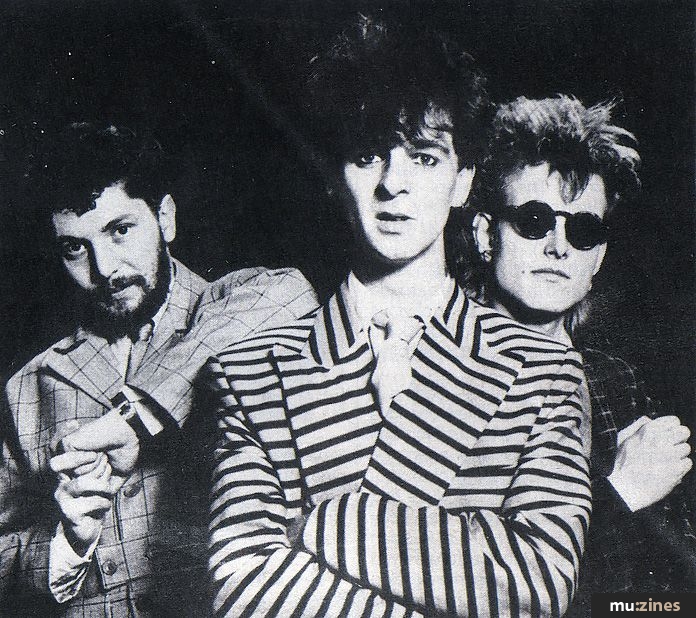
Fiat Lux means 'Let there be light', and they shed light aplenty on their first album. A sound that shines through — according to dark-haired vocalist Steve Wright — like "a searchlight in a sewer." If you have room in your heart for just one more electro-pop band — make it Fiat Lux.
They don't fit easily into anyone's preconceptions. They never have. Getting it together in a house in the country is not what you expect from modernists, but it's a setting that's exactly right for Fiat Lux. In their Smithybrook Farm rehearsal studios, low whitewashed oak beams loom perilously close to speaker cabinets, to Ian Nelson's Jupiter 8, to microphones, David Crickmore's Memorymoog, bronze sax, Fender guitar, and assorted other instruments. We distribute ourselves around the room and listen to monitor mixes of the album over sweet coffee and a tube of 'Jammie Dodgers', the high-tech decor standing in odd — but not inappropriate — contrast to the rural setting.
"Our second single, 'Photography', drew some flack", travelogues Steve with evident amusement. "It got called turgid, critics didn't like its slowness it seems. Other people, who took the time, caught onto the mood of it and really liked it."
"Radio exposure is so important," asserts Ian, "and we didn't get the plays we needed. It was scheduled for a 'Round Table' one Friday. It was gradually getting nearer and nearer the end of the programme and it hadn't been on yet. Then they played the last record and it wasn't ours. Our plugger said 'I bet I'll go in there tomorrow and they'll tell me it would've been the next one up if they'd had time'. There's something momentarily wistful in Steve's voice as he adds "it was little things that didn't happen, like that."
All bands complain about lack of air time. It's part of the game. But for Fiat Lux it's more valid than most. Listen to their current single, the reflectively beautiful "Secrets". There's a delicacy within the dynamics of melody and harmonies that give it irresistible power. No pretentions, no art-pop cerebral frosting; they rely on the cumulative addiction of its pure melody. Like "Photography" it's too slow for Disco launch, and too subtle for radio's approach to immediacy. It needs repetition before yielding up its full potential — it's worth the effort, but it needs those plays to break on through to the other side.
The album reveals similar slow burners. The spacious 'Embers' in particular stands out. "This song is all about leaving spaces", comments blonde Crickmore as it washes lushly around him. "Leaving a few spaces is in some ways a lot better than filling them." Drifting guitar chords float around a dramatic Scott Walker colouration, Ian's hypnotic sax weaving and dancing like wave-forms. Then 'Blue Emotions' — "the nicest Socialist song that anyone's ever heard" — which is something like Heaven 17 might sound with OMD shading. Later on there's 'The Moment', with nagging horns and intricate vocal harmonies, a slow loping acoustic guitar trim around a clean sax break; the slightly more orthodox electro-pop 'Breaking the Boundary'; and the fast funk of 'No more Proud' with its lyrical density served up through straining vocals. Here the chromatic drum-pulse percussion falls into place like the strokes of a well-oiled guillotine drawing from a tight reservoir of power. But it's in the beauty and clarity of the slower tracks that Fiat Lux deliver, and collectively, in album form honed and sharpened by Hugh Jones' meticulous production, there's no way they can now be overlooked.
"Anything we have an inclination to use in a particular context we can use without feeling that we're part of one sect or another."
Soft Soap
There's sufficient facial similarity to betray Ian's filial relationship to Bill Nelson. And it's an obvious critical tactic to suggest nepotism at work in the Fiat Lux debut — 'Feels Like Winter Again' — which emerged on Nelson's Cocteau label. But that single was recorded (in Leeds' Ric-Rac studios), became an "NME" 'Single of the Week' and went Top Three in the Indie lists even before Ian had expanded the line-up to a three-piece. Crickmore and Wright have a history of prowling Yorkshire stage-boards in various combinations extending back some way. At the same time that Ian Nelson was honking sax with brother Bill's Red Noise, Steve was playing in "The Cabinet of Doctor Caligari" as part of the Yorkshire Actors Company; while on the radio John Peel was playing the complex jazzy singles David was cutting with the under-rated Magnificent Everything. But it was the collaborative success of 'Feels like Winter', and the subsequent national tour with Blancmange, that fused the Fiat Lux identity into a tight professional unit. From which the step to Polydor, 'Photography', and the album, were natural progressions.
"There's some room for hindsight," acknowledges Steve around a mouthful of Jammie Dodger. "Over the last couple of days I've listened to "Winter" again. It's great, but it seems really naive now I listen back to it. Not 'cos there's anything wrong with it, it's just maybe not how it would sound if we did it now."
"What we would've raved about six months ago now seems really uneventful," concurs David. "I'm glad about that. It means we're moving on all the time. If they still sounded great that would mean we weren't achieving any progression. Now we've got fairly advanced backing tracks, fairly advanced equipment, and hopefully we can come up with some fairly advanced sounds with them. In the early days the songs were slightly more basic. We were forced to rely more on the backing tapes simply because we didn't have the facility to create a lot of the synthesizer sounds we wanted. We were limited to a Casio and a sax before we had any money!"
Light Work
"Now we have a lot more work to do," admits Ian. "There's more opportunity to cheat, but we don't want to do that. The responsibility falls on us to play a great deal more of the keyboard and synth parts live on stage. It now tends to be more a percussion-orientated backing tape. But a lot of the parts on the album which appear to be triggered mechanically and sequenced are actually played in real time. What we've done in a lot of cases is actually to replace certain voices on the Linn-drum with real drums which we've set up in the studio. So the sounds are actually original drum sounds triggered through digital delay units. They give the impression of being sequenced because they're quite repetitive and synced up to a particular pulse, but they're not actually done mechanically. They're done live by human beings".
"We were limited to a Casio and a sax before we had any money!"
"You can use the TR808 which was once hailed as the best drum machine you could get. It's got separate voices on it and everything. But although it's now been superceded by the Linn it's still as useful because it has some interesting sounds which aren't obvious Linn sounds. You can use it in conjunction with other triggered sounds, through something like an AMS (which can hold a sample of sound, which could be a live sound, and use that to trigger the machines)."
Ian sits forward for emphasis. "The problem with drum machines is that, because technology's becoming cheaper and is available to almost everybody, they're now so widely used. There's only a certain number of permutations to the Linndrum sound regardless of what chips you put in. But if you actually combine it with this technique of using real drum-sounds digitally reproduced, and treating them in different ways, you can get away from the stereotyped drum machine sound. There's nothing wrong with certain sounds off certain drum machines. No matter how cheap they are, some of them have an interesting characteristic that can be used in a particular song. But it's useful to have the facility to be able to combine them with more sophisticated things. We've always tried to avoid using the machines in the conventional sense."
The limitations lie with the musician, they infer, not the technology. Donning my agent provocateur's hat (a jaunty pork-pie model!) I suggest that, whereas the electro-pop format was once vaguely revolutionary in its implications, it's now become an establishment. So much so that a new generation of bands — like Red Guitars from Hull — are reverting back to re-stating the importance of traditional Rock instrumentation.
"There's a case for one or the other," concedes Steve. "But what we've tried to do is integrate all instruments into what we're doing." David nods animatedly. "The thing is, not to put a limit on it," he argues. "Like on those tracks you just heard, we've got things as old as the hills. There's a Mellotron doing some of the parts because they have a distinctive sound that's uncreatable outside Fairlightland."
"There's nothing wrong with certain sounds off certain drum machines. No matter how cheap they are."
In Harmony
Voices overlap like three-part fully-interlocking harmony as Fiat Lux warm to the dialogue. "Obviously we still use 'real' bass guitars and guitars. In fact there's a slightly heavier lean towards guitars on a lot of new stuff. Just to give it a harder edge. We had that edge in the beginning because things were more primitive. Now we get it by using a bit more guitar here and there. There's more guitar, but not because we're lagging behind this trend Folks! But because some of the songs need more zappiness."
Steve sums up. "This whole thing about reverting back to restating the importance of traditional instrumentation is like saying that the only way good popular contemporary rock music can be made is by using the guitar. What did Bill Nelson call it — a plank of wood with wires on? And it is just that. If a song is suitable then sure, use it. But I don't see that that provides any justification for proclaiming "We're a GUITAR BAND. We're not one of those wimpy synthi-pop bands."
"It's exactly the same prejudice that began the whole synth-orientated thing," protests David. "It'll go round in trends like that, and I don't think we want to be a part of that. We want to feel that anything we have an inclination to use in a particular context we can use without feeling that we're part of one sect or another. If it needs a Hoover — we'll use one."
As the last finely textured notes of the Fiat Lux album fade on my domestic sound centre it becomes obvious that the novelty phase of 'machine music' is a long time dead; bands like Fiat Lux are bringing back human warmth. In the same way that they've integrated their modernist studio into its rural setting, and mated electric with acoustic sounds, they've humanised their machines, redeploying their characteristics in the perspective of musical considerate is.
"That was one of the things that differentiated us from the average synthesizer band in the beginning," explains David. "Most synth bands relied on the monotone-type format, with the synthesizers fizzing away to add the melody. We always went for the melody, with synthesizers adding texture and arrangement." They're restating the importance of the song.
Ian stands to emphatically kill the tape machine. "Things have to change and adapt because times are changing. There's a lot of looking back, a lot of stasis. We're not interested in reviving the Sixties, the Fifties, or even the Forties. Were quite content to rape the Nineties."
Fiat Lux boot historical considerations and hit the current moving targets of cult and culture precisely. If you have room in your heart for just one more...
Publisher: Electronic Soundmaker & Computer Music - Cover Publications Ltd, Northern & Shell Ltd.
The current copyright owner/s of this content may differ from the originally published copyright notice.
More details on copyright ownership...
Electronic Soundmaker - Feb 1984
Donated by: Ian Sanderson
Interview by Andy Darlington
Help Support The Things You Love
mu:zines is the result of thousands of hours of effort, and will require many thousands more going forward to reach our goals of getting all this content online.
If you value this resource, you can support this project - it really helps!
Donations for May 2026
Issues donated this month: 0
New issues that have been donated or scanned for us this month.
Funds donated this month: £0.00
All donations and support are gratefully appreciated - thank you.
Magazines Needed - Can You Help?
Do you have any of these magazine issues?
If so, and you can donate, lend or scan them to help complete our archive, please get in touch via the Contribute page - thanks!
Please Contribute to mu:zines by supplying magazines, scanning or donating funds. Thanks!
Monetary donations go towards site running costs, and the occasional coffee for me if there's anything left over!

 @mu_zines
 RSS Feed
 Blog
Blog