


Magazine Archive
Home -> Magazines -> Issues -> Articles in this issue -> View
Rhythmic Control of Analog Sequencers | |
Article from Polyphony, September/October 1978 | |
This article will not be a general discussion of sequencers and how they work. It will be confined to analog, as opposed to digital sequencers. (Examples of analog sequencers are the Arp 1027 and 1613; the Oberheim MiniSequencer, the Moog 960, and the Aries AB-334.) We assume that the reader has a basic working knowledge of the general operating principles of the analog sequencer, and of voltage-controlled synthesizers in general.
Specifically, we will be dealing with a question that, sooner or later, occurs to most sequencer users, who quickly become bored with producing sequences of events of uniform duration. The question is: How do you control the duration of each step of the sequence? Exactly? (With the exception of a few of the masters of the art, such as Roger Powell and Morton Subotnick, this question seems never to have occurred to most synthesists on record.)
The answer to the question of rhythmic control boils down to finding a method for controlling the frequency of the sequencer's clock. The theoretical basis of the solution can best be approached by clarifying what frequency ratios mean to us.
To most musicians, frequency ratios are equivalent to musical intervals. Ask the average synthesist what it means when two oscillators are tuned to a 3/2 frequency ratio, for example, and you will probably get the answer: "It means they're tuned a perfect fifth apart."
This could be true, if the oscillators in question were operating in the audio frequency range. But what if they were in the subaudio range? (i.e., below 20 Hz.) If you listened to the outputs of these two oscillators, would you hear a "fifth"? Would you hear anything? If you were listening to the sine or triangle outputs, you would hear exactly nothing.
If you were listening to the sawtooth outputs from the oscillators, you would hear each one emitting a series of evenly spaced clicks; one oscillator would be clicking slightly faster than the other. If you listened to both signals at the same time, you would hear these two "click tempos" superimposed, in other words a cross-rhythm like the one in figure 1. (Assuming the oscillators were synced exactly into a 3/2 ratio).

Figure 1
Looking at it from another standpoint: if you're playing 3 in your right hand against 2 in your left, your hands are tuned to a perfect fifth. Tell that to your drummer.
What we are getting at is simply this: pitch and tempo, two musical parameters which have been traditionally considered unrelated, are actually two perceptually different manifestations of the same physical signal parameter: frequency. As a corollary, pitch intervals, whether successive or superimposed, are a function of frequency ratios of audio-range signals; the corresponding ratios in the subaudio range are perceived as sequences of events of varying durations (successions of different frequency ratios) or as cross-rhythms (superimposition of different frequencies).
This idea of the mathematical equivalence of pitch (and, if you think about it, melody, harmony, and timbre) and rhythm, which may seem novel at first, is, in fact, not so new. At least one composer — Henry Cowell — was speculating about these relationships and incorporating them into his work as far back as the Twenties. More recently, in the Fifties, Stockhausen has utilized some of the same ideas in his electronic music, most notably Kontakte. For those interested, I suggest looking into Cowell's book New Musical Resources, and Stockhausen's article in Perspectives of Contemporary Music Theory.
Now, before dealing with the implications of the above for the sequencer user, there is another mathematical relationship we must consider: the relationship of frequency, period, and duration. This relationship is quite simple; period is the inverse of frequency, (P=1/F)
For example, if a waveform of any kind has a frequency of 100 Hz., its period (duration of a single cycle) is .01 sec. If the frequency is 1Hz., its period is 1 sec., and so on. From now on, the term duration will be substituted for period, since this is a more common term in describing the relative lengths of musical events.
From the above information, we can now infer that durational ratios are the inverse of frequency ratios. As an illustration, let us refer back to the previous example of a 3-against-2 cross-rhythm, (see figure 2)

Figure 2
We can say that the lower-frequency oscillator has a frequency F, and the higher-frequency oscillator has a frequency 3/2 F. Therefore, if the quarter note has a duration D, the triplet quarter note has a duration 2/3 D.
To take another example: if the hypothetical subaudio oscillators are tuned to a 2/1 frequency ratio (octave), the resultant clicks could be notated as shown in figure 3.
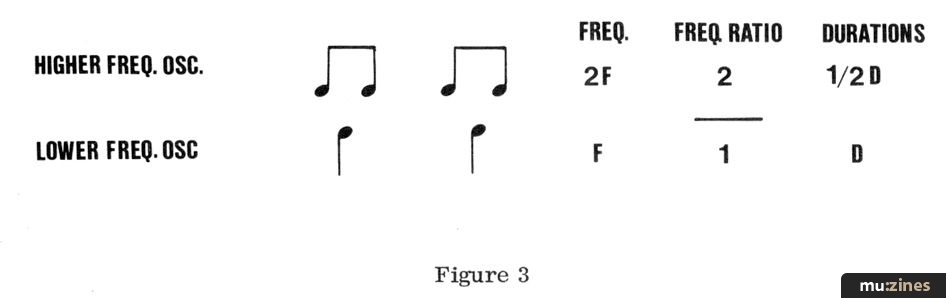
Figure 3
The translation from frequency to duration should be obvious. The 1st, 4th, and 5th columns of the chart shown in figure 10 should clarify these, and other, basic examples of the translation of frequency ratios into ratios of durations.
This completes our theoretical exposition; now we can start talking about sequencers.
Until further notice, we will be assuming that we are dealing with a sequencer which — like the Moog 960, for example — has a voltage controlled clock with 1 volt per octave sensitivity. This is not something you can take for granted about your sequencer, so make note of the exceptions discussed later in this article.
The simplest and most commonplace application of a sequencer is to use it to create a repeating sequence of varying voltages, which are used to control audio-range VCO's. The result is, of course, a sequence of varying pitches, since the frequency of the VCO varies proportionally to the voltage output of the sequencer. This typical patch is shown in figure 4.
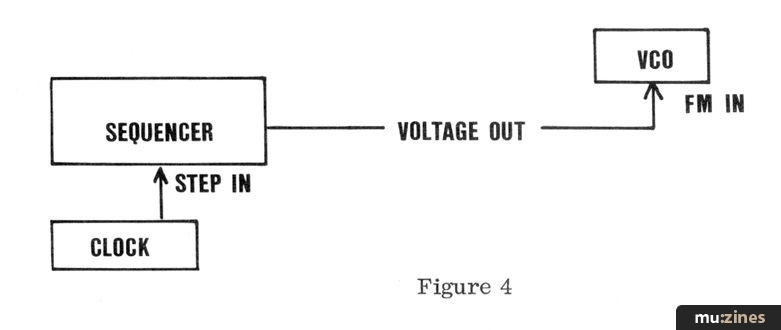
Figure 4
What is it, in this patch, that determines the tempo of the sequence? Obviously, the frequency of the clock. The clock is a subaudio pulse or square wave oscillator which may be internal or external to the sequencer, but which in either case is patched into the step input of the sequencer. If the clock can be voltage controlled, then we can vary the duration of each sequencer step by feeding a voltage output from the sequencer into the frequency control input of its own clock, (see figure 5)
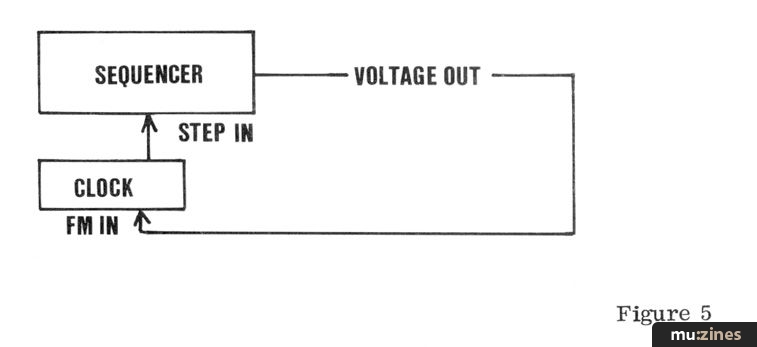
Figure 5
A voltage controlled internal clock is standard on most analog sequencers. There are certain problems, which we will note shortly, which will make it necessary to use an external clock; in such cases a pulse or square wave output from a voltage controlled subaudio oscillator should be used.
Getting a sequence of varying durations is thus quite simple; no great discovery at all, in fact. In light of the consideration of the pitch-rhythm relationships above, adjusting the sequencer voltage steps to produce a desired sequence of durations should be no problem.
Before outlining a "rhythm tuning" procedure for analog sequencers, let us remember, again, that we are assuming a 1v./octave control sensitivity (known as exponential sensitivity) for our clock.
The tuning procedure is as follows:
1) Write out the sequence of durations desired.
2) Translate this into ratios of durations. (i. e., the ratio of each duration in the sequence to the longest duration in the sequence, to which we will refer as D from now on.)
3) Translate the durational ratios into frequency ratios. (i.e., invert the durational ratios.)
4) Translate the frequency ratios into pitch intervals.
5) Patch a sequencer output voltage into an exponentially-controlled, audio range VCO, and tune the sequencer voltages to produce the pitch sequence you arrived at in step 4.
6) The sequencer voltages are now adjusted properly on the output channel you have just tuned up. Patch the same channel of voltage output into the clock's FM input, unattenuated.
This procedure may seem like a pain. It is, at first; so are most synthesizer patches which produce worthwhile results. However, once you get the hang of it, you will be able to program any rhythmic sequence (within the inherent limitation of the number of available sequencer steps) with super human accuracy.
To make things simpler, let's consider a simple example. Suppose we have an 8-step sequencer, and we want the 8-note rhythm pattern shown in figure 6.
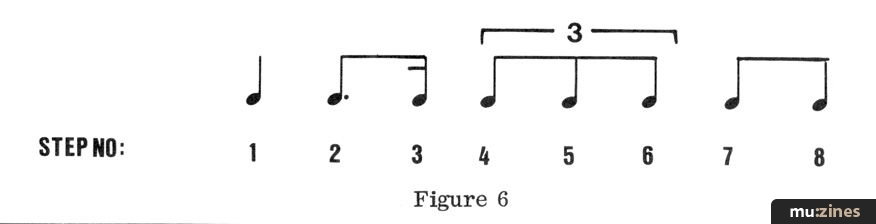
Figure 6
In step 2 of the tuning procedure, we would get the following durational ratios:
D 3/4D 1/4D 1/3D 1/3D 1/3D 1/2D 1/2D
In step 3, these translate into frequency ratios:
F 4/3F 4F 3F 3F 3F 2F 2F
In step 4, these translate in turn into pitch intervals, from which we can get the pitch sequence shown in figure 7. (We start arbitrarily on C; we could start on any note, since only the intervals matter.)
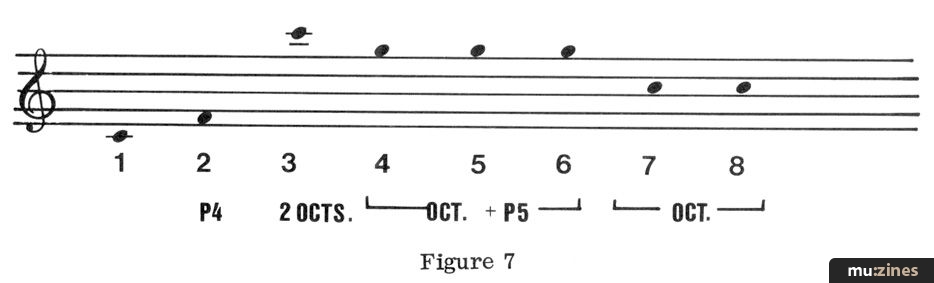
Figure 7
We now have only to complete steps 5 and 6.
The Rhythm Tuning Chart in figure 10 is intended as an aid to beginners in making the necessary translations between pitch and rhythm. Obviously it does not include all possible rhythmic values, but, with practice and an understanding of the theoretical basis of our method, it should be possible to tune up any rhythmic sequences desired.
In using the chart, keep in mind that the choice of a whole note as D is completely arbitrary; the same set of rhythmic ratios may be notated in terms of any basic unit.
Having arrived at a general method for rhythmic control, we must now deal with exceptions and various quirks of particular types of sequencers. As we mentioned, the Moog 960 has an exponentially controlled clock. This is not always the case. Going down the list of manufacturers:
ARP. Arp's 1027 sequencer module (one of the 2500 series of modules) has a voltage-controllable internal clock, but it is not exponentially controlled. Arp's model 1613, a self-contained sequencer, also has a voltage-controlled clock. Whether it is exponentially controlled or not is somewhat irrelevant, because of the presence of an attenuator on the FM input which has a gain of less than unity. In either case, an external clock should be used. Any Arp VCO, in its subaudio operating range, will do, since all Arp VCOs are 1v. per octave.
ARIES. The new Aries sequencer, soon to be released, does not have an internal clock at all. Use any of the Aries VCOs, or the internal clock of the Sample/Hold module if you have one. Do not use the dual LFO, since it's not voltage controllable.
SEQUENCERS WITH QUANTIZED OUTPUTS. Some sequencers, such as the Arp 1613 and Electrocomp, have "quantizers" which digitally round off the voltage settings to the nearest 1/12 volt, to make equal-tempered tuning easier. In voltage-controlling the clocks, internal or external, of such units, don't use the quantized outputs. The un-quantized outputs are available, and should be used for rhythm tuning; otherwise inaccuracies will result.
OBERHEIM. In dealing with the above mentioned sequencers, no adjustment to our tuning method had to be made. The Oberheim Mini-Sequencer is an exception, however.
If we wanted to get the same 8-step rhythm sequence as that in the example previously mentioned, and tuned the Mini-Sequencer as we would ordinarily, we would instead get the sequence shown in figure 8.
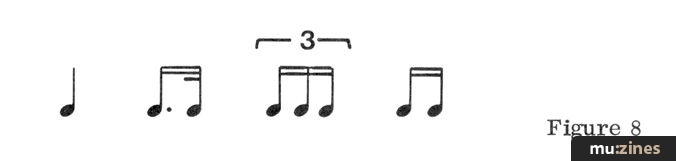
Figure 8
Why? Because the control sensitivity of the internal clock is 2 octaves per volt. There is no input for an external clock on the Mini-Sequencer; otherwise that would be the best way around this problem. (You could have your sequencer custom modified for this, of course.) We therefore have to resort to a kludge. The method is: when you get to step 4, cut all the pitch intervals in the sequence in half (Octaves become tritones, semitones become quarter tones, etc.).
The reason for this should be obvious. All the voltages must be halved, since a voltage that would ordinarily cause a VCO's frequency to be multiplied by some value n will now cause it to be multiplied by 2n.
Another option would be to put an attenuator with a gain of 0.5 between the sequencer's 2nd voltage output and the clock's control input; this, however, would again involve some custom work.
As an aid to users of the Mini-Sequencer, an extra interval column has been included in the tuning chart. (3rd column: Halved Interval) All intervals which have been indicated as flat or sharp should be tuned a quarter-tone flat or sharp. Even if you aren't so hot at tuning quarter-tones, the resultant rhythms will be perceived as accurate, as long as you're in the ball-park. The human ability to detect small pitch deviations is much more accurate than the ability to discriminate the equivalent deviations in duration.
Now have some fun with this: What chord is the equivalent of the complex cross-rhythm shown in figure 9?
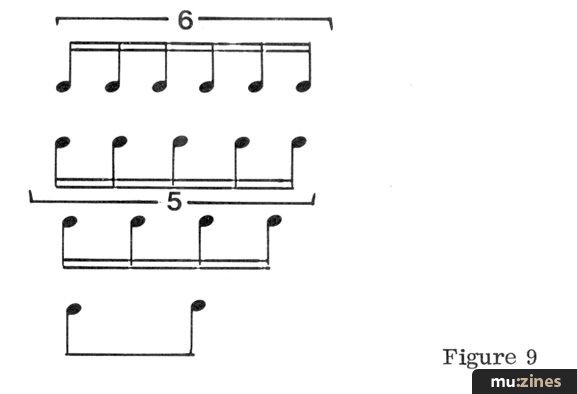
Figure 9
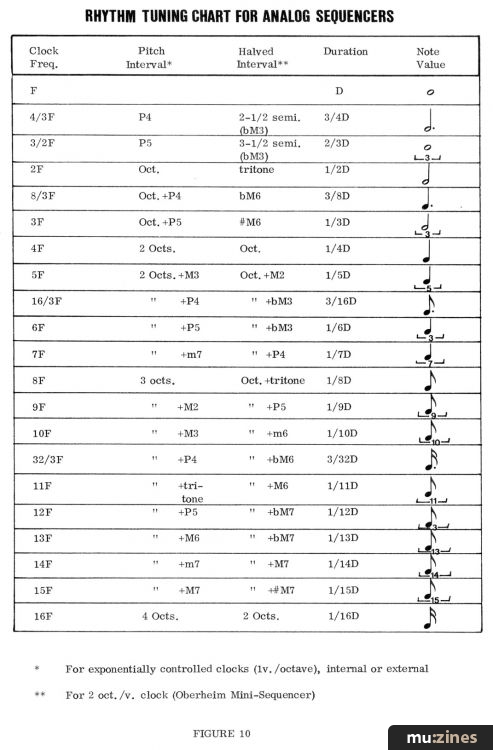
Figure 10
John Duesenberry is a faculty member of the Boston School of Electronic Music.
More with this topic









Browse by Topic:
Sequencing
Publisher: Polyphony - Polyphony Publishing Company
The current copyright owner/s of this content may differ from the originally published copyright notice.
More details on copyright ownership...

Polyphony - Sep/Oct 1978
Donated & scanned by: Mike Gorman
Feature by John Duesenberry
Help Support The Things You Love
mu:zines is the result of thousands of hours of effort, and will require many thousands more going forward to reach our goals of getting all this content online.
If you value this resource, you can support this project - it really helps!
Donations for April 2026
Issues donated this month: 0
New issues that have been donated or scanned for us this month.
Funds donated this month: £0.00
All donations and support are gratefully appreciated - thank you.
Magazines Needed - Can You Help?
Do you have any of these magazine issues?
If so, and you can donate, lend or scan them to help complete our archive, please get in touch via the Contribute page - thanks!
Please Contribute to mu:zines by supplying magazines, scanning or donating funds. Thanks!
Monetary donations go towards site running costs, and the occasional coffee for me if there's anything left over!

 @mu_zines
 RSS Feed
 Blog
Blog