


Magazine Archive
Home -> Magazines -> Issues -> Articles in this issue -> View
String Synths | |
Article from Electronic Soundmaker & Computer Music, March 1984 | |
Ensemble keyboards
John Wright looks at the budget way to get into polyphonic keyboards
Although polyphonic synthesizers are becoming more and more accessible in terms of price, the musician who is just starting out (or one who needs to add a subsidiary or practice keyboard to his setup) can still find the shop price of a true polysynth daunting. If, however, you are prepared to make a few compromises in versatility and shop around the secondhand market, there are plenty of polyphonic bargains to be had in the area we've called Ensemble Keyboards and String Synths. Usually these will offer string or organ sounds, often with full polyphony, and sometimes with synthesizer effects using a single filter divided between all the notes. Specialised keyboards such as the Logan Vocalist or Diamond Voco-Strings offer choir effects, and there's a good selection of electronic pianos with organ or clavinet settings.
Below is a list of some of the keyboards we had in mind with very approximate guides to their second-hand price. Many of these are still in production, often heavily discounted in the shops now that the ceiling of polysynth prices is becoming lower. We asked keyboardist John Wright to examine a few keyboards in detail, and this article presents his comments. Good hunting!
| Roland RS09 Organ/Strings | £250 |
| Roland SA09 Piano/Organ | £250 |
| Godwin 849 string synth | £300 |
| Moog Opus 3 versatile strings/brass | £400 |
| ARP Omni 1/II synth/strings/bass | £400 |
| Elka Rhapsody 490/610 classic strings/piano/harpsi | £150/£250 |
| ARP Solina classic strings/brass | £350 |
| Yamaha SK20 synth/strings/brass | £300 |
| Welson Symphony Rhapsody 610 clone | £275 |
| Hohner K2 basic strings | £150 |
| Eko, Instastrings, Crumar etc | as above |
| Logan Vocalist voices | £175 |
| Logan String Melody powerful strings/organ etc. | £300 |
| ARP Quartet desirable strings/organ/piano/brass | £200 |
| Roland 505 'paraphonic' synth(!) | £350 |
Introduction
During the last couple of years or so the development of the Polyphonic Synthesizer has made it necessary for many of us to view the whole subject with an infinitely open mind. Many of the very latest machines can do everything bar making the tea, whereas most of the early String and Brass type keyboards had very specific individual purposes. To a large extent this is true of many of the very latest available, and because of this it is necessary to think carefully before dashing out to buy this type of instrument.
My survey is not intended to be a comparative study; the six instruments I looked at are different both in what they offer and price-wise. I must add that there are many, many more to choose from, and hopefully we will be looking at some of these in the future.
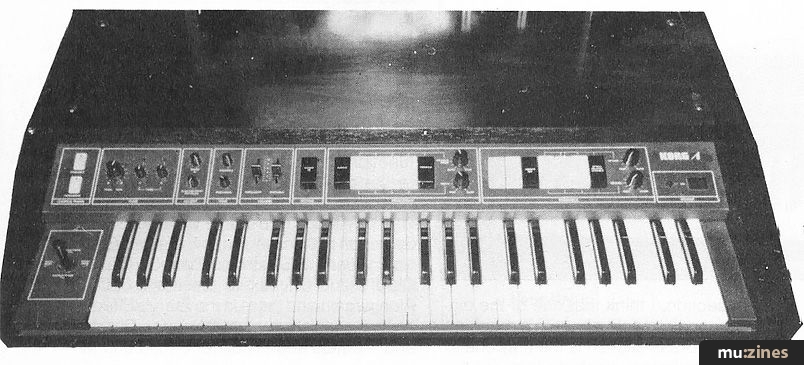
Korg Lamda
Korg Lambda — Polyphonic Ensemble
A 48-note keyboard featuring Strings, Brass, Clavi, and Harmonics. Surrounding the keyboard and control panel there is a highly polished deep wood top and side panels, making it a fairly heavy, solid piece of equipment.
The two main action stations (as it were) are the Percussion section and the Ensemble; either or both of these can be selected by the two illuminated switches on the far left of the control panel. Along from these switches the pitch control can be found; the total pitch variance is half a tone, and there are also A and B pitch controls which can achieve split two channel tuning. I found that with a small adjustment the effect was quite nice, although heavier use of these had the opposite effect!
The next sector of the control panel contained the Accent controls — Brass FC and Electric Piano Key Click. Along again and there are tone controls for the Ensemble and Percussive sections followed by independent Volume Slide controls for the same.
Standing alone is an Octave Shift Rocker switch, this does just what it says and shifts everything up by one octave. The next two sectors of the control panel contain the rocker switches and knobs for the selection of 'whatever sir would like'; within the Percussive part there are rockers for Sustain, Electric Piano, Clavi, Piano, Harmonics and Tremolo, followed by two knobs, one for Tremolo Speed and one for Decay Speed. In the Ensemble part there are rockers for Brass, organ, Vibrato Off, Chorus Strings I, Strings II, and Attack Release Variable followed again by two knobs to control Attack and Release Speeds. Finally, on the far right there is the on/off switch. To the left of the keys is the Joy Stick pitch bend control with which you can go up or down one tone by moving left to right. On moving the switch forwards and backwards the Chorus phase is activated; I found this facility to be of minimal use, but perhaps I didn't have time to discover its full value.
Well, what about the sounds? Taking the Percussive section first. Electric Piano — this sounded very much like, well, an electric piano, not of course, anything like the Fender Rhodes variety but still a good sound and much enhanced by the use of aforementioned Electric Piano Key Click. Clavi — a strong sound probably very useful for the funk musician. Piano — another good sound in itself and average in terms of electric instrument imitating the strung variety of piano — remember them? Harmonics — a high sounding chiming sort of sound, almost Chinese, very nice; within the Percussive section the Tremolo and Sustain switches and their controls can be used in conjunction with any of the sounds, which mix quite well in any order although of course this is a matter for individual taste.
Secondly, the Ensemble. Brass — good and fat, just how it should be and very flexible when used with the Brass FC switch which is an individual control to mute or brighten the sound, the latter giving more attack. Organ — not bad, perhaps a bit on the high side but quite acceptable. Chorus — I suppose this is meant to be the choir on its own; I thought it was messy, not too impressed. Strings I and II — very good sound indeed, Strings II are the same as Strings I but an octave higher. The Octave Shift switch is particularly useful. Mixing within the Ensemble section is very good and even the Chorus added character to the sound. The Vibrato Off switch would also be useful in particular circumstances and the Attack Release Variable facility is of obvious importance. It is quite possible to mix both the Percussive and Ensemble sections and, of course, the sky's the limit. At the back there are Jack sockets for Sustain Pedal, Expression, Trigger, Phones, Stereo 1 and 2, and a mixer output.
On the whole, this is a machine of quality, it is well made, has a good touch and good switches (no wobbles).
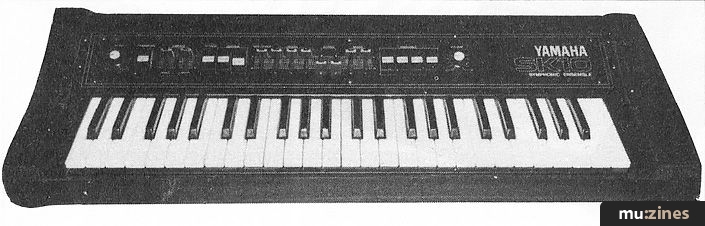
Yamaha SK10
Yamaha SK10 — Symphonic Ensemble
The Yamaha is a very simple machine of solid appearance and well made. I did in fact use one of these a couple of years ago whilst recording, more out of necessity than anything else; it did the job okay although it wasn't that special. I must admit to never having heard anyone rave about them; I feel that perhaps the machine lacks aggression.
This is an Organ, String and Brass machine. Starting with the controls — far left is the Pitch control which covers half a tone, next to this is the Transpose switch, which shifts everything up by one octave. Alongside, there are two sliders which control the Vibrato, one for speed the other for depth. Next again are the Attack and Sustain controls.
The Attack switch when activated simply slows the attack, no doubt for some this would prove to be a little too simple. The Sustain controls are easy as well — Sustain Short gives a die-off of about two seconds, and Sustain Long about four seconds. There is a slider for the brilliance control.
Access to the sounds are through Slider controls; there are three for Organ, two for Strings and two for Brass. The Organ sliders 8', 4' and 2' give tones an octave apart. The Organ sound is in fact quite strong and slightly 'churchy'. When the Ensemble switches are activated (there is one for each sound), the Vibrato works on the Selected Sound giving a chorus/phased effect; there is a most noticeable improvement when this facility is utilised. The String section is reasonable and improved by use of the Ensemble switch. The Brass section is really rather disappointing, it is not what you would call 'brassy' and on the whole quite weak.
When I put the machine through its paces, I was reasonably impressed by what could be achieved by mixing the three sounds. The last switch on the Ensemble patch is a Speed Convertor and has the effect of doubling the speed of the chorus/phasing. Although the machine doesn't tend to be known for anything apart from Organ, Strings and Brass, you could say that a piano sound can be achieved and although obviously not resembling the aforementioned strung variety the sound is just as much 'piano' as 'piano' is on many similar types of machines which loudly claim to contain the sound.
One of the most noticeable problems from my point of view is the inappropriate balance between volume emitted from lower, say F below middle C downwards, and the right-hand territory; it is perhaps a problem due to a lack of tone controls on the machine, as mucking about with the amp didn't seem to help. At the rear of the machine you will find the power switch and sockets for output, volume pedal and phones. At the end of the day this is a machine which can do the job, and of course on the secondhand market you should be able to pick one up for quite a reasonable price.
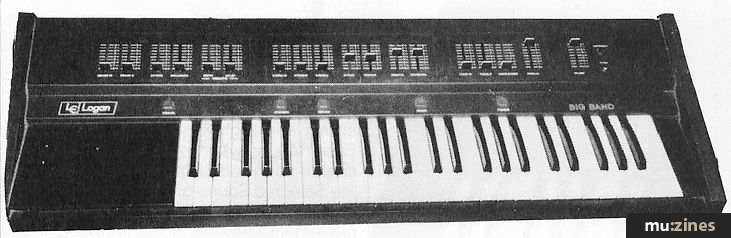
Logan Big Band
Logan Big Band
Have to laugh don't you — top prize in the silliest name category. I stumbled across this one quite by accident whilst looking at the Yamaha SK10 at Woodcray Manor Studio; there it was in one of the back rooms amongst millions of other bits and pieces. Anyway I plugged it in and awaited the outcome with anticipation. I hadn't in fact heard of this machine before, although I am led to believe it was reasonably well known a few years ago. I don't know where I was at the time, or perhaps I'm just ignorant! I remember the early Logan String Machines from about 1976, they were the ones with round buttons which fell off a lot, but the sound which they produced was always held in high esteem.
The Big Band features a variety of sounds including Brass, Strings, Organ and Piano plus a few more to be mentioned further on. The machine itself is reasonably well made, is quite large, and the controls are of quite good quality. The off/on switch is at the rear of the machine along with a normal type output socket, however, the Volume Pedal socket was of the DIN variety, intended for a special optoelectronic pedal which isn't too common.
The first controls on the left of the panel are for the Brass sound; each sound section has a master on/off switch for selection purposes, so if I just want the Brass sound I press the Brass switch and a small light comes on, if I want Brass and Strings, I press the two appropriate switches. There are Slider controls throughout in each sound section. In the Brass section the controls are; Brass 16', Brass 8', Attack, Brilliance and two controls for Vibrato, one for Depth and one for Delay. In the String section there are; Strings 16', Strings 8', Strings 4', Attack and Sustain. The same controls also work for the Organ control switch. Next to String controls are two more for the Small Reed section which features Musette and Accordian. Along again, and there are the Piano controls, which are; Piano 16', Piano 8', Harpsichord and Sustain. Finally on the far right is the Volume control.
The Brass sound on this machine is by far the winner, I was extremely impressed by the numerous qualities involved in making this up. The Attack control ranges from immediate to an arrival time of approximately one second and the Brilliance control gives the sound the essential bright effect. Altogether, everything that a Brass section should be is here with good controls which enable the sound to be rearranged in a number of ways.
The String sound in no way matched the Brass although it was acceptable, and could be adjusted and obviously mixed, so at the end of the day it wasn't too bad.
The Organ sound again is below par, being a little weak in its construction.
The Musette and Accordion sounds which come from the Reed sections were reasonably insignificant, however, they are useful extras and go well into the mix.
In the Piano section, the Piano and Harpsichord sounds are a little on the muted side. I found that by a little mucking about within this section I could get a fairly good Organ sound, one that in my opinion was better than that which came from the Organ section. I think that one of the biggest disappointments about this machine is that the Brass section is the only one to have a Brilliance control, this facility throughout would have improved many of the shortfalls by giving additional life.
The greatest use for the Big Band really is as a Big Band. Using various combinations of sounds, and let's face it there are plenty to choose from, the full potential comes to light and the machine can be very impressive indeed. There must be quite a few of these on the second-hand market and probably for some very reasonable prices, and if you can get one for a good price my advice would be go ahead.

Korg EPS-1
Korg EPS-1
If you're thinking of buying new and spending a bit more, I insist that you look at this one; new on the market and incorporating the latest technology, it really is most impressive. The 76-note keyboard is fully touch sensitive and is advertised as being the only low cost electronic keyboard available which offers touch sensitive articulation of both Piano and String sounds. The modern design makes the keyboard a very attractive instrument with neat control layout and an excellent touch.
The first of the controls is the Master volume; next to this are all the controls for the Piano section. There are three Tone controls, Bass, Middle and Treble which are within the Equalizer sector. Next to these is the Presence knob; the Presence function can either be turned off or pre-set to the desired level and activated when desired too, by simply pulling the knob outwards. Along from these are the Sound Selection buttons — Piano I, Piano II, Electronic Piano I, Electronic Piano II, Clavi I, Clavi II and Off. Above these are LED's. Along again and there is the Stereo Effects sector consisting of buttons for Chorus and Tremelo and knobs for Speed and Intensity.
In the middle of the panel there are controls for Key Dynamics and Key Transpose. The Key Dynamics allows you to shape the response from the keyboard to your own touch. The Key Transpose switch allows you to transpose the entire keyboard up and down a fifth from Middle C. Many keyboards now seem to have this facility and I suppose for some this is a godsend; I prefer not to use key transposers myself for fear of being haunted by Miss Ripley, my old piano teacher!
The String section has within it two Envelope controls, Attack, which features the Key Dynamics facility if the knob is pulled outwards, and the Release control. There are Bass and Treble controls in the Equalizer sector and finally the Strings on/off button and volume control.
I put the machine through the motions starting with Piano I and II. Modern keyboard design is certainly much in evidence these days. Previously, piano sound on multisound keyboards has never been anything to shout about. On the EPS-1 this is of superb quality; Piano II is a little brighter than Piano I and both are impressive, again very good quality-wise and a very good imitation of the Fender Rhodes/Wurlitzer type sound. The Electric Piano II like the Piano II is a little brighter. Clavi I and II yet again, are of good quality. It is not possible to mix any of the sounds within the Piano section but this is no problem.
There is plenty that can be done to rearrange shapes and colours of the sounds, most obviously by the use of the equalization controls and of course the Presence and Key Dynamics knobs, and most importantly by the way you play. With the touch sensitivity alone you can have a sweet or powerful sound. The sound is at its liveliest when appropriate levels of Chorus and Tremolo are added — courtesy of the Stereo Effects controls; these can do so much for a sound which is already very good.
Next, I turned off the Piano section and selected Strings, and in keeping with everything else, they were very good as well with plenty of room for control via the Envelope and Equalizer controls — vaguely reminiscent of the classic Polymoog string sound.
Finally, I tried out a few mixings between Piano and Strings sections and this is when I got carried away. The mixing was brilliant; having so much control enables the Strings to accompany the Piano however you like. With the beauty of it all I just had to go through my party pieces.
At the back there is a Pitch control and Sustain Pedal socket; the Pedal is high quality and has a similar feel to that on a normal piano. There are three output sockets; Strings, Right, Left/Mix. Strings is a separate output for the String section alone so you can add in a volume pedal or effects if you wish. Right and Left/Mix normally provide for both sounds, however if the Strings output is used then only the Piano sound is provided by these two jacks. Left/Mix alone is for mono output. Finally, there is a Stereo phones socket.

Korg Delta
Korg Delta Strings Synthesizer
The Delta is a combination of Polyphonic Synthesizer and String Machine; it is a 49-note keyboard with plenty of trimmings. Well worth a look as second-hand market prices are very reasonable.
The control panel is quite complicated and it is not easy to go into full detail about all the bits and pieces which are featured for the control of the Synthesizer section. Firstly, there is a set of controls for the joystick; by the use of these you can predetermine how much you want the stick to do for you by simply narrowing or widening the pitch bands. The joystick itself will also control Vibrato etc by the forward/backward motion. In the next sector there are two fairly simple controls for Vibrato Depth and Speed and next to these is the Tuning control and an Octave Up switch.
The Synthesizer's Signal Generator features Slider controls for 16', 8', 4', 2' and white noise, so there's plenty of scope. Below these and to the side are the Voltage Controlled Filter (VCF) controls featuring a slider control for cut-off frequency, two knobs for controlling Resonance and EG Depth and two switches, one for Filter Mode (Bandpass and Lowpass) and one for the switching of the KBD follower (on/off). The Envelope Generator has slider controls for Attack Time, Decay Time, Sustain Level, Release Time and switches for VCA EG Mode and Trigger Mode (single, multiple).
By comparison the Strings section controls are fairly simplistic. There is an Octave Balance control knob; by using this you can base yourself either around 16' or 8' or mix yourself somewhere in between. There are Attack and Release controls, Bass and Treble controls and a Trigger Mode switch (single/multiple).
On the far right of the panel there are two sliders for the Volume control of Synthesizer and String sections, and below these is a Master Volume on/off knob.
Describing what can be achieved by this type of Synthesizer is always difficult as there is never any one place in particular to start as there are no pre-sets and no memories. Anyway the sounds which I constructed all seemed to be pretty good, although I did find the scope for diversifying from the main sound structure a bit limited. The cutoff frequency along with the Resonance and EG Depth controls came in very useful and are vital in the moulding of the sound shapes. On the whole though, and especially for the price of it, this is a good synth.
The String sound is decent and I did like the Octave Balance control. Essentially, though, this is another keyboard which is at its best when you start mixing everything up together. The String section's separate Attack and Release controls allow you to layer the Strings nicely on top of the Synth and the side by side individual volume controls are handy for quick and easy mixing. It would have been handy to have individual on/off switches as well as the volume controls so if you're using either of the sections individually and want to change to the other or use both you could go straight in at pre-determined level.
At the back there are sockets for phones, high and low outputs, independent Synthesizer and Strings outputs, Trigger input and output jacks and foot pedal Signal input.
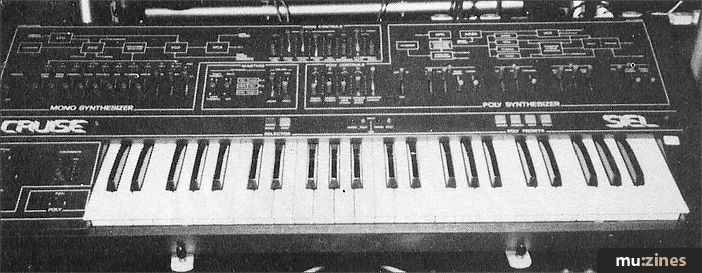
Siel Cruise
Siel Cruise
If my memory serves me correctly the well-known ARP Quartet was in fact a Siel instrument simply stickered up to say ARP. Since ARP seem to have disappeared, Siel have stepped up their assault on the Rock Keyboards market. The Cruise is dual function, being a monophonic synthesizer on one hand and a polyphonic on the other. In fact the polyphonic part seems to do everything that the ARP Quarter does. The product itself is exceptionally well made, and the switches are different, having a spring gliding action.
The Mono Synthesizer section offers the following presets — Bass, Tuba, Trombone, Trumpet, Flute, Piccolo, Sax, Clarinet, Violin, Bass and Guitar. By the flick of the preset/free switch to the free position you can access a series of varying wave forms. There are controls for Attack, Decay, Sustain and Release, also there are Frequency cutoff and Resonance controls as well as Vibrato on/off, Depth, and Speed. The Pitch bend and Portamento facilities work only on the mono section, which I thought was rather a shame but inevitable in the sort of keyboard we're discussing. There are separate controls for pitch on mono and poly sections.
The Poly Synthesizer section features four main sound types — Brass, Strings, Reed and Piano.
The Brass presets are Trombone and Trumpet along with Resonance and Crescendo. The presets are used in conjunction with the 'Poly controls'; for the Brass there are Attack and cutoff. The sound is good and of course all the bits and pieces help a great deal.
The Strings sounds — Cello and Violin — are also impressive; the two controls are accompanied by a Percussion switch.
The Reed section which features reasonable Musette and Accordion sounds also has a very good Church organ sound.
Finally the Piano section features a Piano which is a little on the muted side, a reasonably good Clavi and Honky Tonk.
There are additional controls within the Poly controls sector; those which can be used with the various presets are identified by the illumination of an LED above each. The animator is particularly effective, giving a chorus effect.
The mixing capabilities of the Cruise are extensive to say the least. Any of the four main poly sounds can be mixed, and this in itself can be very effective. The more involved mixing is made possible by the split keyboard (middle C). There are a set of controls which enable the variations including independent volume and indication LED's. You can have a complete mix in, mono left-poly right or poly left-mono right. Outputs at the rear are poly and mono, mono, keyboard extension pedal and volume pedal. Undoubtedly, a machine with great potential owing to its impressive flexibility.
Shopping
The recommended retail price of the Korg Lambda was in the region of £1,000 last time I looked; you needn't pay anything like that though! I would guess that you will find them on the second-hand market for around the £500 mark or less.
The Delta generally seems to be about £100 cheaper than the Lambda, however, I have seen these advertised second-hand for as little as £300.
With the EPS-1 being a new machine it is a matter of careful discount searching. Recommended retail is around £1,200 but I have seen them advertised at substantially discounted prices.
As the Yamaha SK10 and the Logan Big Band have been around for a good while, I should have thought you could expect to pay between £200 and £300 for either of these.
Finally, the Siel Cruise retails for £649, you can expect smallish discounts on this.
Thanks to Norman Hackett Ltd, Reading for permitting the examination of the Korg Lambda. Woodcray Manor Studio, Wokingham for the SK10 and Big Band, and Capital Keyboards Centre, Rose-Morris, London for the Korg Delta, EPS-1 and Siel Cruise.
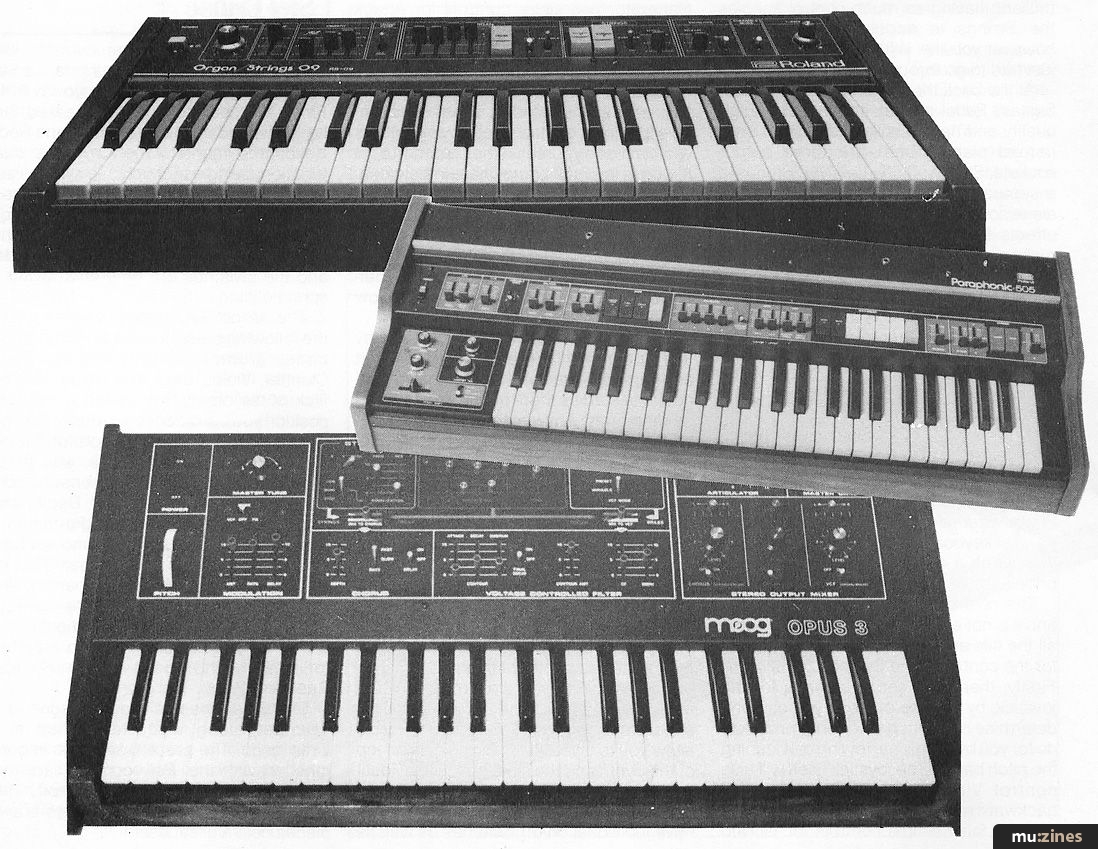
Roland RS09, Roland 505, Moog Opus 3

Welson Symphony
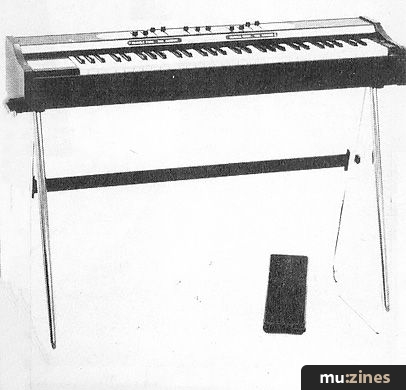
Elka Rhapsody
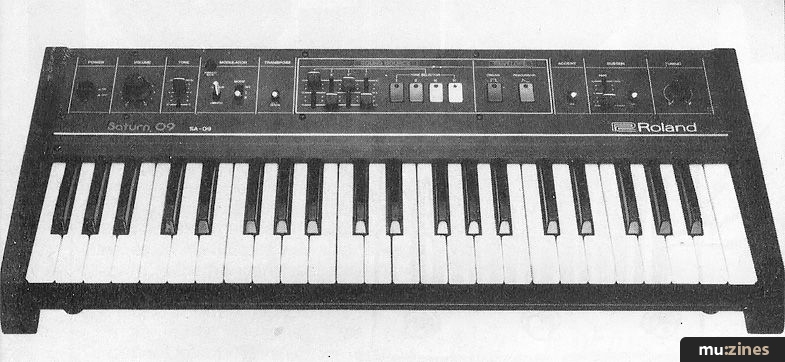
Roland SA09
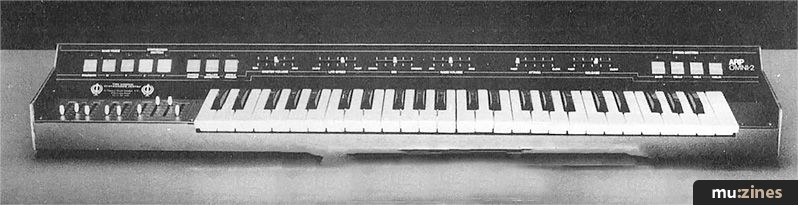
ARP Omni-2
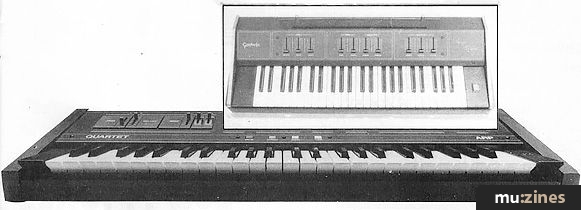
Godwin 849, ARP Quartet
More with this topic
 Interfacing The Past (Part 1) |
 Juno Jive! - Yesteryear's Gear: Roland Juno synths |
 The Rime Of The Ancient Sampler - The Mellotron: A Historical Perspective |
 Total Recall - Coachbuilt classic |
 Making More Of The Kawai K5 |
 Taurus Taurus Taurus - Bass Pedals |
 Total recall - Akai the old |
 Return Of The Prophet |
 Analogue Synths - In The Digital Age |
 80 Days - Yamaha CS80 |
 The Games People Played - YESTERYEAR'S GEAR: Olympic drums |
 Inside The Synclavier (Part 1) |
Browse by Topic:
Vintage Instruments
Also featuring gear in this article

Korg EPS-1
(EMM Jan 83)

Siel Cruise - Synthesiser
(EMM Jan 84)
Browse category: Keyboard > Korg
Browse category: Keyboard > Yamaha
Browse category: Keyboard > Logan
Browse category: Synthesizer > Siel
Publisher: Electronic Soundmaker & Computer Music - Cover Publications Ltd, Northern & Shell Ltd.
The current copyright owner/s of this content may differ from the originally published copyright notice.
More details on copyright ownership...

Electronic Soundmaker - Mar 1984
Donated & scanned by: Mike Gorman
Topic:
Vintage Instruments
Gear in this article:
Keyboard > Yamaha > SK-10 Symphonic Ensemble
Synthesizer > Siel > Cruise
Gear Tags:
Feature by John Wright
Ads for Gear in this article:


Help Support The Things You Love
mu:zines is the result of thousands of hours of effort, and will require many thousands more going forward to reach our goals of getting all this content online.
If you value this resource, you can support this project - it really helps!
Donations for March 2026
Please note: Our yearly hosting fees are due every March, so monetary donations are especially appreciated to help meet this cost. Thank you for your support!
Issues donated this month: 0
New issues that have been donated or scanned for us this month.
Funds donated this month: £0.00
All donations and support are gratefully appreciated - thank you.
Magazines Needed - Can You Help?
Do you have any of these magazine issues?
If so, and you can donate, lend or scan them to help complete our archive, please get in touch via the Contribute page - thanks!
Please Contribute to mu:zines by supplying magazines, scanning or donating funds. Thanks!
Monetary donations go towards site running costs, and the occasional coffee for me if there's anything left over!

 @mu_zines
 RSS Feed
 Blog
Blog