


Magazine Archive
Home -> Magazines -> Issues -> Articles in this issue -> View
Symetrix 525 | |
Dual Compressor/limiter GateArticle from Home & Studio Recording, February 1986 | |
A compressor/limiter with programme dependent characteristics.
A programme-dependent compressor/limiter with built-in expander gate.

There are a great number of compressors currently available but the 525 differs from most of them in that it has no attack or release controls. Certainly this is not the first design to take this approach (witness the Aphex Compellor), but certainly such designs are in the minority. Rather than allow the user to set up the attack and release times, the 525 adjusts these automatically to suit the input programme material, which gives us some insight into the intended application of such a device.
Compressors were originally designed to restrict the dynamic range of signals so that they could be recorded on a medium having an inherently inferior dynamic range to that of the human ear and consequently the sounds that it responds to. At this time, there was no thought of creative use, just a need to make the loud bits quieter and the quiet bits louder.
Creative applications were discovered soon afterwards and this involved the use of attack and release controls. A typical example of this is the trick of emphasising the attack of a sound by setting the attack time of a compressor to be too slow to respond to the initial few milliseconds of the input signal. What happens in this case is that the leading edge of the sound gets through uncompressed, but shortly afterwards, the compressor starts to work and reduces the level of the following signal. On an instrument such as the bass guitar, this gives a clicky emphasis to the beginning of each note.
However, the Symetrix 525 decides the attack and release times automatically, presumably in a manner designed to produce the least obtrusive side effects for all types of material, and so one could draw the conclusion that this machine is designed for use in situations where the tonal characteristics of the input signal need to be preserved even under conditions of heavy compression. Typical uses here might be the compression of vocals and complete mixes or submixes.
In addition to the compression function, the 525 contains a fast acting peak limiter and an expander gate. Packaged in a 1U rack mounting case, the 525 is very compact measuring little over five inches from front to back.
Facilities
Limiting is included because it is possible under normal circumstances for a short duration transient to slip through the compressor circuit uncontrolled, and this may be of a high enough level to cause clipping in the next stage of the audio chain. To combat this problem, the 525 contains a peak limiter which acts independently of the compressor circuitry to ensure that no clipping occurs. Strictly speaking, few limiters are fast enough to guarantee this effect, but very short periods of clipping are in practice undetectable and do in fact sound better than the degradation in transient response caused by an over-vigilant limiter. The limiter can respond in half a millisecond which, though not record breakingly fast, should keep any clipped transients short enough to be undetectable.
Also included in the design is an expander gate. Most people know what a gate is but there seems to be a little confusion as to the significance of the expander aspect so I will attempt to explain.
A simple gate can be thought of as a switch which turns off the signal when the input falls below a certain level or threshold. A more sophisticated gate may fade the signal gently once the signal falls below the threshold but either way, once the signal has fallen below the threshold by however much, it is destined to be shut off until the level once again rises above the threshold causing the gate to re-open.
An expander still uses a threshold system but once the signal has fallen below the threshold it behaves in a rather more intelligent manner. Rather than simply shutting the signal off, it reduces its gain according to its level, rather like a compressor in reverse; the lower the level falls, the lower the gain becomes. Signals just below the threshold are affected the least whilst the quieter ones are subjected to a substantial reduction in gain, and this has a similar effect to a gate but with less obtrusive side effects. The 525 takes this one step further and employs a system based around a programme-dependent expansion ratio and this type of operation is often known as soft knee operation. In effect this means that signals just below the threshold are treated less severely whilst very low signals are virtually switched off and all this is aimed at making the gating action less noticeable.
You may even wonder why a compressor has a built-in gate at all but a little thought will reveal the reason. In order to keep the signal as constant as possible, a compressor effectively turns up the gain as the input signal level falls. When the input falls to zero or thereabouts, the gain is maximum and that means that any hum, hiss or noise present at the input will be made more prominent. This might occur between phrases or words in a vocal track and is clearly an undesirable state of affairs. The expander gate is included to ensure that these periods of silence remain silent. This is likely to be less relevant when a complete mix is treated as most compositions contain few if any periods of complete silence and so a gate is of very limited use.
"...you'll have to examine your reasons for buying a compressor before choosing the 525."
Controls
Having told you that the 525 has only a few controls, it seems only reasonable to take a look at them.
The two channels are identical and operate either independently or as a dedicated stereo unit depending on the setting of the stereo switch mounted in the centre of the front panel. Incidentally, you may be forgiven for asking what the difference is between a stereo compressor and two mono ones. After all, the two channels of a stereo signal are quite separate aren't they? The answer is that in the stereo mode of operation, the compressor gain is controlled from a signal derived from both inputs such that both channels always operate with the same gain. Thus, if something loud happens on one channel only, both channels will reduce in gain and this is essential if image shifts are to be avoided. If the two channels were to be treated independently, the apparent position of sounds within a mix would move around disturbingly and whilst this may be fun as an effect, it's definitely not the order of the day for unobtrusive processing.
The first control is the expander/gate threshold, and this may be set to operate anywhere between 0 and —60dBm. A slightly different range is employed for the compressor/limiter section and the threshold here is variable from +20dBm to -50dBm whilst the Ratio Control covers the range 1:1 to 20:1.
Lastly comes the Output Gain control which is used to add make-up gain and this has a LED clip indicator which lights up if you try exceed the available headroom.
Though the unit performs limiting, compression and expansion, only a single VCA (voltage controlled amplifier) is used in each channel and all the side chain control signals feed into this including the output gain control. This type of VCA, the TA104, offers less than 0.05% total harmonic distortion and gives the wide dynamic range and low noise expected of a professional piece of equipment.
The only other control is the Channel In/Out button which disconnects the side chain signal from the VCA and a six section LED meter displays the amount of gain reduction from 2 to 40dB. When the unit is switched to operate in the stereo mode, the controls on the left hand channel take precedence and control both channels.
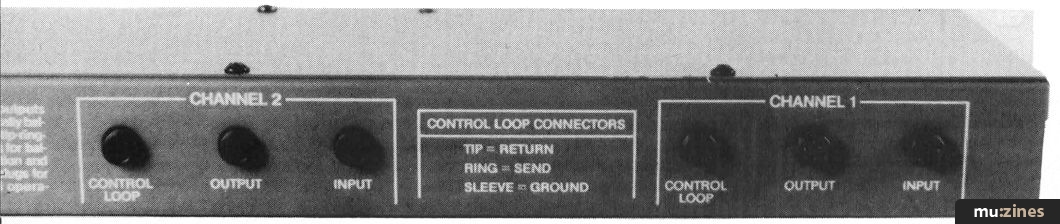
All signal connections are made by means of ring/tip type quarter inch stereo jacks though only the input is balanced. The ring of the output jack is grounded and the body of the plug is connected to earth via a resistor which is instrumental in avoiding ground loop problems.
It is possible to break into the side chain circuit of either channel via insert jacks on the rear panel and these are again of the stereo ring/tip kind. In this way it is possible to insert an equaliser into the side chain for de-essing or alternatively, the side chain may be controlled from a totally independent programme source as would be the case when doing ducking for voice overs. In this application, the voice would feed the side chain circuitry and the music would be fed through the unit via the normal signal path. In this way the presence of a voice input would cause a drop in music level, though a compressor with variable release characteristics would be better suited to this application.
Because the unit in effect does a lot of your thinking for you, there isn't a lot in the control department so how intelligent is this machine?
In Use
As predicted, the 525 worked well on a complete mix and provided the compression was kept to under 10dB and the ratio to less than 5, the compression was fairly unobtrusive, resulting in a thicker, warmer sound. With more compression applied however, a change in sound quality soon became apparent. In this respect the 525 is not really in the same class as the Aphex Compellor which is all but transparent in operation. This is fair enough as the Compellor is over twice the price but I really expected the programme-dependency part of the system to be more subtle than turned out to be the case.
On most individual instruments or recorded tracks, the unit performed well, delivering a clean tight sound with the minimum of pumping but the lack of manual attack and release time controls precludes any creative experimentation in this area.
The unit compares favourably with compressors of a similar price though and I was particularly pleased by the way in which the expander gate worked, especially on vocal and drum tracks. This tightens up the sound significantly and though you do have to set the threshold carefully for best results, it is still easier to set up than a conventional gate.
Conclusions
This is a cleverly designed unit, incorporating a very well behaved expander gate and my only quibble is with the fact that there's no control over the attack and release time constants. It's all very well having a control-free compressor if it works on all kinds of input without making its presence felt, but this unit doesn't fall into that category unless used very sparingly. If a compressor is going to change the character of the input, then it may as well have a few controls on it so that you can actually decide how to alter the sound.
Of course there are two sides to every story, and this unit will satisfy those users who don't have a feel for setting up compressors or just want something easy to use. The results are good on all types of input programme material if a trifle inflexible, and it's difficult to get a sound that is actually bad unless you use a compression ratio that is far too high or set up a totally inappropriate threshold level.
As you've probably inferred by now, my feeling is that this is a well designed unit but that it falls somewhere between two camps. Within the limitations imposed by its format it works very well indeed, but as always, you'll have to examine your reasons for buying a compressor before choosing the 525.
The Symetrix 525 costs £401.35 including VAT.
Further details from: Sound Technology, (Contact Details).
Publisher: Home & Studio Recording - Music Maker Publications (UK), Future Publishing.
The current copyright owner/s of this content may differ from the originally published copyright notice.
More details on copyright ownership...

Home & Studio Recording - Feb 1986
Donated & scanned by: Mike Gorman
Review by Paul White
Help Support The Things You Love
mu:zines is the result of thousands of hours of effort, and will require many thousands more going forward to reach our goals of getting all this content online.
If you value this resource, you can support this project - it really helps!
Donations for May 2026
Issues donated this month: 0
New issues that have been donated or scanned for us this month.
Funds donated this month: £0.00
All donations and support are gratefully appreciated - thank you.
Magazines Needed - Can You Help?
Do you have any of these magazine issues?
If so, and you can donate, lend or scan them to help complete our archive, please get in touch via the Contribute page - thanks!
Please Contribute to mu:zines by supplying magazines, scanning or donating funds. Thanks!
Monetary donations go towards site running costs, and the occasional coffee for me if there's anything left over!

 @mu_zines
 RSS Feed
 Blog
Blog