
Magazine Archive
Home -> Magazines -> Issues -> Articles in this issue -> View
The Shape of Things To Come | |
Article from Sound On Sound, February 1987 | |
Another digital reverb from Alesis, a waveform digitizing pad for the Roland S50 sampler, Passport's multitrack software for the Atari ST, exclusive news of the world's first ever 8-track recorder to use standard cassettes, and more...
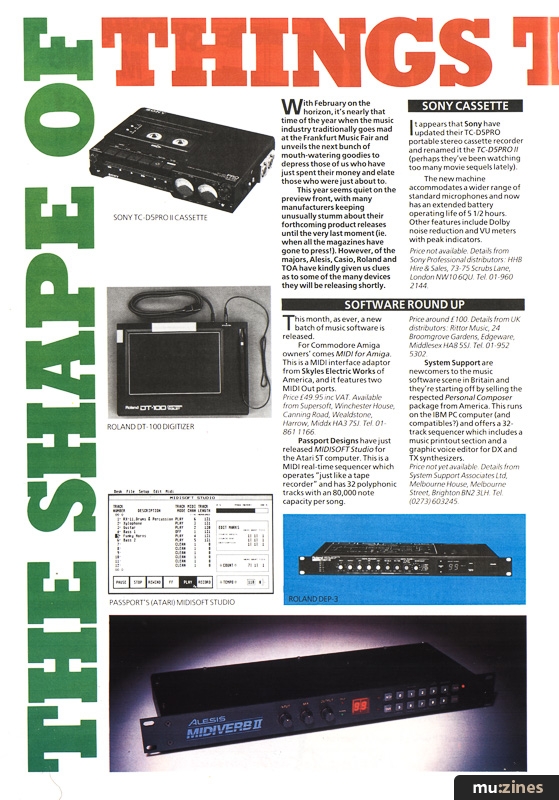
With February on the horizon, it's nearly that time of the year when the music industry traditionally goes mad at the Frankfurt Music Fair and unveils the next bunch of mouth-watering goodies to depress those of us who have just spent their money and elate those who were just about to.
This year seems quiet on the preview front, with many manufacturers keeping unusually stumm about their forthcoming product releases until the very last moment (ie. when all the magazines have gone to press!). However, of the majors, Alesis, Casio, Roland and TOA have kindly given us clues as to some of the many devices they will be releasing shortly.
SONY CASSETTE
It appears that Sony have updated their TC-D5PRO portable stereo cassette recorder and renamed it the TC-D5PRO II (perhaps they've been watching too many movie sequels lately).

SONY TC-D5PRO II CASSETTE
The new machine accommodates a wider range of standard microphones and now has an extended battery operating life of 5 1/2 hours. Other features include Dolby noise reduction and VU meters with peak indicators.
Price not available. Details from Sony Professional distributors: (Contact Details)
SOFTWARE ROUND UP
This month, as ever, a new batch of music software is released.
For Commodore Amiga owners' comes MIDI for Amiga. This is a MIDI interface adaptor from Skyles Electric Works of America, and it features two MIDI Out ports.
Price £49.95 inc VAT. Available from (Contact Details)
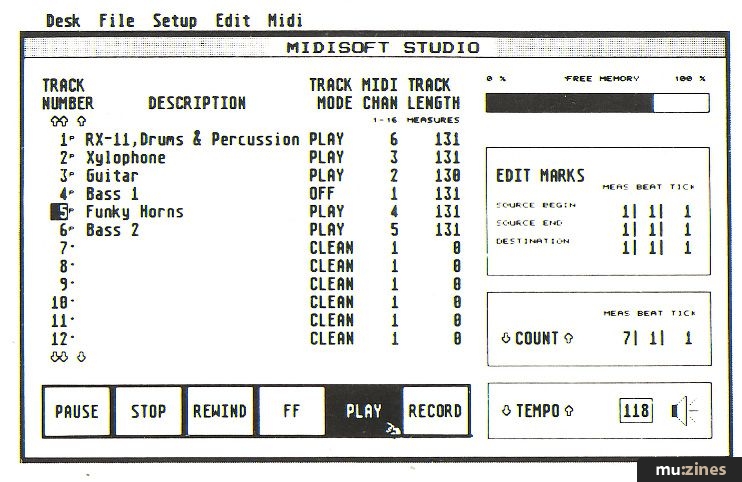
PASSPORT'S (ATARI) MIDISOFT STUDIO
Passport Designs have just released MIDISOFT Studio for the Atari ST computer. This is a MIDI real-time sequencer which operates "just like a tape recorder" and has 32 polyphonic tracks with an 80,000 note capacity per song.
Price around £100. Details from UK distributors: (Contact Details)
System Support are newcomers to the music software scene in Britain and they're starting off by selling the respected Personal Composer package from America. This runs on the IBM PC computer (and compatibles?) and offers a 32-track sequencer which includes a music printout section and a graphic voice editor for DX and TX synthesizers.
Price not yet available. Details from (Contact Details)
CASIO SAMPLERS
After the success of their budget SK-1 sampling keyboard at the very bottom of the market, Casio are introducing three new more advanced samplers.
The SK-100 offers 0.8 seconds sampling time at 10kHz, looping, reverse, key transpose and envelope functions. It uses a 49-note four octave mini-keyboard, and in addition 159 chords can be stored in memory. It also has a built-in mic.
The SK-200's similar in design except that it features 4 x 0.8 seconds sample time, or 1.6 seconds when linked.
Finally, the top of the range model is the SK-2100 which again features the same sampling specification but has a normal size four octave keyboard.
Casio are also entering the electronic drum market with their DZ-1 MIDI Drum Translator, DZ-20S Snare/Tom Pads and DZ-30B Bass Drum Pad. Translators built into the DZ-1 allow you to control up to eight drum pads simultaneously and other features include function editing for MIDI channel, program and note number settings.
No prices available. Details from (Contact Details)
OBERHEIM SAMPLER
Unlike most keyboard companies who have been forced to manufacture sampling systems to compete, Oberheim have quite neatly avoided the battle and taken the rather unique step of designing a 'replay only' machine that can be controlled by a MIDI keyboard, the DPX-1.
This rack-mounting unit has been developed with studios in mind since it can currently replay samples from three of the most widely used keyboards, namely the Ensoniq Mirage, Sequential Prophet 2000 and E-mu Emulator II. To accommodate the different storage methods of these machines, the DPX-1 features two disk drives - one 3.5" for Ensoniq/Prophet disks and one 5.25" for Emulator disks.
Once samples are loaded, the DPX-1 offers 8-voice polyphony and full MIDI control, including the new Universal Dump Standard for transferring samples from one machine to another via digital code, and means that a studio does not have to buy every sampler on the market just to enable clients to play back their already sampled sounds.
Price £1495 inc VAT. Details from UK distributors: (Contact Details)
ALESIS MIDIVERB II
Just a few weeks before Christmas Alesis unveiled their new 16-bit Microverb.
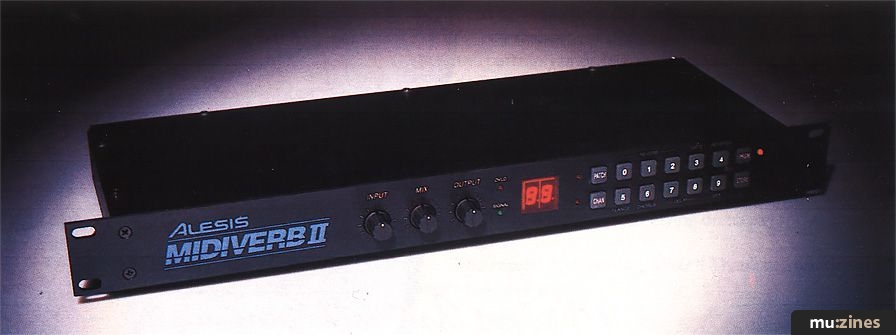
Now, just a matter of weeks later, they are adding a new flagship to their stereo reverb range, with the MIDIVERB II.
After the huge success of the original MIDIVERB launched almost a year ago and hotly pursued by the MIDIFEX, it's no surprise to see Alesis taking the logical step and combining both units together. However, the 19-inch rack mounting device is not purely a simple combination.
The MIDIVERB II features 99 preset effect programs and includes 29 reverbs, 20 echoes, 10 chorus, 10 gated, 10 flange, 10 delays, plus much more. All effects are in stereo with jack connections on the rear, and the unit features 16-bit PCM conversion (an improvement on the original 12-bit MIDIVERB) which results in a wider 15kHz audio effect bandwidth and plentiful 90dB dynamic range.
The MIDI aspect of the unit enables you to assign up to 32 of the 99 presets to any MIDI channel/program number and store them for remote selection from a keyboard or sequencer.
Price £399 inc VAT. Details from UK distributors: (Contact Details)
TOA 8-TRACK CASSETTE
For immediate introduction after February, TOA have announced the 310D Digital Effector.
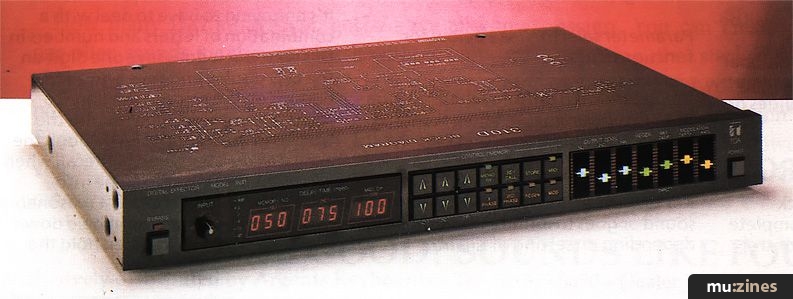
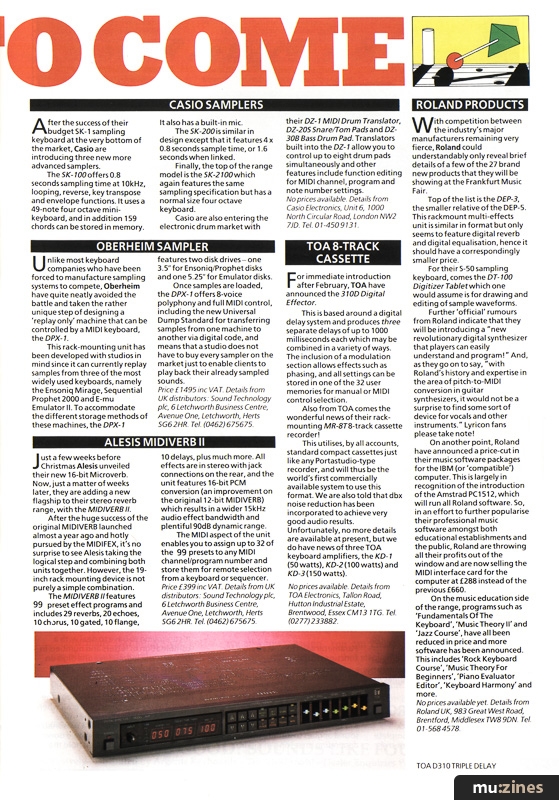
TOA D310 TRIPLE DELAY
This is based around a digital delay system and produces three separate delays of up to 1000 milliseconds each which may be combined in a variety of ways. The inclusion of a modulation section allows effects such as phasing, and all settings can be stored in one of the 32 user memories for manual or MIDI control selection.
Also from TOA comes the wonderful news of their rackmounting MR-8T 8-track cassette recorder!
This utilises, by all accounts, standard compact cassettes just like any Portastudio-type recorder, and will thus be the world's first commercially available system to use this format. We are also told that dbx noise reduction has been incorporated to achieve very good audio results. Unfortunately, no more details are available at present, but we do have news of three TOA keyboard amplifiers, the KD-1 (50 watts), KD-2 (100 watts) and KD-3 (150 watts).
No prices available. Details from (Contact Details)
ROLAND PRODUCTS
With competition between the industry's major manufacturers remaining very fierce, Roland could understandably only reveal brief details of a few of the 27 brand new products that they will be showing at the Frankfurt Music Fair.

ROLAND DEP-3
Top of the list is the DEP-3, the smaller relative of the DEP-5. This rackmount multi-effects unit is similar in format but only seems to feature digital reverb and digital equalisation, hence it should have a correspondingly smaller price.

ROLAND DT-100 DIGITIZER
For their S-50 sampling keyboard, comes the DT-100 Digitizer Tablet which one would assume is for drawing and editing of sample waveforms.
Further 'official' rumours from Roland indicate that they will be introducing a "new revolutionary digital synthesizer that players can easily understand and program!" And, as they go on to say, "with Roland's history and expertise in the area of pitch-to-MIDI conversion in guitar synthesizers, it would not be a surprise to find some sort of device for vocals and other instruments." Lyricon fans please take note!
On another point, Roland have announced a price-cut in their music software packages for the IBM (or 'compatible') computer. This is largely in recognition of the introduction of the Amstrad PC1512, which will run all Roland software. So, in an effort to further popularise their professional music software amongst both educational establishments and the public, Roland are throwing all their profits out of the window and are now selling the MIDI interface card for the computer at £288 instead of the previous £660.
On the music education side of the range, programs such as 'Fundamentals Of The Keyboard', 'MusicTheory II' and 'Jazz Course', have all been reduced in price and more software has been announced. This includes 'Rock Keyboard Course', 'Music Theory For Beginners', 'Piano Evaluator Editor', 'Keyboard Harmony' and more.
No prices available yet. Details from (Contact Details)
Publisher: Sound On Sound - SOS Publications Ltd.
The contents of this magazine are re-published here with the kind permission of SOS Publications Ltd.
The current copyright owner/s of this content may differ from the originally published copyright notice.
More details on copyright ownership...

Sound On Sound - Feb 1987
News
Help Support The Things You Love
mu:zines is the result of thousands of hours of effort, and will require many thousands more going forward to reach our goals of getting all this content online.
If you value this resource, you can support this project - it really helps!
Donations for June 2026
Issues donated this month: 0
New issues that have been donated or scanned for us this month.
Funds donated this month: £0.00
All donations and support are gratefully appreciated - thank you.
Magazines Needed - Can You Help?
Do you have any of these magazine issues?
If so, and you can donate, lend or scan them to help complete our archive, please get in touch via the Contribute page - thanks!
If you're enjoying the site, please consider supporting me to help build this archive...
...with a one time Donation, or a recurring Donation of just £2 a month. It really helps - thank you!

 @mu_zines
 RSS Feed
 Blog
Blog