


Magazine Archive
Home -> Magazines -> Issues -> Articles in this issue -> View
Expanding MIDI | |
Two New Developments From SycologicArticle from Electronics & Music Maker, September 1984 | |
We take a brief look at two new bits of hardware - an analogue-to-MIDI interface and an expansion board for the DX7 - from Syco Systems' research wing, Sycologic.
London's Syco Systems - best known for their range of imported upmarket computer music systems - have formed a research division, Sycologic. The company's first offerings take the form of an analogue-to-MIDI converter and a memory expansion add-on for the Yamaha DX7.
The MX1
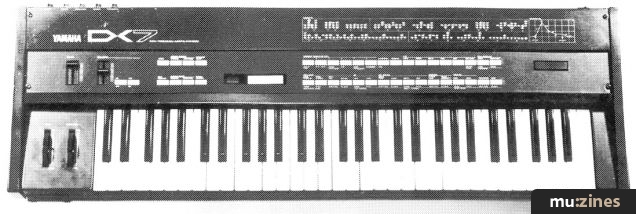
Among the few criticisms levelled at Yamaha's DX7 are its shortage of memories (known in DX language as Internal Voices) and its ability to transmit MIDI data on Channel 01 only.
Sycologic have remedied these shortcomings with the recent launch of their MX1 Memory Expansion board.
The MX1 board plugs into the DX7 internally and doubles the existing number of Internal Voices to 128, arranged in banks of 32. Memory banks are selected by using Function 12 and the Data Entry controls, and the LCD indicates which bank is in use. Should a cartridge be inserted, these voices emerge in place of Internal Bank 2, and Internal Voices can be easily transferred or copied between Memory Banks.
MIDI Modes
With the MX1 fitted, the DX7 is capable of transmitting MIDI data on any MIDI Channel (between 01 and 16) using Function 13 (MIDI Out) and the Data Entry controls.
At the receiving end, the MX1 extends the MIDI In features by allowing the DX7 to operate in Omni Mode (ie. recognising and processing data regardless of which channel it belongs to) when Function 8's value is set to 'All'.
The MX1 software complies with the MIDI 1.0 specification (see E&MM May '84 for details of this), which among other things allows one of 128 patches to be selected. Since the DX7 will now hold 128 voices internally, any voice can be selected remotely via MIDI, and again cartridge voices are made available in place of Bank 2.
Installation
The User Manual gives clear, concise guidelines for fitting the MX1, but also advises that the operation should only be attempted by qualified service personnel.
The facilities offered by the MX1 should appeal to gigging and studio-based musicians alike, and especially to those who intend linking an array of MIDI products together with maximum versatility.
The AMI

This is a microprocessor-based device which converts the analogue one-volt-per-octave format into digital MIDI codes over a five-octave range, with additional inputs that permit the transfer of information pertaining to dynamics, patch changes, modulation and even sync code. Conversion is strictly one-way: analogue synths and sequencers can drive MIDI synths, but there is no provision for playing analogue machines from MIDI devices.
Construction
Built in a smart custom-built 2U rack case, the AMI contains a small dedicated microprocessor system that runs under instructions from EPROM memory, in which reside the conversion routines for the various different modes of operation.
There are eight CV pitch input sockets on the front panel, eight Gate sockets (+5 to +15V range) and eight 'Dynamic and Control' inputs. These respond to inputs in the range of zero to five volts, but may be used to control note dynamics and other MIDI addressable characters.
Operation
When any of the eight gate inputs is triggered, its associated pitch and dynamic values are digitised and then transmitted as a MIDI 'note on' event. If no dynamic information is transmitted, a default value of half full-range is automatically generated.
The operating panel contains four push button switches (three of which have status LEDs) and a seven-segment numeric display is located directly to the right of these, which indicates on which MIDI channel the AMI is transmitting.
The four pushbuttons are labelled Dual, Mono, Control and Channel. When the Control mode is off, dynamic information is added to note events as follows: Poly mode allows control of eight voices polyphonically on one MIDI Channel, Dual allows control of four polyphonically on two Channels, while Mono - not surprisingly - allows control of one voice monophonically on eight MIDI Channels.
With the Control switch activated, the transmittable controls and parameters vary, again depending on the mode selected. In Mono or Poly modes, eight variables can be transmitted for CVs connected to the Dynamic & Control inputs. These are common dynamics for inputs 1-8, patch change (from 1-64), pitch bend upwards, modulation, after touch, and three parameters specific to Yamaha DX keyboards, volume, portamento, and breath control.
With the Dual mode selected, two entirely separate sets of four parameters can be transmitted, depending on the MIDI Channel selected. The first group consists of common dynamics for inputs 1-4, patch change, pitch bend upwards, and modulation, while the second group comprises common dynamics for inputs 5-8, the remaining three parameters remaining constant.
On the rear panel are two sockets which convert drum machine sync signals into MIDI format: 24, 48 or 96 pulses-per-quarter-note clocks may be accommodated, the necessary division being carried out internally.
The socket labelled 'Start/Stop' is configured to operate with Roland equipment, and a Time Out facility generates a MIDI Stop command if more than half-a-second elapses between clock pulses.
When the interface is powered up, the displayed MIDI Channel defaults to 01 although this may be set by means of the front panel buttons to any integer between one and eight inclusive.
An ingenious calibration system is built in and, after a 30-minute warm-up period, the volts-per-octave and offset may be optimised by means of two presets accessible via small holes in the control panel.
It's not possible to say much about this unit other than 'it works' as it is completely user-transparent in operation - exactly what a good interface should be. The controls are sensibly laid-out and work smoothly, and for once the manual is written in clear, concise English: if only there were more pieces of UK-built hardware!
Conclusions
The AMI does everything that can reasonably be asked of it, and all for a price that puts it within reach of the home user as well as the professional musician or studio. It is still rather sad that advances in technology (and marketing?) make this kind of elaborate interface necessary at all, but if you already have a good analogue polysequencer that you're happy with, it's probably cheaper to buy a Sycologic AMI than to sell the sequencer at a loss and buy a new MIDI machine.
The AMI's price is probably as low as could reasonably be achieved for what is a relatively low volume production item, and for the moment at least, there's nothing on the market to touch it in terms of either value for money or facilities offered.
The Sycologic AMI and MX1 retail at £399 and £199 respectively, and further information can be had from Syco Systems, (Contact Details).
Also featuring gear in this article

The Vital Link
(ES Oct 84)
Browse category: Expansion Board > Sycologic
Browse category: MIDI->CV Convertor > Sycologic
Featuring related gear

BeeBMIDI (Part 3)
(EMM Aug 84)
BeeBMIDI (Part 7)
(EMM Mar 85)


Hands On: Yamaha DX7
(SOS Dec 92)

Load Baring
(12T May 85)

Load Baring
(12T Aug 85)

One For The 7 - DX7 Patch
(ES May 85)

One Off - DX7 Patch
(ES Apr 85)


Sight Reading - Yamaha DX7 Digital Synthesizer
(EMM Apr 85)

Steve Gray on the DX7
(EMM Dec 83)

The Right Connections
(ES Oct 84)

The Synths Of The Year Show - Synthcheck
(IM Dec 85)

Understanding the DX7 (Part 1)
(EMM Apr 84)

Understanding the DX7 (Part 2)
(EMM May 84)

Understanding the DX7 (Part 3)
(EMM Jun 84)

Understanding the DX7 (Part 4)
(EMM Jul 84)

Understanding the DX7 (Part 7)
(EMM Oct 84)

Patchwork
(EMM Feb 84)
Patchwork
(EMM Mar 84)
Patchwork
(EMM Apr 84)

Patchwork
(EMM May 84)

Patchwork
(EMM Jul 84)

Patchwork
(EMM Aug 84)
Patchwork
(EMM Jan 85)

Patchwork
(EMM Feb 85)
Patchwork
(EMM Apr 85)

Patchwork
(EMM Jun 85)

Patchwork
(EMM Jul 85)

Patchwork
(EMM Feb 86)

Patchwork
(EMM Mar 86)

Patchwork
(EMM May 86)
Patchwork
(EMM Jun 86)
Patchwork
(EMM Aug 86)

Patchwork
(EMM Sep 86)

Patchwork
(MT Nov 86)
Patchwork
(MT Dec 86)

Patchwork
(MT Jan 87)
...and 19 more Patchwork articles... (Show these)
Browse category: Synthesizer > Yamaha
Publisher: Electronics & Music Maker - Music Maker Publications (UK), Future Publishing.
The current copyright owner/s of this content may differ from the originally published copyright notice.
More details on copyright ownership...

Electronics & Music Maker - Sep 1984
Review
Help Support The Things You Love
mu:zines is the result of thousands of hours of effort, and will require many thousands more going forward to reach our goals of getting all this content online.
If you value this resource, you can support this project - it really helps!
Donations for July 2026
Issues donated this month: 0
New issues that have been donated or scanned for us this month.
Funds donated this month: £0.00
All donations and support are gratefully appreciated - thank you.
Magazines Needed - Can You Help?
Do you have any of these magazine issues?
If so, and you can donate, lend or scan them to help complete our archive, please get in touch via the Contribute page - thanks!
Please Contribute to mu:zines by supplying magazines, scanning or donating funds. Thanks!
Monetary donations go towards site running costs, and the occasional coffee for me if there's anything left over!

 @mu_zines
 RSS Feed
 Blog
Blog