


Magazine Archive
Home -> Magazines -> Issues -> Articles in this issue -> View
Room EQ: Myth or Legend (Part 2) | |
Article from Home & Studio Recording, December 1986 | |
Ben Duncan, the sultan of solder, subjects the concept of room equalisation to further scrutiny.
In this month's thrilling episode, Ben Duncan investigates the different types of circuitry used in graphic equaliser design and then goes on to examine the psychoacoustics of listening.
In part one of this series we identified two distinct classes of graphic equaliser. To recap briefly, in models with constant bandwidth, the Q, (or bandwidth) of the individual filters remains constant, irrespective of control settings, so adjacent faders can be manipulated without interaction. In a graphic without constant bandwidth, there's interaction between bands and the control settings don't really display what's going on.
In order to identify the culprits without mentioning any names, Figures 1-4 display the generic circuit patterns (or 'topologies') used in some well known graphic EQs. But let's begin by outlining the general principles:
All graphics boil down to is just two constituent circuit blocks. One is a filter which amplifies a defined band of frequencies, whilst ignoring all others. This is not surprisingly called a bandpass filter. In an economic design, this will comprise a network of resistors, capacitors and maybe some inductors, configured around a single IC op-amp. Having found a suitable band-pass filter, we then repeat it eight times for a one octave graphic equaliser, or 27 for a ⅓rd octave model, each filter being individually tuned to respond around one of the frequencies marked on the front panel. The other vital component is a circuit block which can either add or subtract the response of the individual filters, via a slider pot, for a continual adjustment between two extremes. Then we can apply boost (by summing or feedforward) or cut (by subtraction or feedback). Again, this kind of network can be achieved with a single op-amp. In the diagrams that follow, we've shown the circuit detail of just one bypass filter, in detail, because the remainder share the same circuit; only their component values differ.
For simplicity, the remaining circuitry is shown in outline only, since in seeking to establish the quirks of your own graphic, identification of the generic bandpass filter is sufficient. Of course this assumes you're in possession of the circuit diagram (which every good manufacturer should supply). Failing this, if you're still keen, you could look for the filter circuit which most closely corresponds with the component patterns inside the actual unit.
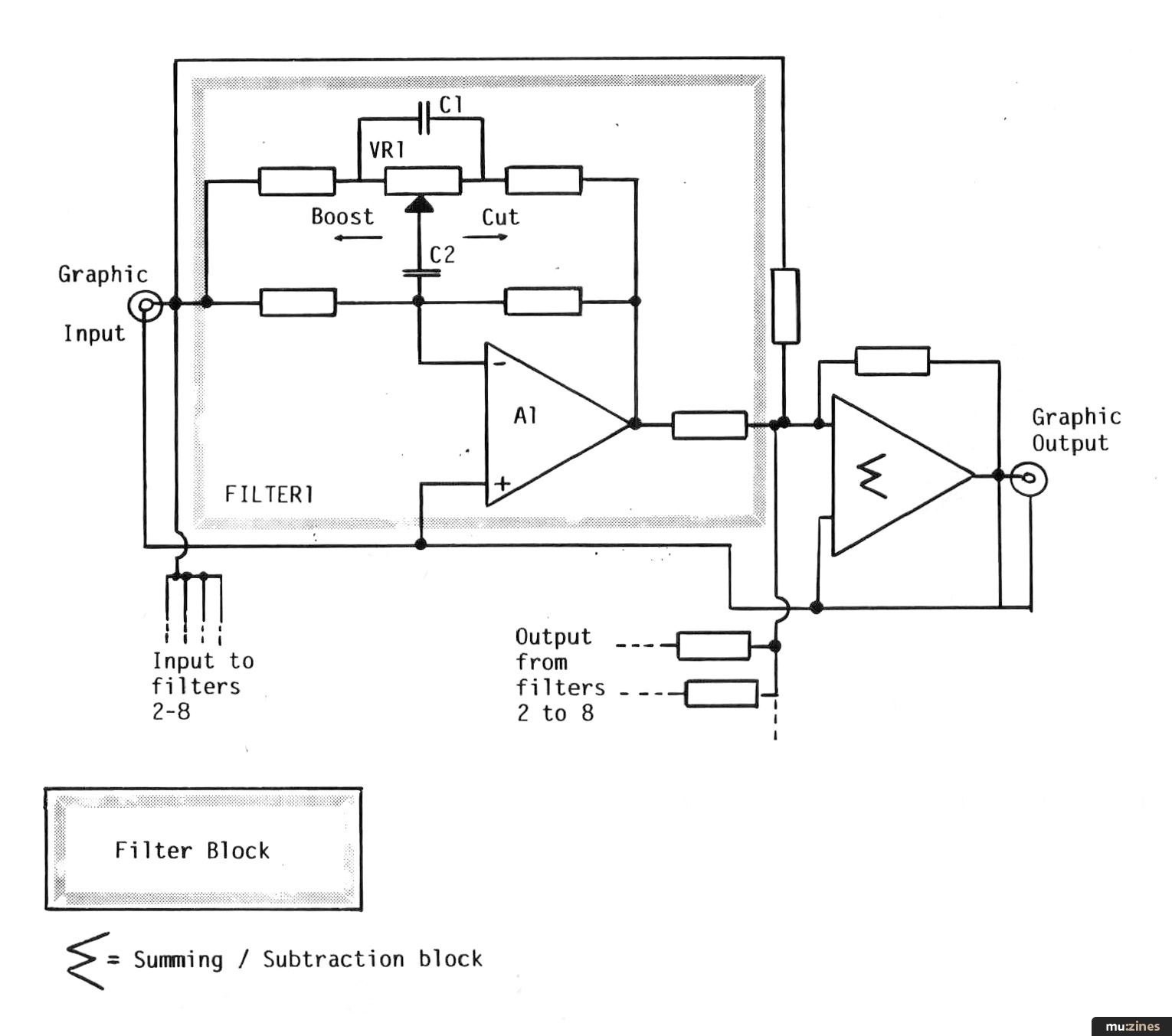
Figure 1. A Baxandall type one octave graphic.
(Click image for higher resolution version)
EQ Circuits Unveiled
The graphic in Figure 1 is built around a filter circuit first presented by Peter Baxandall back in the late 40s. It's exactly the same circuit which is behind the classic bass and treble controls found in so many pieces of equipment. As the slider on VR1 is moved back and forth, the amount of feedback varies, swinging the gain at the filter's output from + to -dBs. Capacitor C1 bypasses the pot at high frequencies, while C2 only brings the wiping contact into action above a certain frequency. From this, it's evident that C1 should be smaller than C2 (for instance about 10 times smaller). Then, while C1 is bypassing frequencies above about 3kHz, C2 is enabling the action of the boost/cut control above 300kHz, and so the filter's boost/cut action is constrained to lie between these frequencies. The main problem with this circuit is that for moderate amounts of boost or cut (below 12dB), its Q is irretrievably low. So the EQ curves are broad and shallow, restricting its use to octave (8-band) graphics. Nonetheless it's essentially a non-interactive, constant bandwidth design, provided no attempt is made to cut corners by hanging a second or third filter network across the filter op-amp (A1). This happens in the classic Baxandall tone control, where bass, treble and even mid-range EQ are gleaned (or even extracted) from a single (sweating) op-amp. The penalty is interaction, and this where many mixing console EQs go wrong. For example, maximum bass boost commonly drops out any high end.

Figure 2. 1-octave graphic EQ, using R.L.C. resonators.
(Click image for higher resolution version)
The filter in Figure 2 revolves around a series capacitor and inductor, which resonate at a frequency defined by their combined values. A resistor is added to define the 'Q' and/or limit their loading effect at resonance, so the whole network is called an RLC circuit. Again, the Q is on the low side, limiting this circuit to ⅛th-octave graphics. In fact, at low bass frequencies, the boost/cut curve's Q is positively abominable, thanks to the near impossibility of fabricating big inductors without incurring a high winding resistance. Worse, if the manufacturer has greedily hung eight bands of EQ off one 30p op- amp (as in Japanese stereos), the Q varies widely with changes in the control settings. In fact it's highest when the slider is set at maximum or minimum. The worst variations can be ameliorated by sharing the eight RCL networks between two or four op-amps, and by staggering the frequencies of the filters hung across each chip. Nevertheless, this circuit interacts, and is best avoided for serious graphic duties.

Figure 3. ½- or ⅓-octave graphic EQ, featuring MFB filters.
(Click image for higher resolution version)
Figure 3 has a more involved boost/cut arrangement, built around a flexible and powerful filter, called an 'infinite gain multiple feedback' or'MFB' filter. It's powerful because we can easily attain the higher Q value necessary for a ⅓-octave bandwidth, and flexible, because we can precisely define the Q and the centre frequency by a suitable choice of the resistor and capacitor values. Alas, good as the filter is on it's own, the composite circuit interacts badly, since the overall output signal is fed back out of phase to the adjacent filters, down the path marked 'FB'. This results in subtraction at the edges of the boost (or cut) curve, effectively boosting the Q. So with several knobs set to boost, we end up with a flat, low Q plateau, flanked by steep (high Q) sides. In other words, the bandwidth isn't as expected. Indeed this circuitry is the guilty one discussed last month, responsible for giving low cost ⅓-octave graphics a bad name.

Figure 4. ⅓-octave graphic EQ, using a VCVS filter.
(Click image for higher resolution version)
The filter in Figure 4 is superficially similar to the MFB circuit, and shares the flexibility in setting up the Q and centre frequency. But look closely at the + and - inputs to the op-amp: it's actually a very different beast, a VCVS (Voltage Controlled Voltage Source) filter. Unlike the MFB filter, its output is non-inverting. Add to this a crafty arrangement of feedback/feedforward loops, and we have a graphic where the bandwidth of the original filters is kept almost constant, regardless of the other control settings. So for a change, we needn't be afraid to mention names: this particular topology is the one contained inside the Rane graphic.
Summing up, the Baxandall-based EQ in Figure 1 is the ideal circuit for octave graphics, whereas the topology in Figure 4 is ideal for accurate ⅓rd-octave graphics; although the same principles could just as easily benefit 1- or ½-octave designs.

Figure 5. Typical phase angles.
(Click image for higher resolution version)
All the graphic circuits discussed above exhibit what's called a minimum phase characteristic. At worst, this means jerky, S-shaped phase curves (see Figure 5). Seen in isolation, it doesn't look too good, but all's well provided the curve isn't too kinked, and the angle remains 'minimum', ie. within +90°. After all, if we've set the knobs correctly, so our speaker's response anomaly is precisely levelled out, it follows that the speaker's acoustic phase curve is precisely cancelled by the electrical phase curve of our graphic.
Room Response: Live or Reflected?
To make any meaningful acoustic measurements on a speaker, it should be located so that there are no obstacles likely to reflect sound from the speaker back into the measurement area. In practice, this means testing a speaker either suspended in mid air, outdoors or in an anechoic chamber, which has highly absorbent surfaces. In everyday rooms, by contrast, sound waves are bouncing all over the place within milliseconds of the music first issuing from the speaker. It follows that what we hear when sitting in front of our monitors is a combination of the speaker's own problems, and (unless the room is heavily damped), an overriding welter of confused, reflected and time-delayed sounds, called reverberation.
This situation isn't as bad as it sounds, since in the beginning, starting with cave dwellers, human beings have had a few million years to adapt to the reverberant soundfield that arises in confined spaces. Today, in the 20th century, it's an everyday ingredient used to enrich music. In fact, the human brain has effectively developed a program in order to separate it out from the direct sound. It's called the Haas effect, after the man who discovered it and it means that to a large extent, we're capable of perceiving the pure, direct sound from any speaker, independent of any following reverberation. That's to say we'll hear our monitors, irrespective of the room provided there's a decent interval of 15 to 20mS before the reflected, reverberant sounds start to arrive. After this interval, the computer between your ears can even interpret the time delay to the extent of being able to evaluate the room size, since sound travels at an infinite speed, and the reflective paths are naturally longer than the direct path from the speaker cone to our ears.
The other proviso is that we should be in the near-field. Generally this means being close enough to the sound source so that the reverberant contribution to the sound isn't overwhelmingly loud, irrespective of its timing. In general, the PA mixing position in a lofty concert hall is located where the soundfield is overwhelmingly reverberant. On the other hand, the reverberation is at least delayed long enough for the direct sound to be clearly distinguishable, thanks to the distant walls and very high ceilings. At the opposite end of the scale, inside the average studio's control room, the direct soundfield is dominant over most of the space, but the reverberation, whilst low in relative level, arrives too soon. Typically, the first reflections reach our ears in under 15mS, making it hard work for our ears to pick out the direct sound.
These facts have two important ramifications. Firstly, to hear the whole of what's on our tape, and nothing else, we need to achieve the late initial arrival (>20mS) of reverberation, as in the concert hall. At the same time, we need to achieve this in the nearfield. Secondly, any attempt to EQ the combined response of the speaker plus the reverberant field is self defeating if you're aiming to hear a natural tonal balance: Given that the reverberation is much more coloured than the direct sound, this only goes to screw up the direct sound our ears are struggling to focus on.
Next month we'll look more closely into sorting out the priorities in the control room.
Series - "Room EQ"
This is the last part in this series. The first article in this series is:

Room EQ, Myth or Legend?
(HSR Nov 86)
All parts in this series:
More from these topics
 Keyboard Matrix Interface For EK-3 |
 Workbench - Impedance. What is it?! |
 Reverb Modification |
 Build A Hum Loop Isolator |
 Sample & Hold Modification - Provides Note Bender |
 A Chorus Line-Up - Which Chorus? |
 |
 Hi-Fi Graphics |
 Sound Absorbers - Acoustics (Part 1) |
 The Ultimate Blinky Light - LED Wall Art - Visual Environment Machine |
 Digital Delays Survey |
 Adventures with Op-Amps |
Browse by Topic:
Acoustics
Effects Processing
Electronics / Build
Publisher: Home & Studio Recording - Music Maker Publications (UK), Future Publishing.
The current copyright owner/s of this content may differ from the originally published copyright notice.
More details on copyright ownership...

Home & Studio Recording - Dec 1986
Donated & scanned by: Mike Gorman
Topic:
Acoustics
Effects Processing
Electronics / Build
Series:
Room EQ
Part 1 | Part 2 (Viewing) | Part 4
Feature by Ben Duncan
Previous article in this issue:
Help Support The Things You Love
mu:zines is the result of thousands of hours of effort, and will require many thousands more going forward to reach our goals of getting all this content online.
If you value this resource, you can support this project - it really helps!
Donations for June 2026
Issues donated this month: 0
New issues that have been donated or scanned for us this month.
Funds donated this month: £0.00
All donations and support are gratefully appreciated - thank you.
Magazines Needed - Can You Help?
Do you have any of these magazine issues?
If so, and you can donate, lend or scan them to help complete our archive, please get in touch via the Contribute page - thanks!
Please Contribute to mu:zines by supplying magazines, scanning or donating funds. Thanks!
Monetary donations go towards site running costs, and the occasional coffee for me if there's anything left over!

 @mu_zines
 RSS Feed
 Blog
Blog