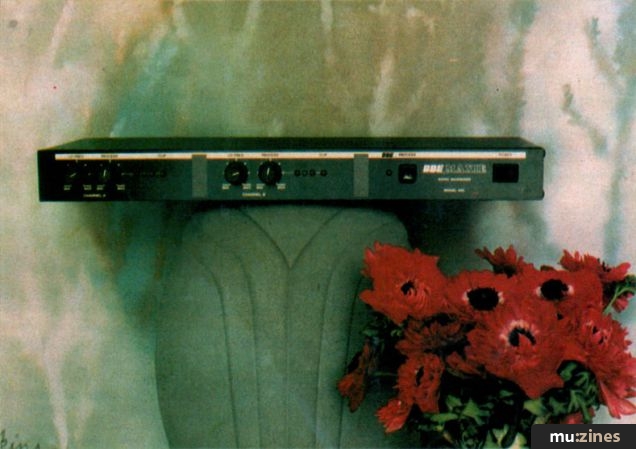
Barcus-Berry 402 Sonic Maximizer
(MT Mar 87)


Magazine Archive
Home -> Magazines -> Issues -> Articles in this issue -> View
BBE Sonic Maximizer | |
Article from Sound On Sound, April 1991 | |
Does BBE's new box of psychoacoustic tricks offer a new way of livening up a mix? David Mellor takes his music to the max.
Here's a little experiment for you to try at home: take out the master tape of your best recording, place it on your replay machine and sit in an optimum listening position in front of your speakers. If you can find your way there with the lights out and sit comfortably in the lotus position then so much the better. Press the play button and, while breathing slowly and deeply, listen to the music. After a minute or so ask yourself the question, 'Where are the instruments in the sound image?' Now take out your favourite CD and play the best track on it. Ask yourself the same question.
Armed with the answers to these two questions you are now ready to find out whether you are a potential candidate for ownership of the BBE Sonic Maximizer. If you are a typical home recordist then the chances are that your answer to the first question was somewhere between two and five metres behind the plane of the speakers. The answer to the second question might have been a metre or so in front of the speakers if you picked a good recording. One of the characteristics of a good recording is that it has the quality of coming out of the speakers and insinuating itself in your auditory canals when it wants to. An excellent recording can place itself anywhere in a sound field extending some tens of metres into the distance. This is part of the illusion of recorded sound, and expert engineers using the best equipment in near-perfect monitoring environments can achieve amazing things.
At home, we don't have the best conditions for producing such a good recording. It just isn't practical, either financially or logistically, except for the lucky few who have found mega-success in music and can build the studio of their dreams. The difference between a home recording and one made in a good commercial studio is very often one of immediacy. The 'professional' recording says 'I'm wonderful and I'm going to make you sit up and take notice'; the home recording says 'I'm over here if anyone would like to listen, please'.
MAXIMISATION
If we home recordists are to take on professional studios at their own game and stand a chance of winning (and yes, it can be done) we need all the help we can get to give our recordings a professional sound. Perhaps we might never achieve the full capability of a no-holds-barred commercial studio, but we can certainly give them a run for their money, given the right tools with which to compete.
One question that we might ask is 'why don't home recordings sound as good as pro recordings?' My answer to that (or at least one of the possible answers) is that the more you pay for your console, the better the EQ you get. This applies all the way up the price table, and if you can afford a full-price console like a Neve, then you'll get better EQ facilities than if you buy a Soundcraft (although in the medium price bracket, Soundcraft do produce a very good EQ). Basically, you get what you pay for, and a more versatile EQ needs more components, it's as simple as that. The benefit of having good EQ on the console is that you can fine tune each instrument and allow it to achieve its absolute maximum potential. If your EQ facilities are limited, then each instrument will fall some way short of its best, and this will have an effect on the final mix.
If, as I outlined earlier, one of the principal differences between a home and a pro recording is that the home recording tends to recede into the speakers while the pro recording springs out, then if someone invented a device that could counteract this we would be some way towards redressing the balance. As you might have guessed by now, the BBE Sonic Maximizer 322 is such a device, and within this criterion it does indeed make your recordings sound more professional. Let's be clear that it does nothing for a badly played, badly mixed, noisy and distorted master tape, but if everything else is good, then your mix will take at least two steps forward out of the speakers, and that can't be a bad thing at all.
PSYCHOACOUSTICS
Psychoacoustics doesn't have anything to do with the soundtrack of a certain Alfred Hitchcock film, rather it is the science (some might say pseudo-science) of the way we perceive sound. Every so often a device or process will come on to the market claiming to enhance a recording in a subtle and mysterious way. Usually there is a fanfare of publicity, an incomprehensible explanation of how the system works, and then nothing more is heard of it as it disappears into oblivion. But reputable engineers have made analyses of the way the ear operates and have come up with systems of unimpeachable worth, such as the various Dolby noise reduction processes, which bend the rules and allow us to record sound more realistically and, if we wish, more artistically. The BBE engineers claim to have done the same thing for the way a loudspeaker works and I'd like quickly to summarise their findings:
Loudspeakers all suffer from a less than perfect amplitude and phase response. If the amplitude response isn't flat, then some frequencies will be reproduced louder than others. If the phase response isn't ideal, then the timing differences between the various frequencies of a signal will be altered. Higher frequencies are usually delayed and reach the listener after the lower frequencies, thus making the sound 'muddy' or 'smeared' and changing the characteristics of the instruments. BBE have developed a model of a typical loudspeaker and have worked out the corrections needed to bring the phase relationships between signals back to what they should be. Of course, different loudspeakers have their own individual characteristics, but there is a sufficiently high degree of consistency for the process to be valid.
I don't think anyone would disagree that the loudspeaker with the perfect frequency and phase response has yet to be invented. So let's see how BBE deal with the problem, once again in summary:
The signal is split into three frequency bands: below 150Hz; 150Hz to 1.2kHz; above 1.2kHz. The low frequency band is delayed by approximately 2.5 milliseconds relative to the high frequency band, and a front panel control allows a cut or boost at 50Hz. The mid band is delayed by 0.5 milliseconds and passed through an active band pass filter. The high frequency band is passed through a high quality VCA, and is used as a point of reference to make dynamic amplitude corrections in both positive and negative directions to the high frequencies. RMS average loudness detectors monitor the mid and high bands, comparing the relative harmonic content and controlling the high frequency content at the output via the VCA.
I think that what this means is that, as well as applying delays to the low and mid bands, it also monitors the level of the mid band and cuts or boosts the level of the high frequencies in accordance with that.
However it does what it does — and I do find it difficult to believe that all this processing is improving the overall accuracy of the signal's reproduction — all we really have to do is judge the Sonic Maximizer Model 322 on the quality of the results and not get blinded by the scientific verbiage.
SIMPLICITY
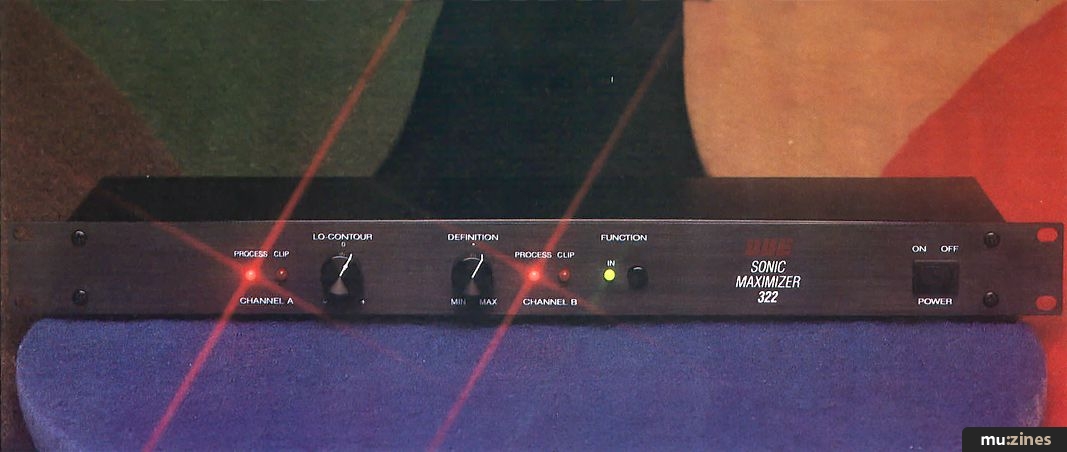
In an age when music and recording equipment of all types is becoming increasingly complicated to operate, and not always to good purpose, the BBE Sonic Maximizer is refreshingly different. Discounting the power switch, which I don't really think of as an audio processing tool, this unit has only three controls. Anyone who judges value for money by the operational parameter count is I fear going to be severely disappointed! The one switched control is Processing In/Out which lets you compare the maximised signal with the unmaximised version. In an ideal world this would have been a true relay bypass, as all in-line effects units should have, but that's just one of only two very minor quibbles I have about this unit. The Lo Contour and Definition controls I shall come on to shortly.
The Sonic Maximiser is a stereo device with quarter-inch unbalanced jack inputs and outputs. This unit is intended to be used with line level signals, so you can't plug a mic or electric guitar straight in, but this is no drawback. My other quibble is that the peak level is restricted to +16dBu. This is below professional headroom standards and therefore the Model 322 is definitely for use at lower domestic levels only. Perhaps this is to differentiate it from the more expensive pro version.
When connecting it up to your system it's important to remember that the Maximizer is an in-line device, like a compressor or noise gate. This means that you feed it with the untreated signal and then use only the processed signal that comes out.
Now, those two other controls... The Lo Contour, despite its arcane nomenclature is a simple bass control. Actually it's a rather good bass control, because it allows you to cut virtually all the lowest frequencies or wind them up from an almost unlimited supply of bottom end, which is of course every engineer's dream. I wish my mixer had low frequency EQ like this; it's obviously a result of choosing the correct turnover frequency and characteristic.
The Definition control is more what the Maximizer is all about. Basically, the further clockwise you turn this, the more trebly the signal gets. But this isn't an ordinary HF control, because it does sound radically different. The only way to describe it is to through what I found when I tried it out.
I fished out of my expanding library of DAT tapes a couple of mixes that I was basically happy with, but which I thought could do with a bit of tweaking to bring them up to a fully professional standard. I first listened with the Maximizer bypassed. "Great mixes", I thought, "it's amazing what you can do with low-cost equipment these days". Then I engaged the Model 322. To say that the difference is like chalk and cheese would be to say that a Rolls Royce is a bit like a Renault 5. Taking the Maximizer out of circuit is, if anything, an even more convincing demonstration of its worth — the mix sounds so hopelessly drab without it. LEDs on each channel show whether the signal is high enough in level to be processed and also whether the unit is clipping, and this is really all you need to know because the evidence of your ears will tell you the rest. It's a bit like using an aural exciter, but without the added noise and distortion.
Of course, the Sonic Maximizer isn't a universal panacea for all recording ills. For instance, if the mix is lively enough already then using the Model 322 won't make it any better. Also, if in a bout of over-enthusiasm you over-process a mix, then listening to it later at a high volume will give you a bit of a headache. I also found that the Maximizer is best suited to rhythmic, energetic music. Anything mellow or laid-back just doesn't sound right when processed. The unit can also be used for individual instruments and vocals, but I feel that its best use is in processing complete mixes. I suspect that dance music producers will find it particularly good at rejuvenating and putting extra excitement into sampled beats.
In conclusion, the BBE Sonic Maximizer Model 322 is a valuable tool to have in the effects rack. Used with due consideration for its strengths and weaknesses it can provide a professional edge to home studio productions. You could pay a lot more to get a sound like this.
FURTHER INFORMATION
£197.80 inc VAT.
Stirling Audio Systems, (Contact Details).
Also featuring gear in this article

Publisher: Sound On Sound - SOS Publications Ltd.
The contents of this magazine are re-published here with the kind permission of SOS Publications Ltd.
The current copyright owner/s of this content may differ from the originally published copyright notice.
More details on copyright ownership...

Sound On Sound - Apr 1991
Donated & scanned by: Mike Gorman
Review by David Mellor
Ads for Gear in this article:

Previous article in this issue:
Next article in this issue:
Help Support The Things You Love
mu:zines is the result of thousands of hours of effort, and will require many thousands more going forward to reach our goals of getting all this content online.
If you value this resource, you can support this project - it really helps!
Donations for August 2026
Issues donated this month: 0
New issues that have been donated or scanned for us this month.
Funds donated this month: £0.00
All donations and support are gratefully appreciated - thank you.
Magazines Needed - Can You Help?
Do you have any of these magazine issues?
If so, and you can donate, lend or scan them to help complete our archive, please get in touch via the Contribute page - thanks!
Please Contribute to mu:zines by supplying magazines, scanning or donating funds. Thanks!
Monetary donations go towards site running costs, and the occasional coffee for me if there's anything left over!

 @mu_zines
 RSS Feed
 Blog
Blog