Reverb Modification
Electronics / Build, Maintenance / Repair / Modification
(PL Jul 77)


Magazine Archive
Home -> Magazines -> Issues -> Articles in this issue -> View
Build a Wa/Anti-Wa Pedal | |
Using the PAIA/DeARMOND Foot PedalArticle from Polyphony, April 1976 | |
The first question is what do I mean by Wa/Anti-Wa. Well, a normal footpedal wa-wa usually has a simple bandpass filter, and you can sweep the bandpass of that filter up and down by a rocking motion with the pedal. In normal practice, the resonant frequency of the filter increases (higher apparent pitch) when you push down on the pedal, and decreases when you pull up on the pedal. By this definition of wa-wa, the anti-wa behaves in exactly the same manner but with one difference: pushing down on the pedal lowers the resonant frequency and pulling up on the pedal raises the resonant frequency.
By itself, this isn't too useful an effect, since you have to reverse your thinking compared to a regular wa-wa pedal BUT — if you could combine two filters into one pedal, so that as you pushed down one filter went up and a separate one went down — and as you pulled up the reverse occurred - then you'd have something. The effect is quite interesting, especially if you tune the filters differently; more about this later. Frankly, there's no way to describe the sound in print. Let's just say that if you like wa type pedals but have gotten a little tired of the sound, or want something that's a little different then read on.
Luckily, the Wa/Anti-Wa can be easily configured using a PAIA/DeArmond foot control. Let's look at the schematic:
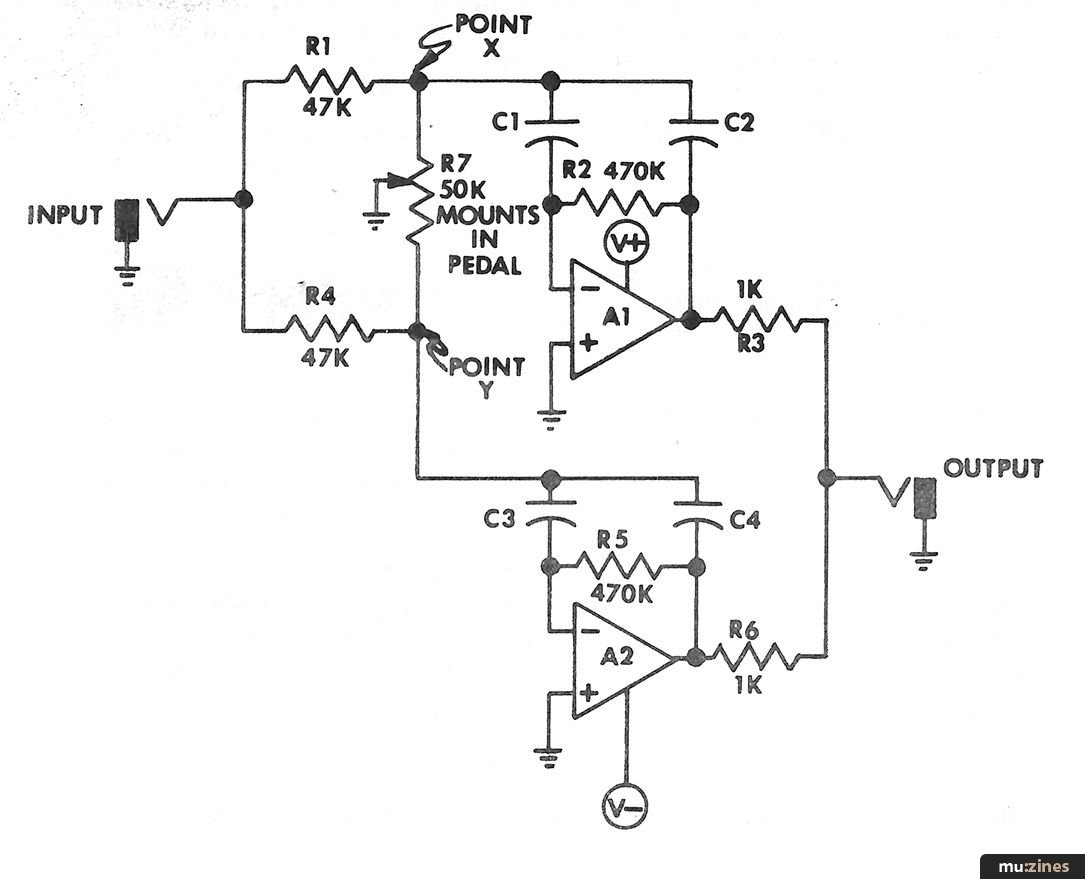
Figure 1
A1 and A2 are operational amplifiers, such as two 741's, a single 5558, a 4739 or whatever. Keep in mind, though, that this is a filter and for best results choose the lowest noise IC you have. You could also use something like an LM3900 if you bias the (+) inputs and add output coupling capacitors. Anyway, each op amp is configured in a filter. The resonant frequency of filter A1 depends upon the resistance from point X to ground; the resonant frequency (r.f.) of filter A2 depends upon the resistance from point Y to ground. Therefore, by connecting each point to the extreme ends of a 50K pot and grounding the wiper, we end up changing the resonant frequencies of the filters — equally, but in opposite directions.
So, take a PAIA DeArmond pedal and remove the nice 1M pot that's already in there, and replace it with a 5OK pot that has a reasonably long shaft (so the little gear thingie can screw onto the shaft). I don't really want to go into details here; the modification is pretty obvious with a pedal sitting in front of you.
For best results, connect up the V+ and V- lines to a regulated source of ±5v. to ±15v. Batteries will also work, but a supply is generally a much better idea.
THE FUN AND GAMES PAST OF THE WHOLE THING
There are several variables in this circuit that make it fun to experiment with. The tuning of the filter depends upon the value of C1 and C2 for filter A1, and C3 and C4 for filter A2. (Note that these capacitor pairs should be matched). Different instruments will require different tunings. For example, with guitar .001 for C1 and C2 and .0039 for C3 and C4 gave wonderful results. With bass, .002 for C1 & 2 and .005 for C3 & 4 works pretty well. For electric pianos and such, try .001 for C1 & 2 and .005 for C3 & 4. Make sure, though, that you don't tune the two filters the same, as the sound produced is remarkably dull compared to the interesting stuff that occurs when you tune them differently.
Another variable in the circuit is R2. If you'd like a peakier sound and a little more gain, change it to 1M (ditto R5).
The final variable well talk about is in the pedal itself. Like most volume pedals, the PAIA DeArmond pedal doesn't give a full pot rotation; unlike most volume pedals, it comes pretty close. I'd recommend playing with the gear/pot combination until you get a sound that pleases you the best. For example, mine is set so that even with the pedal all the way to one extreme there is still a little resistance between point X and ground; at the other extreme, point Y goes almost completely to ground — just a few hundred ohms stand in the way. I've played with a lot of different choices... some of them really didn't make it, but after a little experimentation you're sure to hit someplace where you say "Eureka!" and just leave it at that.
PLAYING WITH THE PEDAL
The Wa/Anti-Wa I built has the higher-tuned filter going up in r.f. when I push down on the pedal, with the lower tuned filter going down in resonant frequency. This seemed to work best. You'll find the extra wide throw of the pedal makes the Wa/Anti-Wa even more useful, as you can selectively "Wa" just one filter, just the other, or sweep back and forth over the whole range of the pedal and get a variety of bizarre effects. In any event it's a lot of fun and sounds different from your average Wa pedal... and it's not at all expensive to build.
More with this topic
 |
 Frequency Divider - Turns Gnome Into "Super-Gnome" |
 Electro-Music Engineer - Transistor Power Amplifier Surgery |
 An Ultra VCO From The 4720 |
 Lab Notes: Potpourri & The Apple Connection |
 Circuit Maker - Digital Equipment Protector |
 The String Damper |
 Keyboard Matrix Interface For EK-3 |
 ElectroMix 842 (Part 1) |
 BeeBMIDI (Part 1) |
 Chip Parade (Part 1) |
 Analogue Equipment Design - for Rock 'n' Roll (Part 1) |
Browse by Topic:
Electronics / Build
Publisher: Polyphony - Polyphony Publishing Company
The current copyright owner/s of this content may differ from the originally published copyright notice.
More details on copyright ownership...

Polyphony - Apr 1976
Donated & scanned by: Retro Synth Ads
Feature by Craig Anderton
Help Support The Things You Love
mu:zines is the result of thousands of hours of effort, and will require many thousands more going forward to reach our goals of getting all this content online.
If you value this resource, you can support this project - it really helps!
Donations for August 2026
Issues donated this month: 0
New issues that have been donated or scanned for us this month.
Funds donated this month: £0.00
All donations and support are gratefully appreciated - thank you.
Magazines Needed - Can You Help?
Do you have any of these magazine issues?
If so, and you can donate, lend or scan them to help complete our archive, please get in touch via the Contribute page - thanks!
If you're enjoying the site, please consider supporting me to help build this archive...
...with a one time Donation, or a recurring Donation of just £2 a month. It really helps - thank you!

 @mu_zines
 RSS Feed
 Blog
Blog